“On longer evenings Light, chill and yellow, Bathes the serene Foreheads of houses.” — Philip Larkin, “Coming” (excerpt)
Lots of things coming. Coming up. Coming soon. Coming back. Coming too soon or too late. Just coming. Some things unexpected, like Peat yesterday triumphantly coming to us with a Canada goose egg in his mouth. He delivered it to me, the gorgeous large warm beige shelled pre-bird and I managed to return it to its future siblings in the nest while mom screamed in the river; with all the rain and the nest just at the edge of the water in the willows I wonder if it was, or will be, all in vain. I spent some night currency wondering if geese can move a nest filled with eggs.
Egg return
Speaking of birds (how odd), a new season is coming, and lots of grass is coming up and this gets many of us excited about big broods of chukar chicks to come. This often happens to us about this time of year, and sometimes it’s warranted or reasonable or logical, and other times it’s just stupidity talking. Or hope. “Hope is the thing with feathers,” as Emily said.
Other things will come between now and the season, which is like having that autumnal hope in the bank, sitting there acquiring interest faster than Jeff Bezos’s new ex-wife’s new savings account. For us, the thing between is summer and fishing, this time with our first drift boat, a nod to latent insanity and, ostensibly, our dogs: they can come with (even though they’re mildly pissed off about being confined to the floating thing), which — in the past — they couldn’t, so this should be interesting.
Angus doesn’t want to be left behind again
More rain is freaking coming, too. The hope is that the earth in Hells Canyon won’t be talcum in late September, as it was last year.
Something’s coming from Leslie; yesterday she shared her second bombshell of the week with me (the first being her wonderful post and video): she’ll soon have me put some of her chukar-inspired creations on the blog’s store. I’ll let her let that cat out of that bag, though. Sometimes I know what’s good for me.
I’m contemplating getting some new hats, too, but not sure if anyone’s interested in that. We’ve got some left, but don’t push them. It’s coming to that.
“Range after range of mountains. Year after year after year. I am still in love.”
– Gary Snyder
Spring break this year, we drove across the West and past many, many mountain ranges in Idaho, Nevada, Utah, Arizona, and Montana. I didn’t dare sleep in the car or stare at my phone while being a passenger moving past them because I’d miss them. Instead, I gazed across the landscapes or would read my tattered paper road maps splayed across my lap and try to find out the elevation of the highest peak that I could see in the distance or the next little town coming up. On one particular mountain in Nevada, I tried to imagine the route I’d take to the top. Looking out the back window as we drove past it, Bob asked what I was doing and I told him I was trying to figure out a good route to the top. He asked if I was planning on doing that anytime soon. I told him no, but anything is possible.
The western United States is blessed with vast areas of public lands in the middle of nowhere that rarely get stepped on by a human foot, but it doesn’t make them any less special or less valuable. If anything, it’s the opposite.
It wasn’t until spending time the past few years hiking around the chukar hills that I realized how important they were to me. On our road trip across the West, I started reflecting back on all the many hundreds of miles hiking up and down these mountains and back to the beginning. I felt like talking about it in the video (below).
I almost didn’t go hunting on the last day of the season. I woke up tired.
The day before, I’d gone out with the dogs for my fifth hunt in seven days. Overwhelmed by the dread of the looming last day and already missing it, I wanted to take advantage of the unusually pleasant weather we’d been having in this part of Idaho, plus a schedule — or shall I say a lack of schedule — that allows me to hunt in the middle of the week. When I took early retirement from my employer last year, someone told me “The worst thing about being retired is that you never have a day off.” It’s true.
My second to the last hunt of the season was also my 52nd hunt. I know this, because back in September on opening day, as I’d done the previous season, I started keeping track with data off my GPS watch, if I could remember to turn it on. I like to know where I hunted, my distance hiked, how long the hunt was, and elevation gained. When I got back home I’d write it all down with a ball point pen in my hunting journal which is hand lined with a ruler on a paper notebook. Nothing fancy, just the old fashioned way. Bob, who I’ve dubbed the king of gadgets and who one of the UPS guys a couple of years ago called the king of Amazon Prime because of an almost daily delivery of books or some type of high tech gadget, keeps meticulous detailed records of all his hunts on an Excel spread sheet. Besides all the stuff that I like to keep track of he, likes to record how many shots fired, how many killed and bagged, lost birds, shooting percentage, how far each dog ran, averages and totals for each category, and a barrage of other miscellaneous notes.
After losing all the elevation in the truck driving deep down into the canyon and finding the place I wanted to hunt the second to the last day of the season, a place unoccupied and not near anyone else, I parked and left on foot with the dogs heading back up uphill for about an hour to the middle of a ridge. Angus and then Peat bolted in a direction that I didn’t want to go but I followed anyway. A couple of minutes later, my Garmin beeped that Angus was on point 127 yards away. Whenever Angus points, it’s almost always legit. Peat, on the other hand, has a collar that’s so ultra sensitive to him stopping for just a second to pee or to smell something that I’ve found myself often ignoring it when it signals me that he’s on point. I picked up the pace through the deep snow drifts that were tucked between forests of sagebrush, and zigzagged my way down to Angus. Once I found him, Peat soon arrived to back him up. I slowly and quietly inched my way in front of Angus, and the birds busted. One shot, and one chukar went down as we also watched the rest of the covey fly downhill changing direction and then disappearing behind a ridge near us instead of flying across valley and to the opposite ridge.
Not much snow for the end of January.
It took a few minutes for Peat to find the downed bird and we had no plans to give up on it because the day before I’d winged one that flew down hill into a some bunch grass and rocks and the dogs couldn’t find after 30 minutes of searching. While Peat was retrieving the bird, Angus continued to hunt. It was almost like they had an agreement between them that one would stay looking for the one that I shot and retrieve it while the other continued on searching for the scattered covey.
On a bed of the terrible noxious weed, medusahead.
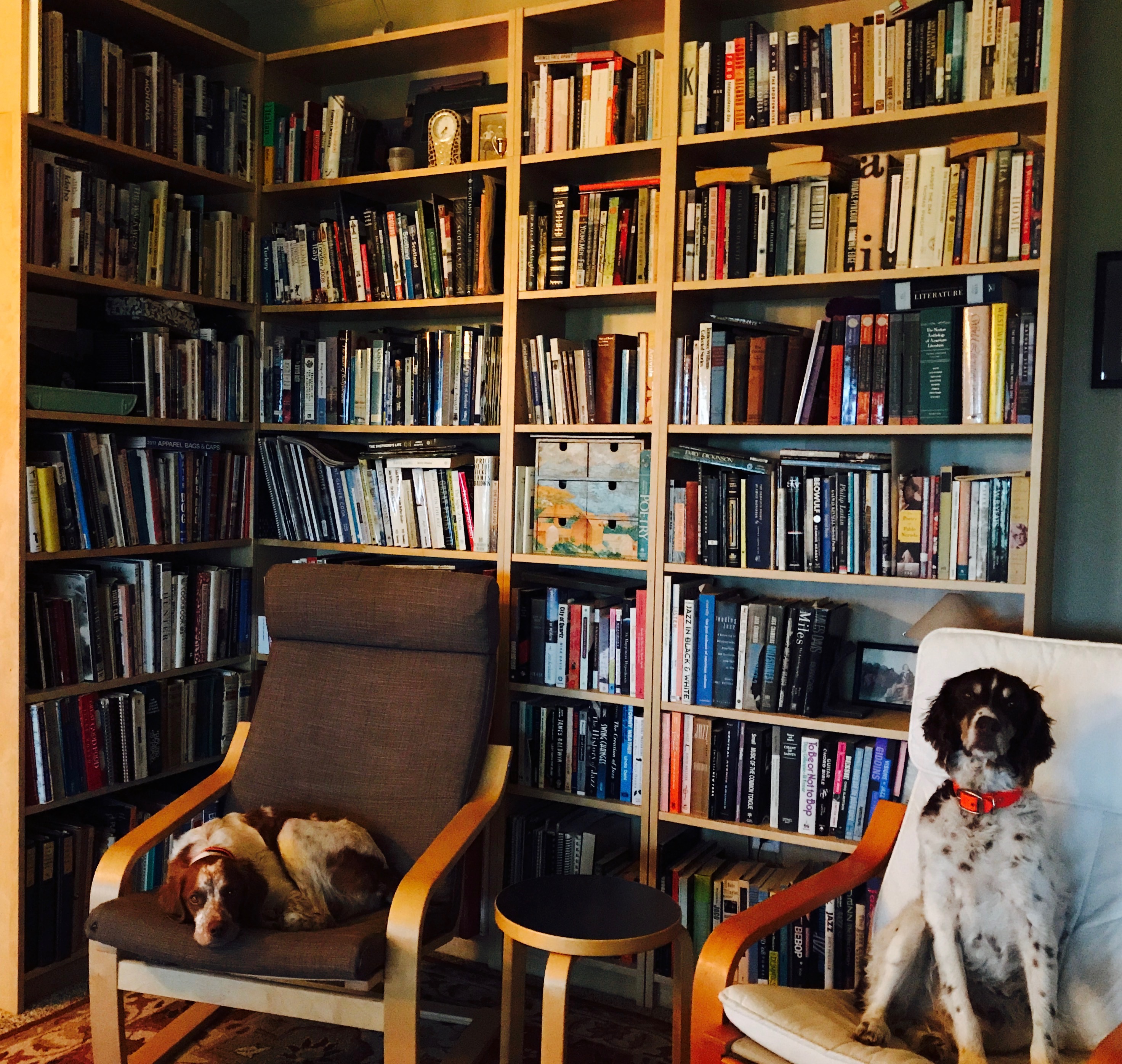
We continued in the direction of where the covey flew, traversing the rocky and muddy sagebrush and medusahead-covered slope. Angus below me with Peat working above me, my Alpha beeped that both dogs were pointing at the same time, on a different covey and not the ones that had just busted. Stopping to stare down at the screen to figure out which dog was closer, Peat flew past me heading towards Angus with a fairly fresh 3-foot-long mule deer leg in his mouth. This was no surprise because one of his many affectionate nicknames I’ve given him over his life time besides “Little F*#ker,” “Little Dummy,” “Crazy Eyes,” “Precious,” or “Sweet Pea,” is the “Garbage Man.” He has this uncanny knack of finding the stinkiest, nastiest, usually dead thing, and either rolling in it or running around with it in his mouth, unwilling to give it up for anything. Our current UPS delivery person last spring, a guy named Sail, was walking up to our house doing a delivery to support bibliophile Bob’s habit that I yelled at the top of my lungs to “STAY CLEAR” while I was hosing off and scrubbing Peat with a skunk concoction remedy for the fourth time after he rolled on a dead skunk near our house.
The big question of the day was whether Peat would drop the deer leg when he got up to Angus. As I fought my way through the sagebrush, I pulled out my phone and was actually hoping to capture what might possibly be the first photograph of a dog pointing with a deer leg in his mouth. To my disappointment, when I got up to both dogs, Peat backing up Angus again, Peat didn’t have the leg in his mouth anymore. He had actually dropped it.
The spooky birds busted below Angus flying downhill before I could get into position in front or to the side of Angus to shoot. This has been the theme for most of January where it’s hard to get near chukar before they bust wild. The dogs and I continued into the direction of both scattered coveys before my Garmin again beeped both dogs on point. Again, both dogs were located in different directions. Peat was closer but I could see him above me pointing downhill below a rocky outcropping so I headed uphill. One single busted from the rocks, and I shot once as the quick flying bird disappeared behind the rocks so fast that I didn’t know if I’d hit it or not. My Garmin beeped again, Angus was still pointing 180 yards below. “You have to always honor the point” was something Bob stressed to me last year, so I headed downhill towards Angus. Wondering where Peat was, I stopped and looked behind me uphill just as I saw him running downhill with a chukar in his mouth. I was so thrilled and surprised at the same time that I’d actually hit that one. Angus who held the bird or birds as long as he could before they probably eventually busted returned to check up on me wondering why I didn’t go down to his point.
Not a tailgate shot but a rock shot.Double day: my first ever.
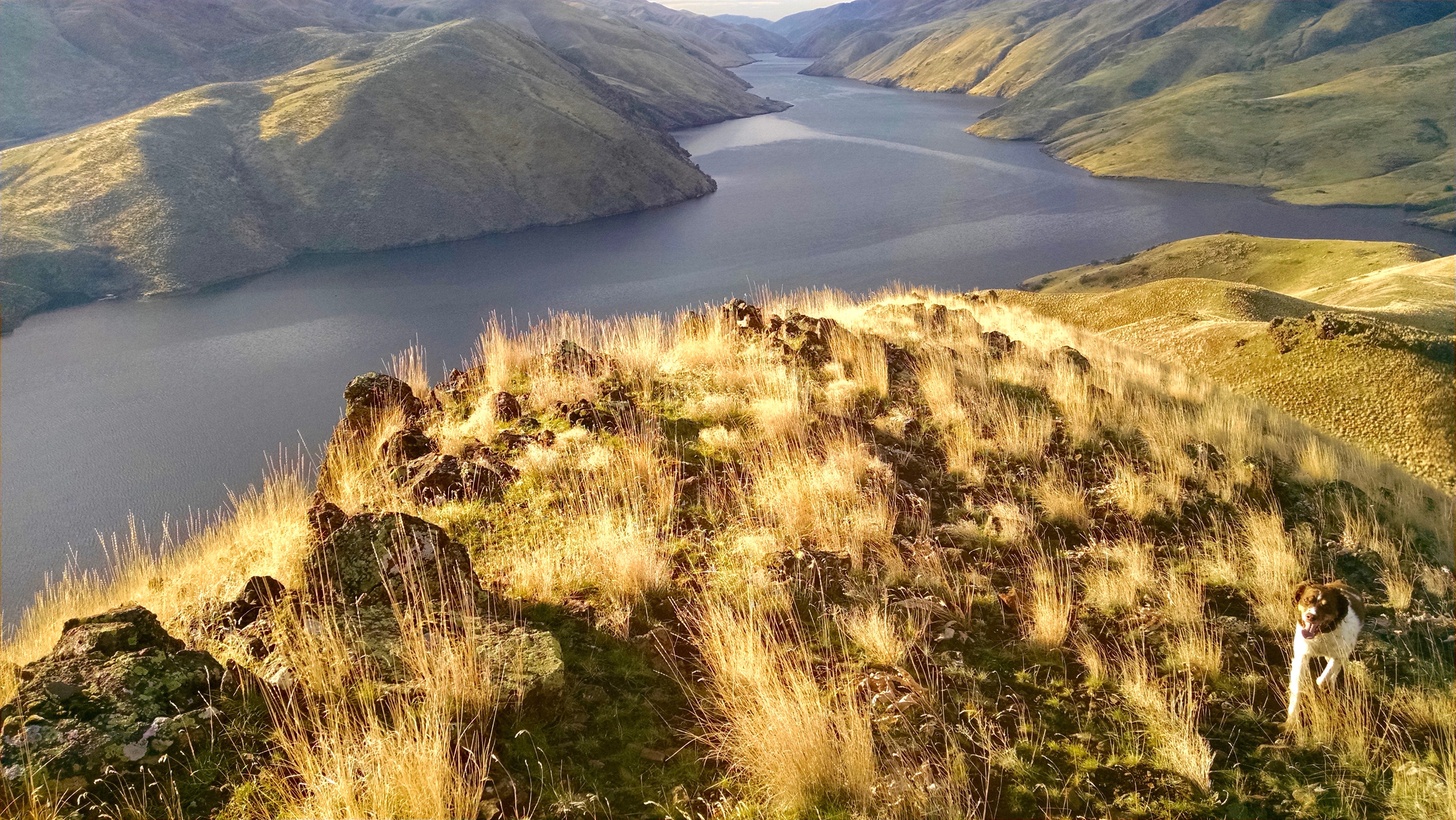
The following day, the 31st, closing day, we went one final time. My goal was to head uphill and find a place with views of the surrounding valley. I wasn’t worried whether we’d find more chukar, I just wanted to take it all in. The plants, trees, rocks, and other kinds of birds and animals define my place in this ecosystem.
A treasure and a treasure.
We headed up a narrow and snowy two-track in a deep valley lined with trees and bushes. Peat in his usual fashion found an animal bone and wouldn’t give it up. I forced it out of his mouth and flung it as far away as possible. I continued on looking at the ground at elk and deer tracks plus Peat and Angus’s tracks in the patches of snow. A paw print that I didn’t recognize at first caught my eye. It was a big cougar track, fairly fresh probably from that morning and heading the same direction. Peat’s body language and routine changed. Instead of running up the trail out of sight a ways and coming back like he normally does he was sticking close to me, running a few feet ahead, stopping and smelling the ground, and continuing on another few feet before repeating smelling the ground again. I watched Angus down by the creek; he wasn’t acting differently, but he’s older and wiser and not the big chicken of the two dogs.
Still, the cat track and Peat’s behavior was a bit unnerving. We continued up the road and I kept Angus closer to me and instead of carrying my gun on my shoulder, I kept my gun in the ready position and carefully listened and looked behind frequently. I could never willfully or ethically kill an animal like a wolf, coyote, or this cougar that I wasn’t planning on using for food but I actually thought about having to kill something to protect myself or the dogs, and this was the first time I felt the dogs or myself might be the prey.
Roles reversed. I now know how the chukar must feel.
On the final climb. 63,755 feet in elevation gain for the season. Peat and Angus way more.Upland Peat.Angus on the decent.Chukar hills.One last point.Taking it all in.Last photo of the 2018/2019 season.
Great weekend around here. Friends spelled us from our default being together in our separatenesses, and they hunted with Leslie Saturday and Sunday. On Saturday I thought I’d head up the old dirt road with them until they started climbing, and it was wonderful to get outside in the terrain I adore. Fog hung around a little while, but we soon got out of it, about the time the dogs treed a large ruffed grouse, and set in baying like coon hounds. I tried to get it to fly from its hawthorn branch perch so that the dogs would give up the ghost on the grouse, but it just would not budge. Leslie fixed it by shaking the whole tree, and reluctantly it fled.
Walking back down the road alone was weird. It couldn’t have been more beautiful and temperate on January 26th, and I knew birds surrounded me on the ridges above. Not being permitted to pursue them is something I just haven’t experienced until now. And I’ve never walked in chukar country without at least one of my beloved Brittanys. Perhaps it’s a preview of impending reality.
Today I was all in. We walked up the same road, and Leslie wanted to hunt the opposite ridge. It was icy in the shade, but we made it up the slope without any of us falling, and eventually to a ridge containing some birds. Not having my gun or pack, but the Nikon, I had no trouble going up or down, and am thrilled nothing hurts, even now, hours later as I write this.
Enjoy the photos.
Charge!Whoa!“It was up there not long ago where I swear I saw a Himalayan snowcock!”“Yeah, right up there in those rocks. It was HUUUUGE!”Gretchen didn’t fall for it, but Leslie’s still laughing.Following in some other creatures’ feetsteps.Evidence of Goodale’s Cutoff?Lots of crossings today.Wallowas, wow. If you look carefully, you can see Angus pointing, and Peat heading over to him.Angus backed by Peat backed by the Wallowas. Not sure if Leslie realizes Angus is pointing.Birds go, Gretchen shoots, Peat pursues, gentlewoman Leslie watches.Kind of tricky descent with mud, ice, and snow.Angus never stops. 20 miles yesterday, at least 10 today, on severe terrain. Marvel.
WARNING: This has very little to do with chukar hunting. But it does have to do with people who read and comment on this blog.
I went back to my classroom today for the first time since surgery 10 days ago, and saw some of what my students have been up to. Actually, I’ve been able to read and comment on lots of their work from home; I use Google Classroom for most of my assignments in all of my classes, which is really dynamic and allows me to have real-time dialogues with students as they work on stuff, and it eliminates the pounds and pounds of papers I used to have to lug between home and school.
Anyway, one of the assignments for my dual-credit English 101 students (they get college/university credit for the required English 101: Introduction to Composition, as well as their junior or senior high school English credit) was to create a set of posters — as a class — showing some high-level writing “moves” that I could use for other classes as anchor or concept charts to help teach these ideas to all levels (I teach 9th through 12th grade). This is a challenging assignment because they have to read a complex text (which each poster cites) about rhetoric and writing theory and apply the ideas to these posters and use other examples to help illustrate their “move.”
Here are my instructions: “As a class (work in groups; sign your names on the poster(s) you worked on), I want you to create a set of FOUR POSTERS, each poster focusing on one of the writerly moves mentioned in #3. Each poster should have “forwarding” on it, along with — obviously — which “move” the poster is describing. Each poster should also have some example of the move from a text high schoolers might be familiar with. Finally, each poster should have somewhere on it a full MLA citation for Harris’s book, including the page numbers from which information on the poster comes. Poster paper and colored markers are in the cupboards. I recommend doing a “draft” of your poster on 8.5 x 11 paper before committing your ideas to the big poster paper.”
I had no idea what “texts” they’d use as examples, and didn’t give them any suggestions. Here’s one of the four posters:
Extending and forwarding concept poster (click to enlarge).
Another poster, by Orion and Jason, on the concept of “borrowing” (I didn’t take a photo of that one; sorry) used a video I made a while back as the example text to demonstrate what a “borrowing” move looks like; their poster explains that I “borrowed” “Only Connect” from my favorite high school English teacher, who “borrowed” it from E.M. Forster’s novel Howard’s End. Here’s that video, which the kids have seen once or twice in the past 6 years (and their poster has the correct MLA citation for the video!):
Memory is strange enough when you’re thinking about your own. I hope my students remember things I teach them, but sometimes I find they remember things I didn’t mean to teach them, but that I simply shared with them.