He thought he kept the universe alone; For all the voice in answer he could wake Was but the mocking echo of his own From some tree-hidden cliff across the lake.
–Robert Frost, from “The Most of It”
One of the reasons I was attracted to chukar hunting long ago was that it was the only activity I wanted to do that allowed me to be truly alone. None of us normally has that level of control over any situation outside of the privacy our homes. Being in a beautiful environment that pretty much guaranteed solitude, on land that was available to anyone, was — in my life — rare.
I’ve been lucky all these years to replicate that nearly every time, even hunting with others I chose to hunt with. Focusing on the landscape and the dogs and where the birds might be was the limit. For me, that was chukar hunting.
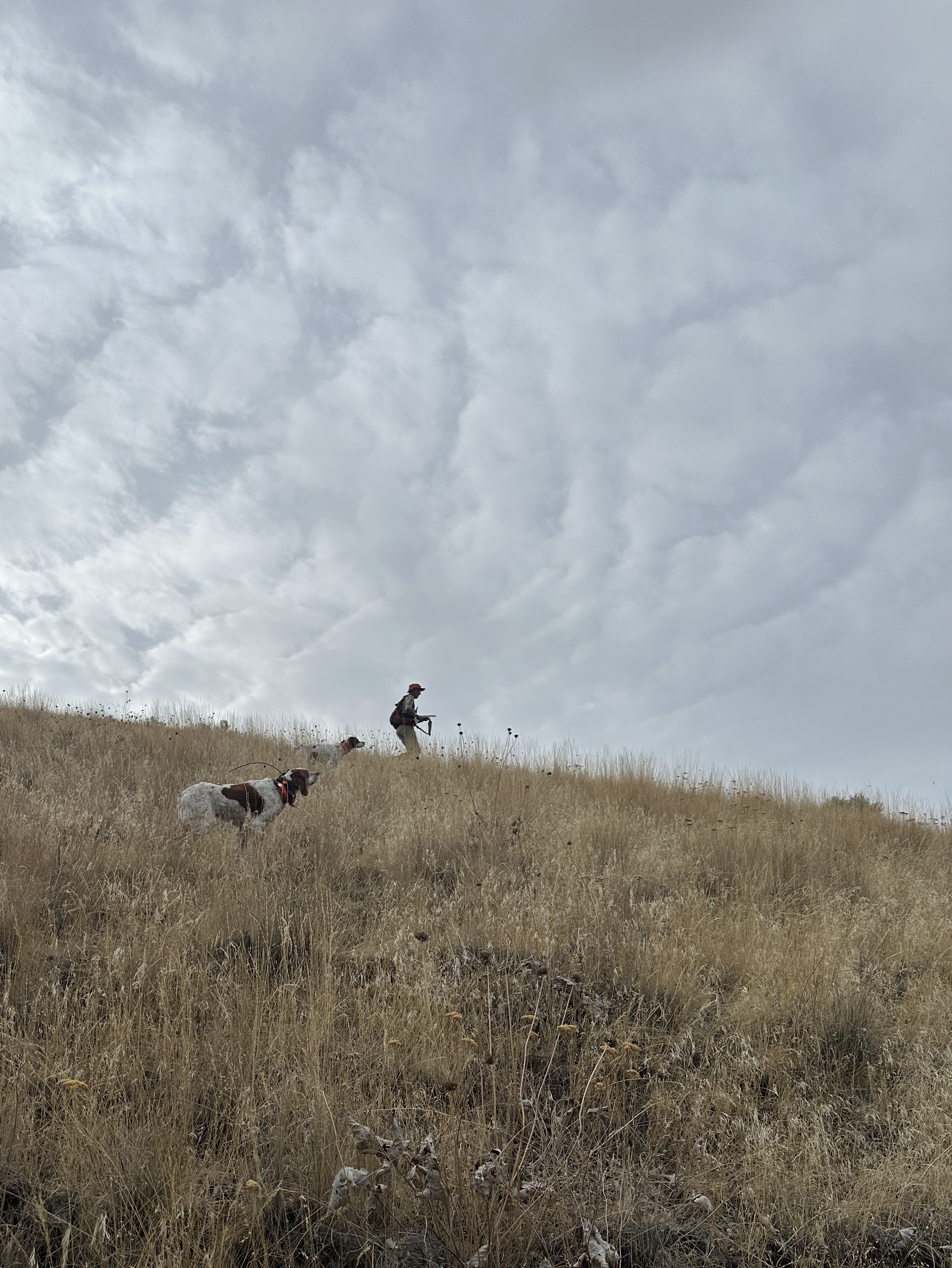
Yesterday we were lucky enough to hunt for the second day in a row with a good friend visiting from out of state. He’d brought his UTV to get us to places we hadn’t hunted for years since we’d moved away. Hunting along a reservoir with more than 75 miles of shoreline, and no other vehicles on at least half of that it felt like we were surrounded by endless public land occupied only by the wildlife and grazing cows.
The dogs found birds immediately. Before we got to the first point, gunshots rang out close by, surprising all of us. We’d thought we were alone. Clearly, someone else was hunting nearby. We hustled away from the shots, which continued — clearly they were getting into birds. We corralled our dogs and headed up the large draw in front of us, thinking we were moving away from the other person or people. Within a few minutes, four hunters appeared at the bottom of the draw we were in; they’d come from the drainage to the south. They spread out so we could easily see them; three wearing hunter orange, one not. Only one dog. They watched us climb away from them up the draw for at least 20 minutes, and we speculated on what they might be thinking. We’d been planning to spend the day hunting both sides of this very large and steep draw and suddenly we felt our plans evaporate in the face of another party’s gaze. Were they hoping to cross to the other side of the draw? Were they thinking they might follow us? They didn’t move. Finally, I started heading to the other side of the draw, and soon found a rock to sit on. I sat while Leslie continued climbing. For twenty more minutes I sat there watching them. They didn’t move. Peat sat by me, whining, confused, not hunting. Finally, one by one, they slowly headed back to the draw they’d been in. Sounds of their shots began choiring frequently again.
With the seemingly infinite amount of land all around us in every direction, and the obvious prevalence of chukar nearly everywhere, it seemed absurd to me that we would even see other hunters. That this group seemed to be pressuring us, or affecting our plans in any way, seemed even more ridiculous. Clearly, this group was operating with a much different mindset than I was: if I knew I was even near another group, especially in an area with almost unlimited places to hunt, I would quickly move away from them.
That’s all I’ll say. I don’t know why they did what they did. Maybe there’s a good explanation for it. I never talked to them. We ended up hunting up and over the ridge into another draw entirely and had a good hunt. But I can’t forget that other group and the impact its actions had on the first hour of our time out there.
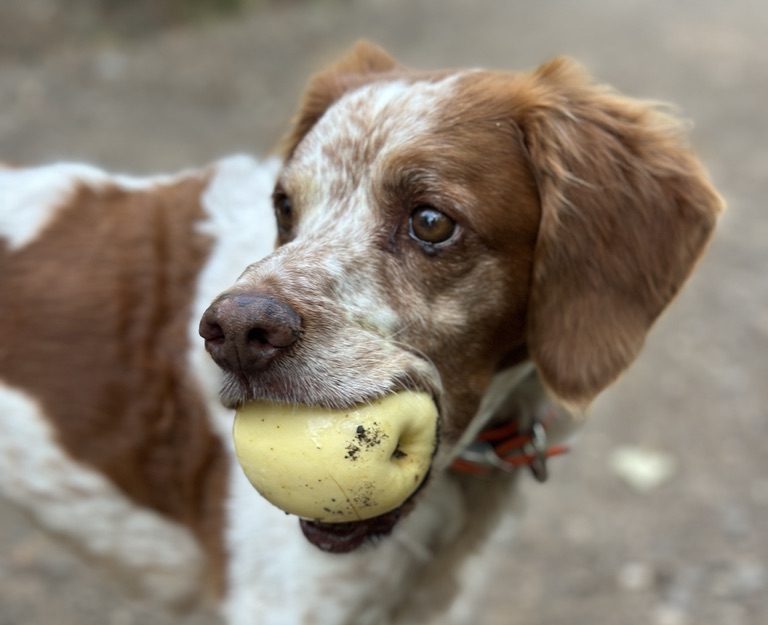
Anyone who’s done this for a decade or more has watched a dog get old. Age, or agedness, is relative. Glenna only made it to 10. Angus 13. Peat turned 11 on April 2. Even though he’s still “going on two” we think he might be losing his mind. With all of the obvious (or so we think) parallels between what’s happening to our own bodies and minds and what we observe happening to our dogs’, we attribute changes in his behavior simply to age. Naturally.
We’ve been lucky with Peat, comparatively speaking, as have we with ourselves. Today, he’ll be anesthetized for some vet work, but nothing major. By Peat’s current age, Glenna had been dead for more than a year and Angus had started to show signs of the cancer that killed him. Peat’s had his share of warrior wounds (torn pads, barbed-wire-induced gashes, etc.), but — knock on wood — nothing extremely worrying or unusual. Like many older dogs, his body is increasingly covered with lipomas and skin tags, and his mouth is a cesspool, with breath that even a mother could never love. And his teeth — well, he’s had some pulled for rot and we expect more today. I take the blame for not being a better dental monitor. You’d think I’d learn.
What keeps me up at night, though, is wondering how his mind is doing. Or what it’s doing. Thunder and, more so, fireworks, have always scared him, but this year seems far worse for him. So much so that his nightly routine, even when the skies are clear and there are no loud noises nearby, features him burrowing into the back of our bedroom closet, burying himself as far from reality as possible. It’s the closest thing to attempted doggy suicide I’ve seen. There are many stable things about him still: his constant obsession with food, his playfulness, his alertness and barking at anything he deems unusual or out-of-place, his daily morning ritual of coming into my closet to smell whether I’m putting on hunting clothes, looking up at me with plaintive eyes that make me want to collapse from love. But, probably projecting, I wonder if changes in his behavior are evidence of dementia.
His physique remains young. We’ve done a good job keeping weight off of him, but the few times he’s had a vacation from us and stolen anything and everything from his hosts to eat (even though we warned them he’d do exactly what he infamed himself by doing) we’ve picked him up noticeably heavier. His muzzle has grayed a little, but it’s hard to notice when you’re with someone every day. Strangers seem amazed he’s as old as he is.
We worry we’re forgetting things more easily: words, names, experiences, why we walked all the way across the house to get something that — when we get there — we can’t remember. And then we see Peat seem to forget he’s eaten already, or see him exhibit a new habit like his pre-bedtime burrowing, and we project our own worry onto him. Or do we?
Despite the thousands of years that have passed since humans began documenting their experiences and speculating on the meaning of life, nobody really knows. Nobody has ever known, nor will they ever. That hasn’t stopped lots of people from confidently stating what they think it is. I’ve certainly done it here, and probably have contradicted myself more than once. But I am pretty sure about this: dogs help increase a person’s wonder.
This began from a story my neighbor, a golf course superintendent, told us one night. It was fascinating to learn about what his employees served up to him. And so it began.
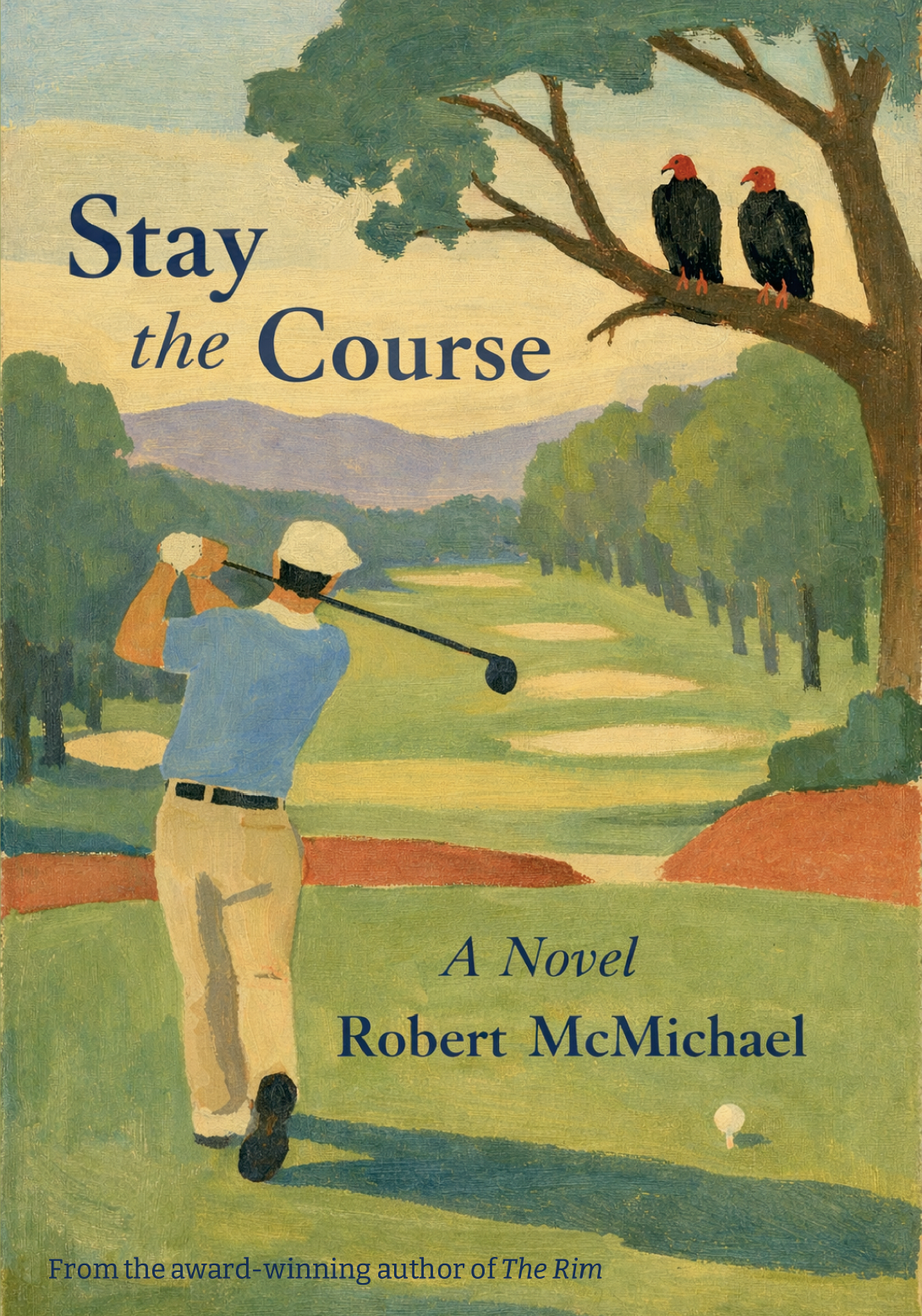
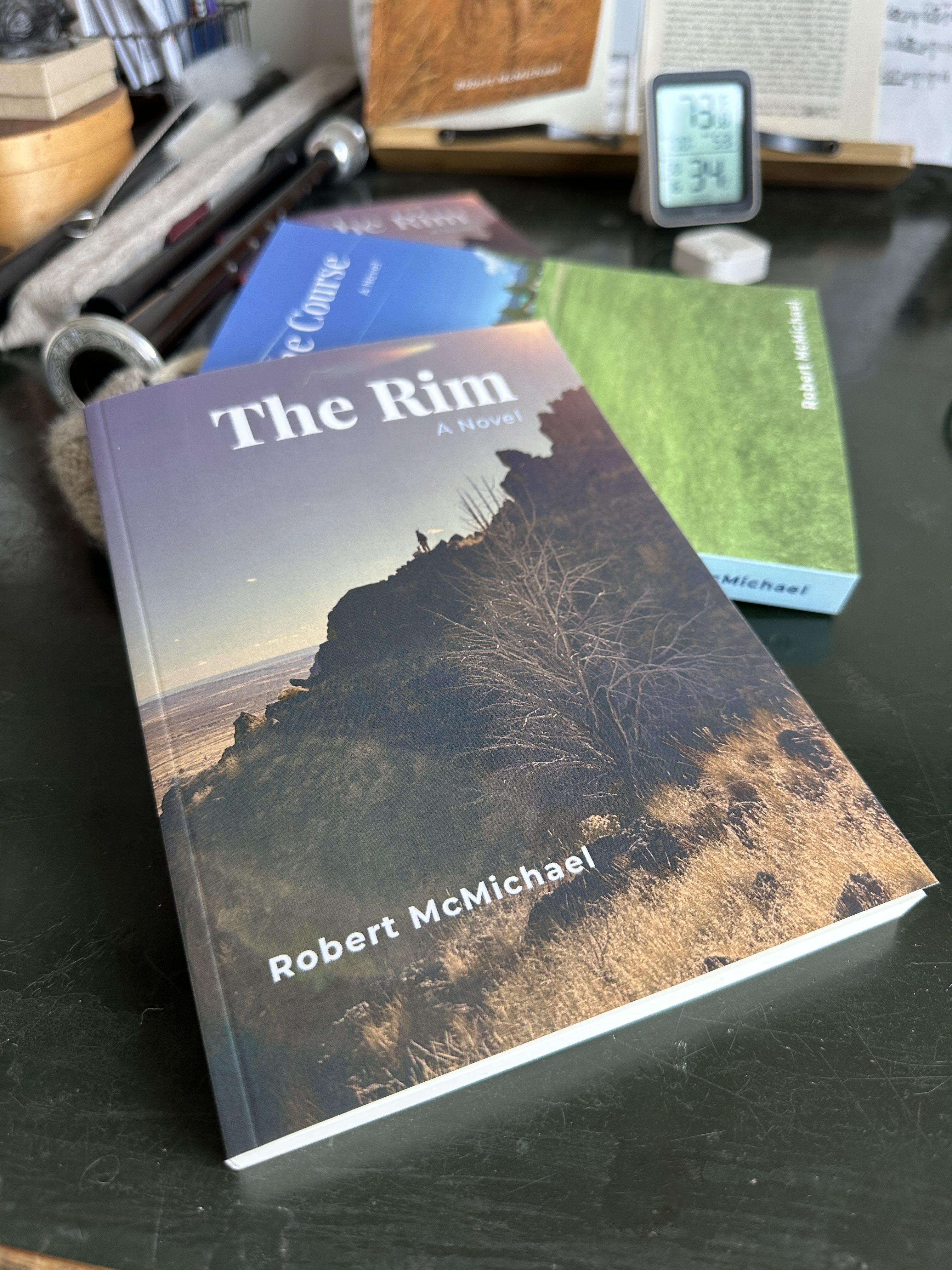
About a month into it, I realized that I was writing a sequel to my first novel, The Rim. But Ennis, one of five characters in The Rim, was the sole narrator of Stay the Course. At the end of the first novel Ennis learned, at 18 and just about to leave for college, a lot is left up in the air. Stay the Course begins about 25 years later, but incorporates lots of flashbacks filling in some of the blanks. Now he’s a father and a husband, a skilled professional, no longer a hunter, and has grown as a human. Like you’d expect anyone to.
This is the fourth book published by Chukar Culture Press.
[Leslie originally posted this on October 30, 2018; it was one of the most heavily commented-on posts we’ve published here. We just received word that Sam passed away, aged 87, on April 18th, 2026. Our hearts are heavy. He played a big part in our chukar hunting lives, and in our adaptation to the area. He trusted us with his “secret spots,” many of which became our go-tos. He was our neighbor. He liked communicating with us, and when he decided he didn’t have what it took to do the gnarly uphill hikes chukar hunting requires in Hells Canyon, he’d call us to ask how we did. Or he’d just stop by, sometimes with a Shiner Bock (he wasn’t crazy about the IPAs I brewed). He taught me how to hand load shells, and gave me most of his equipment and material. He introduced us to Jeremiah Weed. “Want some weed,” he’d say, with that winning smirk. Priceless, especially coming from a highly decorated jet fighter pilot. He was an avid reader of this blog, too, but made no bones about greatly preferring Leslie’s pieces to mine. One of his last comments on this blog was something like, “Keep making memories. You’ll need them.” As if he needed to remind us not to forget him. Impossible. Rest in peace, dear friend. You are missed.]
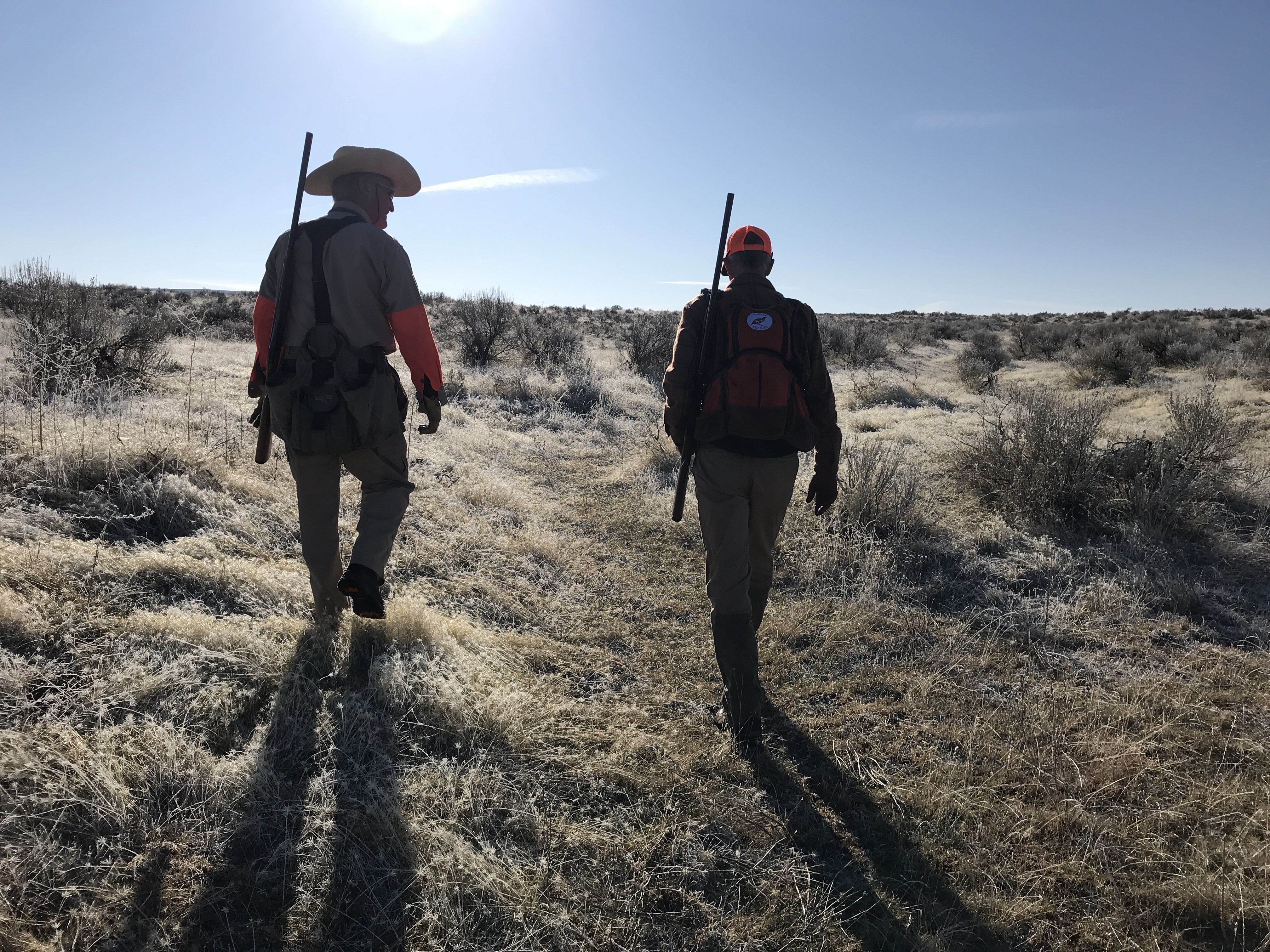
If you’ve never been to Hells Canyon on the Idaho/Oregon border before, the first thing you notice as you’re driving down the long, narrow, windy road of Highway 71 and descending deep into the canyon are the very steep hillsides covered in sagebrush, bitterbrush, golden-colored grasses and lots of rocks. Some people say, “It’s no country for old men,” but I’ve been chukar hunting down there with my 80-year-old neighbor Sam for the past couple of seasons, and he’s putting all those naysayers in their place. In my opinion, he’s an Idaho-side Hells Canyon chukar hunting legend. Most people have never heard of him because he’s not on social media, doesn’t have a blog, and doesn’t even know what a hashtag is; he’s just a modest guy with a long time obsession with bird dogs, upland hunting, and Hells Canyon.
Growing up in North Texas, Sam got his first taste of bird hunting at the young age of 10 looking for Bobwhite quail in Pineywoods, Texas. A former Air-Force F-16 Pilot, he has traveled the world, and obtained his first hunting dog from a breeder in Las Vegas near where he was stationed in the Air Force. Fond of the pointing dog breeds, he’s never looked back and has since owned several German Shorthair Pointers, German Wirehaired Pointers, and Drahthaars. He told me his favorite birds to hunt are upland birds and that’s why he fancies pointing dogs over flushing ones. Over the past 70 years, Sam has hunted birds and has covered a lot of ground in the process all over the United States. Sharp-tailed grouse and Hungarian partridge in eastern Montana in the early fall, Mearns quail in Southern Arizona in the winter, pheasants in the Midwest, not to mention chukar partridge, Hungarian partridge, Ruffed and Dusky grouse and California Quail in all the Western States.
Back in 1985, before moving to Idaho and during a road trip around the West, Sam got his first taste of Idaho chukar down in Hells Canyon in the area now known as the Cecil D. Andrus Wildlife Management Area. Back in the day, when Sam first hunted on it, the area was privately owned and a place where obtaining hunting privileges meant knocking on doors. At the ranch hand’s house, which is now the office for the Andrus WMA, a sign directed you go to up to ranch owners’ home and knock on their door to ask for permission. Sam knocked, and Mrs. Hillman answered the door and gave him permission to hunt along West Brownlee Creek. Sam said he obtained his 8-chukar limit rather quickly, something that would never happen very easily today, and in return, and as a gesture of thanks, Sam went back to Mrs. Hillman and asked her if she wanted some chukar and how many. She was surprised because nobody had ever asked her that before. Sam took the birds down to the river, cleaned them, and gave her 3 or 4 chukar.
Watering his dogs
In 1993, the Richard King Mellon Foundation acquired the ranch from the Hillmans and then transferred ownership and management of it to the Idaho Department of Fish and Game for wildlife conservation. The entire wildlife management area is currently composed of lands owned by Fish and Game, the Idaho Department of Lands, the U.S. Bureau of Land Management, and the U.S. Forest Service. The Idaho State Fish and Game department is responsible for the daily operations on the Andrus WMA.
There are 24,000 acres on the Andrus WMA, and Sam’s covered a lot of it on foot. His vast knowledge of the area is something he didn’t read in a book called “How to Hunt chukar on the Andrus WMA” because, to my knowledge, one doesn’t exist. Like most people he did it the hard way and figured it out for himself. That’s something to be proud of.
Sam on the descent
Sam is a wealth of first-hand information. We talk about dogs, habitat, guns, strategy, and terrain on the drive together down into the canyon. He knows the Andrus WMA like the back of his hand. One thing I’ve learned from Sam is that he’s firm believer that the Andrus WMA belongs to all of us, and he frowns on folks that hunt it all the time and act like it’s their own private hunting ground. “Just because it’s in our own back yard doesn’t give us any more right to be there than anyone else.” Sam moved to Cambridge 12 years ago to be closer to Andrus WMA, just like my husband Bob and I did six years ago. “There’s plenty of ground for everyone,” he always tell me. I couldn’t agree more. Access to quality public lands where most days you never see another person is what makes upland hunting down in Hells Canyon so special.
Susie on pointSam and Susie
Besides the exercise that keeps Sam young, he hunts for the pure beauty of the sport; it’s just himself and his two dogs, Hannah and Susie. He doesn’t carry a camera or phone with him for documentation. Instead, he spends all of his time actually hunting rather than stopping and staring at a tiny screen and taking pictures of himself or others. His memories are to share with his friends and family in person when he gets home, oral communication, face-to-face just like the old days. I’ve learned a lot from Sam, and feel that I share his same passion for hunting. We share the love of the outdoors and seeing excellent dog work, that’s our priority while being out there on the mountain.
Photographs don’t do Hells Canyon or the Andrus WMA justice anyway. You can’t appreciate its unique beauty unless experienced in real life. Another reality of most chukar hunts is that sometimes you can’t find birds, or the ones the dogs do find bust wild before you can get into position to shoot. Last week, we were both lucky and we each got one bird that our old dogs Hannah and Angus retrieved for us. It was a very good day.
My favorite view
When I do hunt with Sam we take more breaks to rest. I’m okay with that because there’s always a glorious view of the vast landscape while you catch your breath, and also it’s more time for the older dogs to rest and get water. Sam is the real deal; I want to be more like him and pray my body holds up until I’m his age. The two of us are quite a pair I’m sure, an anomaly in the chukar hunting world: an 80-year-old man and a 56-year-old woman in this game of chasing chukar up and down mountains that seems to be dominated by young men with big quads.
Sam’s dogs Hannah and Susie to my right
Two weeks ago, hiking around the vast Andrus WMA on ground where you’d swear nobody has ever set foot before, ever, Sam found a stainless steel spoon laying in the dirt. He picked it up, dusted it off, posed for a quick photo with my camera, then put it in his upland vest. I told him, “I bet you’ve never found a spoon hunting before!”
We both laughed.
I asked him if he’s ever found any other interesting things in his years of hunting and said the only other thing he could remember finding was a small pocket knife once. In the past, I’ve found at least a half dozen deflated shiny Mylar balloons and one mule deer shed that I almost stepped on, but no personal objects a human has ever lost.
Sam and his recent findMylar balloon from some far away place (we did haul it out to throw-away)
The days I don’t hunt with Sam or Bob doesn’t hunt with him, he’ll call us on the phone and ask if we found any birds and where. He’s the only person we share our secret hunting spots with, and he shares his with us. In truth, there’s no such thing as secret chukar hunting spots. Our motto is, “The birds are where they are!” Sam and I have both been skunked at our so-called secret hot spots. On one hunt, I asked him, “What’s our strategy today?” He said the recent reports indicate all the birds are down near the water. We found the opposite: a covey of chukar on top of a dry rocky ridge as far from water as possible. It just shows you.
Sam and Bob last season scoping out a hopeful hot spot
Heading home and back up the canyon in the pickup after a recent hunt, the talk turned to the upcoming election. Sometimes we don’t always agree on everything, but it was agreed that we didn’t understand the Prop. 1 historical horse racing initiative that we will soon vote on here in Idaho. Sam and I decided that we had more important things in the world to think and talk about driving home, and agreed it was chukar hunting.
The Rim is my first novel, started about 10 years ago during a creative writing class I was teaching. Parts of it have been published in literary journals, but this is the first time it’s been all inside one cover. It’s short, and dark, but has a lot about hunting in it.
Like Chukar Culture: Memory, Dogs, Paradox, it’s available on this site, as well as on Lulu’s bookstore and (soon, I think) at Amazon (which nets me about a dollar, unlike the two other options).
I’m proofing the copy of the sequel novel to The Rim (called Stay the Course), which will be available before the end of the month.