I am overwhelmed by the comments on Leslie’s last post. It feels a little strange being so forthright about this spine surgery thing because it’s really not that big a deal (he says, as he makes a big deal, as usual, about something that’s not); as I write I’m aware of several friends living with cancer, and one about to lose the battle. It’s hard not knowing what to say about that. So I just want to say thank you to everyone who sent good wishes. They were all appreciated, even the one subtly criticizing my beard (which was actually right on).
As Leslie said, I was pretty anxious about having surgery, but feel lucky to have had a great experience all the way around. The neurosurgeon, Dr. Hajjar, did a great job. He’s not known for his affability; I saw him for 30 seconds before he operated (most of which consisted of me asking if I could play my bagpipes soon, and his saying yes) and about a minute the next morning. But it was immediately clear to me when I was aware of my body that the pain was gone.
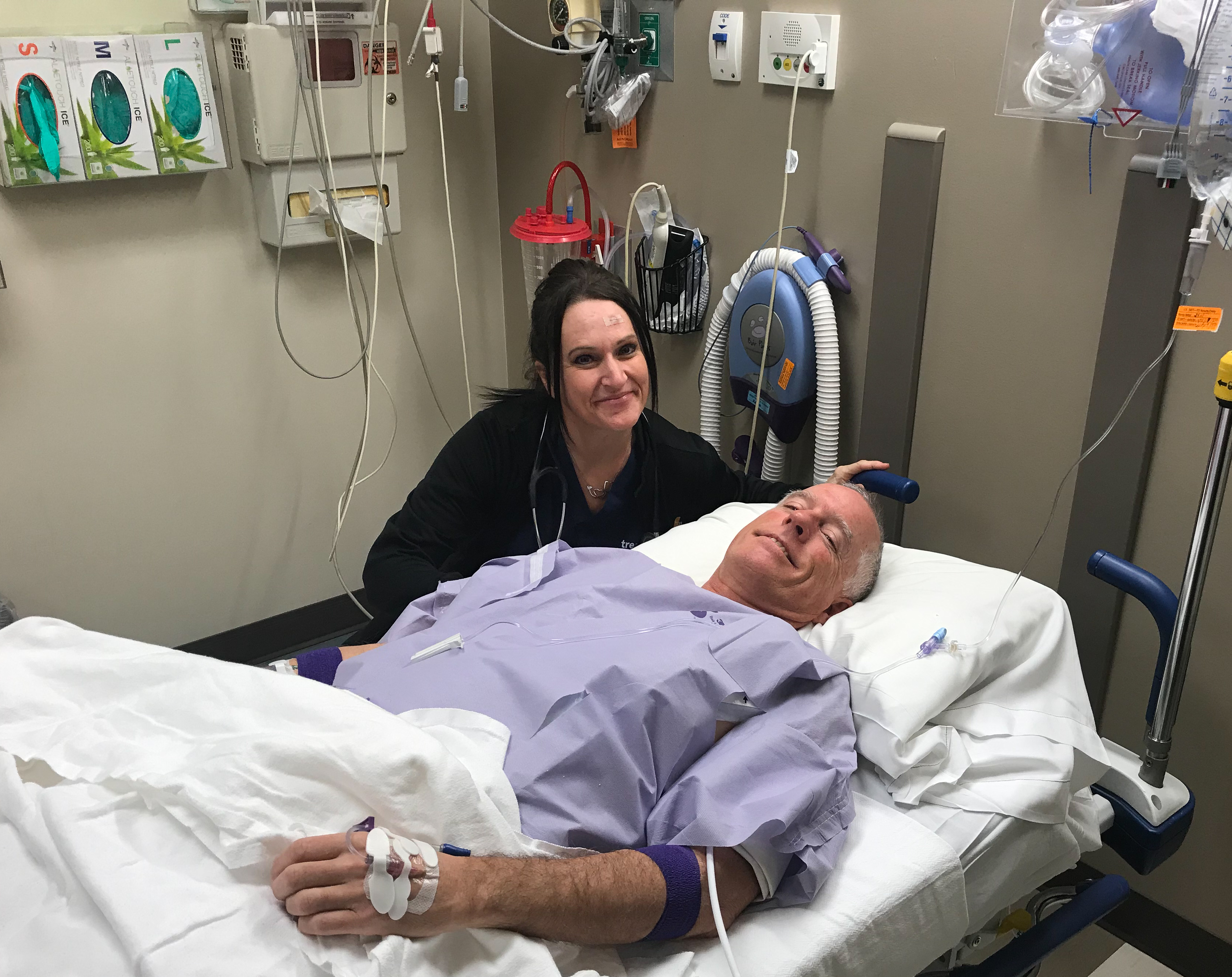
Pre-op nurse Amy. I think I finally found my color: expect to see me in a lot more lavender next season.
Dr. Hajjar is one of the surgeons who owns Treasure Valley Hospital in Boise. Having lived in Boise for 12 years, and having commuted past TVH on my bicycle for 9 years, and with a wife in health care, it’s weird to think I had no idea the hospital was even there. It’s only one floor, very small and tucked away in the back of a sort of semi-industrial park not far from the mall. What made it a good experience, in addition to the outcome, was the people working there. Angela and Carolyn in Registration; Kelsey the nurse aid who set me up in pre-op; the very, very affable nurse Amy who did all the computer charting and IV setup and had me do this “incentive” inhaling thing and seemed impressed with my lung capacity, and shared with us the fact that 20 years ago she’d flown through a windshield and has suffered for the last 17 years tiny shards of glass slowly and painfully erupting through the skin on her face and head; Jackie, the other nurse who IV’d my left arm which played vein hide-and-seek from the 20-gauge needle; Todd the anesthesiologist who looked like an ultramarathoner and was very calm and clear about what was about to happen; Georgette the pharmacist who charmingly cleared the path for post-op prescriptions; the OR nurse Christine who, even though she had her surgical scrub cap on reminded me of Tina Nicely, a really good friend from junior high even though she’d thrown the apple core at Kevin Hoagland which he thought I’d thrown and punched my lights out for it right there on the asphalt volleyball court (the only “fight” I’ve been in); the night shift RN LeeAnna who made me laugh at 3:50 a.m. with a story of her 3-year-old diving headfirst off of an 8-foot bookshelf onto their couch and bouncing across the living room; the night CNA Melanie who moved like a cat waking me several times without really waking me; the morning RN Matt who knew his job as well as anyone in any occupation I’ve ever met; the morning CNA Eliza who walked us to the car in the sleet and carried my stuff and greatly simplified Matt’s directions to the place we had to go to get a back brace. I mention this in case anyone in the area is looking for a good place to go for an operation. I think they even have several of those machines that go “ping!”
So, not your typical hunting account. Apologies if you were hoping for something more interesting. But I really feel compelled to say how moved I am by the graciousness of strangers, especially in a world that, if all you knew of it came from the news, would seem hopeless, cruel, and pointless.
Speaking of hopeless, cruel, and pointless: there is one thing I feel obliged to mention. Possibly the worst thing about this for me, even worse than the soreness from the surgery and the unknown recovery road ahead, is that I’m not allowed to sleep with my dogs, which also means my wife (no — she’s not a dog; she sleeps with them because they can’t not sleep with at least one of us. It’s in our bylaws). Leslie pointed out that it’s a bit ironic that the last post I wrote was about sleeping with dogs. I had no idea this was going to be a thing or I might not have had the surgery. It’s only temporary (about a week), but it does hurt. Peat told me he’s not very happy about it, especially the hurtful implication that he’s unclean; I felt it imprudent to mention the coprophagia. Anyway, I hope he’ll get over it, and I will try my best.
Finally, I’m extremely blessed that Leslie is here to take care of me. It puts a lot of things in perspective. I might learn something useful. And I hope the weather clears soon so she can take the dogs and herself hunting and get a well-deserved, hard-earned break from my sorry ass before the season ends.
Post-op meal: breakfast burrito, flourless chocolate cake, orange juice, and prune juice! A Norco-influenced pose at Bi-Mart on the way home, waiting for prescriptions to be filled.Back home with my peeps.
Yesterday, was my last hunt with Bob for the season. It was also Bob’s last hunt. We’d hoped he’d last until the end of the month but tomorrow he’s undergoing spinal surgery.
Our life for the past three months has revolved around his spine. Yes, our life. It’s not that it’s getting in the way of hunting things; we’ve spent many hours in the car together traveling back and forth for medical-related appointments and things, and his spine affected our ability to travel out of state to visit family over the holidays because sitting in a car or plane would be unbearable. We’ve missed going to see his students play basketball games for fear of being trapped in the bleachers when the pain would start up again. Bob even got to the point where he couldn’t go into the grocery store with me for even 5 minutes so he could pick out his own yogurt and cereal since I can never remember what kind he likes. Our time together spent moving up and down the chukar hills with the dogs looking for birds and being totally in the moment was the only time he said he forgot about his pain. When it did act up, the dogs were confused by him suddenly stopping to lay on the ground to get into a position that would lessen it.
Yesterday morning was spent doing chores he won’t be able to do after his surgery and other last minute things before heading out to hunt. Because of my lack of experience running our snowblower up and down our driveway by myself, we spent 15 minutes going over how the beast worked. I started out taking notes on a piece of paper but Bob suggested a video on my phone might be better so it would make more sense later.
I think he’s right. He knows me better than I know myself.
Opting out of hunting for the day and knowing I’ll have more chances before the season ends on January 31, I wanted Bob’s hunt yesterday to be for himself and for him to experience every point, every flush, and retrieve with both dogs. When Bob and I hunt together, Peat goes with Bob and Angus usually sticks with me. My fear every time we hunt with Angus is that we might lose him. This season because he’s almost totally deaf and going blind he’s relying more on his fine-tuned nose to find birds and because of this he’s ranging farther than he normally does.
Layers upon layers on our ascent from the valley below.Bob and AngusMagical pointAngus still moving like a young dog.Chukar nearby, Peat knows. He’s only getting better each season.
Heading up into the hills from the place Bob decided he wanted to try hunting, he wasn’t totally alone. I decided to follow along hoping to capture the pure essence and gorgeous landscapes of everything around us. It was just like the old days before I started carrying a gun; I’d be hot on his heels for every square mile hoping to catch with the camera some of the action and beauty of the sport. Looking down from the rocky outcroppings on the delicate hoarfrost covering the fresh green-up, the fragrant sage, tall pine trees, and the luminous light on the hillsides made an idyllic last hunt. The steadfast and confident points by Angus and the slow and very intense creeps of Peat backing him was stunning to witness.
Fresh scent nearby.Peat taking the lead for a change.Angus pinpointing chukar scent; he’s as good as ever. Chukar hills as far as you can see.Peat’s fast feet gliding across the terrain.Moving into position in front of Peat’s point.South facing slope traverse.Angus pointing chukar in the sage.Double point.Locked up.
Lastly, yesterday on our long descent hunting down the ridge on the soft and muddy south-facing slopes, the dogs would lead us to frozen but protected draws. I witnessed the wonderment and fair chase of the wild busting coveys of chukar fueled by swirling cold winds now at our backs, and the curious mule deer we awakened from his nap in the tall grasses tucked next to the sage. All birds quickly disappeared over the next ridge, followed by the dogs who continued to work hard like they always do to find the same or another covey.
The sound and smell of dogs and people
Our relationship has been a challenge the past three months. We both vowed in sickness and in health or something like that a long time ago. I know first-hand and intimately the fear patients face the second they set foot into a hospital. I worked in a major medical center as a patient care provider for 36 years, and the roles are reversed now: it’s not easy having a loved one on the receiving end and to witness his anxiety and fears of not knowing what might happen next, and the anticipation of general anesthesia, and knowing you are depending on someone or something else to breathe for you. Finally when the surgery is done, the long-term recovery, the medical bills in the mail that will soon follow, the reality that all of us are getting older and are slowing and falling apart: sometimes it’s hard to deal with or fathom.
We are some of the lucky ones to have health insurance, sick leave accrued, and money that we stashed away for a rainy day microdiscectomy. The weather forecast for tomorrow and the rest of the week calls for a chance of snow and then rain.
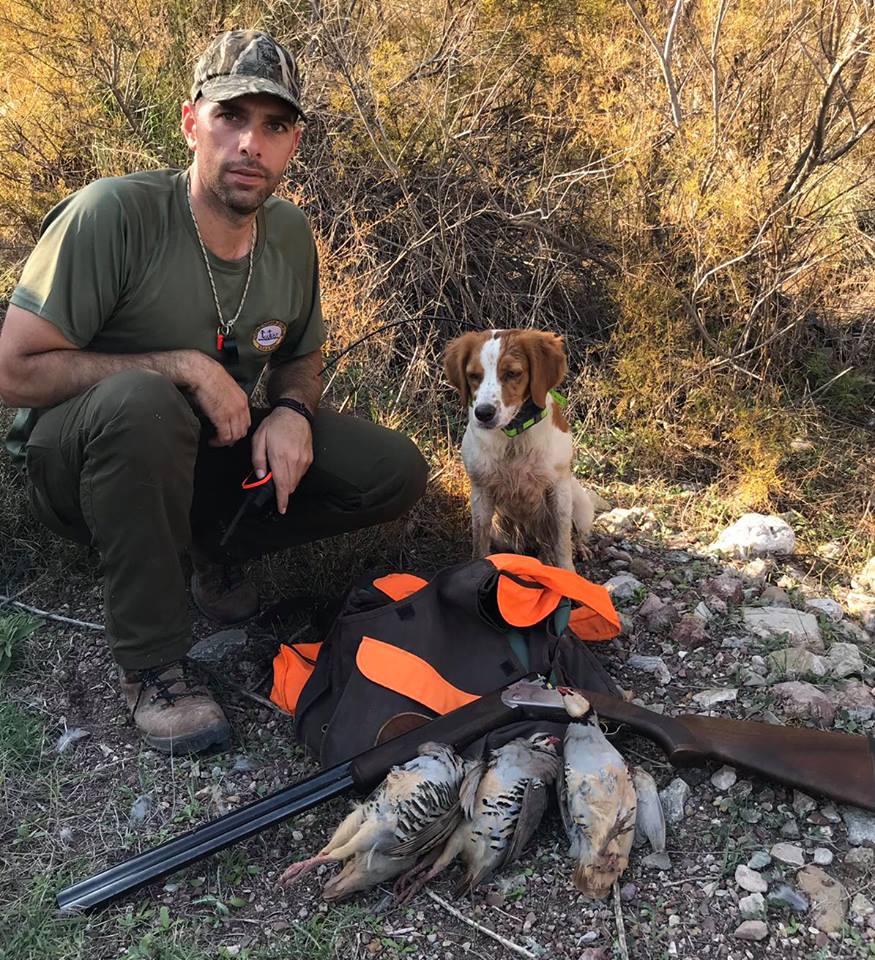
Haris Papadopoulos, Molly, and some evidence of a good day’s chukar hunting on Cyprus
Haris Papadopoulos contacted me through another blog of mine about two years ago with some questions about our dogs and the Brittany breed in general. He lives in Cyprus. We’ve been in touch since then, and just a few days ago he sent a report on his chukar hunting season with some photos of his young Brittany, Molly, himself, and the terrain where he hunts. He agreed to let me share his information on this blog, and even agreed to let me interview him via email. I am very grateful to him for the time he took to write responses to my questions, especially since English isn’t his first language. I can’t say enough about how wonderful it is to connect with strangers like Haris through a shared passion for bird dogs, pursuing challenging game, and the indescribable effects it all has on us. Here are my questions and Haris’s responses, which I’ve only lightly edited. Enjoy.
Please tell us about yourself: where you live, what you do for a living, where you grew up, and how you became interested in bird hunting.
I live in Cyprus, an island in the Mediterranean Sea. My hometown is Famagusta but most of my life I have lived in Limassol. I used to travel a lot because I was a professional athlete (sailor), and for 9 years I was living in Athens so I could do my preparation and have easier access to central Europe for regattas. I studied sports management but due to the fact that we own a family transportation business, I decided to help my father keep the company. Our clients travel from all over the world to visit Cyprus for summer. So, as you might understand during holiday season, I am really busy.
My family, grandpa, father, uncles, and cousins from the day I can remember, we were hunting together during chukar season. I even remember my first bird. Oh, that sound, when chukar leave the ground… All the magic is to see the chukar going up… Every time, after so many years, it feels the same!
So, as a kid I could spend time with my father only when we were hunting, and actually now, as a grown-up, I feel blessed that I took these first steps with him. He taught me not only how to hunt but also the ethics behind hunting. Even though I still go hunting with my family, when we leave the car and take the dogs out, everybody hunts alone. This way the odds are in favor of the birds.
Molly surveys the chukar terrain on Cyprus
Please talk about chukar hunting in Cyprus, what licensing and regulations are like there, if chukar hunting is popular, and what the terrain is like.
First of all, in Cyprus there is no such thing as a private guide to offer hunting experiences or trips. Licenses are under public control. Every year they publish a map and you can check the areas you can go for hunting. To be allowed to get a license you have to be at least 18 years old and pass a written exam. You are allowed to hunt only with over-under or side-by-side shotguns which means only two shots. The quota for chukar is 4 birds per hunting day. You are allowed to start hunting as soon as the sun goes up and stop as soon as the sun goes down… Approximately (during chukar season) this means between 6:15 am until 4:50 pm. Before and after these hours your gun has to be packed and inside the car.
Chukar season opens the first Sunday of November and ends last Sunday of December. We are only allowed on Wednesdays and Sundays, so approximately we get 17 hunting days with our dogs. I know it is not a lot but Cyprus is so small that if they allow more hunting days, the population of chukar, which is already decreasing, will completely disappear. But at least we can exercise our dogs from 15 July until end February, but I personally stop before chukar start to mate.
Chukar hunting is very popular in Cyprus. Our population is 1.2 million, and last year we issued 44 thousand licenses. But hunting chukars needs strong legs, big lungs and good working dogs. Usually you can see hunters around the first 4-5 hunting days when it is easier to locate the birds. After that, especially on Wednesdays, I don’t see a single hunter up the mountain.
The landscape is very similar to the one you are hunting. Rocky and low vegetation. Some Cypriot hunters prefer the woods, but I believe that is not chukar’s favorite. Through your videos I would say that the Hells Canyon landscape is very similar to the one I hunt.
Mixed bag!
Do you hunt other types of birds in addition to chukar (I noticed a woodcock in one of your photos)?
My heart beats only for chukar. BUT… There is a very big but here. Unfortunately, as I mentioned before, the chukar population on Cyprus is decreasing. Also, I believe the quota per hunting day of 4 birds is too high. So, even though I could spend all hunting season chasing chukars, I don’t. Some of my hunting days I spend on woodcocks. I do like woodcock hunting, different landscape, different conditions but if I had to choose, I could hunt chukars for the rest of my life.
Molly as a puppy
Please describe your relationship with bird dogs; did you grow up having bird dogs?
It’s not just a relationship. I can’t really find the words to say it. Dogs were always part of my family. At the beginning of this interview I mentioned that from the first day I remember, I was hunting. Same for bird dogs. My father always hunted with English pointers. He really loved them. I found some books, when the Internet was not even a thought, that showed he was ordering his dogs from British breeders. Our first pointer came to Cyprus 1978, before I was even born. So, as a kid we always had a dog around.
Molly in her second season
Please describe your interest in the Brittany breed.
Two years ago, after I came back from Greece, I really wanted to get my first bird dog. The one I will grow and train. At that time I really felt like a teenager. My father insisted I get an English pointer because they are the best, and bluh bluh bluh… You understand what I am saying. I really wanted to prove him wrong! One day at work, during my lunch break, I was watching some YouTube videos and noticed “Thanksgiving Partridge Hunt 2016.” As soon as I clicked on the video, the first thing I saw was Peat on point. After 21 seconds, I pushed the chair back and thought, Wow! All these years and I didn’t even know that Brits exist? I started watching one video after the other and I got really addicted. That was it, I contacted Bob to get some advice and I remember his words: “Get a Brit and just show it Love.”
Please describe how you trained Molly, what was challenging about training her, and how often you and she hunt together.
First thing, we learned the basics: sit and stay, ok, and give hand because I liked it. She was a bit nervous on wait, but I thought, she is still a pup, she will learn.
Molly is almost 2, so I had my first full season with her this year. Last year, when she was a pup, I was taking her with me for hunting or exercise to become familiar with the field, get the smells, and overcome any fears she might have.
Oh, god! The first year I thought I’d made a terrible mistake. She was so nervous, so anxious and I thought that I got a flushing dog instead of a pointing dog. I read so many books and thought I tried everything. I remember one day I planted a quail and I had her on leash. As soon as she got the smell she was trying so hard to flush it that she was crying… That day I said, Ok, I have to email Bob again for some advice. Indeed, he was right: she was just young and passionate. We finished the first season without a single point. We went back to the training field all January until mid-February… We were sleeping together, eating together, watching movies together, and sharing the same passion together. But we were missing that point.
I will never forget 12 February 2018. 6:53 am. First point on chukar! I got on my knees, took her in my arms and started crying. Before my eyes, my baby girl was growing up.
From that day everything changed. We started our training sessions mid-July for this season. Was very hot, but we didn’t stay out for long. Maximum 1 hour because with more than 30 degrees Celsius [86 Fahrenheit], she was not able to stay for more. A hunting day can last 8 hours if we don’t hit the quota early in the morning, so she has to be well prepared for this. One hour during summer could easily be 4 hours during winter.
This season, Molly still hunted with so much passion, but through experience she is learning how to turn passion into smart hunting. Point after point, she understood that in order to shoot a bird she needs to point. She needs to show me the way. Without her I cannot track, and without me she can’t get.
Please describe the best hunting day you have had with Molly, and what made it special.
You know sometimes it is not the numbers that can make the best memory. That day was different. Every time I cover approximately 12 to 14 kilometres [7.5 to 9 miles] and Molly three times that with a lunch break… Since we’d been getting so many points during training I was seeking something more…
Hot and light wind day. Half way you can find 5 pine trees on one side of the cliff (not very steep), where there is good shade to get some rest. We started walking around 6:30 am and we didn’t see a single chukar, and by then it was already 11:00. So, as I was resting, Molly went on the back side of the cliff to get some water from a stream coming down. After 2-3 minutes I heard the beeper on my Alpha, and I could see her on point. I said, No way! I jumped up, put on all my gear again and started to run. Indeed, not only Molly was on point but she blocked her first chukar! Pointing and blocking are different. In Cyprus, it is very rare for a chukar to be blocked so that the hunter will be able to get within a distance of 2-3 meters and then flush the birds himself. Her nose was so close, her eyes were so big. All her body was shaking. We were so happy to get that one and I was so proud of her. My Molly, my gun dog, my princess!
One of the purest pleasures I know is, upon getting into bed, having Peat collapse himself onto my left side, pressing his back against my ribs and torpedoing his head across my armpit, his nose inches from my face, and his relaxed amber eyes peering into mine as he sighs his little wheezy “tired old man” sigh.
Angus, the gentleman, consented to forego the bedtime “hole shot” to Peat once the younger dog proved trustworthy enough to join us on the bed, which was at about three months. Whether Angus was happy about this self-relegation I’ll never know; he doesn’t seem to have held it against me, and I miss having him in my armpit (I wrote about cradling Angus at bedtime in Gray’s Sporting Journal in 2015), a kind of sacrifice of intensity in our relationship that I worried would happen while we considered adding another dog to our household. True enough — it did. So the pleasure of Peat snuggling up against me isn’t quite so pure as it sometime seems.
Both our dogs spend most of the night with us in bed. They occupy different places, moving around, changing positions from fully stretched out (it’s amazing how long they can make themselves and how much king-size bed real estate they can commandeer) to curled like a furry donut, recalling the small circles of dirt I’ve seen while elk hunting which coyotes have carved out of snow for their beds in the woods. Often, they’ll each head to bed before we do, as if to let us know they’d prefer we join them, even though it’ll be 7:30 or 8; usually, this is a day they hunted or got a lot of exercise.
Bedtime, on a hunting day…
Angus prefers my side of the bed, at the end where my feet would be, with his head near the edge, and he’s always there while I’m getting ready for bed. Often I’ll sit next to him on the bed while I floss, and put my nose to his while I’m doing my cat-cow stretches on the floor before getting into bed. He expects me to move him toward the middle of the bed, which I do as carefully as I can — we both have arthritis in our lumbar area — and then I give him a neck, back, shoulder, and hip massage, which he seems to enjoy and I like to think has helped allow him to hunt hard without noticeable reduction in effectiveness well into his 12th year of life. I’ll finish by rubbing the inside of his ears, which always elicits a sigh of satisfaction, and giving him a kiss on his forehead.
Peat the retired sheet wrestler
Peat’s bedtime routine also begins before we get into bed, but is far more dramatic than Angus’s. Peat is the first “sheet wrestler” we’ve ever had. For the first couple years of his life, whenever he jumped on the bed — whether it was bedtime or not, and this could be several times a day — he’d violently pull the covers and pillows of the fully-made bed nearly clean off so only the fitted sheet remained intact. He still does this, but not quite as frequently. He also sheet-wrestles the couch, although we don’t keep sheets on it; instead, he removes the seat-back cushions and pillows, violently and haphazardly ejecting them from the sofa, clearing a space for himself about the size of the interior of a VW bug. We believe he’s trying to make a nest for himself, but his approach is like Genghis Khan on crack. Once finished, and it’s anyone’s guess what precisely might create the signal of completion in his brain, he collapses into a ball with a huge sigh, gives us a look that says, “Why must you make me do this every night?” and goes to sleep.
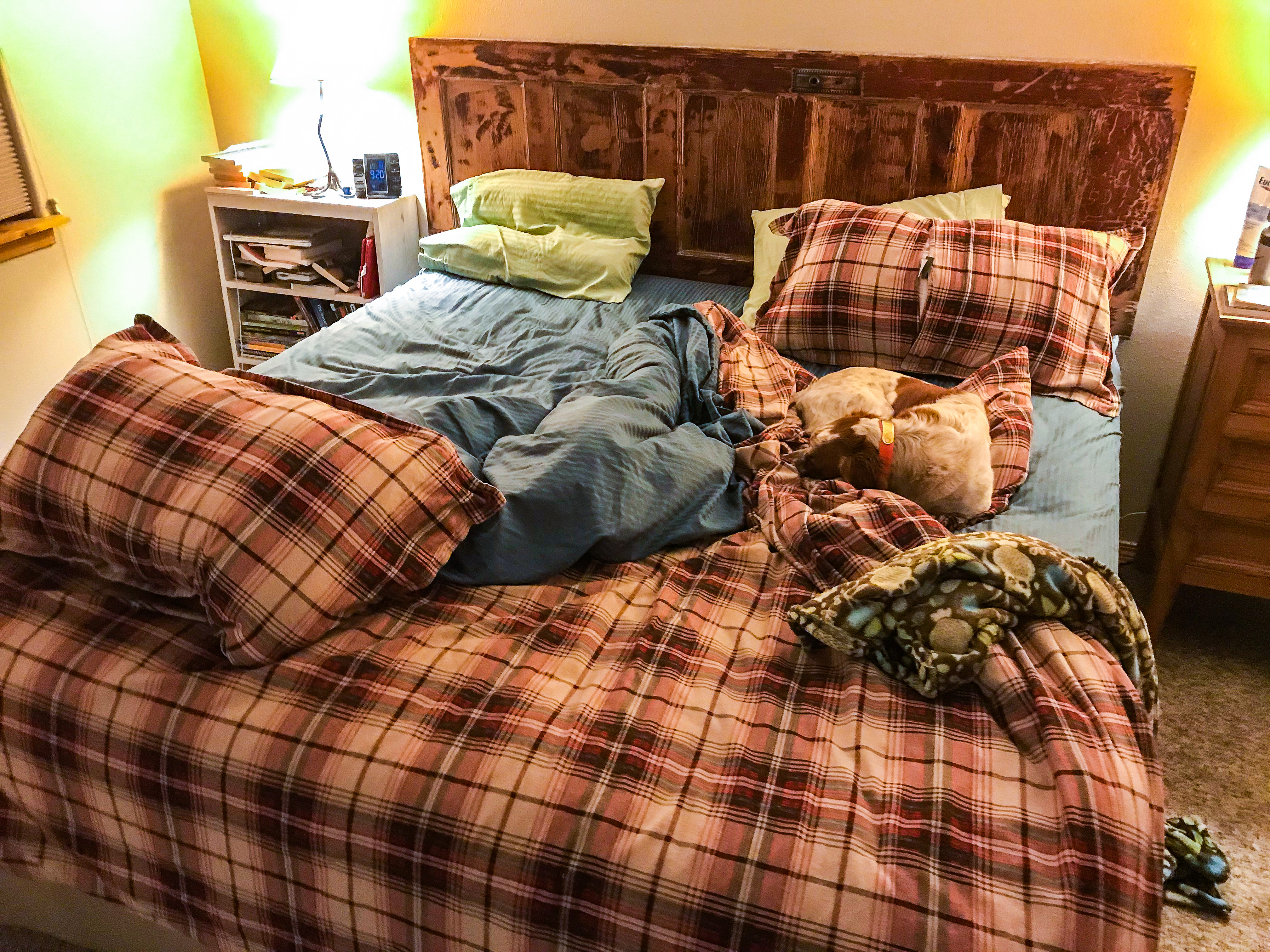
A Modest Proposal: Peat must barricade himself from all potential interlopersA half-baked effort for a fully-baked dog
One of the good things, and there are a few, of being an insomniac, is that I get to witness my dogs sleeping on our bed more than someone who is a sound sleeper (such as my wife). I love seeing them dream, sometimes with their tails quivering happily as though they’re slaloming through sage on a fresh partridge scent. Angus, much more than Peat, occasionally whimpers while dreaming, sometimes desperately, which worries me and makes me reach over and gently pet him to interrupt what might be a canine nightmare. But who knows? Still, I consider it one of the great gifts of bonding with a dog to be able to imagine what they might dream about. This will always matter to me.
Peat dreaming of alectoris plethoris
Leslie also loves sleeping with our dogs, but she doesn’t get to witness the experience as much as I do because she’s, well, asleep. But she knows it happens, and often falls asleep serving as another one of Peat’s particular sleep-foils. He’s got his particular positions with her as he does with me; with Leslie, Peat takes advantage of the fact that she sleeps on her side, which gives him more surface area to collect body heat (at least that’s my guess).
Peat in his usual place with Leslie, often after I’ve gotten up to go to school.
I realize not everyone sleeps with, or approves of sleeping with, their bird dogs. The reasons for not doing so might be moderately persuasive to an open-minded person: their restlessness can interrupt your sleep cycle; it makes them soft; you can get meningitis and giardiasis from them (I often wonder about this since both our dogs are both saprophagic and coprophagic); it’ll ruin their ability to tolerate temperature extremes; it will damage their olfactory receptors; and they’ll ruin your sex life. I’m sure there are other reasons, but I really didn’t do much research on the question because I’m not actually interested in changing my behavior because I am pretty close-minded about this. First, my sleep cycle can’t be any more interrupted than it already is, and it has nothing to do with dogs on the bed; I’ve had insomnia as long as I can remember, at least 25 years before ever getting my first dog. Second, if my dogs are “soft” from sharing my bed, I shudder to imagine what a hardened version of themselves would do to the local chukar population; I fear chukar would go extinct from “point-fright.” Next, given the frequency, for more than a decade, of wet, bacteria-laden, often feces-infused canine saliva from Angus’s (and now Peat’s) licks and kisses, and the fact that I’ve never gotten sick from them, I’m not too worried. Maybe I’ve developed an immunity or something, or it could just be luck and I’ll actually end up dying from a kiss, like Jesus did. I can think of worse ends. Fourth, it does seem my lazy dogs are overly sensitive to heat, especially in the early season. But I can honestly say that I’ve never considered their endurance to be a limiting factor on my hunts. If anything, it’s always and only the reverse. And as far as cold goes, I’ve seen them shiver a few times, but — again — they can endure much more than I can, and it’s not like I’d ever ask them to go hunting by themselves when it’s 20-below. Fifth, similar to the “softness” question, if my dogs’ noses functioned better than they already do, I’d feel so sorry for the birds that I’d probably have to stop hunting as it would no longer be “fair chase.” Finally, well, I’d better not talk about the last thing.
My ancestors, I’m pretty sure, slept with dogs, and some of them probably still are sleeping with them. I’m talking about those medieval knights (I realize I’m assuming I’m descended from at least one knight like this) whose graves are adorned with brass rubbings showing them in their armor, with the two most important things a knight could own: his sword, and his faithful dog. The dogs are always at the feet of the knight, which makes sense aesthetically and otherwise. The best sense it makes to me is that it’s a bridge from then ’til now: the two most important things I own, when it comes to chukar hunting at least, are my gun and my dog.
A brass rubbing I did in England in 1978, now hanging in my classroom.
The question always arises: were these loyal dogs buried with the knights? I’ve heard that they were but then that brings up the terrible question, what if the dog was still alive when the knight died? I couldn’t find any answers to this on the Internet, so I’m betting the dogs’ bones aren’t actually in the graves with the knights, but rather that they’re symbolic. Of what I’m not sure, but probably they symbolize what dogs would symbolize on anyone’s memorial today: loyalty, unconditional love, one could go on. Maybe even the poet Billy Collins’ ideas about what dogs think of their owners might pertain.
Curious what your dog might think of you? You might be surprised.
I doubt I’ll be buried with one of my dogs. I think I’ve asked to be cremated, and unless an awful coincidence occurs and my dog and I shuffle off this mortal coil at the same time I’d be horrified if someone even thought of dispatching my dog so he (or she) could go with me. But I wouldn’t mind if what was left behind of my brief stint on earth was some kind of evidence of my love for these creatures (which might seem over-the-top to those lucky bastards who’ve had dogs their whole lives; I didn’t get my first dog until I was 38), and — if I am lucky — their love for me.
Yesterday, we carefully sneaked out of the house to head down to the canyon with just Peat, leaving Angus behind. The old warrior Angus has been running lots of miles hunting the past couple of weeks and against his will we forced him to take the day off. We knew getting ready to go wouldn’t be easy without him catching on so we put both Peat and Angus inside the car in the garage while we dressed and loaded up our hunting gear into pickup outside. Once ready, we let them back into the house and corralled Peat outside into the pickup and drove off and looked back as Angus was watching in disappointment from the fenced yard.
The higher mountain elevations were blanketed with a fresh layer of snow overnight so we decided to hunt in a spot down in Hells Canyon, a place we hadn’t walked around this season and where there wasn’t as much snow. Our starting point was an easy spot to access right off the highway. Bob decided not to hunt so Peat could have a chance to hunt for me for a change. In the past so far, and we’re not sure why, but whenever Bob hunts, Peat prefers to only stay with him. As with all hunts down in the canyon, the terrain dictates that the only way is up so we headed up a small game trail in a thick draw lined with brush and trees hoping to find some grouse on the way up. Within five minutes, Peat busted through the brush and stopped above us, barking his head off. His bark was different this time, not his usual high pitched barking he makes when he flushes a grouse up into a tree. His bark was deeper and had the sound of fear in it. We quickly made our way up to him and found the source of his agitation. A big beautiful bobcat with haunting golden eyes was caught in a trapper’s snare underneath some bushes. I was angry. How could a trapper get away with putting a trap in an area close to a popular bird hunting area where hunting dogs could also get accidentally caught? Trapping bobcat in Idaho is totally legal from Dec 14-Feb 16 in this area so there was nothing we could do but walk away. We normally carry heavy duty wire cutters in case the dogs ever got into a snare but they were at home in Bob’s hunting pack. I would never mess with any trappers traps unless one of the dogs got caught in one and I would never tamper with or free wildlife from traps because it’s actually illegal to do so.
Trapped cat
Trying to put the whole affair behind us and forget about it, we continued our climb up about 1,500 feet with Oregon at our back and up into the snow that we were trying to get away from in the first place before finally getting into some birds.
Fence line ascentThe wall
Once at the top of the steep climb, Peat found and pointed a covey of Huns and I managed to knock down one as they busted and flew downhill over the ridge. Peat, not used to hunting with just me, was confused on whether to bring the bird to me or to Bob.
First point of the dayThe retrieveThank you Peat!Pointing chukarPointing a covey of chukarWhat next?Heading down and away from the draw
The bluebird sky, amazing views, and Peat brilliantly hunting just for me made up for our terrible start. Yesterday’s hunt will be forever remembered as “Bobcat Gulch.” Now knowing that traps are in the area we will probably never hunt there again and especially not during trapping season.