He thought he kept the universe alone; For all the voice in answer he could wake Was but the mocking echo of his own From some tree-hidden cliff across the lake.
–Robert Frost, from “The Most of It”
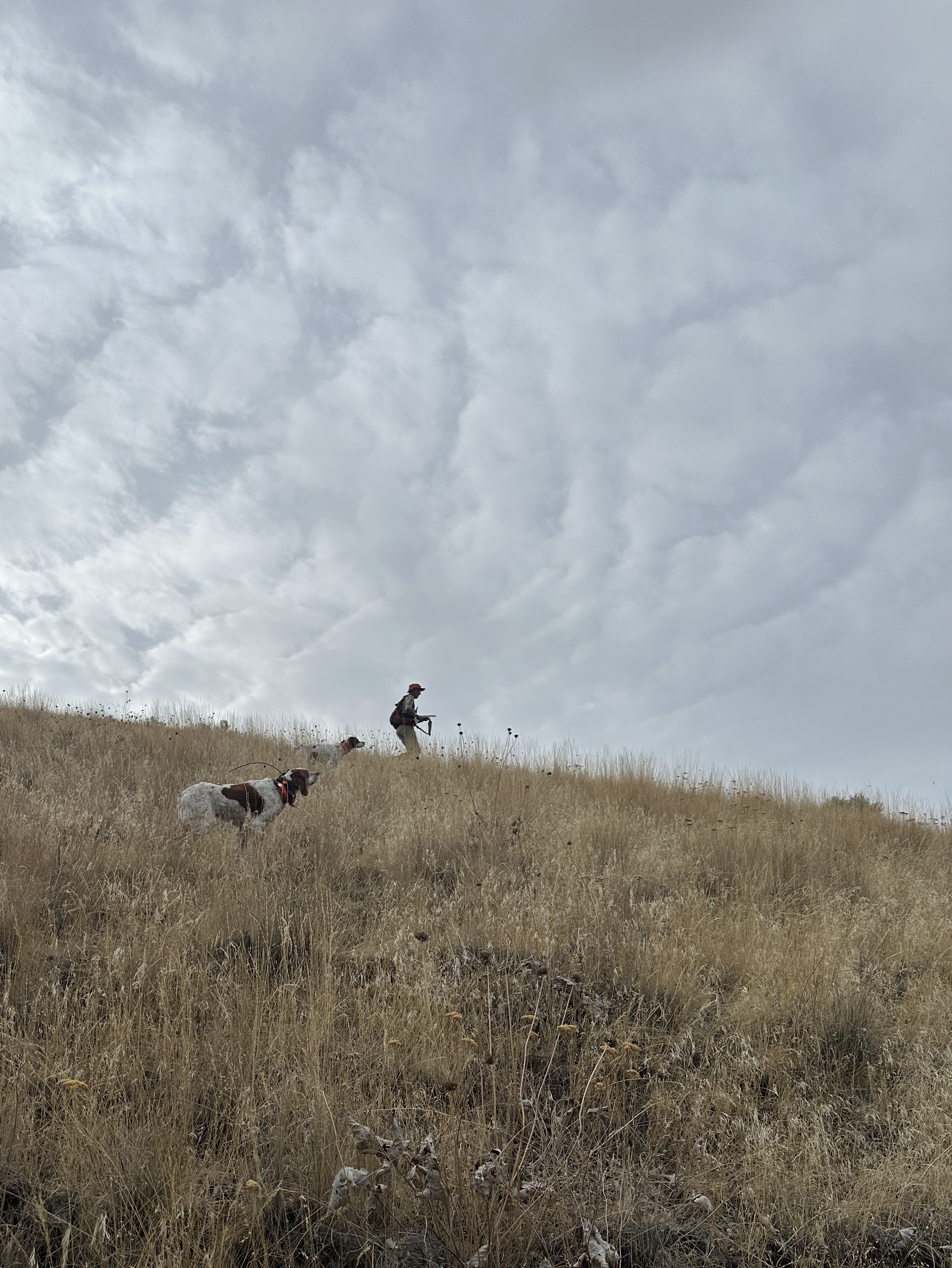
One of the reasons I was attracted to chukar hunting long ago was that it was the only activity I wanted to do that allowed me to be truly alone. None of us normally has that level of control over any situation outside of the privacy our homes. Being in a beautiful environment that pretty much guaranteed solitude, on land that was available to anyone, was — in my life — rare.
I’ve been lucky all these years to replicate that nearly every time, even hunting with others I chose to hunt with. Focusing on the landscape and the dogs and where the birds might be was the limit. For me, that was chukar hunting.
Yesterday we were lucky enough to hunt for the second day in a row with a good friend visiting from out of state. He’d brought his UTV to get us to places we hadn’t hunted for years since we’d moved away. Hunting along a reservoir with more than 75 miles of shoreline, and no other vehicles on at least half of that it felt like we were surrounded by endless public land occupied only by the wildlife and grazing cows.
The dogs found birds immediately. Before we got to the first point, gunshots rang out close by, surprising all of us. We’d thought we were alone. Clearly, someone else was hunting nearby. We hustled away from the shots, which continued — clearly they were getting into birds. We corralled our dogs and headed up the large draw in front of us, thinking we were moving away from the other person or people. Within a few minutes, four hunters appeared at the bottom of the draw we were in; they’d come from the drainage to the south. They spread out so we could easily see them; three wearing hunter orange, one not. Only one dog. They watched us climb away from them up the draw for at least 20 minutes, and we speculated on what they might be thinking. We’d been planning to spend the day hunting both sides of this very large and steep draw and suddenly we felt our plans evaporate in the face of another party’s gaze. Were they hoping to cross to the other side of the draw? Were they thinking they might follow us? They didn’t move. Finally, I started heading to the other side of the draw, and soon found a rock to sit on. I sat while Leslie continued climbing. For twenty more minutes I sat there watching them. They didn’t move. Peat sat by me, whining, confused, not hunting. Finally, one by one, they slowly headed back to the draw they’d been in. Sounds of their shots began choiring frequently again.
With the seemingly infinite amount of land all around us in every direction, and the obvious prevalence of chukar nearly everywhere, it seemed absurd to me that we would even see other hunters. That this group seemed to be pressuring us, or affecting our plans in any way, seemed even more ridiculous. Clearly, this group was operating with a much different mindset than I was: if I knew I was even near another group, especially in an area with almost unlimited places to hunt, I would quickly move away from them.
That’s all I’ll say. I don’t know why they did what they did. Maybe there’s a good explanation for it. I never talked to them. We ended up hunting up and over the ridge into another draw entirely and had a good hunt. But I can’t forget that other group and the impact its actions had on the first hour of our time out there.
Hercules Metals sent this press release today (July 30, 2026), announcing the addition of a team of (non-American) mining operations folks. I’m no expert, but it looks like Hercules is ramping up the exploration phase (which is how they sold it to the locals in Cambridge, with the carrot of jobs and other community benefits) to an actual mining operation.
If you read the press release, there is not a single word about the impact of an open-pit mine (or any other form of mineral extraction) on the landscape, the public land, or the community. Idaho law allows what they’re doing, but anyone who uses that land — whether it’s ranchers with grazing allotments, big game or bird hunters, or other recreationists — knows that first, they won’t be able to use it ever again, second, that it will poison the Snake River irreparably, and third, that the way of life championed by Cambridge and the “Upper Country” will be forever lost.
Tell me I’m wrong. Tell me I’m being stereotypically alarmist. Tell me I’m a communist. Tell me that the donation of the bulk of the public land this operation will destroy wasn’t really intended to protect crucial wintering ground for deer and elk. Tell me I’m smoking something. Any of that would be preferable to what seems to be coming.
Anyone who’s done this for a decade or more has watched a dog get old. Age, or agedness, is relative. Glenna only made it to 10. Angus 13. Peat turned 11 on April 2. Even though he’s still “going on two” we think he might be losing his mind. With all of the obvious (or so we think) parallels between what’s happening to our own bodies and minds and what we observe happening to our dogs’, we attribute changes in his behavior simply to age. Naturally.
We’ve been lucky with Peat, comparatively speaking, as have we with ourselves. Today, he’ll be anesthetized for some vet work, but nothing major. By Peat’s current age, Glenna had been dead for more than a year and Angus had started to show signs of the cancer that killed him. Peat’s had his share of warrior wounds (torn pads, barbed-wire-induced gashes, etc.), but — knock on wood — nothing extremely worrying or unusual. Like many older dogs, his body is increasingly covered with lipomas and skin tags, and his mouth is a cesspool, with breath that even a mother could never love. And his teeth — well, he’s had some pulled for rot and we expect more today. I take the blame for not being a better dental monitor. You’d think I’d learn.
What keeps me up at night, though, is wondering how his mind is doing. Or what it’s doing. Thunder and, more so, fireworks, have always scared him, but this year seems far worse for him. So much so that his nightly routine, even when the skies are clear and there are no loud noises nearby, features him burrowing into the back of our bedroom closet, burying himself as far from reality as possible. It’s the closest thing to attempted doggy suicide I’ve seen. There are many stable things about him still: his constant obsession with food, his playfulness, his alertness and barking at anything he deems unusual or out-of-place, his daily morning ritual of coming into my closet to smell whether I’m putting on hunting clothes, looking up at me with plaintive eyes that make me want to collapse from love. But, probably projecting, I wonder if changes in his behavior are evidence of dementia.
His physique remains young. We’ve done a good job keeping weight off of him, but the few times he’s had a vacation from us and stolen anything and everything from his hosts to eat (even though we warned them he’d do exactly what he infamed himself by doing) we’ve picked him up noticeably heavier. His muzzle has grayed a little, but it’s hard to notice when you’re with someone every day. Strangers seem amazed he’s as old as he is.
We worry we’re forgetting things more easily: words, names, experiences, why we walked all the way across the house to get something that — when we get there — we can’t remember. And then we see Peat seem to forget he’s eaten already, or see him exhibit a new habit like his pre-bedtime burrowing, and we project our own worry onto him. Or do we?
Despite the thousands of years that have passed since humans began documenting their experiences and speculating on the meaning of life, nobody really knows. Nobody has ever known, nor will they ever. That hasn’t stopped lots of people from confidently stating what they think it is. I’ve certainly done it here, and probably have contradicted myself more than once. But I am pretty sure about this: dogs help increase a person’s wonder.
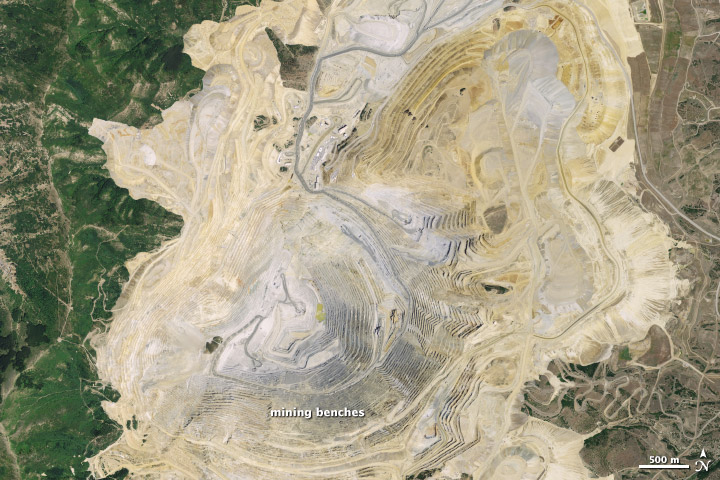
The image above is of a part of the Bingham Canyon open-pit copper mine in Utah. (Photo courtesy of NASA Earth Observatory, Jesse Allen and Robert Simmon)
“Can you guarantee this won’t be an open-pit mine?” — Question from attendee at Hercules Metals town hall meeting, Cambridge, ID, May 13, 2026
“No.” — Chris Paul, CEO of Hercules Metals
Hercules Metals has expanded its mining exploration on the Cecil Andrus WMA and USFS public lands along Highway 71 west of Cambridge, Idaho. The combination of their leased land on the Andrus WMA and their mining claims on USFS lands to the southwest now runs about 73 kilometers (about 45 miles), on both sides of Highway 71. Hercules is the largest of the six or seven other mining companies with leases and/or claims in the area; numerous others (mostly foreign companies, like Hercules) have begun exploring the “zone,” and off-road equipment, bulldozers, drilling pads, and storage facilities have drastically increased on this important and beautiful section of public land. We didn’t hunt on the east side of 71 last season because of all the drilling and road-making activity, but we observed it from across the canyon on the west side of the road. The disturbance to the area between Brownlee Guard Station and Grade Creek was shocking from a distance. Access by foot up or down Camp Creek, one of our old favorites, is now basically closed as it is the main access point for all of the heavy equipment heading up and down that road.
What follows is my account of a site visit to the area, an aerial view from a Cessna 210, and the Hercules Town Hall meeting in Cambridge on May 13 of this year.
On the Ground
In early May, I had the good fortune to accompany Randy Fox and Jeff Abrams of the Idaho Conservation League on a drive-around of the area where Hercules has been conducting its exploratoratory drilling for copper and silver, on both the Cecil Andrus Wildlife Management Area (the “Andrus”) and National Forest Service land west of Cambridge, Idaho.
As I’ve reported before, Camp Creek, which has been closed to motorized vehicle traffic since as long as the Andrus has been the Andrus, has been Hercules’ sole entry point for its drilling. We were able to get a key to the closest nearby gate (Grade Creek, just a bit west of Camp Creek) and drove up that road. About halfway up, a little spur led to a locked gate past which sat some huge poly tanks and other material and equipment, so we pulled off and took a brief look at that area. Both Jeff and Randy were impressively knowledgeable not only about what we saw there, but also about historic mining material (there was lots of evidence of a previous — they thought maybe the 1960s or 1970s — mining operation there).
An old drill core fragment, with floor joists from an old mining structure at this new storage site.Jeff looking at the remnants of the structure, situated between two springs
This storage area seemed neglected. Pallets of drilling “lubricants” and other material (including polyacrylamide) had obviously succumbed to at least a season of weather, with whole pallets of “grout” in bags that had broken open and begun dissolving. Other material, also on pallets, had had their cellophane wrapping blown off and — in several cases — containers of material had fallen over and spilled contents onto the ground.
Pallets of eroded Barite grout. “Non-toxic” but also not a natural part of the environment there.One of many pallets of polyacrylamideOne of many buckets of polyacrylamide that had spilled its contents onto the ground. Polyacrylamide’s precursor is acrylamide, a known neurotoxin and carcinogen. Its biodegradability is still heavily debated. AMC 206, a drilling fluid viscosifierCurious what a 5 gallon container of vegetable oil runs a mining company…These poly tanks looked to be intactJeff taking a closer look at one of the tanks.Drilling pipe stacked beside the poly tanks; Jeff looking into the sun while Randy inspects a pallet of drilling materials and other apparent garbage.
We continued on through the area, stopping here and there to look at the new roads that had been bulldozed into the open hillsides, leading to drilling sites, some of which had been “reclaimed,” and some of which looked better than we expected. Most of the roads, including several we’d hunted on for years, had been dug down several feet (e.g., the one from, Camp Creek up the hill to the south, then over one of my former favorite ridges to hunt chukar). The water source for the current drill site was Camp Creek, with a decent-sized gas-powered pump sending water through a series of hoses probably about a third of a mile up the hill. I don’t know how much water a 8,000-foot drill hole requires, but it’s a fair amount. I also don’t know what the holes that penetrate existing aquifers do to those aquifers. Since most house wells in the area are drilled down about 150 feet (a deep well is maybe twice that), I can imagine that each hole that Hercules drills intersects numerous aquifers. I imagine a hydrologist could tell you what kind of impact drilling exploration has on aquifers. I do know that cross-contamination in drilling is fairly common, especially when drilling operations don’t do a good job sealing the bore holes after they’re finished. Whether anyone checks these is anyone’s guess. Chris Paul has said that one of the reasons they decided to explore Idaho for minerals was that it had some of the most lenient mining laws and regulations in the U.S.
A reclaimed drill site; I’m not sure how long since it’s been active.This is the road heading down toward Camp Creek. Before the drilling, the road was a flush 2-track.The same road heading up the hill.One of the most recent drill pads, on an entirely new series of roads. Hercules has dubbed this area the “Southern Flats.” It used to be one of my favorite spots for chukar.Just up the hill from the active drill site. Jeff and Randy explained that the ditch below the orange fencing was a catch-basin, and the fencing was to keep animals out of it.
Overall, while I was grateful to Jeff and Randy for inviting me to tag along, and to have learned a lot from each of them, it was hard to see such profound disturbance to an area that I’d spent so many amazing hours on with my dogs and my wife, in all seasons, its beauty and solitude and wildlife, and all of the undefinable yet crucial things that come with that, uninterrupted by heavy machinery.
In the Air
In mid-May, I was lucky enough to get invited by ICL to tag along on an EcoFlight over the Hercules site. I’d never heard of EcoFlight, but was impressed by everything this non-profit does. I joined Randy, Jeff, Dennis Daw (director of the USRT fish and wildlife program), and the EcoFlight pilot Chris Benson for a flight from Ontario, Oregon to the area Hercules is exploring. It was weird and a little disorienting to get my first hawk’s view of terrain I’d come to know so well from the ground. The flight didn’t yield anything surprising (our ground tour had seen to that), but accentuated the natural beauty of the area; the day was perfect for flying and the spring greenup and remnants of snow on surrounding peaks made for stunning views in every direction. Picturing an open-pit mine, like the one in Butte, Montana or the huge Bingham Canyon mine in Utah on this landscape makes me feel ill.
From left: Randy Fox, Dennis Daw, Bob McMichael, Jeff Abrams (photo courtesy of EcoFlight).Snake River, Brownlee Reservoir, Brownlee Dam, Brownlee Creek Inlet, Woodhead Park (photo courtesy of EcoFlight). Hercules’ activity is to the right of the photo (not visible here). Hercules drilling pad (active, on left) on Southern Flats area just south of Camp Creek (photo by Bob McMichael)Highway 71 (extreme right edge, and in lower left), with Camp Creek road heading east. The Southern Flats area with the active drilling site is in the top center of the photo (courtesy of Bob McMichael).Pilot Chris Benson (left seat), Randy Fox (right seat) inside the EcoFlight Cessna 210.
In the Hall
Hercules hosted a town hall meeting on May 13 in Cambridge’s Exhibit Hall. As expected, career politician Judy Boyle (of Ammon Bundy-supporting infamy, including her personal appearance in support of the Bundys’ 2016 violent and illegal take-over and occupation of the Malheur Wildlife Refuge in Oregon) introduced Hercules CEO Chris Paul by emphasizing the “national security” aspect of mining’s search for copper and silver. Boyle’s been promoting the mining exploration project west of Cambridge from the outset, but this time didn’t hawk it as a local job-providing affair. Instead, she limited her introductory comments, which confused me a bit: either she assumes she doesn’t have to try to sell the locals on the project or she knows that it won’t provide many jobs if it turns into an actual mining operation, or she knows she’s helping push the destruction of the Cecil Andrus Wildlife Management Area, mainly out of spite for the great Democratic leader of Idaho and former Secretary of the Interior.
Paul presented a brief slideshow about the project, then introduced his new tech director who explained what they’re doing up there, including showing a video by an Australian company. Several people I talked to afterward wondered why Hercules hadn’t made its own video, which probably could have been done more easily…
During his presentation, Paul referred to Hercules Metals as a local company, even though it’s Canadian, and referred to the “Property” Hercules has mining leases on in the Andrus WMA as land they owned; in fact, Hercules owns less than 100 acres of the “Property,” which encompasses about 24,000 acres. The company’s headquarters is on a 7.7-acre property in Cambridge that was recently purchased by Hercules’ owner, Anglo-Bomarc, a Vancouver-based Canadian mining company with a tax address registered in Toronto. Paul also highlighted the “extensive” financial contributions Hercules has made to about 20 local organizations, which seemed very similar to Perpetua’s PR campaign to sell to the locals farther north its controversial Stibnite Mining project. I haven’t asked any of the organizations how much Hercules gave them, but even if it’s $1,000 each (which is doubtful), that’s only $20K. Pretty cheap marketing for the “dupes” Paul called Idahoans in a podcast I shared in a previous post.
I asked the first question during the Q&A:
“Since Hercules is a Canadian company why do you keep referring to it as local or American?” He obviously didn’t appreciate being called out like that, and shifted to an immediately defensive stance.
“What’s your question?” he asked.
“Well, you’ve said you established a local workforce, but what’s in it for the Canadian company?”
“Obviously, corporations pay taxes…” He took another question.
Hercules’ marketing material, including the images on its website, foreground the natural beauty of the area, which — as I’ve written before and which all locals know — is a critical wintering ground for large herds of elk and mule deer, not to mention other game such as upland birds. I have subscribed to the company’s e-newsletters from the beginning and have attended two of its town hall meetings, and never has Chris Paul or any of Hercules’ marketing material ever mentioned the impact of mining on the area, the vast majority of which is publicly owned. At the most recent town hall, the final question was asked by a young woman. “What will be the impact of a potential mining operation on the land there?”
As I’ve heard him say before, to similar types of questions, Paul essentially said that his company is merely looking for potential deposits of copper and silver, and that it “could take years” before they know if any mining company will want to develop a mine there.
Anyone would expect him to say that. What’s disingenuous, though, about his rhetoric, especially when the company’s marketing material highlights the area’s natural beauty, is the fact that — as a mining professional — he knows probably better than anyone that the area will be destroyed.
It’s common knowledge now that we need silver and copper for more things every day. Not even considering the tremendous and accelerating lust for these metals that data centers desire, or the vast amounts needed by the military industrial complex, or the political aspects of either, “alternative” energy and other more “mundane” uses of copper and silver and other minerals that can only be taken out of the ground (recycling supplies only a fraction of our need) is, sadly, a necessary evil of our time. Rationality, though, seems even scarcer than these precious metals when it comes to the location and regulation of some of these mines. In Hercules’ case — like many others’ — environmental safeguards don’t seem as robust as they might when it comes to protecting the landscape and waterways from damage. Hercules sits directly above the Snake River, above a complex of three reservoirs on the second biggest waterway in the west. The Snake feeds the Columbia, and is already struggling with increased pollution from upstream agriculture runoff, resulting in increased algae blooms and toxicity problems that lead to more and more closures of the waterways each year. Mining operations, including exploration such as that Hercules is doing, adds pollution to an already fragile ecosystem.
In addition, most of Hercules’ activity has occurred on the Andrus, which — as previously mentioned many times — is an important wintering ground for deer, elk, and other big game. The land for the Andrus was donated by the Mellon Foundation specifically to protect these animals’ homes during the crucial winter season. Idaho’s unusually lenient mining laws, however, essentially disregard both the intent of the Andrus land donation and the fact of its essential nature to the animal residents. During my time with ICL recently, Jeff Abrams showed us a map he had borrowed from Idaho Fish & Game that showed radio collar data from mule deer and elk throughout the year; Hercules’ exploratory drilling and the development of an open pit mine would literally remove the entire neighborhood of those animals there.
The whole thing just seems like a bad idea. Even if it was the richest deposit of copper and silver in the US (it’s not), it’s too close to the Snake River, it’s on a much too tight 2-lane road that is a major recreation corridor (numerous campgrounds are used year-round on the three reservoirs along the Snake within about 30 miles), it would destroy crucial wintering range for highly prized mule deer and elk, it would eliminate crucial grazing allotments on public land (both on the Andrus and USFS land), it would definitely increase pollution in the Snake River drainage, the companies involved are not US companies and — if the history of these companies and their operation is any indication — the bulk of the workforce would not be locals, and local communities would not see any significant economic benefit. Idaho’s mining laws are a combination of outdated federal and state laws dating back as far as 1872. It’s hard to imagine any sense breaking through any of the numerous leases and claims being granted: the scale of mining today outpaces by an order of magnitude anything imagined 150 years ago.
As one attendee noted near the end of the town hall meeting, if the area were to be developed as an open pit mine, everyone in the room would probably be dead before they saw evidence of it. Chris Paul laughed.
This began from a story my neighbor, a golf course superintendent, told us one night. It was fascinating to learn about what his employees served up to him. And so it began.
About a month into it, I realized that I was writing a sequel to my first novel, The Rim. But Ennis, one of five characters in The Rim, was the sole narrator of Stay the Course. At the end of the first novel Ennis learned, at 18 and just about to leave for college, a lot is left up in the air. Stay the Course begins about 25 years later, but incorporates lots of flashbacks filling in some of the blanks. Now he’s a father and a husband, a skilled professional, no longer a hunter, and has grown as a human. Like you’d expect anyone to.
This is the fourth book published by Chukar Culture Press.