Category: Hunting accounts

  • Hunger

    Hunger

    I don’t know the people who will feed me…

    Frank O’Hara, “The Day Lady Died,” from Lunch Poems (1964)


    Please, sir, I want some more…

    Charles Dickens, Oliver Twist

    Warning: This post is way less about chukar and more about culture, if you can call it that.

    We’d probably prefer to think of the word “hunger” metaphorically rather than literally because it can represent a desire to achieve something great. Of course, as in Captain Ahab’s case, the merit of his quest was debatable, to say nothing of Jeffrey Dahmer’s. Still, absolute hunger is painful and real yet most of us don’t really know it.

    But I wonder about my dogs. They might.

    Peat, Angus, and before them Glenna, have all acted, all of the time, as though they were hungry. Because they never showed signs of being malnourished, I have always doubted them. Is it possible I’ve been wrong? To a dog, what is hunger? I’ll never really know.

    My first dog, Glenna, began life showing no interest in food. It worried me. She was about two when that worry did a 180; a friend came to visit with his two dogs, who were very interested in their food. Glenna caught on and, soon, was food-obsessed. In her twilight years, she would stand in the kitchen, her neck sloping toward the floor, eyes raised and locked on us, and scream at us to feed her, even if she’d recently eaten. I often wondered if the megaesophagus that resulted in her early demise was some sort of cosmic payback. It’s awful to think that, but I did.

    Glenna, about to yell at us.

    Angus, I believe, learned his attitude toward food from Glenna, and then Peat from Angus, although Peat’s really ratcheted it up a few notches. Peat also picked up the coprophagy from Angus, who, maybe relatedly, is still the only dog I’ve had who drinks his urine.

    Glenna teaching Angus how to eat wood
    Angus applying the principle to kibble

    Before you yield to the temptation to offer me advice, I’ve tried for years to “solve” this shit-eating thing. The most comical attempt, looking back on it, was buying some very expensive powder from Drs. Foster and Smith that you sprinkled on the dog’s food to make its poop taste bad. If my reason hadn’t been clouded by my own hunger to stop Angus from this disgusting habit, I would have realized how funny the powder idea was. I mean, it’s shit. How can you make it taste worse than it already does? Needless to say, it didn’t work. Ha ha. Joke’s on me. And I didn’t learn from that, apparently: recently I purchased some (again, very expensive) probiotic powder to put on the dogs’ food, thinking it might help them more completely metabolize their meals and, thus, make the potential residual nutrition in their stools less appetizing. It didn’t work, and Peat might have developed a nasty rash from the stuff. If anybody wants it, the jar’s on top of our garage fridge.

    Both dogs seem — except when hunting — glued to the idea that the world has food for them everywhere and their job is to find and eat it. Our walks are dominated by the poising of my thumb on the “tone” button (if it’s Peat I’m concerned about) or “momentary stimulation” button (if it’s totally deaf Angus I’m worried about) of the e-collar transmitter, hoping to distract the dogs from eating something I think they shouldn’t and which they think absolutely they should. It’s a perma-conflict. It makes me think of what someone once called golf: a good walk spoiled. It’s hopeless, too, because I nearly always have the wrong dog selected when one of them verges on an infraction. Peat stands on his back feet and scarfs chokecherries from overhead branches: I shock Angus. Angus stops mid-trail to inhale day-old turkey diarrhea: I buzz Peat.

    Sometimes, we forget the collars when we’re home, which we always say we’ll never do again, and then we forget them again. As we did last night during happy hour, when it was 98 degrees outside and we thought we’d enjoy a beer in the shade. The dogs had had a long walk-run in the morning, gone in and out all day long, and seemed generally quite tired, and we had just fed them. Plus, when we sit around the table outside, they like to join us by jumping in the padded chairs and halfsnooze in our presence. But not this time. Clearly, they remembered something from the night before, and it wasn’t until we noticed they weren’t chillin’ with us (a matter of a minute or two) that we realized they’d headed straight for the quail nest they’d pointed 24 hours earlier. Leslie got there in time to watch Peat eat several of the eggs but somehow managed to shoo him and Angus off and recovered and replaced 9 of the eggs (we had counted 16 the day before). Leslie was more upset by this than I was (but then I wasn’t there, having chosen to remain in the shade with my new homebrew); I tried consoling her by reasoning that we can’t pick and choose which version of the dogs’ prey drive we approve of: we love and brag about Peat’s prey drive, which makes him a phenomenal hunter but which also, sadly, means we have to live with it when we’re not hunting. That very morning, Peat began the day with his usual pre-feeding charade of trying to out-cyclone a cyclone, alternating growling and attacking Angus with rapid-fire circle spinning from the bedroom through the dog door, all peppered with deafening coyote-like shrieks, and then gobbling his 1/2 cup of kibble in 4 seconds. Sometime after I’d gone back to bed (about 5:30), he counter-surfed a container of mini-cupcakes, took them outside, and ate all of them and part of the container.

    Dogs pointing a quail nest
    Pre-attack eggs…

    So I guess I’m not sure where hunger ends and prey drive begins. How closely, if at all, are they related? If Angus hadn’t showed Peat his intense and nearly constant desire to eat or get fed, would Peat have limited his expression of hunger to the field? I’m under no illusion that we can change any of this (although I suspect some of you might disagree; as always, I’m open to suggestions). But, outside the annoyance of Peat’s daily insanity around feeding, I realized just the other day that I have spent the last 19 years worrying about whether my dogs are really feeling hunger. Because even just the feeling of hunger (and not actual hunger, where you’re starving literally) is painful, gnawing like heartbreak. I hope that’s not it. I don’t want my dogs to feel that.

  • Making Connections

    Making Connections

    Eventually, all things merge into one, and a river runs through it. The river was carved by the world’s great flood, and runs over rocks from the basement of time. On some of the rocks are timeless raindrops. Under the rocks are the words, and some of the words are theirs.

    I am haunted by waters.

    –Norman Maclean, A River Runs Through It

    The final two paragraphs of Maclean’s first story, written in his seventies, may be one of the most-quoted chunks of literature about the west, maybe because it’s an anthem to an original wildness we continue moving away from in ever-accelerating fashion. Maybe it’s just beautiful and has to do with water that moves (all water moves, but at least we can watch and listen to it move in rivers, and feel it if we get in it). I connected with this story when I was much younger and falling in complicated love with fly fishing, a romance that’s recently been rekindled for some reason I’m not sure about. But I am sure that it (the book and its final paragraphs) connects to chukar hunting in some ways that might resonate with other bird chasers. The connections are visible: whether it’s on Instagram or in the flesh, we see people fly fishing accompanied by bird dogs; we see other drift boaters on the Missouri with big, bearded German breeds; in the “off season,” we see Idaho Chukar Foundation posting pictures on Facebook of what he calls “water chukars” he’s landed in some mysterious aqueous artery. There’s a stereotypical ethic, I think, that each activity shares: a honed-down pursuit of elusive, beautiful prey, based ninety percent on knowledge and the other half on patient perseverance. Ultimately, it doesn’t matter why. But there is a connection. It’s centered on the people, and cultivated in them. In a way, all things we experience as people eventually merge into the one person we are. We’re like rivers.

    Fly fishing with bird dogs requires more stops than usual, which is good for everyone.

    Earlier this spring we received the following message on Chukar Culture from a reader we’d never met.

    “Hey Bob and Leslie, I feel like I know you at least a little from your blog. I have commented a few times. I live in Butte, MT and have spent the last 22 years “researching” trout populations within a 60 miles radius of my home. I would be pleased to take you out for a day or two this summer on some of my favorite streams.”

    Chris and his wife Becky took us to a special place dear to them, where he knew we’d have a good chance of catching some Arctic Grayling.

    One of many grayling we caught that day

    The reader, Chris, knew from reading our blog that we’d be in Montana fly-fishing for much of the summer as soon as school got let out. After some emailing back and forth, Leslie and I took a day off from fishing the Missouri and drove down to Butte for our fly-fishing blind date. We put the coordinates of Chris’s house into our GPS. As we got closer and made the right turn into his subdivision we had a deja vu moment. The previous year, driving from Missoula to Bozeman we detoured into Butte to buy fishing licenses, and after leaving one of the local sporting goods stores to continue our journey out of town our GPS took us by mistake into the same neighborhood and down the same street past Chris’s house.

    Peat inspects his first grayling
    Chris and Becky

    The main reason we continue this blog is because of the real connections we make with people who are also passionate about it.

    Next upland hunting season will be our 10th sharing stories, photos, and occasional videos. This blog, and the videos that sometimes accompany it, continue to thicken the web of life for us. Just today, a Turkish man who’s coming to hunt Hells Canyon with his son this fall, sent me a comment asking about the Turkish music on one of our videos. I loved this chance to share a connection with a stranger through both bird hunting and music. The musician, Arif Sağ, whose music I used for the sound on this particular video has a song called “Erzurum” (which I’ve used on another video), which is one of the most memorable places I’ve ever been, and pretty remote, in the mountainous, arid eastern part of the country, which reminded me a lot of the area between Bozeman, Helena, and Butte. Chris, from Butte, was stationed in Erzurum when he was in the Army. I’d never imagined I’d meet another person who’d been to Erzurum, much less catch Arctic Grayling with him in a high mountain lake in Montana.

    Erzurum, Turkey

    Then there’s Haris from Cyprus, and our emailed conversation about Brittany puppies, which has led to a regular correspondence. Someday I hope he’ll be able to visit us with his Brittany Molly. And Larry of Moby Goes fame, who’s become a kind of guide for me about the ideal; he knows he’s at least responsible for several of my students eating chukar legs at lunch. And of course Gabe and Katie of Sunburst Brittanys, whose dogs have upgraded the foundation of our lives, and — I imagine — will continue to do so.

    Students eating chukar legs in my classroom.

    The longer I survive, the more connections strike me, and the more I look for them and, usually, appreciate them. In a way, they’re the only things which matter, and have everything to do with how we see things. Connections we miss hurt us sometimes (but often we have no way of knowing), although some we know will hurt us but we make them anyway; dogs are like that for sure. This blog has connected me, very favorably, with so many people and experiences real, digital, and otherwise that I feel I owe everyone who reads this a big “thank-you.” So thank you: the connections Leslie and I have made through Chukar Culture make our lives bigger and better in lots of different ways. I tried to express some of this six years ago when I made a video for a class I took after my first year of teaching. It’s called “Only Connect,” after the mysterious epigraph from a novel. The fact that each of us is the connector of all the things that make us who we are means that we need other people (and animals and hobbies and curiosities…) to make us who we are. I share it again because its main idea, as obvious as it is, still haunts me, just like this blog and Norman Maclean’s water.

  • Autumn Child

    Autumn Child

    When Peat was 7-months-old, we took him hunting with Angus to a place where his day of hunting lasted exactly 15 seconds. Upon arriving to our hunting destination, we let both dogs out of the pickup and before we knew what was happening we saw Peat streaking a 200-yard beeline to a covey of Huns that were hunkered down in the sage. Standing next to the pickup, we watched in horror as he flushed them before we could get there and then he proceeded to chase them for another 200 yards. Bob was furious and immediately banished him to the pickup and into his crate of shame for the remainder of the hunt. He sat there, staring out through the metal grates wondering what he’d done wrong.

    Yesterday, I took our old Jeep out for a long drive with the dogs on dusty, washboard, gravel back roads near that place with them bouncing around in the back and thought of Peat and his rough start into the world of hunting his first season. If you’ve been following this blog since we got Peat, you’ll know what I’m talking about.

    The following video is a tribute to the dogs. Most of us wouldn’t be doing this compelling sport if it wasn’t for them.

  • Chukar Finery

    Chukar Finery

    Leslie wouldn’t dream of promoting herself, so I’m gonna. I’m doing this because, obviously, I’m proud of her, but also because some of you might find this interesting.

    Leslie’s been making jewelry for a long time, but only recently began making her own silver charms, and only very recently set up an Etsy site to sell her wares: Taisie Design.

    Her interest in chukar has crept into her production aesthetic, and she designs and makes sterling silver charms that have a chukar’s profile portrait, among other things. I don’t wear a lot of jewelry, but if I did, these earrings would be my go-to bangles. I like her aesthetic.

    Leslie sports her own chukar earrings while briefly caressing a lovely specimen from the Missouri (click on photo and expand to see the earrings).

    She also makes, under the business name Salubrious Wax, some wonderful soy wax candles for which she’s designed regionally specific scents. Unlike her jewelry, these aren’t available on her Etsy site; you can get them from The House That Art Built (Ontario, OR), Kaye York Gallery (Cambridge, ID), or Barn Owl Books (McCall, ID). Or you can contact her and try persuading her to send you some candles. They’re good things.

    As a recent retiree, Leslie now suffers from never having a day off. Some people joke about that, but for her it’s true: she’s always up to something new in her studio out in the shop. She doesn’t tell me much about what she’s doing or planning, and sometimes doesn’t even show me when she’s done with something spectacular and I only find out when I go in there to steal a tongue depressor or borrow the heat gun.

    Leslie working with Peat in her studio.

    The other creative outlet Leslie employs out there are her mosaic mirrors and windows. Like the rest of her stuff, she takes her time to get everything just the way she likes it. It’s a good thing we don’t rely on her income and that I rake in the mind-boggling salary of a public school teacher. Otherwise, I’m not sure how we’d make ends meet.

    Leslie’s latest mosaic, currently on loan to me for my classroom.
  • A Walk for Chukar

    A Walk for Chukar

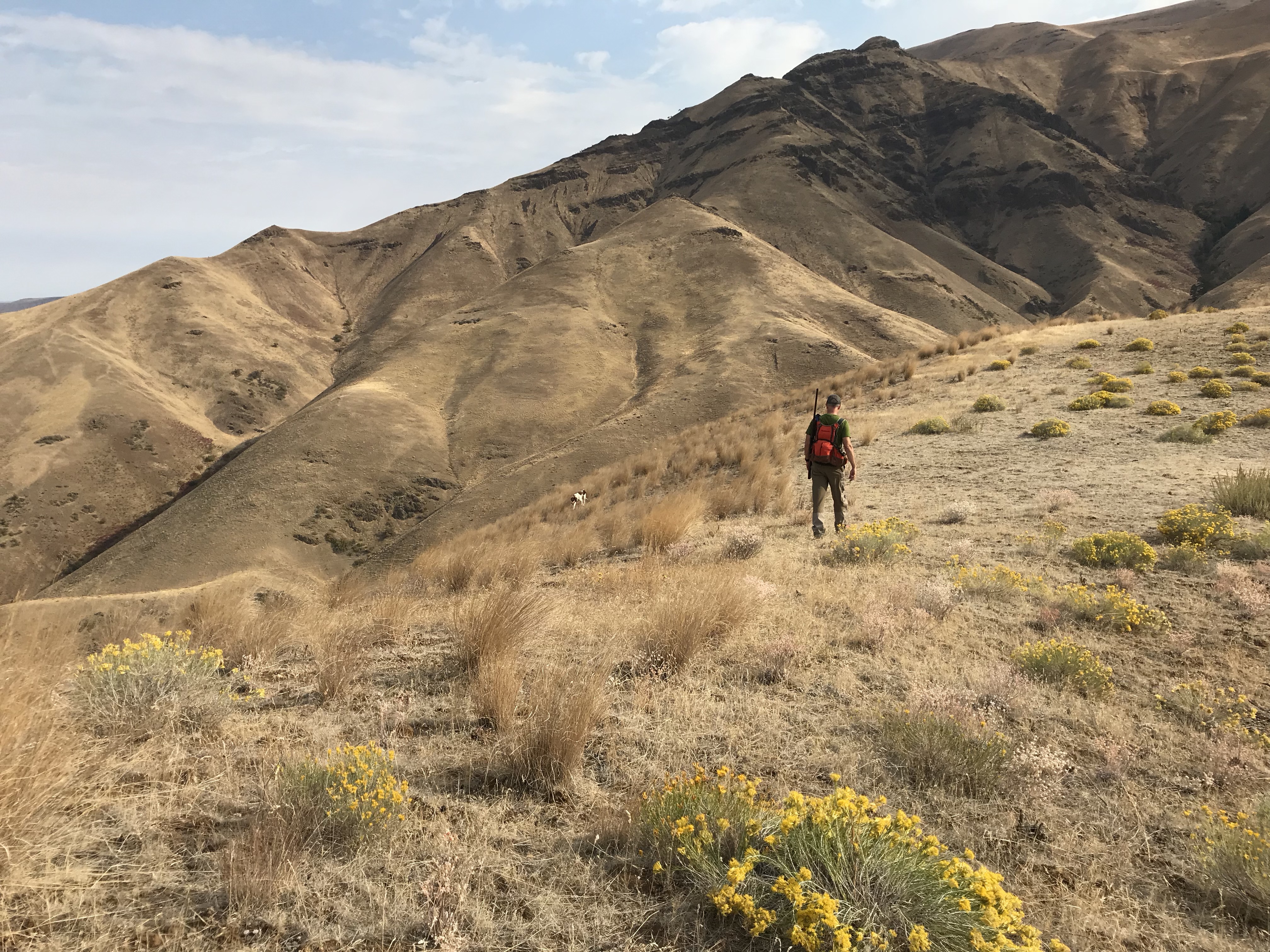
    The landscapes where the birds live dictate where you’ll hunt chukar in the West. Terrain covered in sagebrush, bunch grass, scree veins, and rocky talus outcroppings high up in the clouds is typical in this part of Idaho. You’ll encounter steep traverses and sidehilling that make you wish you had tightened your boot laces tighter. Later in the season, in December and January, it gets snowy, icy, and slick which slows you down especially if you have to posthole it. These hard-to-get places on public lands that can only be reached on foot are what the allure and fuss is all about. It is man and his dog against nature and its elements, or in my case, woman against nature.

    We reminisce and think about these beautiful, wild, and remote places and will plan our hunts next season to purposely seek them out. The reality of it is, you’ll walk a lot, sometimes for hours to find them and only see one covey on good days, but it’s these special places and your attempt to put yourself into position to shoot over a pointing dog that makes you go back another day, and another day, to try again and then dream about the coming season and doing it all over again.

    The video below is my form of ode to walking the chukar hills.