Category: Hunting accounts

  • First Two Months

    First Two Months

    Friday, August 30th.

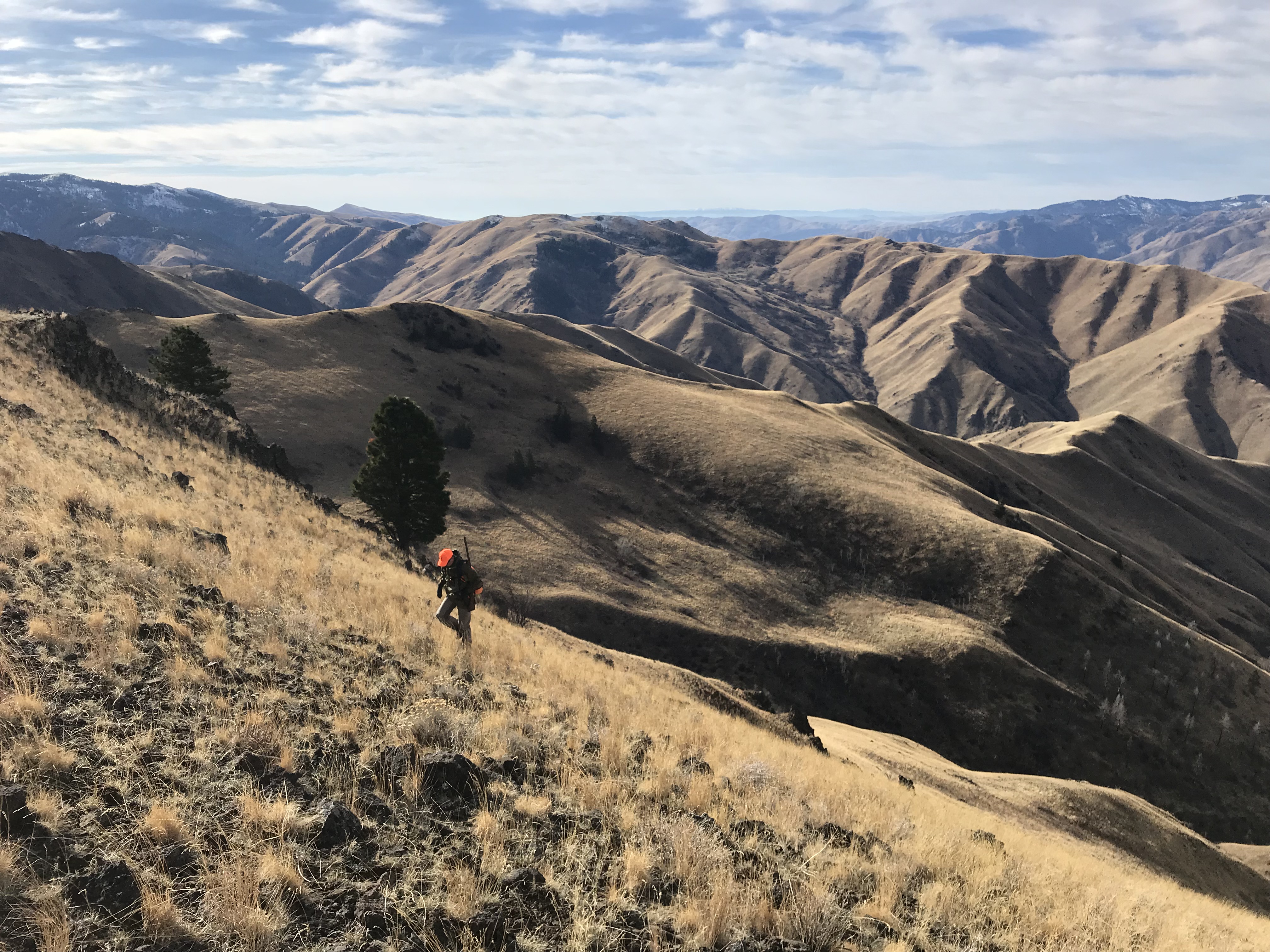
    It was warm outside, t-shirt weather, and I was hoping for a crisp, cool morning on grouse opener but the air felt thick and muggy. You could hear a pin drop in all of its calmness. I worked my way up through the deep draw that was nestled between stands of tall sage, weaving my way through the thick brush, tucking and carefully maneuvering my shotgun, always aware of where it was pointed while crawling over and under branches. Some branches catching the back of my upland hunting pack, I fought my way loose. I could hear Angus intrepidly and noisily moving below me, sticks breaking and dried arrowleaf balsamroot leaves being crushed like potato chips. I caught a glimpse of him as he ran uphill past me. Angus was birdy, his docked tail moving back and forth quickly like a hummingbird. I was hoping to hear the sudden fluttering of a grouse busting for freedom but I heard a different sound instead.

    A quiet staccato cak-cak-cak noise came from overhead in the tall pine trees at the top of the draw. I stopped, picked out a tree and squinted into the sun looking for an outline of a bird overhead somewhere. Balancing from a skinny branch like a tightrope walker, I caught the glimpse of the big dusky grouse staring down at me. Bob and Peat were coming up the other side of the draw and heard the grouse calling. I motioned him over and singled out the grouse in the tree. He pointed at my forearm covered in fresh blood and asked “What happened?” I answered back “Hawthorn spike, I guess?”

    My preferred style of hunting is not seeing or thinking about killing a bird too much beforehand. The killing part of bird hunting is the part that I hate the most. “I’m not going to shoot that grouse out of a tree!” I shouted to Bob. In my mind after I made eye contact with that bird, we now had a relationship. Bob said “It’s just meat, I’ll do it.” The grouse impatient from our conversation about who was going to shoot it flew from the branch. Bob shot and missed and then he continued up the draw where he found a large mule deer shed laying on the ground. Bending over to pick it up, another grouse busted from the ground nearby. He proceeded to mount his gun, spin around, and hit the bird as it flew past. It was an amazing shot. Falling from the sky and into the ticket, Angus was first to the retrieve and took the bird directly to Bob. I was proud that he beat Peat to the grouse.

    The old warrior, or aged warrior, as we call him, Angus seemed perfectly normal and fine during the hunt but after we got home we noticed some tiny drops of bloody urine on the kitchen floor. We had noticed some drops of blood before, about a week prior, but didn’t know where it came from. Examining Angus, we realized it was coming from him. I called our regular vet who’s taken care of Angus for seven years. His answering machine said that he was still on medical leave, which he’d been on all summer, but that he might start taking appointments on the Tuesday after Labor Day weekend. Anxious to get Angus treated right away, we called another vet clinic in another town and they said they could see Angus that afternoon.

    The veterinarian, one we’d only met for the first time that day, walked out of the back examination room and into the waiting room where Bob and I were anxiously awaiting the results of Angus’s urine test. Expressionless, he made eye contact with me and looked away. He began by saying “I have some bad news…….[pause]………the good news is that his lab work looks good……..[pause]……..the bad news is that we went ahead and did a quick ultrasound and he has a urinary tumor and most likely has one to three months to live.”

    Devastated.

    I stared down at the concrete floor and looked up as someone walked past close by, and another person with their dog was heading out the door. Without saying any words to me and just from his expression I could tell the vet was saying, “I’m sorry.”

    Instead of being handed a bottle of antibiotics to fix what we thought might be just a simple urinary infection we were being handed a business card for a vet clinic in Boise that we could call the following week to make an appointment so they could discuss starting chemotherapy which might buy him another six months at the most.

    The long Labor Day weekend was ahead of us, and anxious to get a second opinion right away, Bob called a good friend of ours who’s a vet in Washington state to ask him for some advice. Ethan suggested getting Angus on Piroxicam because it’s been shown to sometimes give good results to dogs with transitional cell carcinoma (TCC) and that surgery was too risky to remove the tumor.

    Tuesday, Sept 3rd.

    After the long weekend, doing our own research and giving it plenty of thought, we decided against pursuing chemo because Angus is 12-1/2 years old. Bob called the vet to see if he could get us some Piroxicam, but he’d never heard of using it for TCC. What!? That same Tuesday Bob called our normal vet , Dr. Gardner, who we liked and trusted, and who’d miraculously made a complete recovery from his illness and was back to business full time. Dr. Gardner called into our pharmacy the prescription for the Piroxicam. We started Angus on the drug on Sept 5th.

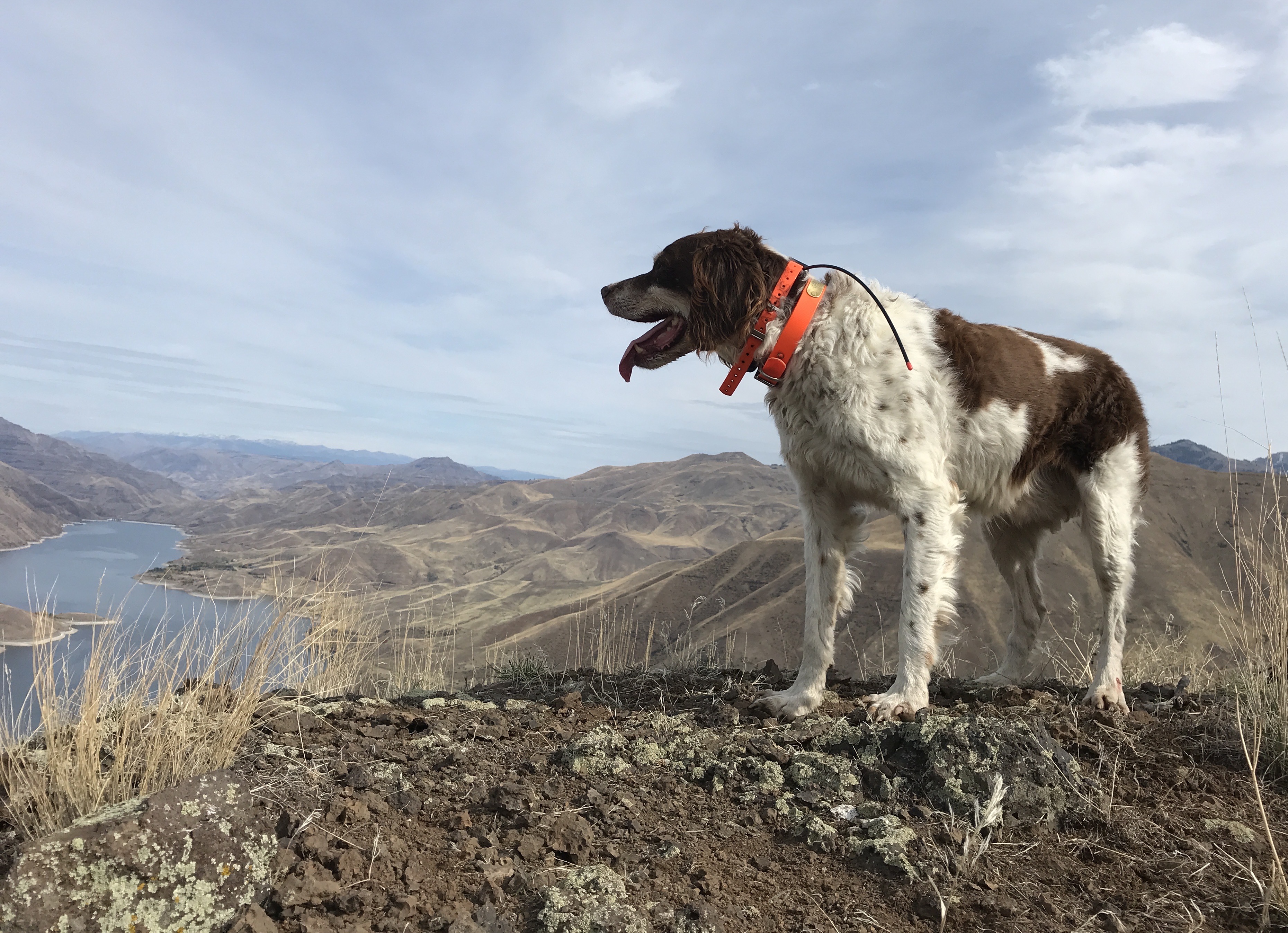
    Chukar opener was Sept 21st, and I’ve hunted with him eleven times now since they found a tumor in his bladder. He’s been hunting hard and pointing chukar and Huns just like he’s always done, and I’ve had the pleasure of shooting over him and have him retrieve birds for me. Looking at him you wouldn’t know anything was wrong with him, but now knowing that this is his last season makes me appreciate things more than ever. Bob and I take turns following him around outside to watch him pee, but the moment he can’t urinate anymore because the tumor is blocking his urinary tract it will be time. Just like in that moment you choose to shoot and kill a wild game bird, it’s a choice we make or are forced to make, and it’s never easy ending a life.

    Miracle dog?

    I’ve been crying a lot lately but don’t want Angus to see me doing it. Dogs are perceptive, they key into your emotions. He doesn’t know that he’s dying. We took him for his two month check up a couple of days ago, and Dr. Gardner said that the tumor was shrinking.

    Another miracle? We’ll take it for now.

    Watching Angus pee.
    Chukar opener
    Last week
  • What It Is

    What It Is

    Sometimes, the best way to define something is to begin with what it is not.

    I think this is because the more stuff we get exposed to, the harder it is to distinguish between things that appear similar but really aren’t. The Internet Age has amplified this, as we all know. Social media in particular has grown into what a lot of people might call a necessary evil (although I personally think it’s very unnecessary, despite the fact that I use it). Each day more of us are seduced by it for one reason or another. And as that happens, the general discourse gets — in my opinion — degraded. This blog’s been around for about a decade, and until very recently it’s been immune to some of the ills I see in the discourse between otherwise anonymous people. “Civil discourse” seems to get rarer each day as keyboard commandos, trolls, and just straight-up assholes feel entitled to ruffle feathers just for the hell of it or, more likely, because they hate themselves and can’t think of anything better to do but project that self-hatred onto strangers.

    So, to put it plainly, as far as what this blog is not:

    — It is not yours
    — It is not a petri dish for trolls
    — It is not Instagram
    — It is not a forum for “free speech” or spam
    — It is not an outlet for unsolicited, uncivil discourse

    What it is (as if that weren’t obvious):

    — A place for my wife and me to share our thoughts, experiences, photos, and videos about chukar hunting and the culture surrounding it
    — A place for civil discussions in response to our posts

    As I said, until very recently, the impetus for wasting bandwidth on this issue never existed here, but I feel compelled (and really saddened) now to do so because I want to make it clear that if you feel like being a jerk on this blog, I won’t give you the perverse satisfaction of publicizing your self-hatred. Sorry.

    If you don’t like what I write, or what my wife writes, and want to say so, we want to hear it if you can be a person about it. I like disagreement; I learn a lot from it. But if you can’t be a person, please don’t read this blog and please don’t comment. Unsubscribe. Go spread your self-hatred somewhere else, or better yet look in the mirror and face yourself and get some help. We’d all be better off.

  • Where to Hunt Chukar

    Where to Hunt Chukar

    Not a great spot for chukar
    Angus doubting this is a good spot for chukar

    [UPDATE: This is a re-post from almost exactly a year ago. I don’t mean to be snarly, but I get emails every day from people wanting to know where to find chukar. I guess this surprises me a little because I must have assumed that people realize chukar hunting is mostly about exploring public land and learning — for themselves — where the birds are. Here’s my response — in advance — if you send me a message asking where to go:

    Thanks for your message. I’m seeing exponentially more hunters in places I never used to see anyone. That’s good (for hunting/public land support) and bad (for me and the solitude I used to have while chukar hunting, which was one of the main attractions for me). I also get messages like yours nearly every day. And I’ve written about this more than once on the blog: chukar hunters know that the birds are where they are, which often is the opposite place the same birds were yesterday. All that being said, I’d say that with all the unseasonably early green-up they could be anywhere. I’ve already had days this season where we saw zero chukar where we had seen many coveys 5 days prior. With two amazing dogs on a long hunt in the best spot I know, last weekend I got one bird. Meanwhile, a friend of mine, with no dogs and a wee OU, limited in an hour in a spot I thought was garbage. The short answer is, I don’t know what to tell you (and probably wouldn’t if I did). Honestly. I’d just look for green up (it’s not everywhere); that’s where we’ve found birds, and not necessarily super close to a water source. Personally, if I could afford it, I’d be hunting in eastern Oregon rather than Idaho based on the reports from last weekend’s opener there.]
     

    One thing I love about hunting chukar is trying to find the birds. That involves working with my dogs, looking at maps, doing lots of exploring (often in vain), figuring out why birds are where we do find them and why they’re not where we don’t. It’s a mysterious thing, and — for me — defines chukar hunting. It’s not pheasant hunting, and it’s not quail hunting, and it’s not sharptail hunting. It’s definitely not grouse hunting, although the big ones are sometimes a bonus I don’t pass up when they present themselves. And I usually miss those. But all of this keeps me coming back.

    This became one of my favorite spots last year, which I discovered while grouse hunting. This year, at least right now, there ain’t a chukar anywhere near it, probably because it’s way too dry.

    Another thing I love about hunting chukar is tempting fate: sometimes I try a new spot that looks terrible just because I think it might actually be good; lots of evidence continues to amass supporting the concept that I have my head up my butt so — as George Castanza did for a while on Seinfeld — sometimes I like to try the opposite of a good idea.

    This might look all the same, but there are lots of birds in some places and none in others. As the annoying aphorism goes, “That’s why it’s called hunting.”

    Which brings me to the main point when it comes to addressing a question I’m getting more often on this blog: chukar are where you find them.

    The act of finding chukar: not always where you look.

    Even if I told someone exactly where to look for the birds (something I’ve told friends in the past), chances are they won’t be there (my friends confirmed this). Moreover, I like getting skunked without running into other hunters, and have had good luck doing just that for the past two decades and I’d prefer to keep it that way. And more moreover, there are no such things as “secret spots” anymore; anyone can get a digital topo map app and find all the telltale signs of chukar habitat if they spent 10 minutes reading about it on this or any other of the great bird hunting blogs out there; if you’ve watched any of the dozens of videos I’ve posted on the blog or my YouTube channel, you might have noticed we don’t go out of our way to disguise the locations we hunt because it’s not that hard to figure it out. But there’s no sure thing, which is why I think chukar hunting is a good metaphor for life; if one wants to be assured of shooting chukar, a game farm would be the best bet.

    Image result for chukar in pens
    These birds will usually be here.

    So do yourself a favor if you want to be a chukar hunter and get out there and explore all the amazing public land while it’s still open to us all. Find the birds yourself and you’ll be prouder for it, and in better shape because of it.

  • #6

    #6

    I just cleaned 20 birds (chukar, Huns, and dusky grouse). As I’ve mentioned before on this blog, I age my birds before cleaning them, sometimes for up to 3 weeks, so they tend to add up when we get around to cleaning them. They go from Peat or Angus’s hand to my Badlands vest to the fridge in the garage. This has worked well for us for years now, and we’re even alive to talk about it. I believe the meat is much tenderer this way.

    Today’s victims (collected from the fridge, not the field)

    The thing that was different today was that in those 20 birds, there was hardly any damage to breasts or legs. A few breasts had a pellet, but only one, and the legs were mostly clean. I wish I could say that this is because I’ve progressed in my shooting so much that I am mainly killing the birds with head shots. I’m probably doing more of that than before because of some changes I’ve made to my mount and leads on crossing shots. But the only thing I can point to that gave us much cleaner meat today is that I’ve basically switched to bigger shot. Number 6 steel to be exact; I mentioned this in a recent post, but the proof is in the pudding (bird meat). And maybe someone can educate me otherwise, but I also think that the steel stuff, although lacking the ballistic superiority of lead, might leave cleaner meat because it’s harder and rounder than the lead pellets that deform easily. Joel Loftis’s informative The Chukar Hunter’s Wingshooting Guide suggests as much.

    I recently talked to Joel, and he’d spent a lot of time (and money) testing out some new shells, and his favorite was the super-expensive Kent Bismuth Upland Shotshells, specifically 12-gauge #6, 1-1/16 ounce, 2-3/4″, 1325 FPS. Several days after he mentioned this, I suffered a moment of insanity that lasted long enough for me to order some online (at $32 per box; yes, per box, not case). I’ll report on how they work for me if I’m lucky enough to hit anything with them once they get here from Mars or wherever they get bismuth, whatever that is. I keep thinking it’s made from expired Pepto Bismol. Maybe it is.

    I also got some of the Winchester waterfowl loads I’d been shooting well with and which did little damage to our meat, which are only $7 or $8 a box, but whose ballistics apparently can’t come close to the bismuth puppies. I keep hearing the words “diminishing returns” in my head.

    Speaking of that, our supply of Joel’s wingshooting guide is diminishing. I never thought I’d write this on this blog, but “get yours while supplies last.”

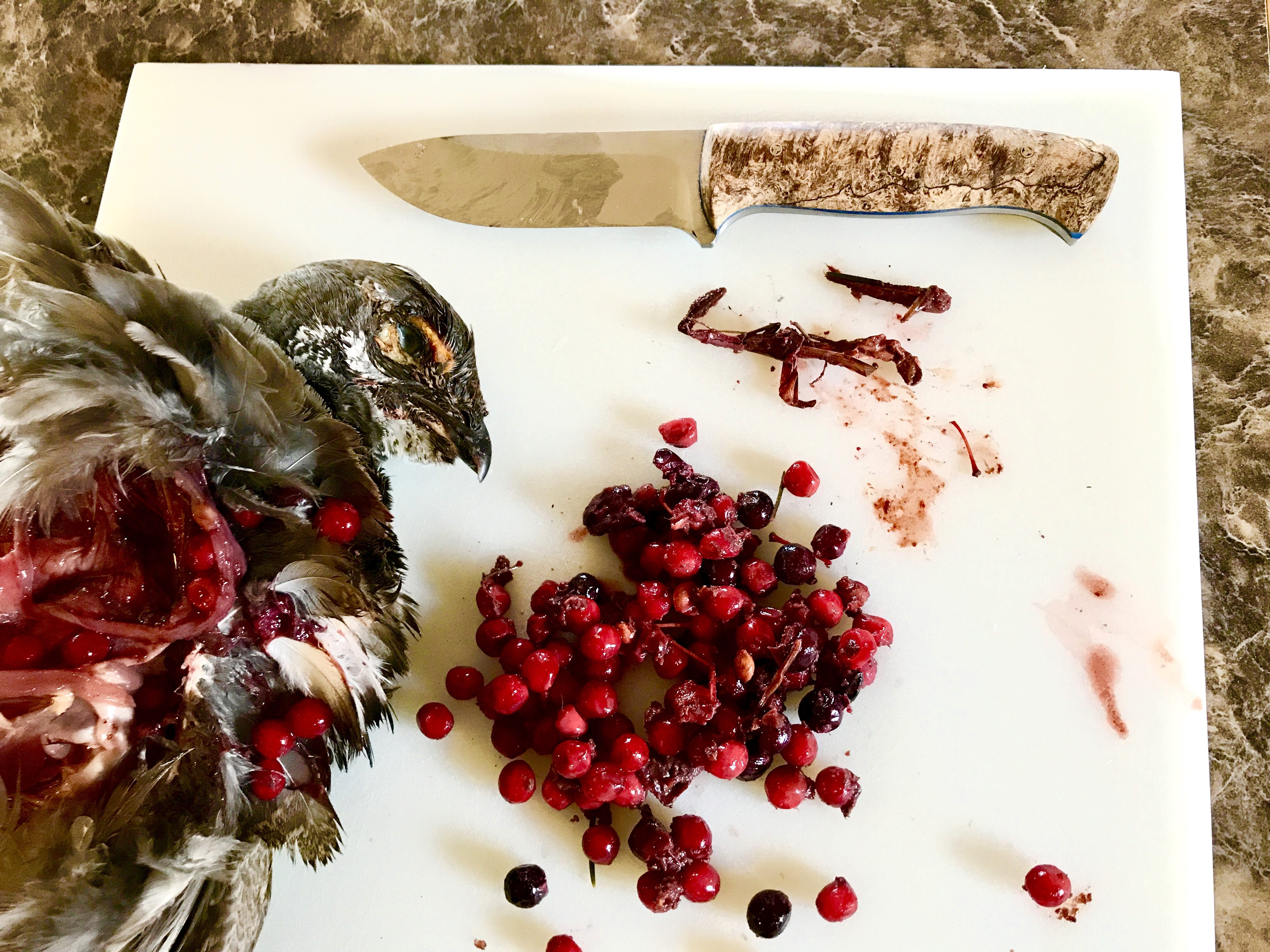
    This dusky grouse crop contained (from top) a grasshopper, praying mantis, berries, and fir needles.
    This is one of the few breasts with any pellet damage out of today’s batch of birds
  • Teaching and Learning

    Teaching and Learning

    Eyes, movement, trust

    [This is a re-post of a post from 2017]

    After hunting chukar for the past 17 years I decided it was about time to take my first shooting lesson. The irony is not at all lost on me, I assure you. As a teacher who tries to espouse and model lifelong learning to my students, not because it will necessarily translate into wads of cash but because it will absolutely make your life better (and who doesn’t think that’s a good thing?), the fact that I’ve followed my dogs into the field for 17 seasons while never having attempted to learn anything to improve my shooting just seems stupid. And I admit that I probably would have gone another 17 or more years doing the same thing had Leslie not decided she wanted to carry and use a gun this season. This scenario has given me some things to think about in terms of the importance of motivation in learning: I think one reason I never tried to learn to shoot better was that I already loved chukar hunting and it was good enough fun for me; I killed enough birds, and my dogs hunted well enough to suit me. Of course I always wished I would make more of the shots, and wondered how other hunters always seemed to bag more birds than I, but that’s pretty much where it stopped. The thing was enough fun that I lacked the motivation to improve on it.

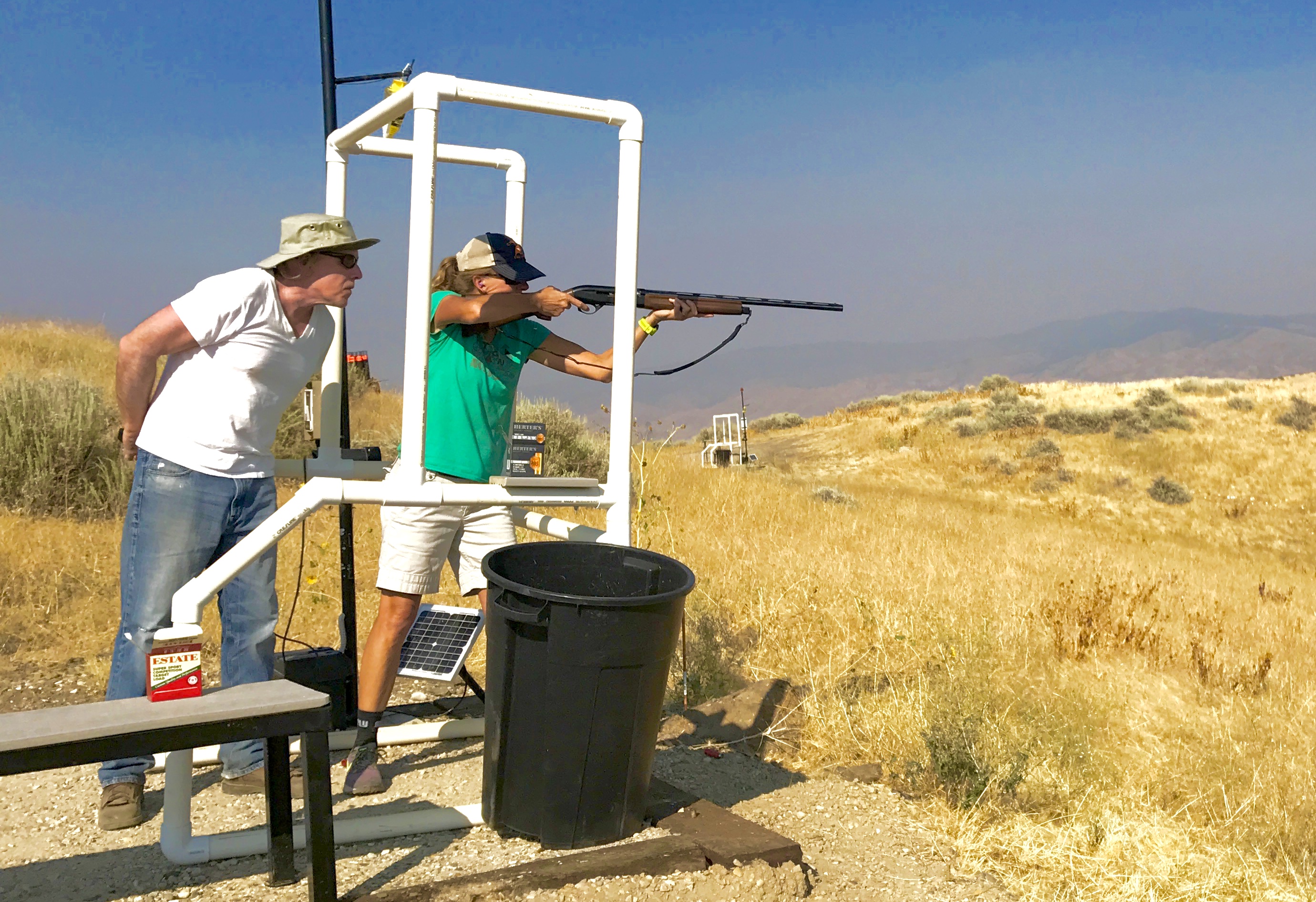
    A kind reader of this blog (thanks, Mark) suggested we check out the new Rock Creek Shooting facility above Horseshoe Bend, and try to get a lesson with Joel Loftis. So I pulled the trigger (ha ha) and set up a lesson and we drove down there. I haven’t been to many ranges, and have never shot sporting clays, so I don’t really have anything to compare Rock Creek Shooting to, but I was impressed. It’s on a 300+ acres chunk of land that looks like good chukar and Hungarian partridge habitat. Their 14 stations replicate a wide variety of “typical” chukar shot opportunities, with a bunch of below-the-feet presentations. The course appears to have been designed primarily with chukar hunting in mind. I wish it were closer to us (it’s a 5-hour round-trip drive). The clubhouse is simple but cozy, with a big outside covered deck overlooking the course (with the afternoon sun to your back), and the folks who run the place are very friendly.

    Dime-sized spot on the beak

    And then there’s their instructor, Joel. He’s intense. We had a two-hour lesson (it actually went a bit over that), and it was all business. No chit-chat, small-talk, or off-topic stuff. Some of my students criticize me for being this way in class, but — maybe because I feel every moment needs to be useful and there’s never enough time — I appreciated this right off the bat. He worked every second of that lesson to have each of us learn as much as we could, and we ran out of time before we covered all the things on his agenda. It was not an inexpensive outing, however, so we can’t afford to do this very often. But we got plenty to work on and practice, and I’m confident that from this one lesson I’ll make many more shots than usual, and — more importantly — increase my enjoyment of chukar hunting. Leslie said as we drove away, “It’s good that I did this at the beginning so I don’t have to undo any bad habits.” Yeah, I should have done this a long time ago. But, better late than never.

    My key take-aways from the lesson are:

    • Eye dominance: I’m not exactly cross-dominant (left-eye dominant/right-handed shooter), but mixed. He did a more elaborate vision test on us than the simple one I did on myself a couple years ago. On right-to-left crossing shots (by far my toughest shot), Joel had me closing my left eye; this will take practice to fix and improve.
    • Vision: the transition from peripheral to specific focus vision is important. He demonstrated this very dramatically by first having us trace with our left hand a clay pigeon from the thrower to the kill zone, which was nearly impossible because of the sudden acceleration of the target (just like a covey of chukar flushing ten yards away), and instilled a visceral sense of panic in us. Then he had us soft-focus on a general area in the anticipated flight path of the target from the same thrower, and then trace its path to where we should trigger the shot. It seemed as though we had twice the time to lock onto the “bird” with this approach. When dogs are on point and a flush is imminent, and you don’t know where the birds are precisely, you have to soft-focus on the area you think they’ll jump into and be ready to transition to hard-focus on the one bird you select to shoot. This eliminated the panic and allowed an easy kill. Of course, when 20 birds flush instead of one clay pigeon coming from the same place every time, it’s a tougher task, but the idea’s the same.
    • Focus: I’ve known for a long time that flock-shooting almost never results in any mortal shots, and so I’ve always tried to remind myself before the flush to pick out one bird, and often I’m unsuccessful at doing that one “simple” thing; I have a much higher percentage on singles or doubles as opposed to large coveys. Joel emphasized not just picking one bird, but focusing on a “dime-sized area on the beak.” At our last stand, a below-the-feet left-to-right crossing shot (probably the most archetypal chukar presentation) I was missing everything despite feeling like I was correctly doing all the stuff we’d worked on. He reminded me about the beak, and then I was able to focus on the leading edge of the clay and hit four in a row. There’s more to this, though (see next one)…
    • Trust: because of the brain and its complexity it’s easy to allow distracting information to interfere with trusting your vision and triggering the shot when it’s optimal. For me, knowing my eye dominance is a bit screwy often makes me want to perfect the alignment after I’ve passed through the optimal shot spot. One of Joel’s mantras was, “Eyes, movement, trust.” On that low, right-to-left shot I was really struggling with confirming the alignment and consistently missed; I’d get on the target and then close my left eye to verify I was on it, not trusting my initial impression, and letting the bird get out of the optimal place to kill it. Once I started trusting my gun mount and vision I couldn’t miss. Doubt is a bitch.
    Slow is smooth, smooth is fast
  • Gun mount: this might be the biggest take-away for me. I have never known how to mount the gun properly. The first thing we did in the parking lot was mount the gun. I’m sure what Joel saw horrified him. So we worked on this first, and at the end of the lesson I realized that when a flush is imminent, consistent mounting of the gun is key to properly getting on birds. Since I began hunting 17 years ago, the extent of my preparation for a flush has been, “I hope I hit something when they fly.” Really. I can’t even tell you what my body or gun would do once I’d spot the dogs locked on point. I’d walk up, try to get in front of them so when the birds flew I’d have a chance at a shot before the dogs got in the way. Now, just from one lesson, I have some things to normalize that preparation for the flush into what Joel referred to as “field craft.” There’s a proper ready position for above- or below-the-feet presentations that I can get in which — because I know how my dogs work — should apply to more than half my exposure to birds in the field. It’ll be interesting to look at videos from last year when the dogs are pointing and see how I prepared for the shot. I’m sure I’ll see lots of jerking the gun around (and lots of misses). The mantra for this part of the lesson came from a British instructor of Joel’s: “Slow is smooth and smooth is fast” (I think I remembered that correctly); the idea is that mounting the gun should be one smooth movement from the ready position to the shooting position, and if it’s slow and smooth you’ll be fast at locking onto the target and hit more birds. Joel also determined there was too much drop on my gun, so I just this morning adjusted that quickly with the shim kit that came with my Benelli Ultra Light. We didn’t get into gun fit too extensively, partly because until a shooter has a fairly well established gun mount (which neither Leslie nor I do), it’s tough to determine a precise fit. At this point, Leslie’s new Montefeltro seems to fit her quite well.
  • Funky elbow, but good posture

    After the lesson, we chatted for a while over a beer in the air-conditioned clubhouse, and learned that Joel — a long-time chukar hunter — also knows a hell of a lot about these birds, their history here, and has some first-hand knowledge of where they came from. If you’re a chukar hunter and want to learn more about how to shoot them more proficiently from someone who gets it, I can’t think of anyone better qualified than this guy.

    I could go on but realize this is a pretty long post. The bottom line, I think, is that it’s never too late to learn something new and make doing what you love even better. The test will come when the season opens in a couple of weeks, but I’m more excited than usual because of what I learned yesterday. Stay tuned.