
“I didn’t know you were left-handed” my father said to me one day while we were having lunch. I sat there not knowing how to reply. I was never his favorite child, something that I’d learned to accept but was stunned at his new realization after being his daughter for over 50 years.
A few weeks later, I told my sister about it and she said it’s because he’s crazy, but this incident was a handful of years before his dementia took over his brain. I think he just didn’t understand how his words could make me feel so not very important.
I admit that after my mom died 13 years ago I didn’t call my dad as much as a daughter probably should. Instead, I would wait for him to call me first but he never did. Sometimes months would go by without any communication with him, and the phone call or birthday card in the mail that I was hoping to receive never came. My twin brother, who also was not my father’s favorite child, didn’t receive a birthday call or card either. I don’t know why we were both disappointed.
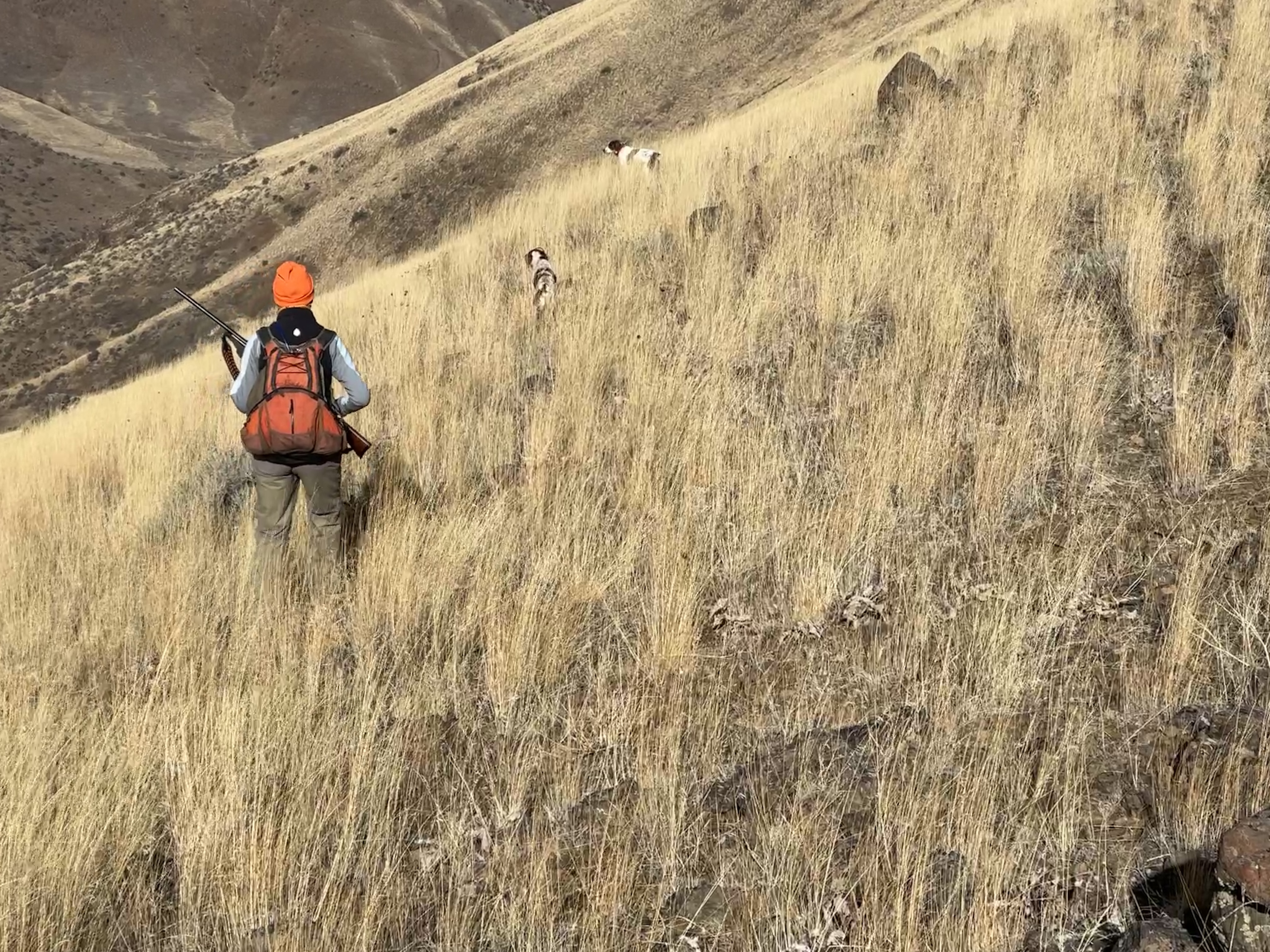
Yesterday, I loaded up the dogs in their crates in the back of my car and left home for a solo hunt to clear my head from recent events. The morning sun was just peeking up from behind the snowy mountain range in the distance. I don’t like to drive at dawn when elk or deer sometimes cross the highway heading out of town but I wanted to get an early start. It was a long drive mostly on dirt and thick gravel for just over an hour. Rarely, in this place where both Bob and I only try to hunt once per season, we’d hardly ever see someone else parked there but I was worried anyway. I was relieved nobody else was there.
My hunt started with a short but very steep climb. As I weaved my way through the sage and tall ancient looking antelope bitterbrush, the air was dead silent and the only sound that I could hear was my own breathing until my Garmin beeped that one of the dogs was on point. Just as I reached the top of the climb Peat was just a few yards away. I walked towards his direction holding my breath and tried to walk as silently as humanly possible. I then heard the sound of wing beats as the covey busted and I got a glimpse of a group Hungarian partridges with their rust-colored tail feathers catching the light. They flew down towards the road. I didn’t want to chase them back down the hill so we continued looking for other birds.
A few minutes later, Peat and Bloom both went on point at the same time in opposite directions. Peat 75 yards to my right, Bloom 200 yards away at 10 o’clock. I headed to Peat first because it’s almost always a sure thing and just as I got to him, a different covey of Huns busted just out of firing range. Wild busts seem to be the common theme from my 16 hunts this season. I squinted down at my Garmin and Bloom was still on point, so I headed his direction and Peat quickly moved the same direction. I watched Peat put on the brakes and stop motionless after he saw Bloom pointing. Trying to guess which direction the birds might fly, I got into position. They busted and I was surprised and elated they were chukar.
Everything seemed like slow motion as I mounted my gun and picked out one bird and hit it as it flew high from left to right. It cartwheeled to the ground and Peat retrieved it to me but it wasn’t completely dead. I held it in my hand and squeezed it hard until it stopped breathing and then stuffed it into my bird pouch. Immediately, an overwhelming sense of sadness swept over me for that chukar. The last time that I cried after killing a bird was seven years ago when I shot a ruffed grouse out of a tree. It was my first time hunting with a shotgun and it didn’t feel right to do what I did at the time but did it anyway. Since then I’ve never shot a bird out of a tree.
The dogs and I continued to hunt, finding more birds but I passed on a perfectly easy shot before realizing that I didn’t want to deal with more than two deaths in one week. The other death this week was my father, who died last Sunday at the age of 86.
On the drive home I’d remembered the advice from a very insightful girlfriend this past summer who has three children of her own. I’d asked her if she had a favorite child. She said it depends on what’s is going on with them and said something like, “The reason your dad hasn’t given you much attention over the years is because he knows you are loved and you are okay. Your sister gets all the attention because she has never had that in her life.” My friend was right. My dad wasn’t a bad person, he just didn’t know how to treat each kid equally.
When I arrived home, Bob was anxious to hear how my hunt went. I told him that I’d never seen so many coveys of huns and chukar in one day. He said, “You don’t seem very happy.”
I came to the conclusion while out there hunting that it wasn’t killing that chukar that made me sad but instead I was thinking about my dad and the fact that I really never had a father. Two years ago when we moved back to chukar country it was partly to be closer to where he lived. We get busy with our daily lives, I regret we never got to know each other.
Bob said look up the poem “The Mower” by Philip Larkin. I did but found another poem by Larkin that seemed more fitting in my moment of angry grief called “This Be The Verse.” Look them up if you feel inclined. I think some of you might relate to them.


Chirp away