Author: Leslie McMichael

  • Hope

    Hope

    My morning ritual every day like clockwork is getting roused out of bed much earlier than I want. Usually the culprit for the rude awaking is Peat because his internal clock tells him it’s time to get fed. Bloom on the other hand is just an innocent bystander to this stupidness. Believe me, we’ve tried to ignore Peat and make him wait to get fed and have even stooped to the level of getting out of bed and putting Peat and his unwilling accomplice Bloom in the car in the garage just to get one or two more hours of shuteye. Bob and I are hoping that moving the clocks ahead one hour this weekend will result in Peat waiting to harass us at 6:00 a.m. on Sunday morning instead of his usual 5:00 a.m. wake up call. I know this whole problem could be easily solved by just stuffing them in crates in another room all night but we like our dogs to sleep with us and don’t plan on depriving ourselves from this pleasure anytime soon.

    After the dogs scarf down their kibble, I let them outside in our fenced backyard. While I’m waiting for them to finish doing their business, I make my coffee and then let them back inside. I grab my laptop and sit down on the couch with Peat curled up next to me on my left and Bloom on my right. I read my email and the news. While all this is happening, Bob is still in bed because he’s an insomniac and is usually up half the night reading and gets his best sleep after I get up.

    This morning, my mother-in-law Barbara who is an avid bird-watcher, had emailed me a link to a bald eagle nest live camera the night before. I clicked on the link and found myself mesmerized and watched an eagle on the nest, feathers blowing in the wind while sitting 145 feet up on a Jeffrey Pine Tree.

    At one point, the eagle named Jackie got up and left the nest for a minute. I could see two small chicks and one unhatched egg. I found myself being very excited and moved by seeing this because apparently, according to Barbara, last year the same pair set up home here had eggs that didn’t hatch.

    The exact location of the eagle nest and camera is not disclosed to protect the eagles, which makes sense; humans should be considerate to the eagles and nature.
    Later this morning while watching, Jackie’s mate Shadow showed up and by now 50,000 people were watching the live stream.

    A couple of days ago, Bob and I took the dogs out for a hike down in Hells Canyon. Bloom and Peat pointed a pair of Gray Partridge. I asked Bob if he knew if the huns or chukar were already pairing up to breed. He thought it might be too early.

    It made me think more about wanting to know more about chukar and Gray Partridge nesting. I remembered years ago finding a study about Hells Canyon chukar and luckily found it again. The 114-page report written in 2001 for Idaho Power is called “Assessment of Chukar and Gray Partridge Populations and Habitat in Hells Canyon.” The link is below:

    https://docs.idahopower.com/pdfs/relicensing/hellscanyon/hellspdfs/techappendices/Wildlife/e32_07.pdf

    If you hunt chukar or Gray Partridge the report is interesting and valuable. Jim Posewitz wrote in his book, Beyond Fair Chase, “Learning about wildlife must begin before your first hunt. The learning process will allow you to become a more understanding and ethical person, and it also will help you become a more successful hunter.”

    Here are some facts about breeding and nesting from the study if you don’t have time to read the whole thing.

    Chukar: Pair formation starts March-April. First eggs hatch March-April. Incubation of eggs 23-30 days. Chicks are capable of flight at <2 weeks of age and appear similar to adults by 18 weeks. Nesting period may extend over 5 months with hatchings from early May-August. During the study 23 nests were found. 87% were on south-facing slopes. The nests were often located within 183-366 meters of water. Rock outcrops were the most prevalent place for nests (56%) followed by grass forbs at 26%.

    Gray Partridge: No information on gray partridge nests in Hells Canyon or other canyon grasslands is available in the report. Based on studies for agricultural landscapes, dates for pair formation vary from region and weather conditions but usually January-February. Female chooses Male. Established pairs may remain together for life. Egg laying begins April-May. Incubation 21-26 days. Chicks are capable of short flights in <2 weeks and longer flights by 6-8 weeks.

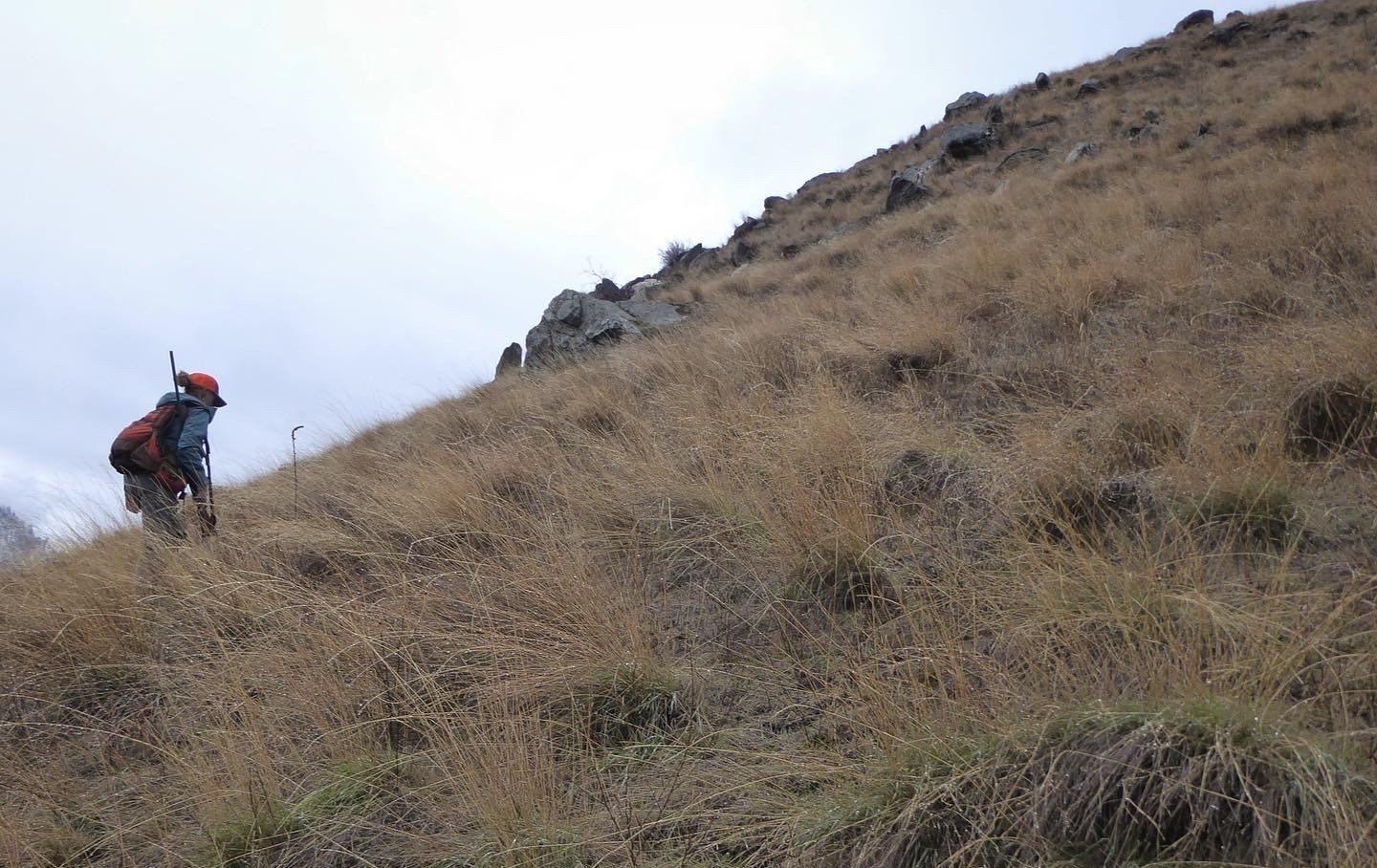
    Sometimes it’s unavoidable but we try to not hike with the dogs off-trail in the spring in areas where we’ve seen chukar or huns during hunting season. Just like with that pair of eagles, we should try as much as possible not to disturb nesting areas. I suppose if you find yourself in the chukar hills with your pointing or flushing dogs this spring, avoid south-facing slopes with rock outcrops near water.

    Emily Dickinson wrote “Hope is the thing with feathers, that perches in the soul.” I find this to be very true.
  • But They Do

    But They Do

    “I didn’t know you were left-handed” my father said to me one day while we were having lunch. I sat there not knowing how to reply. I was never his favorite child, something that I’d learned to accept but was stunned at his new realization after being his daughter for over 50 years. 

    A few weeks later, I told my sister about it and she said it’s because he’s crazy, but this incident was a handful of years before his dementia took over his brain. I think he just didn’t understand how his words could make me feel so not very important. 

    I admit that after my mom died 13 years ago I didn’t call my dad as much as a daughter probably should. Instead, I would wait for him to call me first but he never did. Sometimes months would go by without any communication with him, and the phone call or birthday card in the mail that I was hoping to receive never came. My twin brother, who also was not my father’s favorite child, didn’t receive a birthday call or card either. I don’t know why we were both disappointed.

    Yesterday, I loaded up the dogs in their crates in the back of my car and left home for a solo hunt to clear my head from recent events. The morning sun was just peeking up from behind the snowy mountain range in the distance. I don’t like to drive at dawn when elk or deer sometimes cross the highway heading out of town but I wanted to get an early start. It was a long drive mostly on dirt and thick gravel for just over an hour. Rarely, in this place where both Bob and I only try to hunt once per season, we’d hardly ever see someone else parked there but I was worried anyway. I was relieved nobody else was there. 

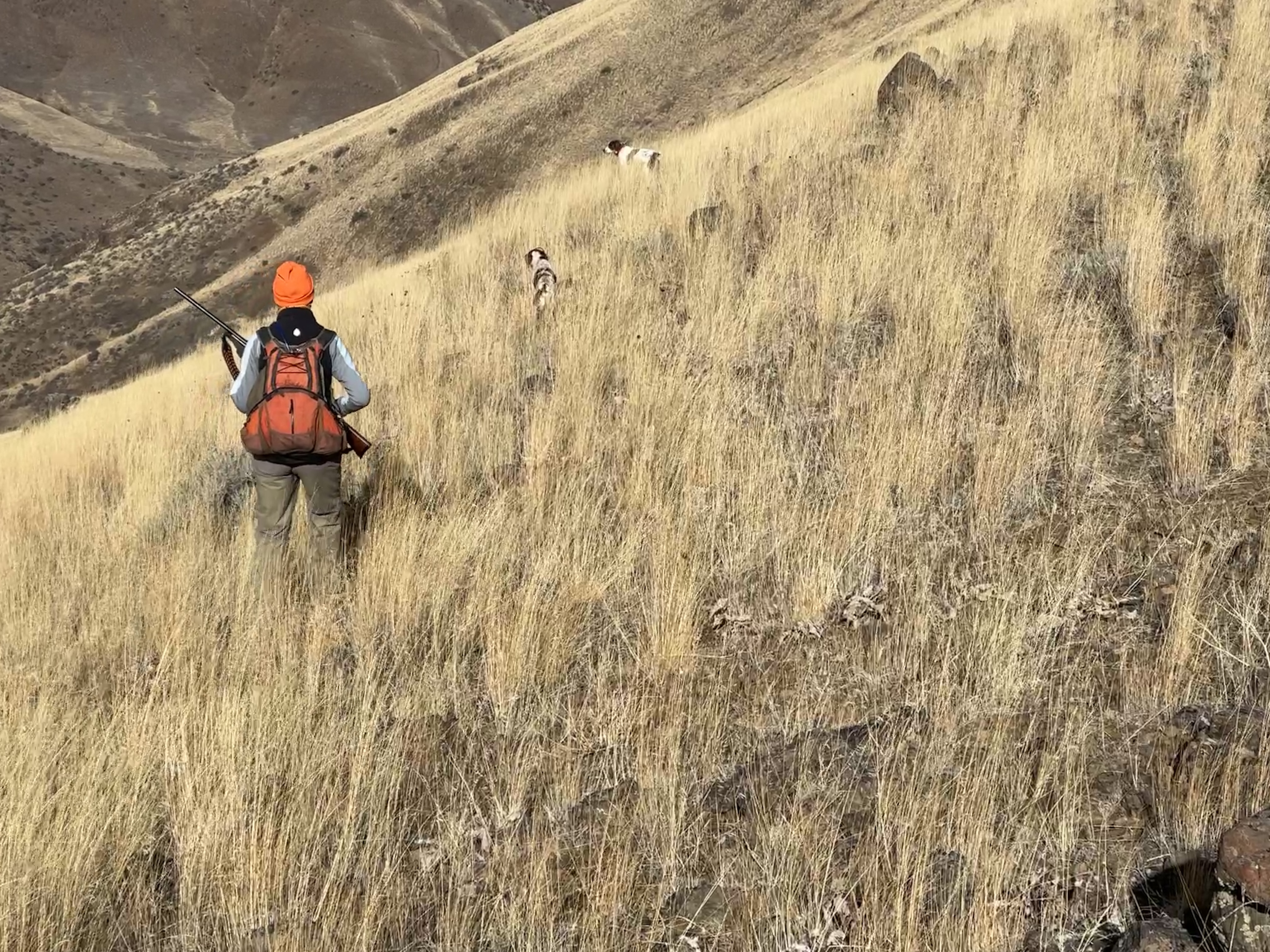
    My hunt started with a short but very steep climb. As I weaved my way through the sage and tall ancient looking antelope bitterbrush, the air was dead silent and the only sound that I could hear was my own breathing until my Garmin beeped that one of the dogs was on point. Just as I reached the top of the climb Peat was just a few yards away. I walked towards his direction holding my breath and tried to walk as silently as humanly possible. I then heard the sound of wing beats as the covey busted and I got a glimpse of a group Hungarian partridges with their rust-colored tail feathers catching the light. They flew down towards the road.  I didn’t want to chase them back down the hill so we continued looking for other birds.

    A few minutes later, Peat and Bloom both went on point at the same time in opposite directions. Peat 75 yards to my right, Bloom 200 yards away at 10 o’clock. I headed to Peat first because it’s almost always a sure thing and just as I got to him, a different covey of Huns busted just out of firing range. Wild busts seem to be the common theme from my 16 hunts this season. I squinted down at my Garmin and Bloom was still on point, so I headed his direction and Peat quickly moved the same direction. I watched Peat put on the brakes and stop motionless after he saw Bloom pointing. Trying to guess which direction the birds might fly, I got into position. They busted and I was surprised and elated they were chukar.

    Everything seemed like slow motion as I mounted my gun and picked out one bird and hit it as it flew high from left to right. It cartwheeled to the ground and Peat retrieved it to me but it wasn’t completely dead. I held it in my hand and squeezed it hard until it stopped breathing and then stuffed it into my bird pouch. Immediately, an overwhelming sense of sadness swept over me for that chukar. The last time that I cried after killing a bird was seven years ago when I shot a ruffed grouse out of a tree. It was my first time hunting with a shotgun and it didn’t feel right to do what I did at the time but did it anyway. Since then I’ve never shot a bird out of a tree. 

    The dogs and I continued to hunt, finding more birds but I passed on a perfectly easy shot before realizing that I didn’t want to deal with more than two deaths in one week. The other death this week was my father, who died last Sunday at the age of 86.

    On the drive home I’d remembered the advice from a very insightful girlfriend this past summer who has three children of her own. I’d asked her if she had a favorite child. She said it depends on what’s is going on with them and said something like, “The reason your dad hasn’t given you much attention over the years is because he knows you are loved and you are okay. Your sister gets all the attention because she has never had that in her life.” My friend was right. My dad wasn’t a bad person, he just didn’t know how to treat each kid equally.

     When I arrived home, Bob was anxious to hear how my hunt went. I told him that I’d never seen so many coveys of huns and chukar in one day. He said, “You don’t seem very happy.”

    I came to the conclusion while out there hunting that it wasn’t killing that chukar that made me sad but instead I was thinking about my dad and the fact that I really never had a father. Two years ago when we moved back to chukar country it was partly to be closer to where he lived. We get busy with our daily lives, I regret we never got to know each other. 

    Bob said look up the poem “The Mower” by Philip Larkin. I did but found another poem by Larkin that seemed more fitting in my moment of angry grief called “This Be The Verse.” Look them up if you feel inclined. I think some of you might relate to them.

  • Snakebite

    Snakebite

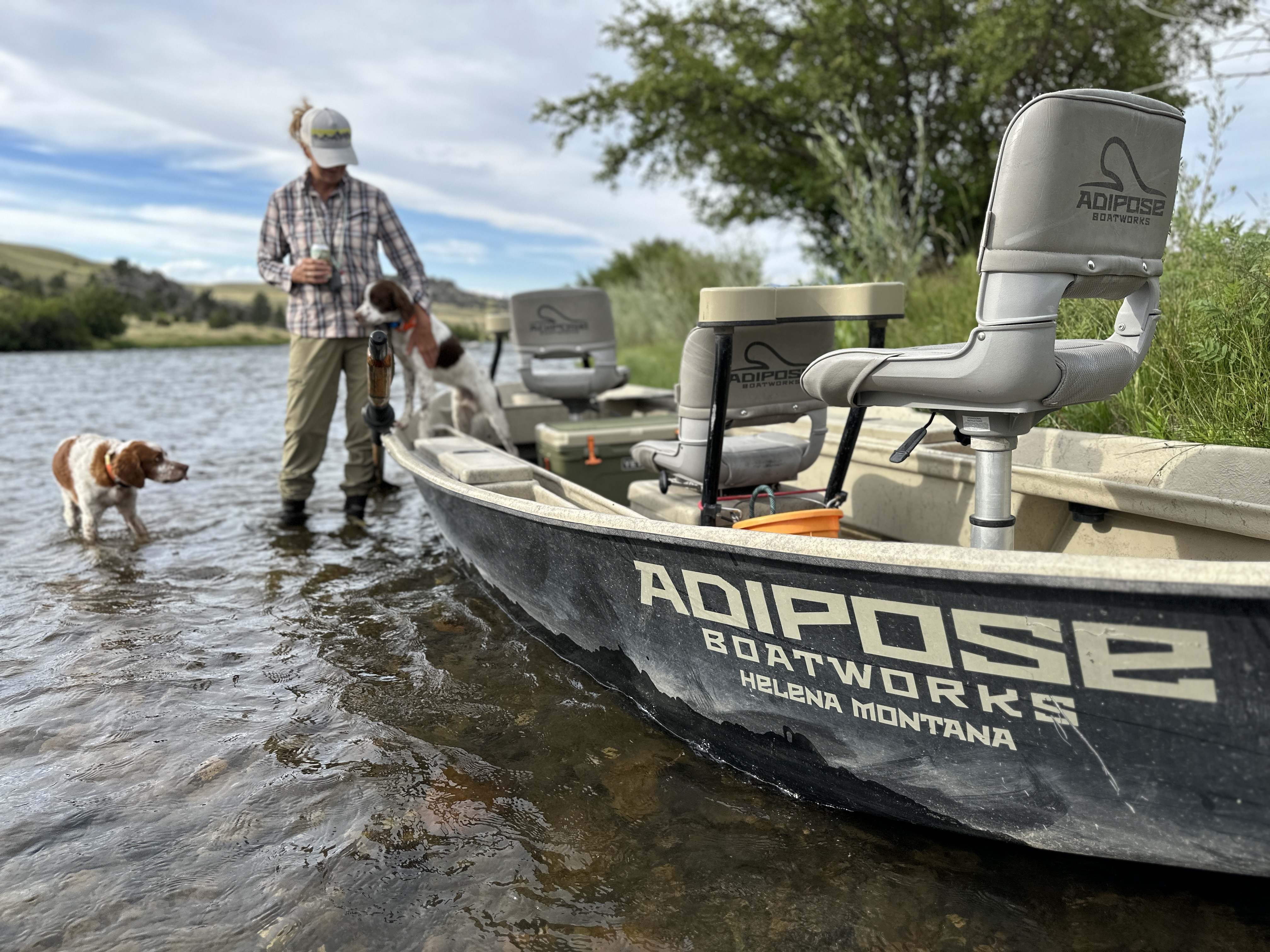
    Camped on the Missouri River in Montana exactly one year ago today on August 1st, Bloom was bitten by that rattlesnake. It was a very hot morning in an area of golden colored stubbly grass parched from the summer heat. We’d been camped there to fly-fish and I’d let both Peat and Bloom off leash on this patch of dry earth just outside the campground boundary several times before without incident.

    Out of habit, and mostly peace of mind, our routine was (and still is) that we always put the Garmin dog collars on the dogs when they aren’t in a fenced area. I wish we had better control of them but we don’t. I always have the hand-held device for the dog collars gripped tightly in my hand or on a strap around my neck ready to audio buzz them to get their attention or for really serious offenses like the time that I caught Peat when it was too late, watching him roll and rub his entire body on a stinky dead skunk.

    The dogs in typical Peat and Bloom pent-up bird dog fashion, honed from too much time on the boat or in the pickup, get unleashed and they go balls-to-the-wall, nose skimming the ground, running like high speed freight trains. I prefer dogs with good noses but those noses can sometimes, actually most of the time, get them in trouble. In our case, unleashing the hounds is like opening the door to a free all-you-can eat breakfast buffet at Golden Corral. A few years ago, on the bank of the Missouri River over by Cascade, checking the boat ramp at Pelican Point, Peat found a ziplock containing florescent bright pink colored rotten Salmon bait discarded by some careless fisherman. He scarfed it down like he was in a Nathan’s hot dog eating contest. It happened so fast we couldn’t even react except to grab him by the collar, scold him, and put him back into the pickup. Within minutes as we were driving down the road, he was puking so violently it scared us. We pulled over to let him out to finish barfing outside and then cleaned the backseat floor mats of the pickup with our “dog vomit kit” that we try to keep stocked with rubber gloves and lots of paper towels. It wasn’t our first rodeo of dogs finding and eating nasty stuff plus puking in the car. It also won’t be our last.

    In that campground where Bloom got bit last year, the dogs were running around nose to the ground and both screeched to a halt and were curiously looking at something. I couldn’t see it at first and assumed it was just another dead ground squirrel or pile of old elk poop until I heard the rattle. Just like fast-draw Clint Eastwood in those fabulous old Spaghetti Westerns, I had that handheld that was around my neck in my hand so fast and I pressed hard with the button rarely used. The continuous shock one.

    Both dogs at once came running back to me and I remember thinking, “Thank God, nobody got bit.” Bloom, my sensitive dog, the one who yelps bloody murder when he gets the smallest needle injection at the vet, was actually bitten on the chin but didn’t show any sort of reaction when it happened. About a half hour later, he started acting odd and looking sleepy, and his chin started to swell. We searched but couldn’t find puncture marks but we knew right away he’d most likely been bit there.

    Making some quick phone calls, we found the closest vet clinic that carried anti-venom which was over an hour away in Twin Bridges. We loaded Bloom into the car and took off driving through Ennis, Virginia City, Nevada City, and Sheridan. Along the way just in case, I rehearsed in my mind what I’d say to the Montana state trooper that had pulled us over for very excessive speeding between all those towns that how dare they slow us down. It was something short and fast like “Bird dog got bit by a rattler!” I’d tell the officer and hope they’d would understand and let us go on.

    We arrived to the Vet clinic and they took him into the exam room for the anti-venom treatment. In the end, everything worked out. Bloom survived with very little complications except for some fur that won’t grow back on his chin.

    Post rattlesnake bite, 2 weeks of healing.

    First upland bird hunt of season. Sept, 2023.

  • Climb

    Climb

    I used to be an athlete a long time ago.

    In the summer of 1989, I watched the Boise Twilight Criterium bicycle race as men rode their bikes at lightning fast speed on laps downtown. I was smitten by the action and excitement. That same month on NBC Sports I watched Greg Lemond win the Tour De France (by just 8 seconds, over a Frenchman no less!) and decided at that exact moment that I wanted to race bicycles. Not having any money at the time, I borrowed $275 from my Mom to buy a used road bicycle, and by September of that year I entered my first race, the Bogus Basin Hillclimb, a 16-mile uphill race, and came in 3rd place for women.

    Wanting to get better at bicycle racing, I asked for training advice from a local Boise cycling legend named Bob Hoene who had won the Bogus Basin hillclimb many times. I remember him telling me something like this: “The best way to know just how far to push yourself is to ride up Bogus as hard as you can until you puke. Once that happens you’ll know your limit.” Later that week, I rode up Bogus with him and puked at milepost 1.5.

    I never amounted to be much of a climber and preferred racing on flatter ground doing time trials or criteriums. In the 1990s, before the promoters of the Twilight Criterium decided to include a separate women’s race, I competed with the men. I loved every adrenaline rush minute of it and even crashed out once. Just like in chukar hunting, I wasn’t intimidated being in a sport mostly dominated by men.

    Twilight Crit start; that’s me in the center with the red helmet.

    I didn’t purposely seek out or want a dog that covered a lot of ground, but yesterday Bloom went on point 256 yards straight above me. I cursed when my Garmin alerted me to this. Every 20 steep steps or so, I stopped, caught my breath and pulled down my fogged-up glasses, checking the Garmin every few seconds hoping he wasn’t on point anymore. But he was. I kept going and felt light-headed and was on the verge of vomiting. My thoughts on the climb up to Bloom made me think about Bob Hoene and my ride up Bogus Basin with him 34 years before. It probably took me another 10 more minutes to reach a place on the climb where I could see Bloom but he was still 75 torturous yards away. After all these years, I still hate climbing but I couldn’t stop because one must always honor the point.

    I hadn’t thought about Bob Hoene for years but now wonder what happened to him? I hope he’s still racing bicycles. Sometimes, I wonder what will become of me.

    My nemesis climb. Bogus Basin prologue start for the International Women’s Challenge stage race, 1993
    Powerbar Women’s Challenge, 1994
    Meeting the great Greg LeMond
  • Legend

    Legend

    50 miles from home, I realized that I forgot to pack my extra shells for our hunting and camping trip. I sat there for a few minutes in the passenger seat in silence and mad at myself at my unthinkable mistake and embarrassed to say anything to Bob. I wanted to run off and hide.

    It wasn’t totally unthinkable. It wasn’t like we forgot the shotguns or our boots this time. A couple of years ago, heading down the road for an out-of-town hunting trip we were about 45 minutes from home when I realized that both of our hunting boots were still on the boot warmers in the garage. We immediately turned around and went back to get the boots which made for a very uncomfortable and quiet detour back home. We swore from that moment on that we’d always have a check-off list for packing.

    I fessed up about my stupid forgetfulness just before crossing the border into Oregon and the big to city to us, Ontario. We exited into the parking lot of the Walmart, parked and headed into the far back corner of the store to shop for shells and to also look for a cheap dog-proof cooler (or in our case Peat proof cooler without zippers like the soft sided ones have). The Walmart Superstore wasn’t so super when we discovered they didn’t sell ammo anymore and the cooler selection wasn’t very impressive. We left empty handed.

    We then drove all the way across town to a couple of other stores that were open but their selection of 20 gauge shells for upland was pretty dismal or non-existent, focusing mostly on waterfowl shot. On the bright side, at least we found a small Igloo Playmate plastic cooler at Bi-Mart and were fairly confident Peat shouldn’t be able to figure out how to open it.

    We forged ahead and originally wanted to stop for a quick hunt somewhere in the desert along the way but it started snowing sideways and then it rained. Not the best hunting weather for us or the dogs. Once we headed south the clouds opened up and we could see blue skies.

    Arriving to the campground in the late afternoon we set up camp. I pulled out my pack from the pickup and opened up the shell pouch to see what exactly was in there and analyzed the situation in my head. Okay, I rarely shoot more than once on a covey and I’ve got 12 shells so that would last maybe four hunts if I only shot three times per hunt. Of those shells three of them were Angus shells that Bob hand-loaded four years ago and they’re filled with some ashes from our Brittany named Angus who died four years ago. I’ve been carrying them around for good luck ever since.

    Good luck Angus shells.

    It wasn’t going to be the end of the world to only have 12 shells but I’d definitely have to be discretionary in my shooting and not waste any shots unless it seemed like it was a sure thing which in the chukar hunting world is totally laughable.

    Just before dinner, we met a fellow hunter in the campground who had been out the previous two days and according to him, the hunting was terrible and he hadn’t seen many birds. It was ridiculous but I was actually relieved to think that chances of shooting would be limited.

    The opposite turned out on our first two days of hunting. It was really good, and the dogs found plenty of birds. We were pleased. Thrilled.

    On our third day of hunting we found an area to hunt that looked good on the maps but in person it wasn’t very promising and no visible water sources were nearby for miles even though the map showed what looked like a small pond which was now drier than a bone.

    Bob and I decided to stay together since I was down to my last three shells, all of which were Angus shells. Not very long after we started our hike from the pickup the dogs started finding birds but I couldn’t get a good shot and passed on ones that were borderline too far away. Towards the end of the day the dogs found and pointed one last covey of chukar up in the rocks above us. Bob got up to them first and they erupted and flew downhill towards me. I quickly mounted my gun, shot, and hit one on a crossing overhead shot. Bloom hauled down the hill past me to retrieve it and beat Peat to it. On the way up heading towards me with the chukar in his mouth, Peat snatched it away from him and continued to run past me taking my chukar to Bob as if I didn’t exist.

    The only other times (yes, plural) Peat stole a bird from another dog was back in 2015 when he was eight months old. Instead of simply attempting to retrieve them, he watched Angus do all the work of finding, pointing, and holding the birds and then would take the bird Bob shot from Angus’s mouth on the retrieve and go off and eat it. He did this for the first 6 birds Bob shot that season. Angus, gentlemanly at the wrong time, didn’t put up much of a fight. Bloom, like his blood relative Angus, didn’t either.

    Peat’s first season was frustrating, legendary, but epic in its own twisted way. Luckily after the sixth time stealing a bird from Angus, a switch turned off or maybe on in his brain and he started retrieving them directly to us and didn’t stop to eat them.

    On the morning of what would have been our fourth hunt in Oregon, we woke up early and noticed a flat tire on the pickup. It was no surprise with all the rocky backroads we’d been driving on the day before. It was 10 degrees outside but at least it we were parked on a flat piece of ground and not pulled off on a shoulder of a busy highway. Bob changed it but now without a spare tire and with the nearest tire repair shop 60 miles away we decided pack up instead of hunting and head home rather than risk being stranded out on some remote rocky and gravel road without cell phone coverage.

    A couple of days after arriving home and anxious to head out again, I went for a solo hunt with Bloom at a place where I’d been before. 20 minutes into the hunt Bloom went on point below me and held them until I arrived. The covey of maybe 15 birds busted and flew downhill. I shot one chukar, it tumbled to the earth, and Bloom retrieved it right to my hand. I was elated! I searched around and found my bright yellow shell on the ground and picked it up and looked at Angus’s name on it. It was an emotional moment. The place where this happened was almost the exact spot where I shot my first chukar back in 2016 that was pointed and retrieved by Angus.

    Divine Intervention?

    Bloom with his super sensitive nose is still figuring out this game but with each hunt he’s getting better. Yesterday, hunting solo with him in a new spot, I thought it would be too windy to find anything but I remembered my friend and longtime hunter Sam telling me years ago, “Birds are on the ground and their world is much calmer; it’s not as windy down there.” Bloom tracked down birds just below tops of ridges in the frigid and howling wind and went on point on at least 6 different coveys and a couple of solos. I didn’t think that I would be able to shoot with my fingers being bitter cold to the bone but it’s funny how you forget the coldness when your dog goes on point.

    Bloom has a lot to live up to with his legendary genetics and with our high expectations but after the last few hunts and seeing him work, he’s going to be fine.

    My first chukar (2017), compliments of Angus (and Peat)
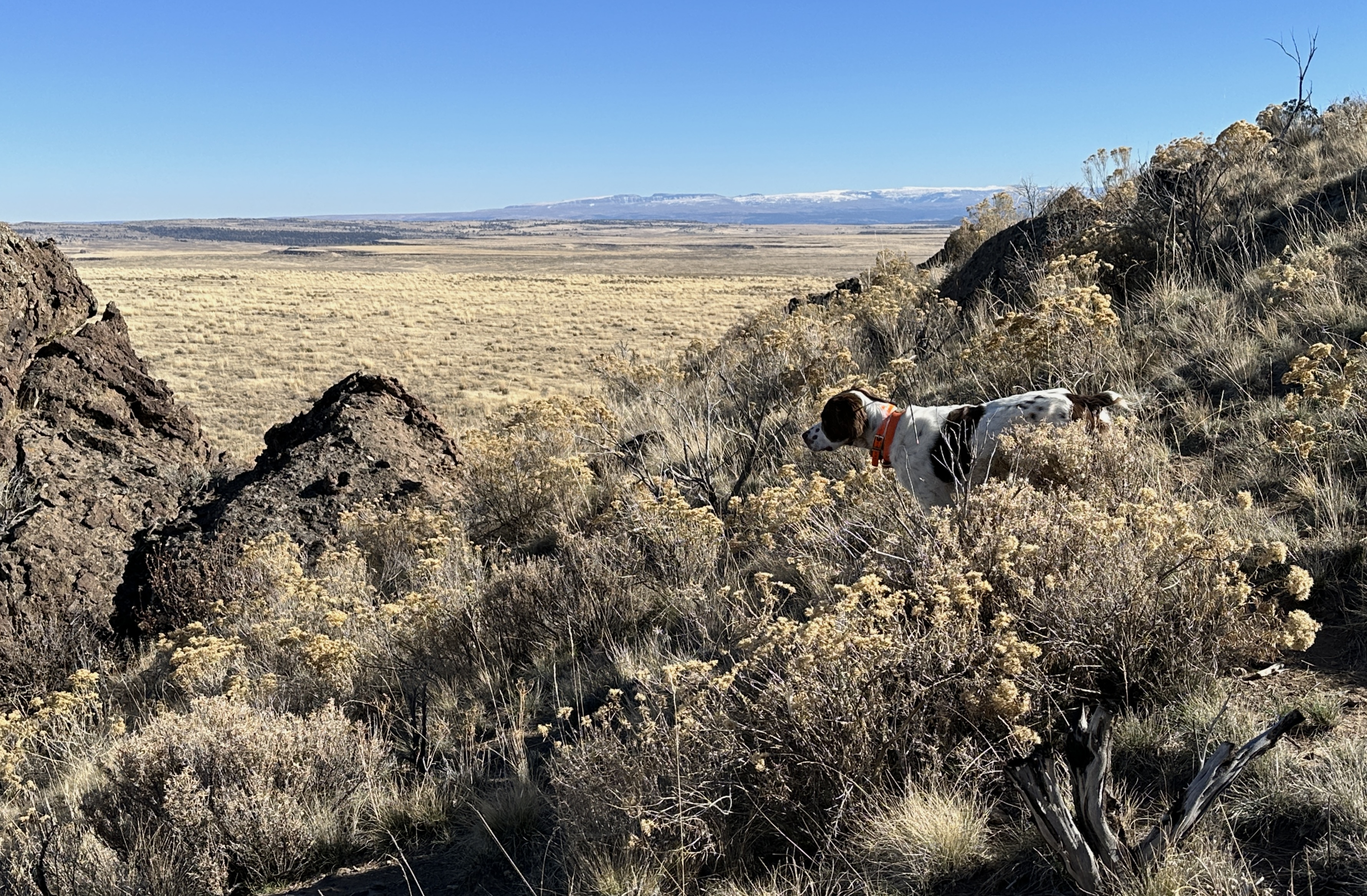
    Bloom pointing a covey of chukar yesterday.