
[Leslie originally posted this on October 30, 2018; it was one of the most heavily commented-on posts we’ve published here. We just received word that Sam passed away, aged 87, on April 18th, 2026. Our hearts are heavy. He played a big part in our chukar hunting lives, and in our adaptation to the area. He trusted us with his “secret spots,” many of which became our go-tos. He was our neighbor. He liked communicating with us, and when he decided he didn’t have what it took to do the gnarly uphill hikes chukar hunting requires in Hells Canyon, he’d call us to ask how we did. Or he’d just stop by, sometimes with a Shiner Bock (he wasn’t crazy about the IPAs I brewed). He taught me how to hand load shells, and gave me most of his equipment and material. He introduced us to Jeremiah Weed. “Want some weed,” he’d say, with that winning smirk. Priceless, especially coming from a highly decorated jet fighter pilot. He was an avid reader of this blog, too, but made no bones about greatly preferring Leslie’s pieces to mine. One of his last comments on this blog was something like, “Keep making memories. You’ll need them.” As if he needed to remind us not to forget him. Impossible. Rest in peace, dear friend. You are missed.]
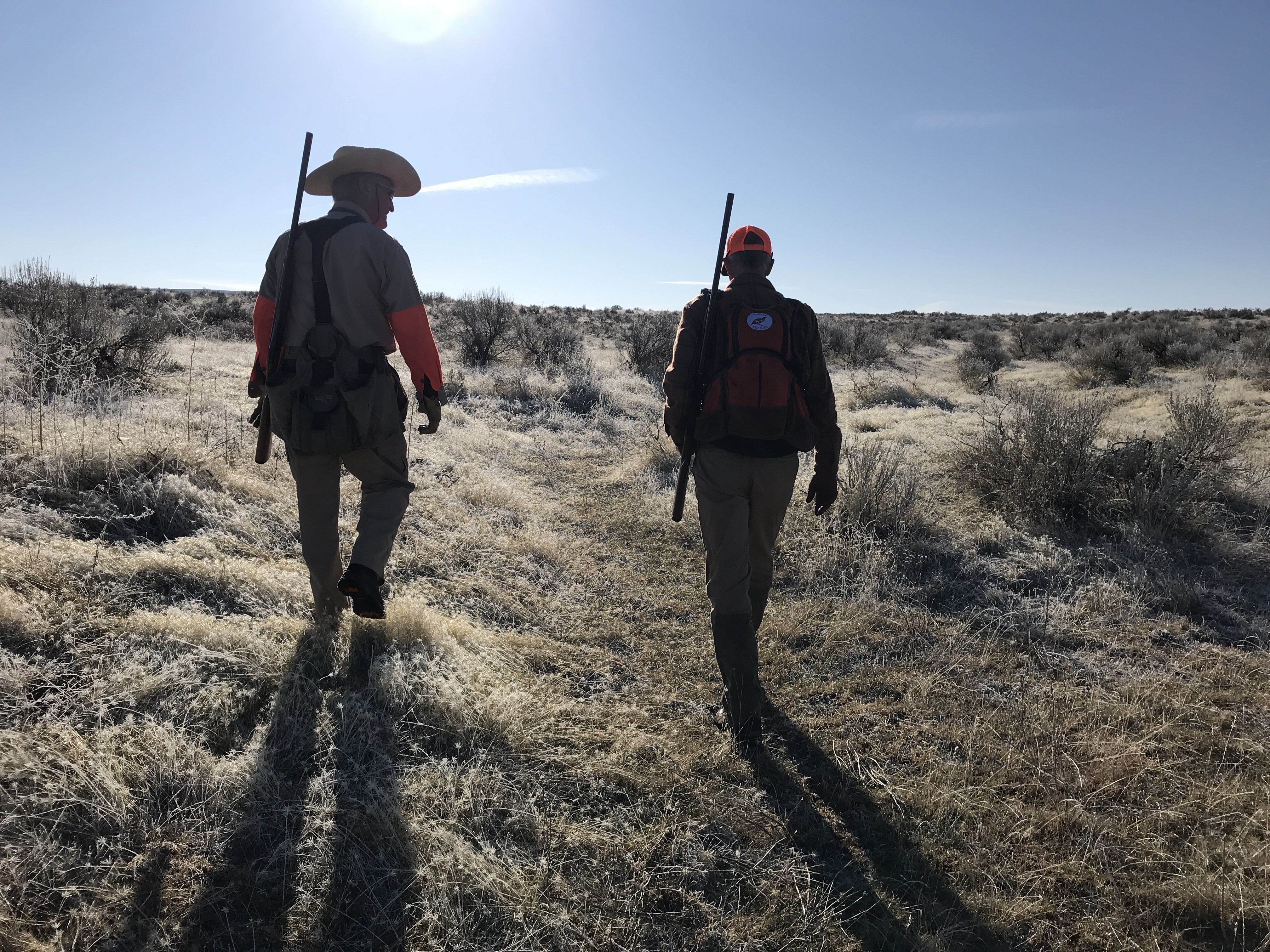
If you’ve never been to Hells Canyon on the Idaho/Oregon border before, the first thing you notice as you’re driving down the long, narrow, windy road of Highway 71 and descending deep into the canyon are the very steep hillsides covered in sagebrush, bitterbrush, golden-colored grasses and lots of rocks. Some people say, “It’s no country for old men,” but I’ve been chukar hunting down there with my 80-year-old neighbor Sam for the past couple of seasons, and he’s putting all those naysayers in their place. In my opinion, he’s an Idaho-side Hells Canyon chukar hunting legend. Most people have never heard of him because he’s not on social media, doesn’t have a blog, and doesn’t even know what a hashtag is; he’s just a modest guy with a long time obsession with bird dogs, upland hunting, and Hells Canyon.

Growing up in North Texas, Sam got his first taste of bird hunting at the young age of 10 looking for Bobwhite quail in Pineywoods, Texas. A former Air-Force F-16 Pilot, he has traveled the world, and obtained his first hunting dog from a breeder in Las Vegas near where he was stationed in the Air Force. Fond of the pointing dog breeds, he’s never looked back and has since owned several German Shorthair Pointers, German Wirehaired Pointers, and Drahthaars. He told me his favorite birds to hunt are upland birds and that’s why he fancies pointing dogs over flushing ones. Over the past 70 years, Sam has hunted birds and has covered a lot of ground in the process all over the United States. Sharp-tailed grouse and Hungarian partridge in eastern Montana in the early fall, Mearns quail in Southern Arizona in the winter, pheasants in the Midwest, not to mention chukar partridge, Hungarian partridge, Ruffed and Dusky grouse and California Quail in all the Western States.

Back in 1985, before moving to Idaho and during a road trip around the West, Sam got his first taste of Idaho chukar down in Hells Canyon in the area now known as the Cecil D. Andrus Wildlife Management Area. Back in the day, when Sam first hunted on it, the area was privately owned and a place where obtaining hunting privileges meant knocking on doors. At the ranch hand’s house, which is now the office for the Andrus WMA, a sign directed you go to up to ranch owners’ home and knock on their door to ask for permission. Sam knocked, and Mrs. Hillman answered the door and gave him permission to hunt along West Brownlee Creek. Sam said he obtained his 8-chukar limit rather quickly, something that would never happen very easily today, and in return, and as a gesture of thanks, Sam went back to Mrs. Hillman and asked her if she wanted some chukar and how many. She was surprised because nobody had ever asked her that before. Sam took the birds down to the river, cleaned them, and gave her 3 or 4 chukar.

In 1993, the Richard King Mellon Foundation acquired the ranch from the Hillmans and then transferred ownership and management of it to the Idaho Department of Fish and Game for wildlife conservation. The entire wildlife management area is currently composed of lands owned by Fish and Game, the Idaho Department of Lands, the U.S. Bureau of Land Management, and the U.S. Forest Service. The Idaho State Fish and Game department is responsible for the daily operations on the Andrus WMA.
There are 24,000 acres on the Andrus WMA, and Sam’s covered a lot of it on foot. His vast knowledge of the area is something he didn’t read in a book called “How to Hunt chukar on the Andrus WMA” because, to my knowledge, one doesn’t exist. Like most people he did it the hard way and figured it out for himself. That’s something to be proud of.

Sam is a wealth of first-hand information. We talk about dogs, habitat, guns, strategy, and terrain on the drive together down into the canyon. He knows the Andrus WMA like the back of his hand. One thing I’ve learned from Sam is that he’s firm believer that the Andrus WMA belongs to all of us, and he frowns on folks that hunt it all the time and act like it’s their own private hunting ground. “Just because it’s in our own back yard doesn’t give us any more right to be there than anyone else.” Sam moved to Cambridge 12 years ago to be closer to Andrus WMA, just like my husband Bob and I did six years ago. “There’s plenty of ground for everyone,” he always tell me. I couldn’t agree more. Access to quality public lands where most days you never see another person is what makes upland hunting down in Hells Canyon so special.


Besides the exercise that keeps Sam young, he hunts for the pure beauty of the sport; it’s just himself and his two dogs, Hannah and Susie. He doesn’t carry a camera or phone with him for documentation. Instead, he spends all of his time actually hunting rather than stopping and staring at a tiny screen and taking pictures of himself or others. His memories are to share with his friends and family in person when he gets home, oral communication, face-to-face just like the old days. I’ve learned a lot from Sam, and feel that I share his same passion for hunting. We share the love of the outdoors and seeing excellent dog work, that’s our priority while being out there on the mountain.
Photographs don’t do Hells Canyon or the Andrus WMA justice anyway. You can’t appreciate its unique beauty unless experienced in real life. Another reality of most chukar hunts is that sometimes you can’t find birds, or the ones the dogs do find bust wild before you can get into position to shoot. Last week, we were both lucky and we each got one bird that our old dogs Hannah and Angus retrieved for us. It was a very good day.

When I do hunt with Sam we take more breaks to rest. I’m okay with that because there’s always a glorious view of the vast landscape while you catch your breath, and also it’s more time for the older dogs to rest and get water. Sam is the real deal; I want to be more like him and pray my body holds up until I’m his age. The two of us are quite a pair I’m sure, an anomaly in the chukar hunting world: an 80-year-old man and a 56-year-old woman in this game of chasing chukar up and down mountains that seems to be dominated by young men with big quads.

Two weeks ago, hiking around the vast Andrus WMA on ground where you’d swear nobody has ever set foot before, ever, Sam found a stainless steel spoon laying in the dirt. He picked it up, dusted it off, posed for a quick photo with my camera, then put it in his upland vest. I told him, “I bet you’ve never found a spoon hunting before!”
We both laughed.
I asked him if he’s ever found any other interesting things in his years of hunting and said the only other thing he could remember finding was a small pocket knife once. In the past, I’ve found at least a half dozen deflated shiny Mylar balloons and one mule deer shed that I almost stepped on, but no personal objects a human has ever lost.


The days I don’t hunt with Sam or Bob doesn’t hunt with him, he’ll call us on the phone and ask if we found any birds and where. He’s the only person we share our secret hunting spots with, and he shares his with us. In truth, there’s no such thing as secret chukar hunting spots. Our motto is, “The birds are where they are!” Sam and I have both been skunked at our so-called secret hot spots. On one hunt, I asked him, “What’s our strategy today?” He said the recent reports indicate all the birds are down near the water. We found the opposite: a covey of chukar on top of a dry rocky ridge as far from water as possible. It just shows you.

Heading home and back up the canyon in the pickup after a recent hunt, the talk turned to the upcoming election. Sometimes we don’t always agree on everything, but it was agreed that we didn’t understand the Prop. 1 historical horse racing initiative that we will soon vote on here in Idaho. Sam and I decided that we had more important things in the world to think and talk about driving home, and agreed it was chukar hunting.
We both laughed, again.


Chirp away