Tag: chukar hunting

  • Grace

    Grace

    Unmerited favor.

    I’ve gotten out quite a bit so far this season. The weather’s been good. We recently took a trip to what — in years past — had been the best place I’d ever hunted chukar, for many reasons. We’d looked forward to it for nearly a year. But for whatever reason the hunting was terrible. Or I should say that the bird count was terrible; the hunting was excellent as it usually is when compared to not hunting. But in more miles than normal we saw a small fraction of the number of chukar we’d routinely seen in the area.

    Still, six or seven weeks into the season, it’s been good in many ways. Stats. Because of the nerdy log I keep, I can see that — so far — it’s taking me less time, distance, and elevation to bag birds than it ever has (my duration, elevation gain, and distance hiked, however, are significantly down — which I attribute to age; you can’t win ’em all). My shooting started out much better than average but — with yesterday’s atrocious performance, perhaps attributable to our first outing in Hells Canyon this season, on jumpier (probably much more frequently hunted) birds — it’s back down to my “normal” (but still unacceptable) 35-ish percent. Most of the 23 hunts I’ve done this season have been in completely new places, closer to home, found on onX; I’ve looked for public lands that — on the computer — looked like they should have chukar, and every single one of them has, sometimes with very good numbers of birds, and usually these have been places that I doubt many — or any — people have looked for chukar (they tend to be places that a UTV can’t get near). The conclusion that I make from these interim data is that — finally — it seems I’m getting more efficient — dare I say better? — at finding and hunting chukar. I could go on about all this. But…

    A person wearing an orange hat and backpack walks through a grassy field with two dogs, amidst rolling hills under a clear blue sky.
    Pretty over-grazed and overly flat terrain, but we’d never been here and didn’t see sign of others, either. And there were lots of birds. Plausible conclusion: the lack of homo sapiens is a good indicator of game bird presence.

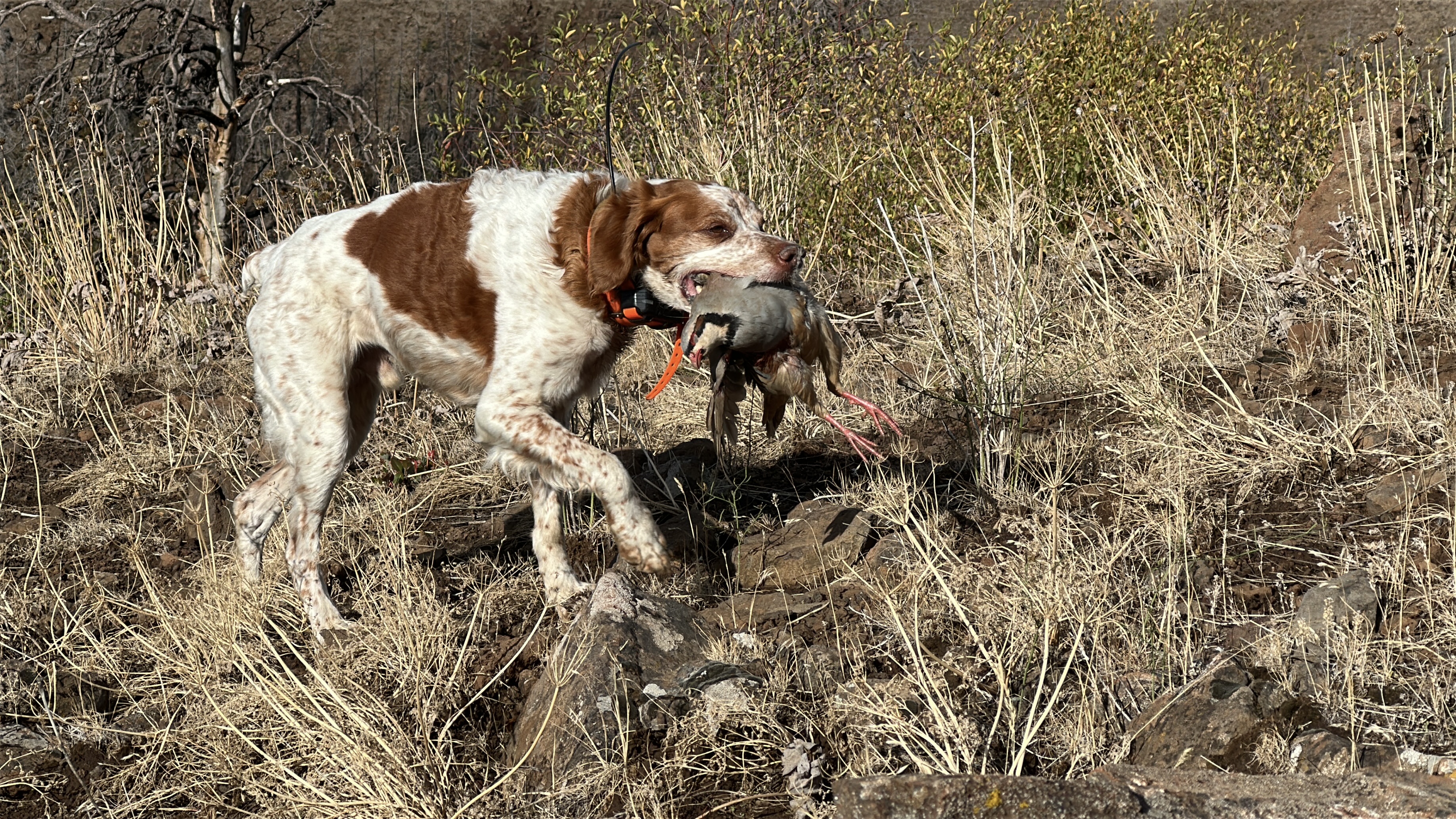
    One of the best things for me this season has been hunting with nearly-eleven-year-old Peat. Five times now he’s chased down chukar that I knocked down, disappearing for quite a while, and come back with them. Yesterday, for the first time this season, Peat disappeared after a bust in which I was able to whiff three times with no visible evidence of having even ruffled any feathers. It was one of those “I can’t believe I didn’t hit anything!” busts. But he came running back to us at least five minutes later with a chukar in his mouth. One of every seven birds I’ve bagged this season has been courtesy of Peat’s hard work after the shot.

    A dog carrying a chukar bird in its mouth, surrounded by rocky terrain and sparse vegetation.
    Peat with the chukar I didn’t know I’d hit

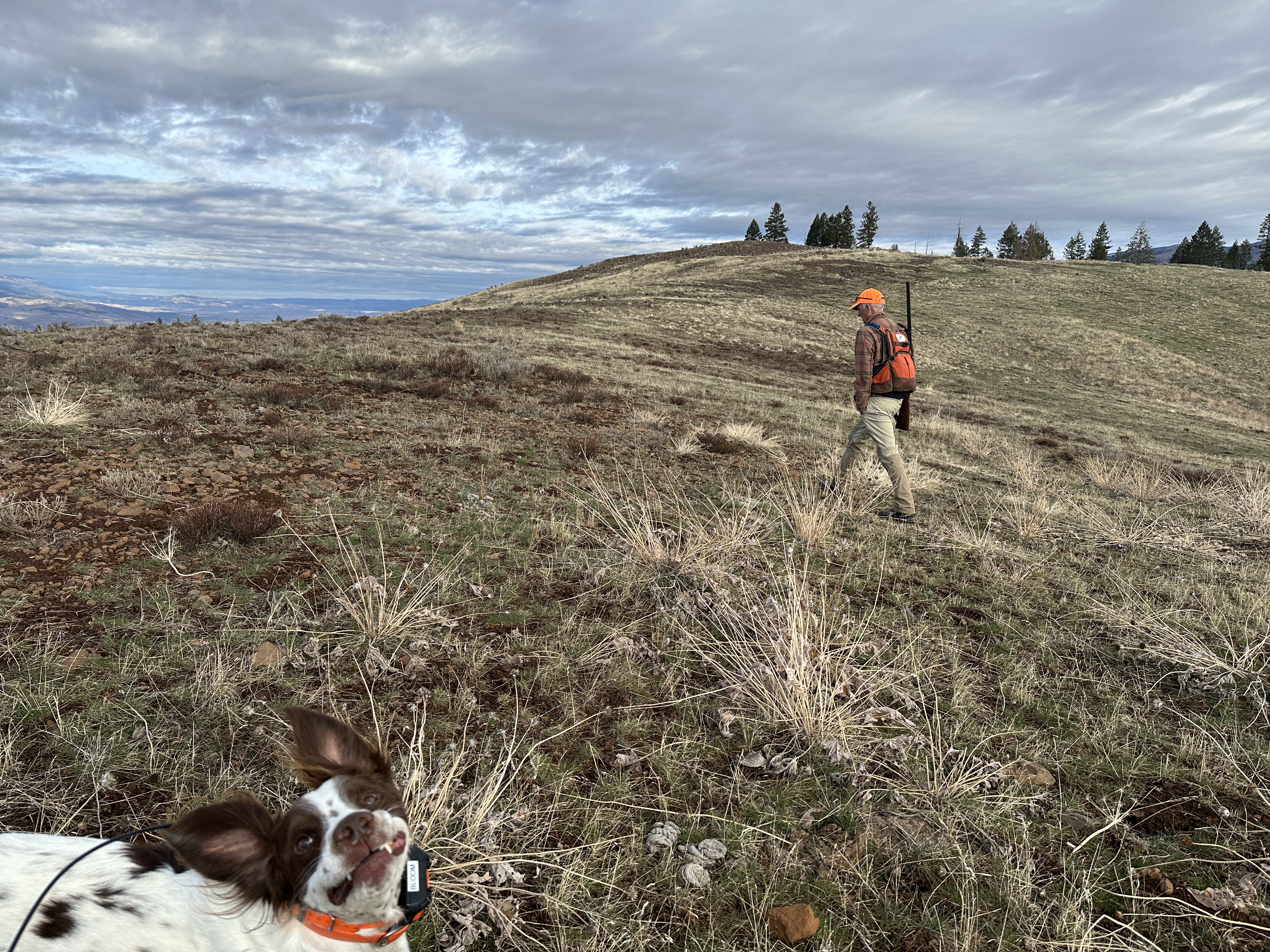
    The Hard Work Before the Shot award will without question go to Bloom. He covers much more ground than Peat does. Bloom averages more than four times what we cover, while Peat does almost three times our distance. Bloom in 18 hunts with me so far this season has run 272 miles, while Peat, in 22 hunts, has covered 237. We’ve noticed that when we all hunt together, Bloom tends to false point fairly often, especially at the beginning of a hunt. He definitely improves as the hunt goes on, but it’s almost like he’s trying to impress Peat, whose favorite thing in life is to honor another dog’s point (see my YouTube channel for many examples of this). Usually, Bloom’s first point of a hunt is several hundred yards uphill from where we’re just getting acclimatized, and we book it up to him, sometimes after he’s been stationary for up to 20 or 30 minutes, and as soon as we get up to him, he bolts. I’ve started calling it a “self-imposed whoa,” which is weird because Angus, who never once false pointed, always pointed with this very un-stylish posture (Angus is Bloom’s great-uncle). But as the hunt progresses, he seems to get more and more solid locating and pinpointing birds, which is really great. He tends to leave the retrieving and tracking duties to Peat, so it’s a good division of labor. I will say, though, in the couple of hunts I’ve done alone with Bloom that he has not false pointed even once, and has been an ideal hunting partner. It’s almost as if he’s trying to tell me that I can still do this when Peat is gone.

    A brown and white dog running through dry grass while carrying a bird in its mouth, with another dog in the background.
    Bloom doing his thing, whatever that is.
    A dog with a collar standing on rocky terrain, observing its surroundings in a grassy field.
    Bloom’s “self-imposed-whoa” posture
    A dog with a white and brown coat, wearing an orange collar, stands on rocky terrain in a grassy landscape, with hills in the background.
    Bloom in a “real” point (birds were there)

    Maybe the best thing that’s made this season, so far, really good is Leslie. I’m not sure about saying this because I realize it might make me look like much more of an ogre than I think I am, but she’s done two things differently this season than she’s done in the eight seasons since she started hunting. First is insisting I go alone with Peat every once in a while. As I’ve said, that’s been beautiful; I think it’s been beautiful for both of us because she’s gone by herself with Bloom several times and has really enjoyed that. Second is, when we all hunt together, she agrees to go where I want to go, and the discussions about the route we’ll try to take get vastly reduced. I’ll be honest here by saying that the main reason I have liked hunting for the 25 years I’ve been doing it is that when one is really hunting everything else disappears, including language and everything that stems from it. There’s nothing else like that for me (except, maybe, playing music). This, for me, makes it necessarily a solo endeavor. Any “foreign” intrusion on that — whether it’s your wife or best friend or boss or whatever — mitigates the escape from everything that is crucial to liking it, to wanting to hunt. So the thing I think I’m most grateful for this season, among many great things, is Leslie’s realization and appreciation of how and why I like hunting. It’s allowed me, for probably the first time since she began hunting (which was a huge step for her for many reasons), to sincerely enjoy hunting with my wife. I realize her sacrifice here, and that, as I said, I might look bad in the equation, but I’m just trying to be honest.

    A woman kneels in a grassy area, smiling while holding a chukar bird in her right hand. Two dogs are positioned nearby, one is a brown and white dog and the other is a tan and white dog. The background features a mountainous landscape.
    Leslie on a recent hunt

    Finally, the other thing that’s made the season so far very good for me has been the book. Many of you have bought a copy of Chukar Culture: Memory, Dogs, Paradox, and for that I’m very grateful. I’d love to hear what readers think about it, so if you’ve gotten a copy please don’t be shy sharing your thoughts with me. I’m trying to figure out how to market it better, but am kind of stymied there (i.e., I’m open to suggestions!).

    Book titled 'Chukar Culture: Memory, Dogs, Paradox' by Robert McMichael, featuring a dog holding a chukar in a grassy landscape.

    Speaking of merch: hats, shirts, and hoodies are coming soon. I will post here when they’re live.

    Thanks for reading, as always, and may your season be filled with as much world-cancelling experience as you’re looking for.
  • Ellie’s Greatest Retrieve

    Ellie’s Greatest Retrieve

    [NOTE: This is the “winning” retriever story, by Trevor Henderson of Twin Falls, ID]

    Quinn and I were hunting chukars in the rimrock country of southern Idaho, the kind of steep, unforgiving terrain where birds run fast and fly faster. The dogs were working well that morning—Ryder and Joker ranging close, casting along the rocky edges. Then they froze—solid point. We stepped in, and the covey blew out like feathered fireworks. Amid the chaos, I squeezed off a shot and watched a bird fold, but we lost sight of where it went down. We figured it landed somewhere near where Ryder and Joker were already nosing around.

    Five minutes passed. No bird. The dogs worked hard, but came up empty. Then, from far below, I caught movement. Ellie, my little liver-and-white sweetheart, had broken off from us, over 200 yards down the canyon. I whistled once, unsure what she was doing way out there. A few moments later, she crested a rocky rise, tail wagging, chukar in her mouth—our chukar. How she knew where it fell, how she found it when the others couldn’t… that’s something only Ellie could do.

    That was Ellie—heart, drive, and nose like no other. She gave everything in the field, day after day. Last season, she was shot and killed by coyote hunters while we chased chukars in that same country. It broke something in me I don’t think will ever fully mend.

    But I hold on to days like that one. When she proved, again, that she was more than just a bird dog. She was my partner, my friend, and on that hillside, the best damn retriever I’ve ever known.

    Rest easy, my sweet girl. You’ll always be on point in my memory.

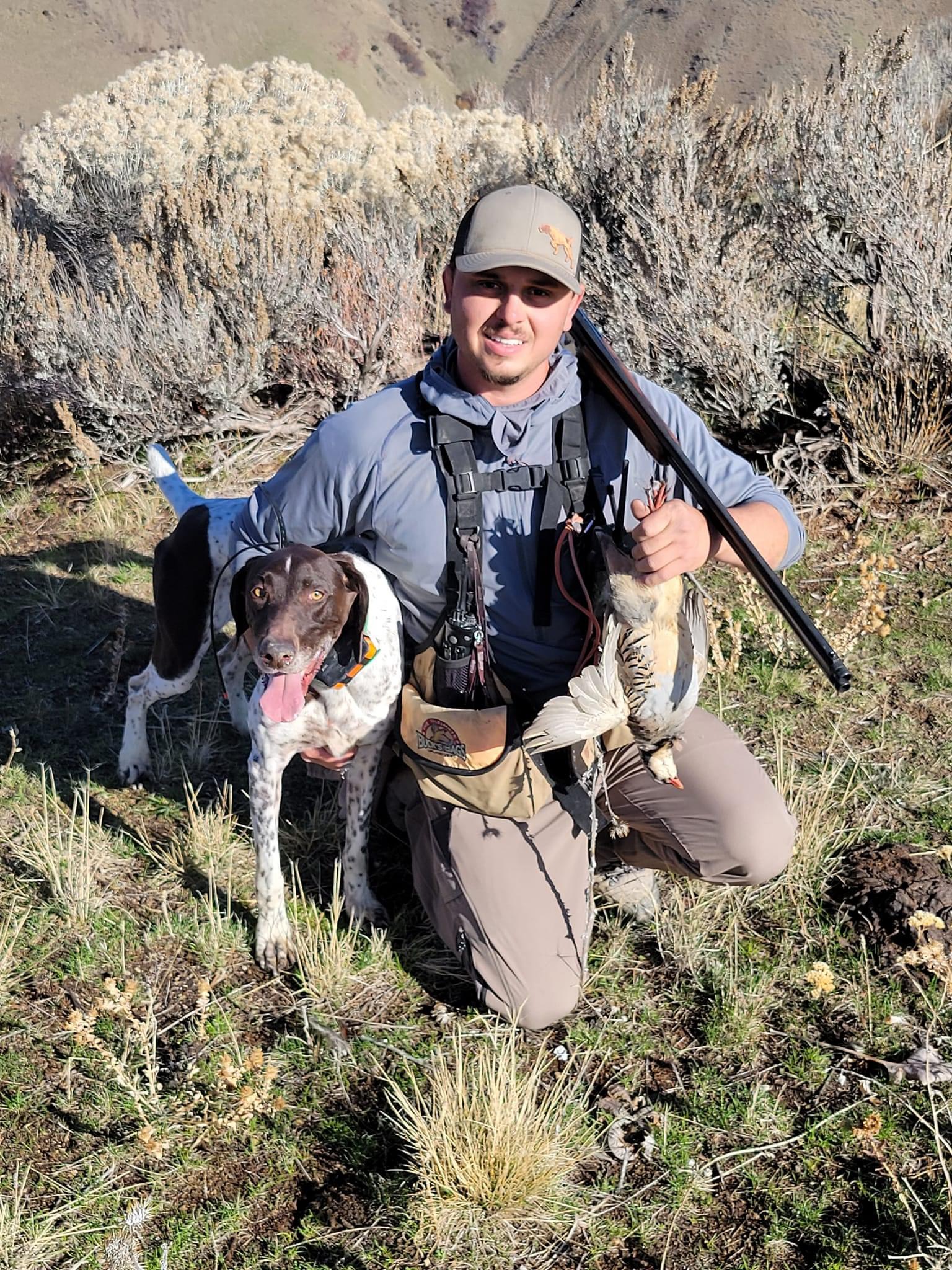
    Ellie bringing back a chukar. (This and the featured photo of the author and Ellie are both courtesy of Trevor Henderson.)

  • Podding

    I was lucky enough to guest on Scott Linden’s excellent podcast “Upland Nation” this week. He asked great questions, and I think it went well (I didn’t hate the sound of my voice more than I normally do). Unfortunately, I think the pressure got to me and I really shorted talking about our dogs and about the paradox of killing something you love, which are the two words in the subtitle of my new book, Chukar Culture: Memory, Dogs, Paradox. If you’re interested in those topics, the book rather focuses on them.

    Still, I’m grateful Scott wanted to include me on his show. Anyway, here it is:

    Podcast episode titled 'Chukar culture' featuring a guest who coined the term, with a scenic mountain background and a host holding a bird.

    In other things chukar, we’ll soon post the winner’s best retrieve story, and in a week or so should have a new bunch of Chukar Culture hats. More to come.

  • Retrieve

    Retrieve

    Do you have a good retrieve story? I know there are some great ones out there. If you want to send your best story as a comment (please keep it under 500 words), I’ll publish the best one as a separate post (Leslie & I are the judges, and we’ll ask for a photo of you and your dog), and send the winner a copy of my new book, Chukar Culture: Memory, Dogs, Paradox.

    The topic of retrieving, in fact, can be so stressful that humor is often forgotten. It shouldn’t be that way. Leslie just reminded me about the time I shot a chukar on Brownlee that we could not find. Three people and two dogs looked and looked, and finally gave up. As a last resort, we ended up looking for it along the cliffs when we were boating back to the ramp, and a friend of mine actually free-soloed up the cliff to check for feathers and found the bird! When he proudly brought the chukar back to me, we all noticed Angus sporting a wisp of arugula and a trace of mayonnaise on his lower lip, the last of my friend’s roast beef sandwich.

    Years ago, when I was a kid and long before I began hunting, I loved Farley Mowat’s The Dog Who Wouldn’t Be. I think it was the opening of the book where he told the story of his dad’s dog who’d accompanied him downtown to a gun shop. Finding a nice side-by-side, the dad took it out on the sidewalk to see how it felt. Tracing an imaginary duck or goose, he said, “Bang!” The dog took off to who knows where, and his dad went back in the shop to haggle with the shopkeeper. A few minutes later, the dog ran into the shop with a taxidermied duck from a store down the street. At least that’s how I remember it.

    Retrieving, and how well our dogs do (or don’t) do this, has been on my mind a lot in the first weeks of this new season. Bloom, for example, seemed to start off deciding he was no longer interested in retrieving; he’d be the first dog to a downed bird, pick it up, and drop it, sometimes several hundred yards down a steep hill, forcing me to lose all that elevation and get it myself. He did this on the first couple of hunts. I was dreading having to work with him to get him back on track. But before I had a chance to do anything, he shined on the next hunt, retrieving everything to hand. Since then he’s been perfect for some reason. Fingers crossed.

    Bloom with one of his “reformed” retrieves (Peat’s happy just to watch)

    Bloom did so well, in fact, for a couple straight hunts that I thought Peat had decided it was much more fun to watch, like Peter Sellers in Being There. But then…

    On three consecutive hunts (the last three hunts I’ve done), Peat found birds I winged hundreds of yards from where I saw them land. Each time, he hadn’t seen the bird fall because they’d busted in all directions, and — like a good shooter — he’d followed a single bird or two which happened to be birds I did not shoot at. I had to call him over to the area and hope he’d pick up the scent. In all of the cases, he went a direction much different than I thought the bird had gone. In all cases, he disappeared for at least ten minutes in dense brush. And each time he came trotting up the hill with the still-live bird softly clamped in his mouth. There is no way I would have found a single one of these birds. He’s saved me, three times now, from losing any birds this season. He’s 10-1/2 years old. I’ve raved about him before, but — as Angus did before him — Peat seems to get better every time we go out.

    It’s good to be lucky.

  • The Yellow Bittern

    The Yellow Bittern

    Anyone who hunts birds knows heartbreak, if only because most of us have been through dogs. The best of them last a quarter of our lives at the most. So we watch them come and go. And then there are the birds. And the land. Innocence. You know what that’s like.

    I’ve been trying to learn a new instrument, the Irish pipes. They’re called “uilleann” pipes (pronounced “ILL-in”), which is Irish for “elbow.” You use your elbow to pump a bellows which fills a bag under your other elbow with the air you need to resonate up to 7 reeds. Then there are 13 keys you play harmonies with using your wrist and thumb while your fingers play the melody on a 14-inch tube with a finicky reed. It’s far more complex and insane than the Scottish pipes, which I’ve played since 2007 and had previously thought was the most ridiculous instrument ever invented. This instrument puts Ireland’s association with drink in a new light.

    Irish music, like the people coming from that small island, is known for its ferocity, its speed. It’s lesser known for what, in my humble opinion, are its much better but heartbreaking slow airs, tunes we Westered mortals might call ballads. Most of those come from old poems or stories, and nearly all of them have Irish titles: Táimse mo Chodladh (I Am Asleep), Port na bPúcaí (Song of the Faeries), Éamonn a’ Chnuic (Ned of the Hills), An Raibh Tú ar an gCarraig? (Were you at the Rock?)…

    An Bonnán Buí (The Yellow Bittern) asserted itself for some reason today. Maybe it was the weather, or the news, how can you know? It’s been a common song over there for a long time, and without getting all musicological on you, I’ll just say it oozed its way into me somehow today. I’d heard a bunch of versions by my favorite players (thanks, YouTube). Everyone does it quite differently, and I’d decided I needed to learn it. I have the printed sheet music, but it didn’t even closely match any of the far better versions by Chris McMullen or Cillian Vallely or Liam O’Flynn. So I picked one (McMullen’s), and started memorizing it. There are two phrases, and it took about an hour to get the first under my fingers. And then I realized there was something more I didn’t know.

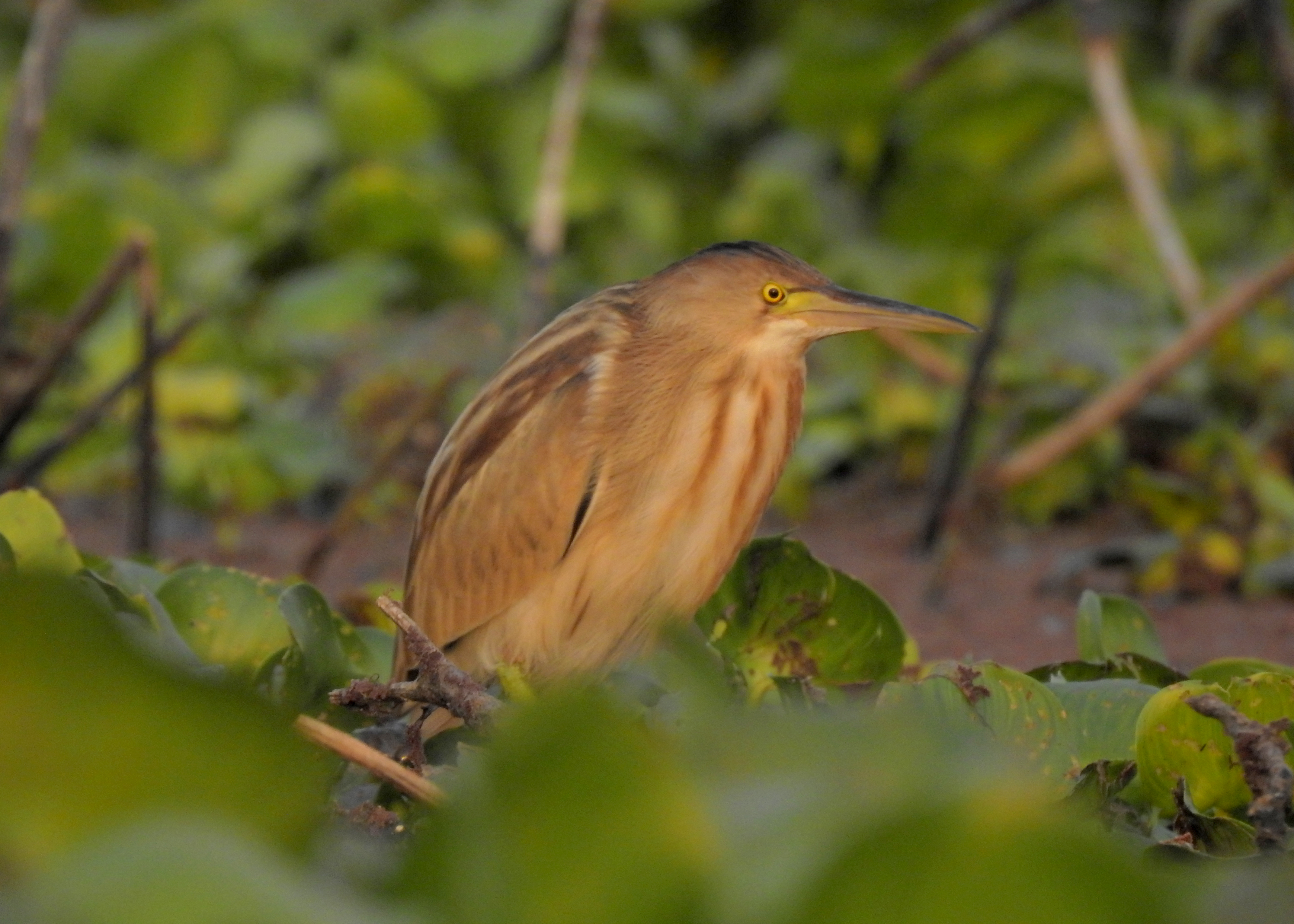
    I looked up the tune, and learned it’s after a poem from the early 18th century by an Irish poet called Cathal Buí Mac Giolla Ghunna. He was an admitted drunk, and this — his reputed greatest work — was about his struggle with alcoholism. He’d happened, in winter, upon a yellow bittern that had died of thirst at the edge of a frozen lake. Like most good poems, this says a lot with very few words. Seamus Heaney’s translation of one of the later stanzas:

    I am saddened, bittern, and brokenhearted
    To find you in scrags in the rushy tufts,
    And the big rats scampering down the rat paths
    To wake your carcass and have their fun.
    If you could have got word to me in time, bird,
    That you were in trouble and craved a sup,
    I’d have struck the fetters of those lough waters
    And wet your thrapple with the blow I struck.

    In the end, the poet decides that — even though his wife desperately wishes he’d quit drinking — he can’t give up drink because he knows that when he dies he’ll get no more.

    I was a music major in college, at first, anyway. One of the first things I learned and have never forgotten is that “programmatic” music is a hoax: any music purporting to paint a specific picture is not only bad but should be avoided and, if you’ve got the time, you should talk shit about it. The professor’s point, I recall, was that music was better than that. It was ineffable. It said more than a simple picture could. That’s why it was important to pick it apart, dissect it, musicologize it.

    When Chris McMullen or Cillian Vallely start playing this tune I see the dead bittern and my heart breaks.

    Today is my brother’s 60th birthday. He emailed me some of his thoughts about why he’s probably going to stop fishing for steelhead, something he’s loved and done for a long time. Much of what he said reminded me, in very different ways, of why I think more frequently these days about not chukar hunting anymore.

    We’ve been hooked on the web cam showing Shadow and Jackie, the 11- and 13-year-old bald eagles trying to raise chicks in a nest high above a lake in the San Bernardino mountains. Two chicks hatched a few days before the third egg, and that littler chick survived long enough to develop a large fan club before it died. No fault of the parents. The weather there has been brutal. We could see them live anytime, and often marveled at one of the parents — only its white head and huge yellow beak visible in a snow-mounded nest — softly covering the babies during a howling snowstorm. We watched Shadow and Jackie bring dozens of dead fish and coots and ducks to the nest, tear them up, and gently feed them to the little fuzzballs. Leslie said today, “Look at all the animals that died to feed those chicks.”

    It’s hard to stay away from the news, even though it’s obvious to anyone with a heart that there’s nothing good there. Very much the opposite.

    I needed to learn about the yellow bittern, its story, today. For some reason. I didn’t expect it to, but it made me cry. That made me feel more human than I have in at least 50 days. So I guess that’s a good thing about heartbreak.

    But then what?