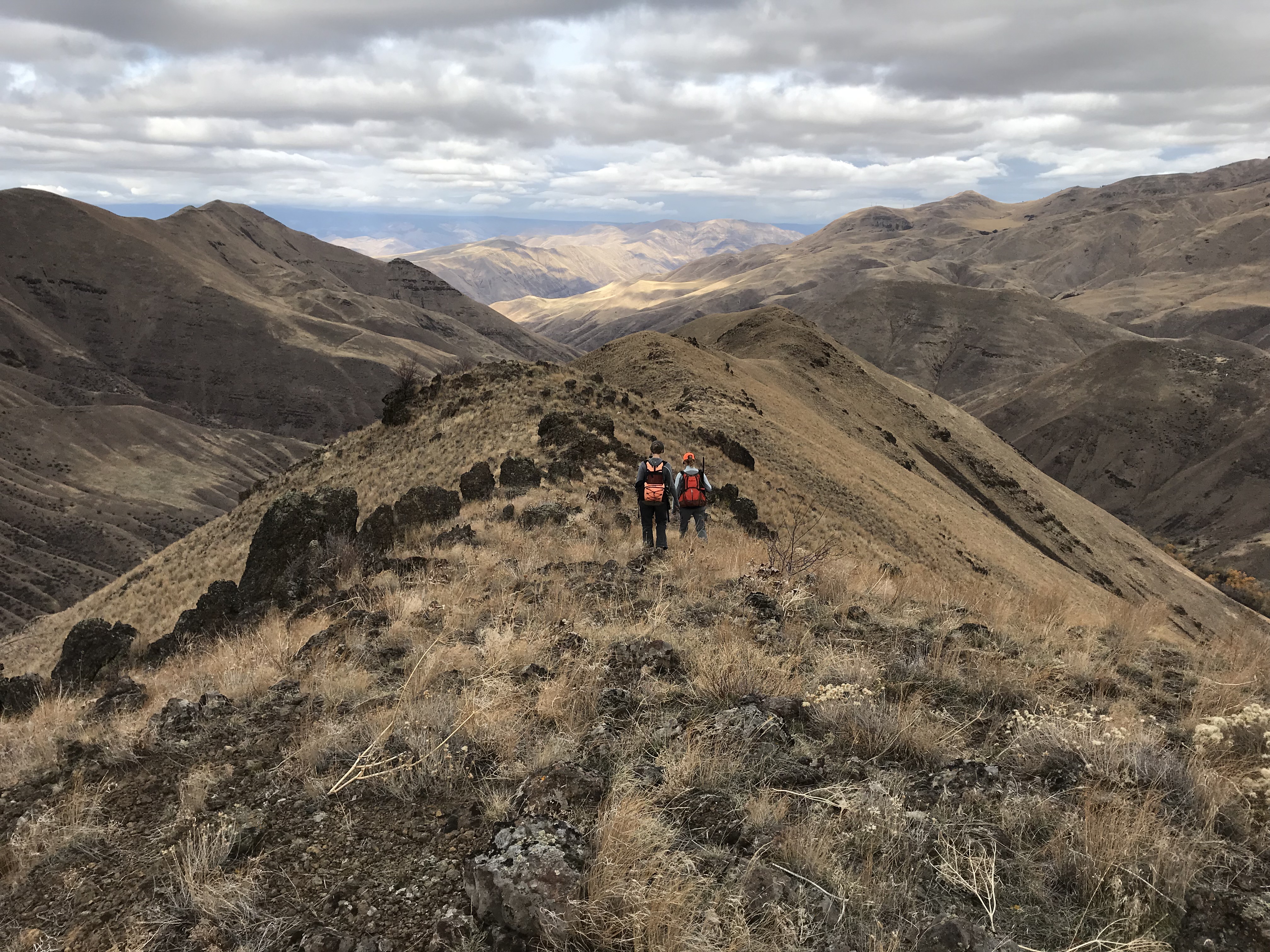
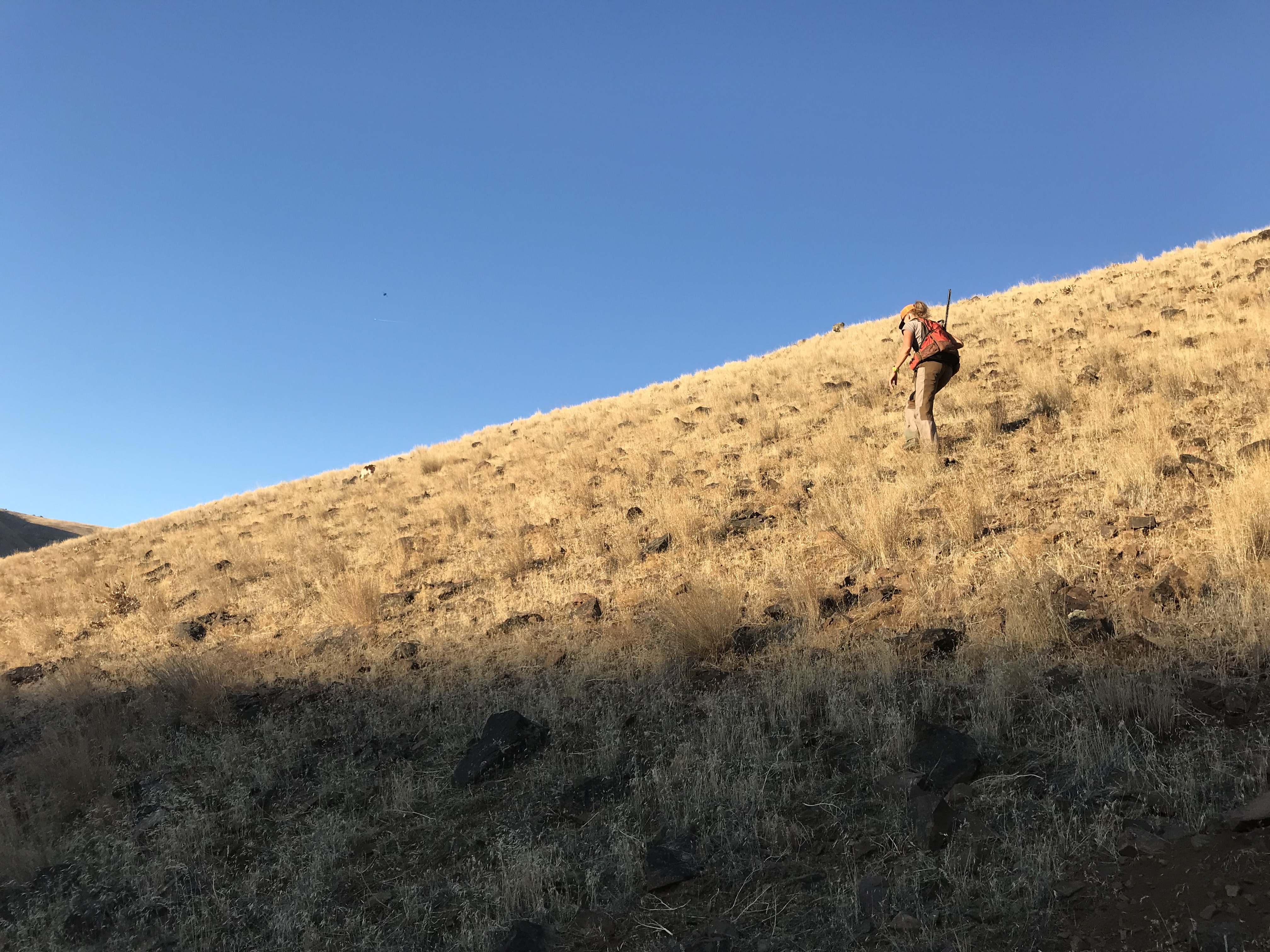
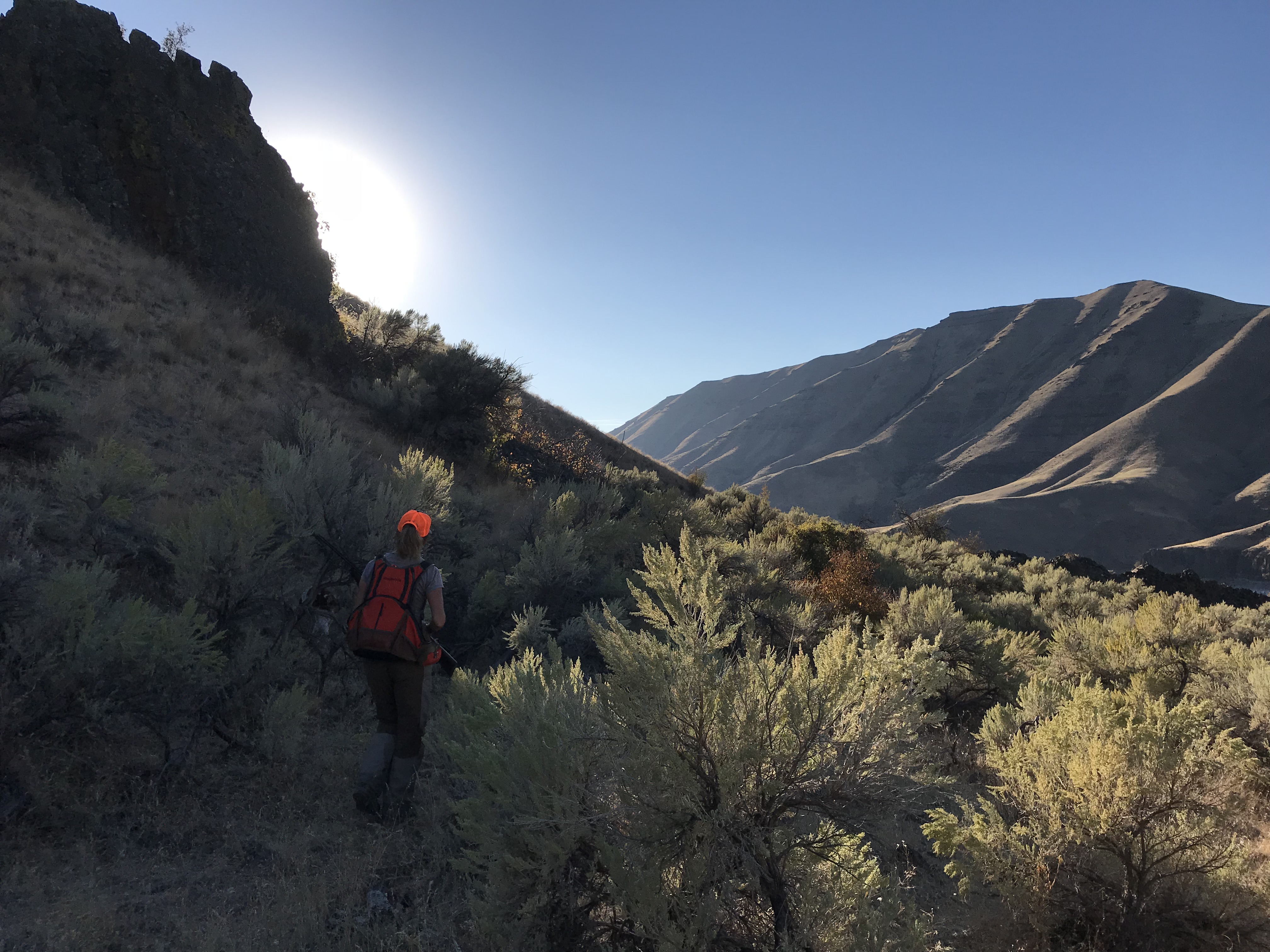
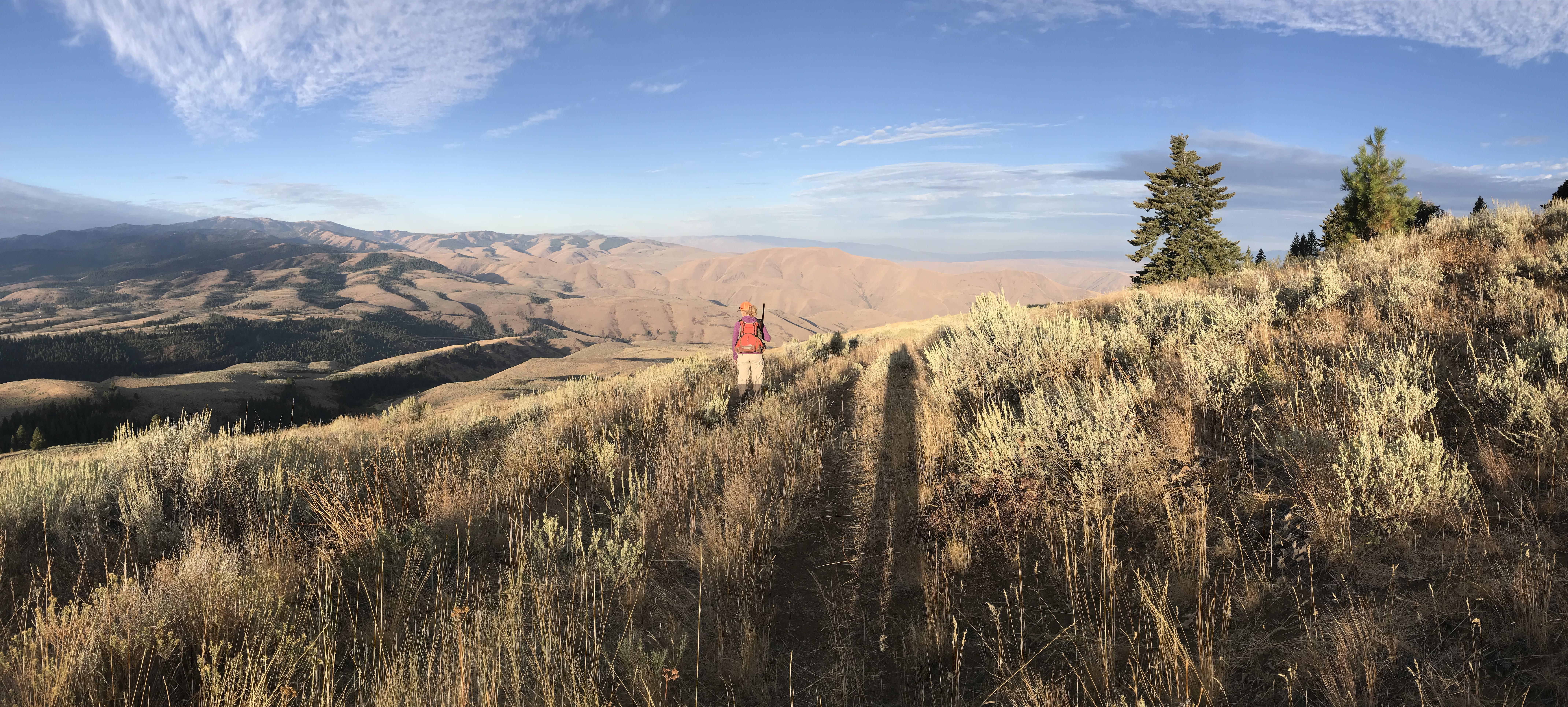
Yesterday, Black Friday, Opt-Outside Friday, or whatever you want to call it, we got lost. Despite extensive research (okay, ten minutes on Google Earth) and years of hiking experience in the area, we ended up nowhere near where we thought we were going. It was cool. Here’s a look:
Leslie was more surprised than I was (mainly because it was her plan; not that I think she’s a bad planner — quite the opposite, actually — but that she takes more pride than I do in knowing where the hell we are and where we’re going). I really didn’t care where we went as long as it looked plausible we’d find birds, and I knew we were going to try someplace we’d never hunted, which I’m always up for, as are — of course — the dogs.
Angus knows
Dogs have no concept of reflexive competence or ineptitude, which is what everyone always says makes them so freaking lovable. So getting lost is a totally human experience, which makes it, yes, cool. Last year, Angus got really lost (to us), and it was very stressful (to us; who knows what he was thinking — probably: “Birds… birds… birds… hill… birds…”) because we knew he was lost while also knowing that he had no idea he was lost; having an Alpha to track him helped us find and re-collect him but when we did he, one, didn’t express any awareness that anything had been amiss, and, two, certainly did not show any gratitude to me for rescuing him, despite the fact that it nearly killed me (really).
Dog on the trail
The weird thing, I think for both of us, was that we didn’t realize we weren’t where we thought we were for a long time. This was partly because, after 3.5 miles and 1500 feet in elevation gained, we finally found birds and focused on that. The other reason is that it was a wee blizzard. This brings weather and motion into the equation, and goals, too, and maybe even shooting percentage: how can you aim for something and think you’re on track only to find out after the fact that you mistook the path? You’re working muscles, brain cells, patience, foot- and hand-eye coordination, navigational “skill” (we now know this isn’t what it’s cracked up to be) for literally hour upon hour and then you find you are way off track. Also, when you don’t know you’re wrong, you can’t know you’re wrong. It’s impossible. And, in a way, it’s the greatest thing ever because it’s the physical parallel to the metaphysical reason hunting is the best thing anyone can do to feel human and nonexistent simultaneously, which is perfection.
Something found
Angus knowing
So I need to remember this. And Leslie needs to think about it and get comfier with the idea. We got lost, and it was great. It’s like Norman Maclean said: “Eventually, all things merge into one and a river runs through it.” In chukar country, there’s always a river, or at least a creek, or at least evidence of one from sometime in the last ten millennia, so you can always “terrain navigate” your way back to the pickup if you remember that. Yesterday, there were lots of those waterways, which is mainly what led to the lovely screwup: we underestimated God’s great riverine capacity. Ridges separate the creeks, they’re all mainly bare and similarly undulating with the same kinds of plants and rocks, so it’s easy to get lost. Isn’t that good?
p.s. The big photo of my big butt at the beginning of this post is a posture I’ve added to my hiking repertoire, which resets the sciatica pain so I can continue. Small price to pay, although Leslie took this without my permission (which is why it’s the header photo).
Our home in the country, Salubrious Basecamp as we affectionately call it, has seen a flurry of adventurous friends and family, hunters and non-hunters, visiting us the past couple of months, each of them wanting a chance to see what all the chukar hunting fuss is all about. We love that our visitors will take time out of their busy lives to make the drive. Our gracious guests, all of them, before arriving will always ask if we need any last minute food items from the city. They will come bearing new craft beers, pastries, breads, snacks, and even single malt whiskey from Taiwan (of all places), things we can’t buy in town at our local general store. We ask them to only bring themselves, but are very grateful of the gifts. In return, we’ll make some game bird-inspired dishes like prosciutto-wrapped grouse marsala or chukar nachos, and take them to some of our favorite public land hunting grounds and allow the ones that hunt the opportunity to shoot over our dogs. It’s not just anyone we’d trust with doing this.
On this day of thanks-giving, I’m most grateful for our family, friends, and the good dogs that enrich our lives and the fond memories of hiking the chukar hills with them.
Cyclists and mountaineers Jon and Sarah
Jon on the descent
Avid fly-fishing nephew, Finn on the right
Runner, teacher, and new hunter Gretchen
Gretchen’s puppy Cody smelling wild chukar for the first time
Ultra-marathoners and triathletes, Bill and Kim
Cody hot on my heels learning about chukar terrain
I’m nervous about this, but there is a point. Let me get to it. First, neither my wife nor anyone else’s wife — as far as I know — has died on a chukar hunt.
This whole thing started because some of my students learned I was a “YouTube” star (I disagree); for them, stardom meant having more than 100 subscribers to my channel (I have 3,000+), and a video with over 1,000 views (my video with the most views has over 1 million). They told me I should be getting paid for my videos, which I didn’t believe. But one of them showed me how to “monetize” them, and I’ve received a couple checks now from Google; I gave the kid $20.
“You have to make click-bait videos! ‘Wife Dies on Chukar Hunt’!” We had a good laugh about their idea, and moved on to the riveting world of participial phrases. But they kept bugging me about it, so I started thinking it might be fun, just about the time I decided I’d had it with Instagram (I deleted my account last summer). So I never did anything about it. The season came, and I sort of forgot about it.
Until today: looking through some of the photos of our hunts so far this season, feeling kind of ho-hum about the lack of moisture and the dry conditions and difficulty finding birds, I came across a 12-second video we staged with Leslie saying something about “dying” from hiking up a steep slope. So I took a few minutes and made a quick video, titled “Wife Dies on Chukar Hunt,” posted it on YouTube, and am now waiting to see what happens.
I wouldn’t even have tried this if I weren’t concerned about the impact of social media on our world. My students’ lives seem to revolve nearly entirely around it. They all have smartphones, even the poorest of them, and — before we decided to ban smartphones at school — would be on them all day long. As cross country coach, I had to make very specific and precise rules about when and where my runners were allowed to use their phones.
Social media has also invaded my little insulated chukartopia: before being persuaded to join Instagram (a cooperative effort by my students and wife, each with a different yet equally futile objective: students so they could stalk me, and wife to help promote this blog and its hat and shirt sales), I operated under the contented delusion that there weren’t many chukar hunters out there. But not long after joining Instagram, and a couple chukar hunting groups on Facebook, I quickly realized that, even during the off-season, the “pile of chukar on my pickup’s tailgate” photo was as common (to others; not me) as fake is to news these days. I felt naïve, and a little disturbed, both by my naïveté and by the existence of a genre of unselfconscious slaughter photos. This blog has featured its share of dead bird photos and videos, so I have no right to criticize anyone for sharing their accomplishment; chukar hunting is badass, and getting a limit is definitely an accomplishment.
But it does bother me, I’ll admit. Part of it might be envy: I’ve only limited one time in the 18 years I’ve been doing this, and I did post a photo of it on the blog (it was a long time ago); I’m not a good enough shot, and not fit enough to hike long enough to find enough birds to shoot limits more than I have. But the other part of it, the part I think social media encourages (especially Instagram, with its ridiculous algorithms of self-aggrandizement), is definitely not something that even remotely represents what I find amazing about this pursuit. If anything, it highlights the thing I like least about it: killing. If there’s a trend in social media representations of chukar hunting, it’s that it’s more about that awful, disingenuous euphemism “harvesting” and not so much about the hunting, or the dogs. And I’m not here to say my way’s the right way — to each his or her own (although, this is my blog). I’m just saying that I find much more intriguing things in any given chukar hunt than the carcasses I can pose for a tailgate hero shot.
The other thing I found extremely disingenuous about Instagram in particular, which led me to delete my account, was that it was a forum for false praise and very limited tolerance for honest exchange of ideas. Granted, it’s a photo app, but the comments on photos — unless the topic or caption was “edgy” — were unreflectively encouraging of slaughter as the primary objective of bird hunting. As long as the photos had some dead birds in them, they got lots of “Great job” and “Go get ’em, dude!” comments. I posted a photo of a private stream (the kind with water and trout in it) in England and linked it to the GOP assault on public lands in the U.S., and got no end of shit for it, which surprised me because — hello? — chukar hunting is a public land game. I mistakenly assumed my chukar hunting followers were down with protecting public land access. Apparently not. Partisan politics is alive and well, even in chukardom. Useful to get that learned.
Which brings me back to “Wife Dies on Chukar Hunt.” In one sense, it’s a “If you can’t beat ’em, join ’em” thing. In another, it’s a (probably ineffective) parody of social media and the fact that even as noble and rarified an activity as chukar hunting is not immune to the depravity of our social-media-obsessed world. Enjoy, or don’t. I really don’t care. Really. And if you feel the urge to comment solely with an emoji (as someone did on a recent post), do yourself a favor and unsubscribe.
“The lunar landscapes above and below the conifer forests that necklace western mountains, the “chukar hotels” (rock outcroppings used by birds), and the overwhelming panorama that negates any notion of supremacy man might harbor is witnessed only by a small percentage of hunters. Climbing defines hunting in the West. There was elation when, after a hard ascent into the clouds, I killed a bird.” – Guy de la Valdene, The Fragrance of Grass
Chukar hotels
Movement defines us, and it enables us to do certain activities like walking, climbing, and chukar hunting.
Last month, I drove my Dad to the Veteran’s Hospital in Boise for his one-year follow-up after he had colon cancer surgery a year ago. In between his CT scan in the morning and visit with his surgeon in the afternoon, we spent a lot of time in waiting rooms. If you’ve never been to the Boise VA before it’s a bustling place of activity and people everywhere. I observed the flow of military veterans, visitors, and staff going up and down the hallways. Some of the veterans, young and old, were being pushed around in wheelchairs, unable to walk. The ability to stand up to walk and then put one foot in front of the other is something that most people take for granted; I know that I do.
Top of the mountain
Last weekend, I went out chukar hunting with Bob and our nephew Finn. After a long climb to the top of the pine covered mountain, we split up. Bob went with Peat down one ridge, and I went with Finn and Angus in another direction. Not far from the top on a very steep descent, I slipped on some loose ground and rocks, and in my desperation and awkwardness not to fall on the ground, my left leg muscle in the front of my thigh felt like it was torn in half. The pain was excruciating and walking was difficult. I was more pissed than anything when I realized my day of hunting was over and our vehicle was 2,000 feet down a steep rocky ridge. I waved and signaled at Finn hunting below me to wait. Slowly I made my way to him pretending that nothing happened. I told him to go on and hunt with Angus and I’d make my way back and for him not to wait for me. I come from a background of years of bicycle racing where crashing hard, getting up, dusting yourself off, and keeping going was nothing new to me. You learn to have a high pain tolerance and it’s a price you pay when you want to do activities where you might get hurt.
Chukar break with Bob and Finn
Chukar hunting on steep talus slopes and sidehills could be dangerous, depending on where you hunt. I’ve fallen a few times and it’s usually not a big deal but this was the first time in ten years of hiking around in chukar country that I felt hurt. Chukar terrain in the West on public lands is almost always in some very remote locations and places where not a lot of other people hike or hunt. In fact, we usually try and find places with little pressure and away from everyone. It’s also not the best place to get injured, and if you couldn’t make it out on your own it might require either getting medical evacuated on a helicopter or crawling on your butt for three miles like Bob did a few years ago when he busted his ankle chukar hunting by himself with no cell phone coverage to call for help. It was actually Bob’s accident that day in 2011 that prompted me to start going hunting with him regularly in case he got hurt again. The other motivation for going with him was that I’d get to see Angus working and get some good off-season cross training.
Chukar terrain
My dad, 80 years old, walks slower now than he used to, partly because he never exercised a day in his life. My parents both came from a long line of non-exercisers and it just wasn’t in the cards for them. Growing up they both smoked cigarettes and I was a second-hand smoker from the day I was born until I was 18 years old. When I moved away from home a week after graduating from high school, it was only then that I realized how badly my clothes smelled of cigarette smoke. I hated my parents’ unhealthy lifestyle and decided that I didn’t want to be like them.
It took my dad and me a long time to make our way through the hallways in the VA hospital. I’m a fast walker, so I found myself getting impatient. I asked my dad if he wanted me to push him in a wheelchair, but — independent and living alone after my mom passed away 8 years ago — he refused the wheelchair because he wanted to walk. We ended up stopping many times walking down the hall, but he didn’t want the wheelchair, I think, because he was proudly wearing his 11th Airborne Division cap. Other veterans heading our direction recognized his army division on his cap and they would stop and chat and reminisce for a few minutes. My dad shared stories with total strangers about being stationed in Germany, stories that I’d never heard before. He never talked about his past when we were growing up. In fact, he didn’t talk much about anything. We continued out of the building and down the sidewalk. His cancer was gone, according to the results of his CT, and his surgeon told him he didn’t need to return to the VA for another year. My dad told me he was proud that he is now a cancer survivor, one of the few times he’s ever expressed his personal feelings to me.
Last season
Last season, my Garmin GPS watch recorded 153 total miles of hiking with 47,275 feet of elevation gain. Some days felt effortless; other days, I felt sluggish and out of shape. On the off days, I’d play games with myself to make it go faster and to take my mind off of the climb. I would take fifty steps before allowing myself to stop and catch my breath. Then I would repeat it again. Angus or Peat would be gliding across the golden grasses and through the sage effortlessly before stopping to point a covey of chukar above me. I’d crank up my pace a notch even though I knew that the dogs would hold the birds. If the adrenaline rush is there, you go with it whether you want to or not. You forget about the pain, and places in your body you didn’t know existed hurt and somehow you’re able to muster up super-human strength when a dog’s on point. I’m not trying to brag about my chukar hunting athletic prowess or say I’m a badass; I’m not. My nephew Porter is a mountaineering guide on Mt. Rainer in Washington State, taking clients to the top of the mountain day after day. He’s badass. If he ever goes chukar hunting with us again, which he did a couple years ago, Bob and I will probably just stay at the bottom with binoculars and watch him chukar hunt with our dogs.
Chukar hunters, like mountaineers, must come either from backgrounds of competitive athletes or the criminally insane. I come from the former and have learned that movement is medicine and it keeps me sane. I hope to be doing this until I’m 80 years old, like our neighbor Sam.
80-year-old Sam (right). An inspiration.
Brownlee
Heading down with Angus yesterday
After resting my leg for a week we went out in the boat on Brownlee Reservoir yesterday to get to a place that looked good for hunting. From the boat to the top of the peak, we both climbed up 2 miles and but my legs felt like jello. Bob and I both got into a lot of birds and it was the most action I’ve seen so far this year. Angus out-hunted Peat and found and pointed all the coveys of chukar we saw. I even had a small victory today for myself: I had more elevation gain than Bob. On the way home in the pickup, I told Bob that today was hard and wondered how long we’ll be able to keep it up. Movement is medicine.
Sunday, September Sunday … Outdoors, Like an early page from The Appalachian Book of the Dead, Sunlight lavishes brilliance on every surface, Doves settle, surreptitious angels, on tree limb and box branch, A crow calls, deep in its own darkness, Something like water ticks on Just there, beyond the horizon, just there, steady clock …
Reading through some stuff for a school project, I came across a poem by Charles Wright called “The Appalachian Book of the Dead,” and some lines in it — because this is what happens sometimes when you allow yourself to read — arrested me and my chukar-on-the-brain-ness. The beginning of the poem, above, intersects with catalogs of my Hells Canyon chukar hunting memory. But it’s the end of the poem that really does it for me, brings it home in all the activity’s weirdness, struggling with the meaning of hunting and competing mortalities, the effort put into it, the miracle of motion, the season changes, and — mostly — the terrain…
It always amazes me
How landscape recalibrates the stations of the dead,
How what we see jacks up
the odd quotient of what we don’t see,
How God’s breath reconstitutes our walking up and walking down.
First glimpse of autumn, stretched tight and snicked, a bad face lift,
Flicks in and flicks out,
a virtual reality.
Time to begin the long division.
Landscape recalibrating stations of the dead
I feel like I’m constantly trying to answer the question for myself, “Why this?” Finding things like this poem, which I don’t “understand” really, helps articulate possible answers, and that’s satisfying. What are you searching for, not just when you’re out there, but — even more — afterward?
I remember Charles Wright from the 1970s. He lived on a street in Laguna Beach next to one of my school friends, and he was a colleague of my dad’s at UC Irvine until he moved east to another university. I remember liking his voice and Southern accent, but it wasn’t until I started teaching English that I’d read any of his poems. I like how things come around in strange, boomerangy ways, paths crossing and getting reasserted unexpectedly, intersections which, if you have the time, notice themselves in you and amplify things you didn’t realize could be amplified.