
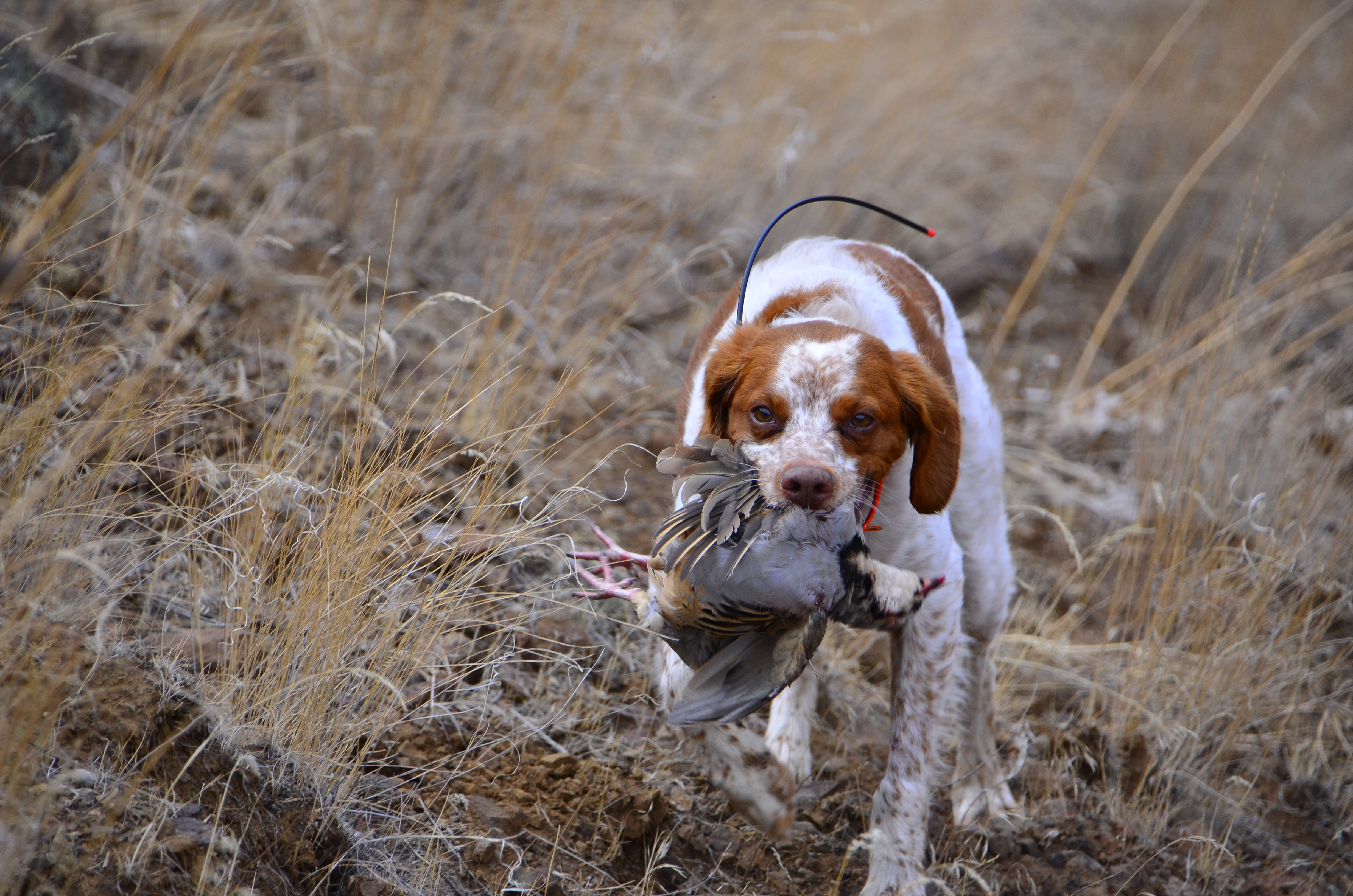
Peat’s first season hunting, five years ago, began quite stressfully for me (and, consequently, Leslie and Angus). The first six chukar I killed that season Peat stole from the retrieving Angus and ran off into the brush and ate them. Any normal person would have been quite upset about this. I was literally livid and utterly distraught. There was, literally, no hope for the future. The only solution would be for me to kill the bastard and then myself. It was the end of the world.

Many people who love hunting talk about losing oneself in the activity as the real benefit from and attraction to the endeavor. I’ve written a lot about that in one way or another. The impulse to take with absolute seriousness a dog’s behavior in the field — when it doesn’t go right — as the beginning and ending, the totality, can be a drawback, a mitigation of the blissful removal of the world hunting sometimes offers. It goes with the territory. It’s also awful to be around someone (me) who surrenders himself or herself to these kinds of imagined tragedies. The price of intensity? Or is that just an excuse?
Well, I was dead wrong, and Peat told me so. The seventh chukar he watched fall to the ground (shot actually by my brother, on a different hunt than the one in the video, about a week later and not far from the same spot in Hells Canyon) he brought at a full sprint straight to my hand. Talk about bliss. Talk about the impossible.
Peat has not erred since. He’s made some impressive retrieves on birds that fell in places I physically could not get to. He’s tracked down wounded birds that ran a long way from where they fell. He’s found birds I didn’t realize I’d killed. He’s just been consistently great at finding and retrieving birds. Yes, ironic.
Yesterday, in the midst of one of the worst shooting slumps I’ve ever had, I managed to wing a chukar on a steep ridgetop. I watched it sail away a little wobbly, and headed in that general direction. Peat found and pointed it, and I missed my second shot at it, and watched it jet straight to the bottom of the canyon and land in a hawthorn patch. With no birds in the bag, and a lot of hope it would die down there, I descended the 1000 feet to its landing spot, which took about 15 minutes because of the rocky and icy steep slope. It wasn’t there. My heart sunk.
Not Peat’s. His tail modulated madly and he clearly had the scent of the bird that had run out of the hawthorn and farther down the canyon. Knowing I’d lost about 1000 feet more elevation than I’d planned and had to regain to return to the truck, I waited and hoped. I watched Peat on my Alpha screen, his GPS collar telling me how far he was every 2.5 seconds. With a normal range of about 150 yards, I watched him go out past 300, then back to 200, then pinball back to 300. A minute or so later, he returned to me, no bird in his mouth. He reconnected to the scent of that bird, and headed back out. He did the same thing, going past 300, bouncing around there, and returning sans oiseau. I gave him some water and gave up, starting back up the long climb.

Peat got on scent again, and retraced his steps as I watched on the Alpha. Again he ranged past 300, 310, 320, bounced around, and then came back to me, this time with a large adult chukar, dead and broken wing, in his soft mouth. I looked at my watch. It was 30 minutes past when we arrived at the hawthorn patch.


Angus blessed us with so much beauty and greatness and left huge shoes for Peat to fill. I’ve been rough on Peat, victim to the comparison game. But I’ve also sung his praises, while never fully eluding the shadow of Angus. It’s a complication most of you who’ve had more than one dog understand. But this irony — Peat-the-bird-eater > Peat-the-retrieving-phenom — now instructs me to let that shadow go and give Peat unequivocal acclaim.
Peat is every bit as good a hunting companion as Angus was.


Chirp away