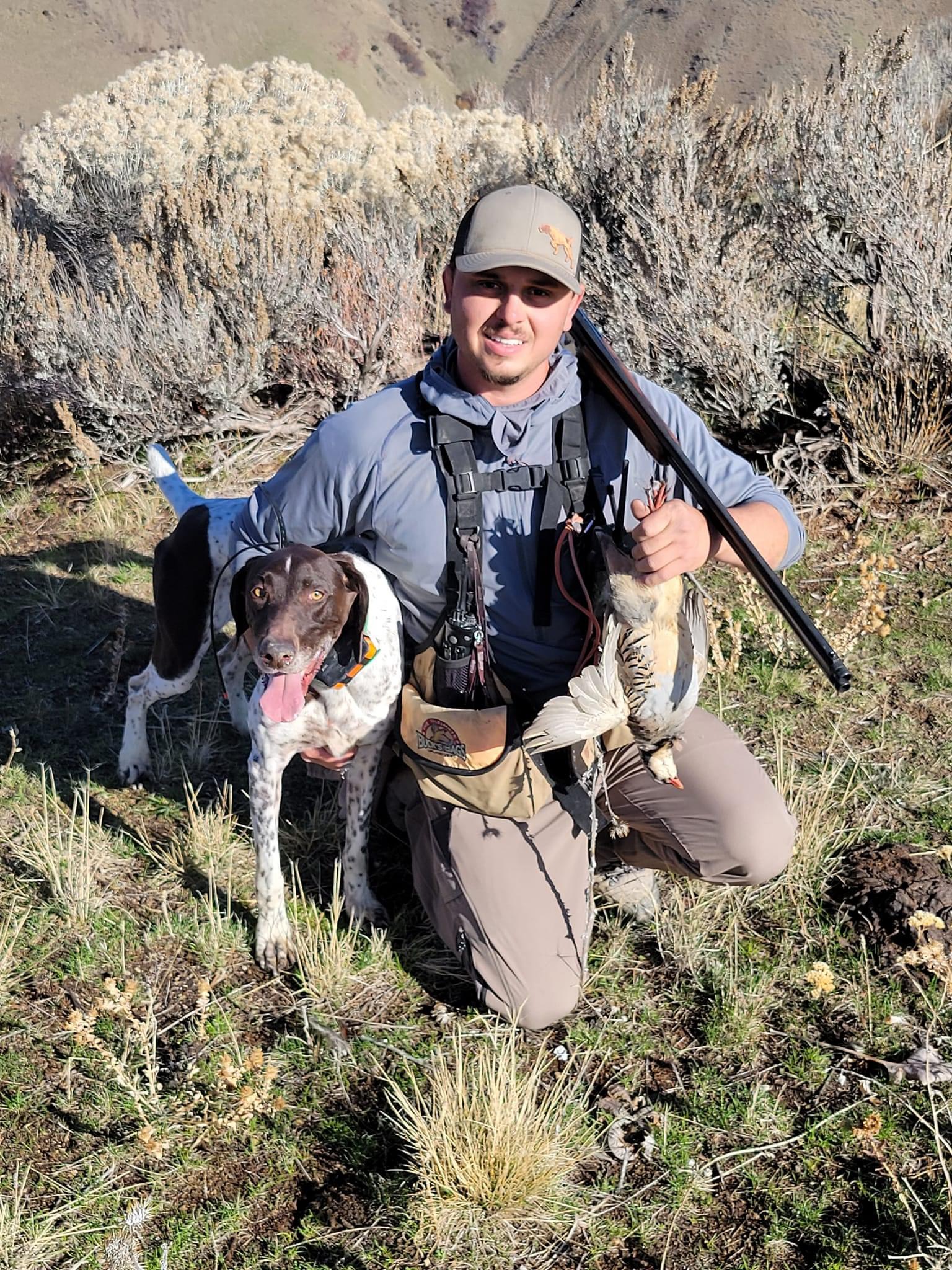
[NOTE: This is the “winning” retriever story, by Trevor Henderson of Twin Falls, ID]
Quinn and I were hunting chukars in the rimrock country of southern Idaho, the kind of steep, unforgiving terrain where birds run fast and fly faster. The dogs were working well that morning—Ryder and Joker ranging close, casting along the rocky edges. Then they froze—solid point. We stepped in, and the covey blew out like feathered fireworks. Amid the chaos, I squeezed off a shot and watched a bird fold, but we lost sight of where it went down. We figured it landed somewhere near where Ryder and Joker were already nosing around.
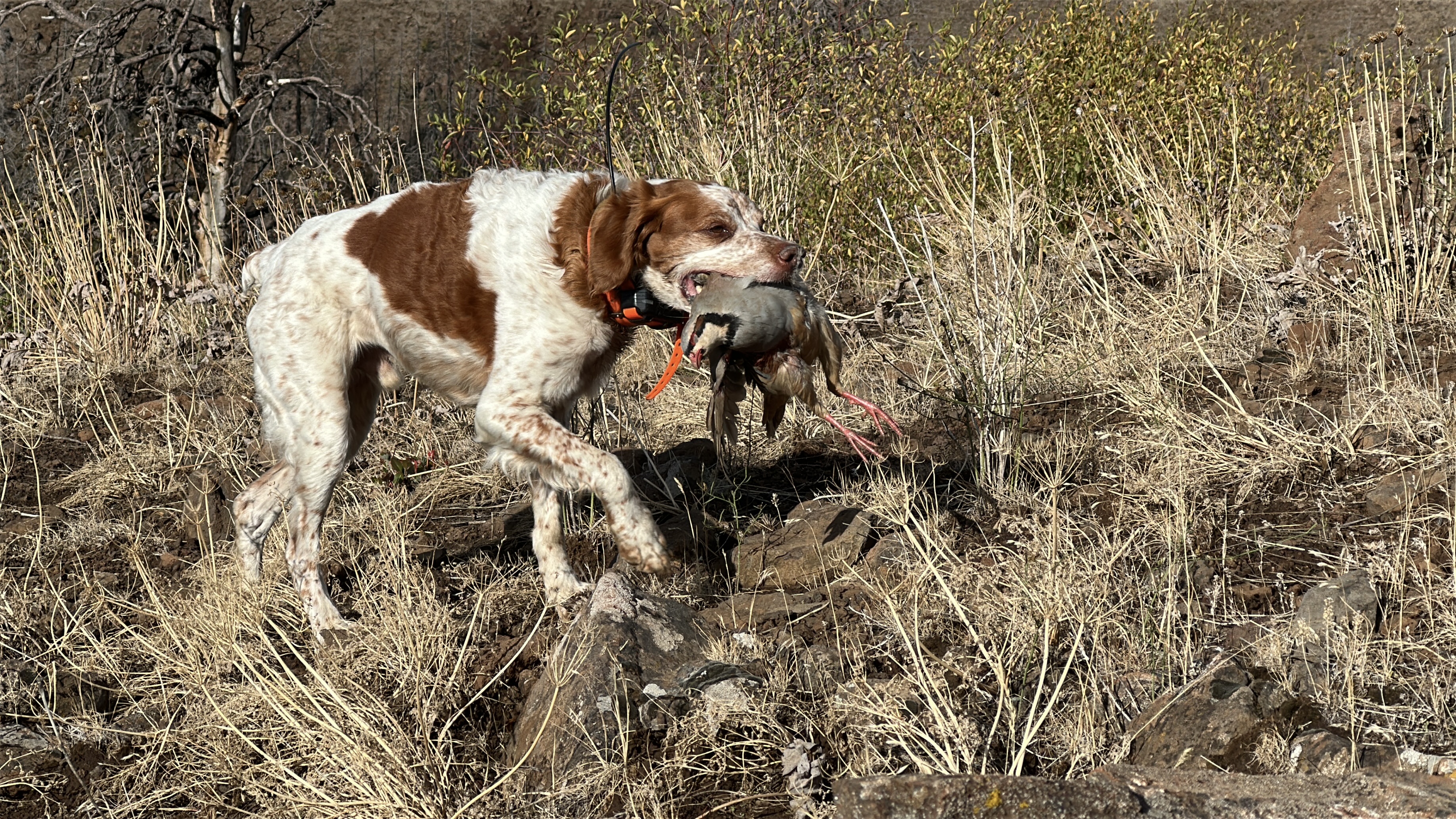
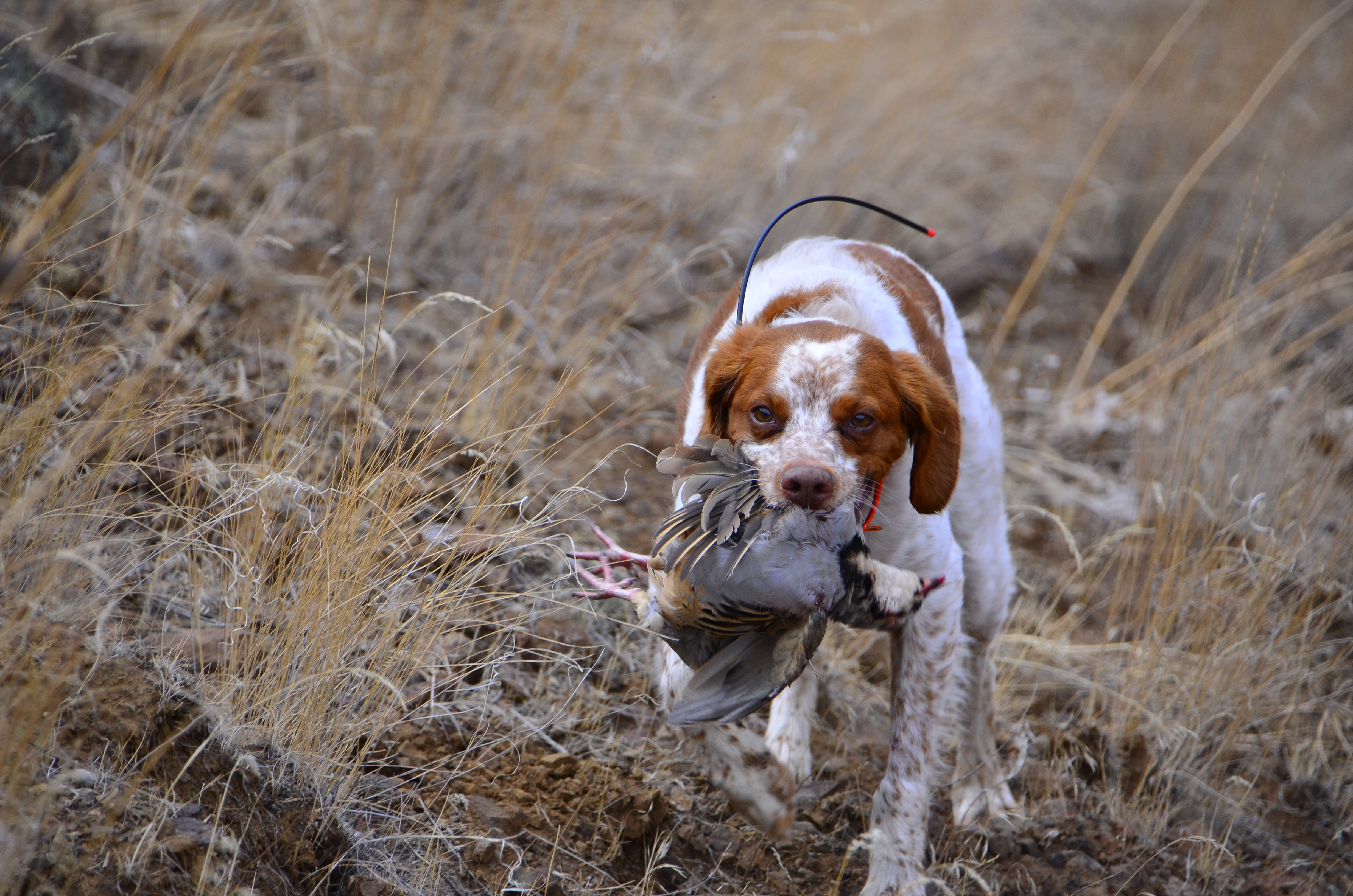
Five minutes passed. No bird. The dogs worked hard, but came up empty. Then, from far below, I caught movement. Ellie, my little liver-and-white sweetheart, had broken off from us, over 200 yards down the canyon. I whistled once, unsure what she was doing way out there. A few moments later, she crested a rocky rise, tail wagging, chukar in her mouth—our chukar. How she knew where it fell, how she found it when the others couldn’t… that’s something only Ellie could do.
That was Ellie—heart, drive, and nose like no other. She gave everything in the field, day after day. Last season, she was shot and killed by coyote hunters while we chased chukars in that same country. It broke something in me I don’t think will ever fully mend.
But I hold on to days like that one. When she proved, again, that she was more than just a bird dog. She was my partner, my friend, and on that hillside, the best damn retriever I’ve ever known.
Rest easy, my sweet girl. You’ll always be on point in my memory.
Ellie bringing back a chukar. (This and the featured photo of the author and Ellie are both courtesy of Trevor Henderson.)
Do you have a good retrieve story? I know there are some great ones out there. If you want to send your best story as a comment (please keep it under 500 words), I’ll publish the best one as a separate post (Leslie & I are the judges, and we’ll ask for a photo of you and your dog), and send the winner a copy of my new book, Chukar Culture: Memory, Dogs, Paradox.
The topic of retrieving, in fact, can be so stressful that humor is often forgotten. It shouldn’t be that way. Leslie just reminded me about the time I shot a chukar on Brownlee that we could not find. Three people and two dogs looked and looked, and finally gave up. As a last resort, we ended up looking for it along the cliffs when we were boating back to the ramp, and a friend of mine actually free-soloed up the cliff to check for feathers and found the bird!When he proudly brought the chukar back to me, we all noticed Angus sporting a wisp of arugula and a trace of mayonnaise on his lower lip, the last of my friend’s roast beef sandwich.
Years ago, when I was a kid and long before I began hunting, I loved Farley Mowat’s The Dog Who Wouldn’t Be. I think it was the opening of the book where he told the story of his dad’s dog who’d accompanied him downtown to a gun shop. Finding a nice side-by-side, the dad took it out on the sidewalk to see how it felt. Tracing an imaginary duck or goose, he said, “Bang!” The dog took off to who knows where, and his dad went back in the shop to haggle with the shopkeeper. A few minutes later, the dog ran into the shop with a taxidermied duck from a store down the street. At least that’s how I remember it.
Retrieving, and how well our dogs do (or don’t) do this, has been on my mind a lot in the first weeks of this new season. Bloom, for example, seemed to start off deciding he was no longer interested in retrieving; he’d be the first dog to a downed bird, pick it up, and drop it, sometimes several hundred yards down a steep hill, forcing me to lose all that elevation and get it myself. He did this on the first couple of hunts. I was dreading having to work with him to get him back on track. But before I had a chance to do anything, he shined on the next hunt, retrieving everything to hand. Since then he’s been perfect for some reason. Fingers crossed.
Bloom with one of his “reformed” retrieves (Peat’s happy just to watch)
Bloom did so well, in fact, for a couple straight hunts that I thought Peat had decided it was much more fun to watch, like Peter Sellers in Being There. But then…
On three consecutive hunts (the last three hunts I’ve done), Peat found birds I winged hundreds of yards from where I saw them land. Each time, he hadn’t seen the bird fall because they’d busted in all directions, and — like a good shooter — he’d followed a single bird or two which happened to be birds I did not shoot at. I had to call him over to the area and hope he’d pick up the scent. In all of the cases, he went a direction much different than I thought the bird had gone. In all cases, he disappeared for at least ten minutes in dense brush. And each time he came trotting up the hill with the still-live bird softly clamped in his mouth. There is no way I would have found a single one of these birds. He’s saved me, three times now, from losing any birds this season. He’s 10-1/2 years old. I’ve raved about him before, but — as Angus did before him — Peat seems to get better every time we go out.
Peat’s first season hunting, five years ago, began quite stressfully for me (and, consequently, Leslie and Angus). The first six chukar I killed that season Peat stole from the retrieving Angus and ran off into the brush and ate them. Any normal person would have been quite upset about this. I was literally livid and utterly distraught. There was, literally, no hope for the future. The only solution would be for me to kill the bastard and then myself. It was the end of the world.
Wait for it… I yell to Angus, “Don’t give it up!” Then you can hear the sound edited to eliminate my creative language…
Many people who love hunting talk about losing oneself in the activity as the real benefit from and attraction to the endeavor. I’ve written a lot about that in one way or another. The impulse to take with absolute seriousness a dog’s behavior in the field — when it doesn’t go right — as the beginning and ending, the totality, can be a drawback, a mitigation of the blissful removal of the world hunting sometimes offers. It goes with the territory. It’s also awful to be around someone (me) who surrenders himself or herself to these kinds of imagined tragedies. The price of intensity? Or is that just an excuse?
Well, I was dead wrong, and Peat told me so. The seventh chukar he watched fall to the ground (shot actually by my brother, on a different hunt than the one in the video, about a week later and not far from the same spot in Hells Canyon) he brought at a full sprint straight to my hand. Talk about bliss. Talk about the impossible.
Peat has not erred since. He’s made some impressive retrieves on birds that fell in places I physically could not get to. He’s tracked down wounded birds that ran a long way from where they fell. He’s found birds I didn’t realize I’d killed. He’s just been consistently great at finding and retrieving birds. Yes, ironic.
Yesterday, in the midst of one of the worst shooting slumps I’ve ever had, I managed to wing a chukar on a steep ridgetop. I watched it sail away a little wobbly, and headed in that general direction. Peat found and pointed it, and I missed my second shot at it, and watched it jet straight to the bottom of the canyon and land in a hawthorn patch. With no birds in the bag, and a lot of hope it would die down there, I descended the 1000 feet to its landing spot, which took about 15 minutes because of the rocky and icy steep slope. It wasn’t there. My heart sunk.
Not Peat’s. His tail modulated madly and he clearly had the scent of the bird that had run out of the hawthorn and farther down the canyon. Knowing I’d lost about 1000 feet more elevation than I’d planned and had to regain to return to the truck, I waited and hoped. I watched Peat on my Alpha screen, his GPS collar telling me how far he was every 2.5 seconds. With a normal range of about 150 yards, I watched him go out past 300, then back to 200, then pinball back to 300. A minute or so later, he returned to me, no bird in his mouth. He reconnected to the scent of that bird, and headed back out. He did the same thing, going past 300, bouncing around there, and returning sans oiseau. I gave him some water and gave up, starting back up the long climb.
I winged the chukar at the peak of the left side, and spent 30 minutes at the bottom while Peat searched for the bird even farther down.
Peat got on scent again, and retraced his steps as I watched on the Alpha. Again he ranged past 300, 310, 320, bounced around, and then came back to me, this time with a large adult chukar, dead and broken wing, in his soft mouth. I looked at my watch. It was 30 minutes past when we arrived at the hawthorn patch.
Angus blessed us with so much beauty and greatness and left huge shoes for Peat to fill. I’ve been rough on Peat, victim to the comparison game. But I’ve also sung his praises, while never fully eluding the shadow of Angus. It’s a complication most of you who’ve had more than one dog understand. But this irony — Peat-the-bird-eater > Peat-the-retrieving-phenom — now instructs me to let that shadow go and give Peat unequivocal acclaim.
Peat is every bit as good a hunting companion as Angus was.