Cleaned the last birds today. The wind here is ice. It’s our millionth day in a row without sun. We hunted every single possible day we could this season, except for the penultimate weekend when we both were sick. We literally outdid ourselves. So did the dogs. Angus is a miracle. I think he’s related to Ponce de Leon.
I can’t wait for next season. There’s a lot to think about, though, and stuff to do in the meantime. It’s important, but will be very hard, to stay positive. Those who know me understand what I’m talking about.
So for now I’ll say it was my best season in many ways. Coming back after last season’s back problems, and without “training” last summer (sitting in a drift boat doesn’t do much for one’s physical fitness), our average hunts were bigger in mileage, duration, and elevation gain than in any previous season. To say that at 57, after doing this for 20 years, I think is pretty lucky. Maybe it says something about desire. Maybe it just is.
Still, I noticed some things this season that weren’t all good, which I’ve mentioned before. Medusahead continues its literally uncontrollable spread-and-destroy blanketing of the range in southwest Idaho and eastern Oregon, and other noxious players are rapidly adding themselves to the list. Bird numbers here — I don’t care what anybody says — are down. The number of chukar hunters using ATVs down here continues to climb. Chukar hunting is my favorite thing to do, but it’s becoming the thing I worry about the most. That sounds silly. But it is true. These birds are pretty resilient, but they’re no match for what’s happening to their environment. Chukar are non-native, so maybe it won’t be such a great loss. But they’re in the same boat as the sage grouse and sharp-tailed grouse in these parts, whose numbers are nearly gone (Fish & Game’s last count in 2016 of the Midvale sage grouse lek totaled 2 — two — birds*). We need to do better by the wildlife we all devote our recreational spirit and finances to.
*From Idaho Fish & Game’s last statewide upland game report, from 2017 re: Sage Grouse in Washington County: “A report documenting seasonal distribution, habitat use patterns, productivity, and survival rates in Washington County is available. Washington County is unique because it is isolated from other sage-grouse populations and habitat; the land is highly fragmented and primarily under private ownership. West Nile Virus has surfaced annually in this area and much of the habitat has been converted/developed to ranchettes. The Washington County population will likely not persist within the next 10-15 years.” [my emphasis; p. 46]
Moving forward. Going backwards, uphill, and slowly descending.
Last hunt of 2020 for us was yesterday, I followed Bob around the chukar hills just like the old days. Camera in hand. No shotgun. Winter is my favorite time to be out there. It’s quiet.
Following tracks of ghosts of deer, elk, and birds. Detective work. Bob whispers to me, “I think they were just here.” I look down to examine the prints in the snow. Tiny dog tracks are heading upwards, the lone elk is going downhill. We keep going up.
We continue to follow Peat. He’s pointing 185 yards away. We look up to see if we can see him, snowflakes are gently falling to earth and into our face. We climb the steep ladder to get to him. He’s focused, patient, and won’t even look towards our direction but knows we’re finally there. His job is almost done.
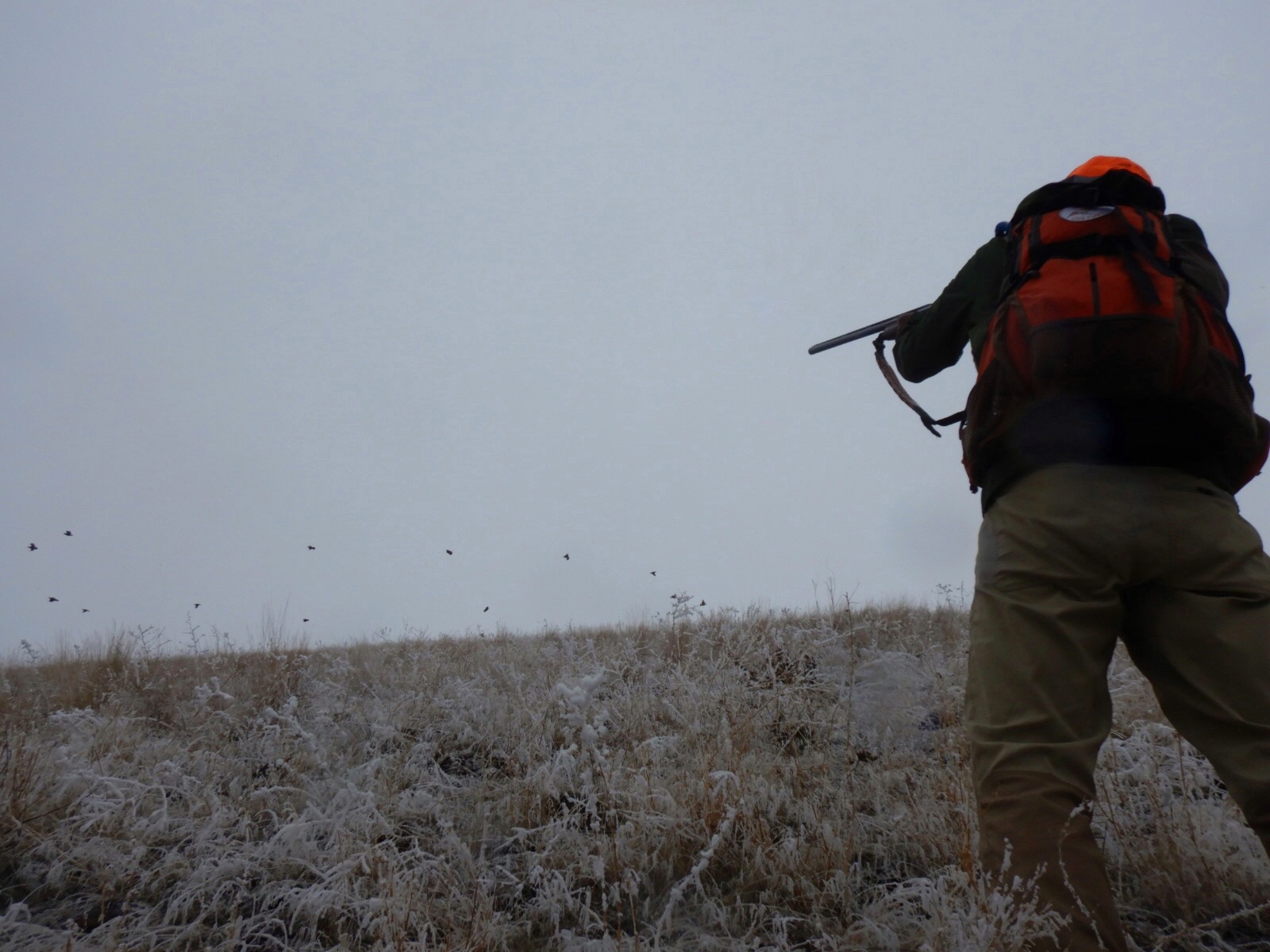
The covey busts, Bob shoots, Peat retrieves. Beautiful dog work. Magical. We continue this sequence a few more times finding new coveys and relocating old ones. The dense fog started to come up from below and the snow fell more heavily. We were dressed for the elements but the ground was getting slippery so we decided to head back to the pickup. Bob tells me, “Be careful on the downhill.” We headed down the same ridge we came up and our footprints, Peat’s, and the elk’s had vanished underneath a fresh dusting of snow.
Not just one dog but two. Not much more work having two. They get fed at the same time, go to bed at the same time, and adapt to each other’s miscellaneous routines at home, like, for example, keying off of each other when it comes to hearing something outside, both of them to end up running full speed through the kitchen and out the dog door barking their heads off. We’d gotten use to having two dogs around all the time at home and on the mountain. The one thing that I loved most about having two dogs was watching them hunt together.
Last June when Angus passed away from cancer it was an adjustment, and a void for everyone, including Peat who now has to do all the work by himself finding the birds. It wasn’t that he was lazy, but he was smart. He was like one of those co-workers that we’ve all had at one point in our lives, the ones that sit back and watch everyone work and then when the donuts arrive from the boss on Friday rush to thank everyone for a good job, and he’d be first in the break room to get the only maple bar. Peat would be the first on the bird for the retrieve, a covey of birds that he didn’t find in the first place but he’d bring the chukar to hand and get all the immediate praise that followed while Angus continued to hunt.
Peat this season was definitely forced to step up his game by being the lone dog. His average mileage used to be three times ours, now it’s four times. He can find birds and he’s the relocation specialist but his nose is either super sensitive or not fully refined because he’s really cautious on pinpointing the covey’s location and getting close enough. The birds are either just very jumpy and busting wild for other reasons. I don’t know if it’s because he spent so much time as the co-pilot.
The main thing I’ve missed this season is watching him honor another dog. Peat in action is a beautiful, mesmerizing and sometimes funny sight to behold. It’s by far my favorite part of seeing a pointing dog work. Looking back, I think he purposely let Angus find all the birds just so he could honor him. They had a beautiful relationship.
Before the season started, we stopped by to visit Angus and Peat’s breeder, Katie and Gabe of Sunburst Brittany’s and I casually suggested that maybe they could loan us one of their dogs. I wasn’t entirely serious and thought that it was stupid to even suggest in the first place, but in November they lent us and entrusted us to keep Custer, their young liver and white American Brittany for a few days. I was excited to have another dog to hunt with again, and I was equally excited just to have the presence of another dog in the house.
One-and-a-half-year-old Custer arrived, and from the get-go it was evident that he hadn’t been around cats before. He went on point when he saw Seamus for the first time. Peat soon took notice of what was happening and acted like he’d never seen a cat before, either (despite getting his ass kicked by Seamus on his first day with us almost 6 years ago!), and both dogs chased Seamus and both got a full set of claws in their furry snouts. From that point when Custer wasn’t tethered to me, he was in his crate on the floor. My 15-year-old cat continued to taunt him by sauntering past his metal crate door within an inch. Cats are masters of intimidation. Trying to train Custer, a kennel dog, to be a house dog that lives with cats in one day so he could be loose in the house was very optimistic.
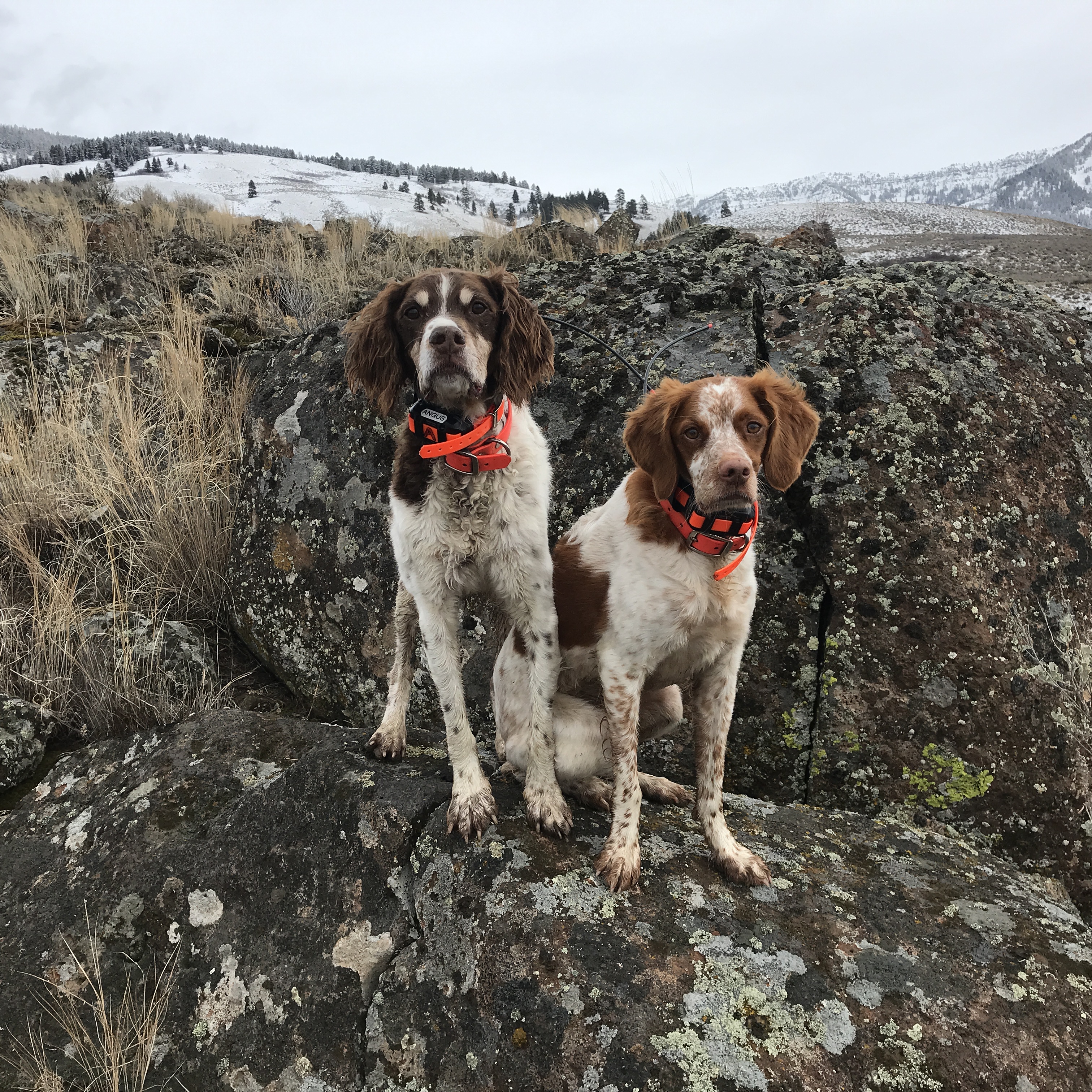
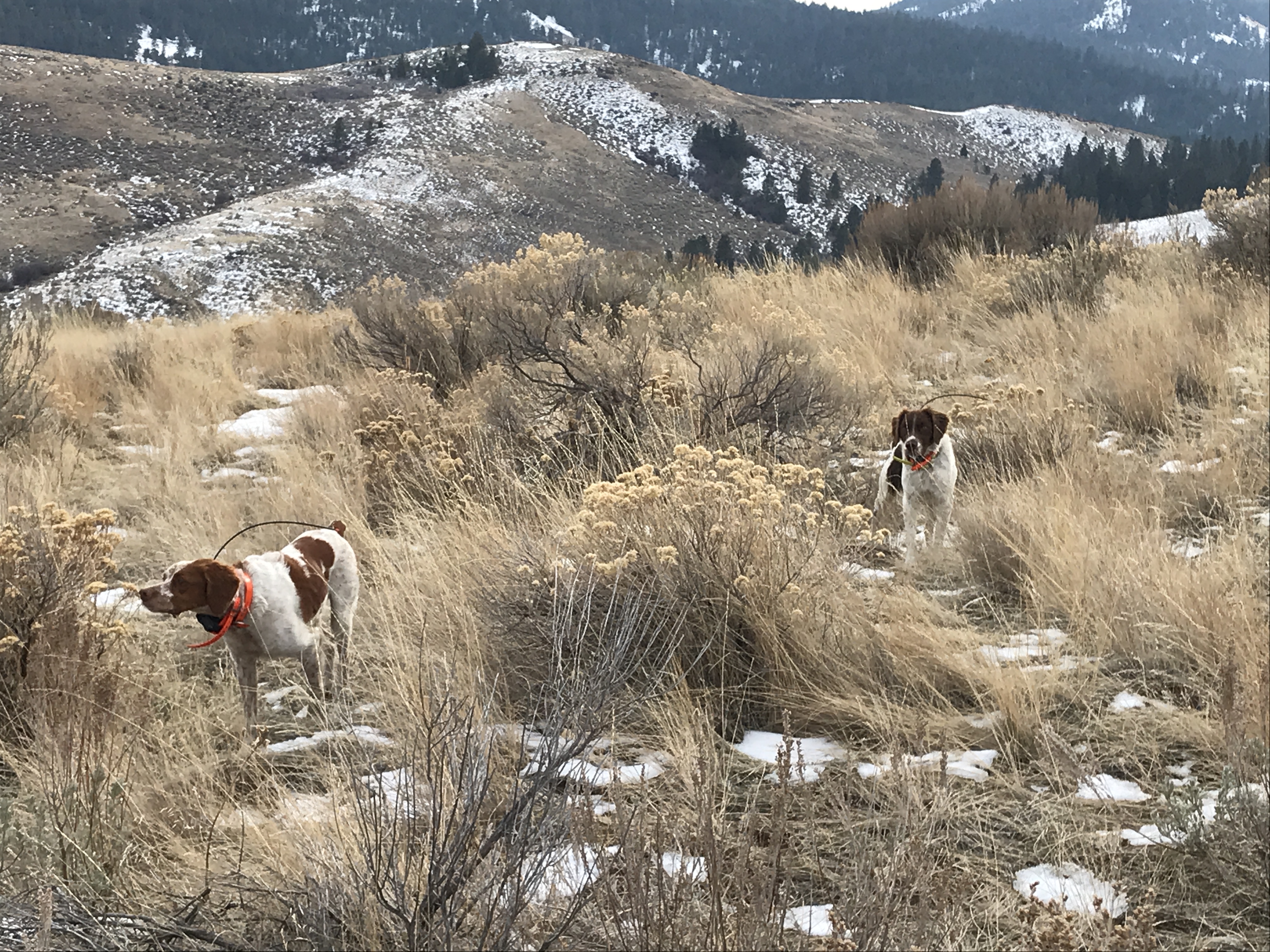
The following day, to give the cat a break from all of us, we took Custer out hunting with Peat to a place on some BLM land not far from where we live. We started out initially wanting to have Custer only hunt with me but realized that he hadn’t bonded with us yet and he wanted to hunt with Peat. About 20 minutes into the hunt, my Garmin beeped that Peat was on point. I headed his direction and could see Peat pointing and Custer honoring him through the tall bitterbrush. It almost brought tears to my eyes seeing two dogs working together again. Instead of getting into position to shoot, I pulled out my phone to photograph and capture the moment.
Custer honoring Peat for the first time.
The next covey of chukar we found, Custer was the first one to point. I slowly got into position and out of the left corner of my eye, I could see Peat running full speed right past him! Instead of honoring Custer, Peat ran right through the covey and busted them. Freaking Peat! I don’t know what he was thinking. I’m no dog psychologist, but on the next covey Custer found later in the hunt, Peat honored him. They took turns on a couple more coveys and we hunted with both dogs together at least six more times before returning Custer back to Sunburst. We would have preferred to have kept him longer if it wasn’t for the cat. I love my cat. That darn cat.
It was a beautiful thing to see Custer, Angus’s nephew, move with the same show-dog gait as Angus. He’s got the same sweet personality, and whisky colored eyes, and is a natural on the chukar hills. Custer is a miracle and a bright hope for the future where next spring a new puppy will be in our lives or maybe one of them will be in yours.
Merry Christmas and Peace on Earth. Enjoy the video!
Custer backing Peat again.Sunburst’s Custer and Peat, November 2020.Peat honoring Custer on some chukar. December 2020Custer post retrieveAngus and Custer, January 2020
Yesterday, Thanksgiving, we hunted a beloved area that got burned in a big fire that started on Labor Day. We weren’t sure what to expect, but have been anxious to see it up close for a while now. From the road, you can only see so much.
Inside it, the devastation was both unsurprising and heartbreaking. Along the creek, you could see temperature changes in the fire’s path, and the flames’ duration from spot to spot. I found myself weeping at times, and terrified when imagining what it might have been like to be there as the inferno navigated its way up the canyon. I felt grateful that the birds and mammals who called that place home are stronger and swifter and smarter than we are. I’m assuming they moved and hope they’ve found suitable habitation.
One of the reasons we chose this place was that I hadn’t bagged a grouse this year. Up high, fir stands in tight draws usually housed good numbers of dusky grouse, the biggest bird we hunt (although next year I intend to hunt sage grouse for the first time). Within five minutes I killed probably the only pair of ruffed grouse left down there. Gorgeous creatures, but the remorse I used to struggle with blind-sided me while looking at their feathers and blood dripping from their beaks before putting them in my bird bag. Clearly, and gratefully, only a temporary resolution.
No sign of chukar in the usual places on the way up. At the top, in the forest, the fire had been greedy thinning the undergrowth, and the large population of dusky grouse had obviously flown the coop. We angled up higher to more open areas whose robust blankets of bunchgrasses were toast, singed into a blackened crewcut. These rolling slopes covered in bunches of grass had made oases for chukar, provided protection from raptors, and now were desolate, bereft of blades.
At closer look, though, a happy sight: almost undetectable sprouts of green emerging from the scorched tufts. I wished I was a botanist so I could predict how long it would take these beautiful plants to reach maturity again and stand firm against the noxious invasion of medusahead, spotted knapweed, rush skeletonweed, and star thistle (among others) that seriously threaten this unique but delicate habitat. I’m eager for spring so I can see how these grasses have fared. I love them. I named one of my favorite beers after them (Bunchgrass Rye IPA).
On one knob that pre-fire was dense with sagebrush, large charred polka-dots showed only the charcoal base of these important and gorgeous plants. Another happy sight, though: in several of them, healthy deposits of chukar poo. Chukar have been there, but we didn’t see any and Peat didn’t find any on our 6-mile (and his 20-mile) hike.
The terrain lured us farther and higher than we’d intended, and on a snowy north-facing slope we found fresh dusky grouse tracks. Seconds later, Peat pointed into a stand of conifers. Two of the pterodactylic galliformes launched simultaneously. Leslie and I each shot at the only one without trees in its way, and we each killed it with shotgun shells I’d loaded containing some of Angus’s ashes. He loved grouse hunting.
On the way down, it was fascinating to see springs in places whose pre-fire plantlife concealed. There was much more water on this terrain, coming out of it, than I ever dreamed in the decade I’ve hunted there. It shouldn’t be surprising: this high desert landscape is stingy with water, so pockets of large plants on the otherwise arid land should signify a spring. Plant-bare, though, you can see it now. But the lack of cover at these springs meant we wouldn’t see any birds that used to chillax there.
Bagging three birds on this hike, despite the remorse, helped make it feel successful. I suppose I should assign more success to the fact that some of the vegetation is rebounding already. But the completely toasted creek bottom dampens the hope for recovery, there at least, because — unlike Hart Crane’s river — the fire did not quickly flee that particular watery spot. Fire and water, hope and sadness. Life.
An early ruffed grouse giftPick up your &%$@!# shells!Bunchgrass comebackPhoenixOther resurrectionsSigns of life and deathFirst dusky of the year (actually, only 1/2: Leslie & I both killed it)Big birds with excellent, appreciated proteinAngus’s legacy
I’ve hunted chukar for two decades now, and once in a while I’ll have a hunt that causes some kind of fundamental reevaluation of my identity. I earned an Ivy League Ph.D., and even I’m proud of that and view it as an accomplishment. At times, I’ve even thought it meant I was at least a little smart. As I struggle to hold onto some sense of myself as a responsible adult involved in a complex of relationships with obligations to and grace from a variety of creatures past, present, and future, what I’ve accomplished seems to matter more to me, and I’m suspicious of that mattering yet take some comfort in it all the same.
There are occurrences, though, that can jettison the whole bit. Usually, it’s kind of a delayed response. “What did I just do?” “I can’t believe I did that,” and it’s not the I’m-so-awesome-because-I-did-that. Instead, it’s the why-the-hell-did-I-do-that?
Yesterday was that kind of hunt. From the boat, based on my extensive knowledge (I’m being sarcastic) of all things chukar, the plan looked promising. Rocks? Check. Water? Check. Cover? Check. Green-up? Check. Tight draws? Check. And, almost as an afterthought: Steep slopes? Check-mate.
So, we tied off the boat and got our gear and dog ready and headed up the hill. We didn’t hear any chukar calling, but that didn’t mean anything. Peat wasn’t birdy and that didn’t evaporate hope. The paucity of partridge poop — ancient or contemporary — didn’t sway us from our quest. Hope is the thing with feathers, so up we continued.
I must have thought it twenty times before I said it to Leslie: “I’m sure Peat’ll point any time.” He didn’t. And so more up.
Just before the summit, which we never intended to reach because we’re so damned smart about this game that we just knew there’d be a bird bonanza at the most halfway up the wall, Peat did point. The birds held in the bowl’s bunchgrass, and Peat was a statue. It was gorgeous to behold. Leslie and I edged closer. The small covey of chukar exploded from where we thought they were, and flew the direction we believed they would. It was perfect. We both whiffed.
A few minutes later, at the summit, .9 miles and 1750′ above the boat, we marveled at the view: snowclad mountains in every direction, another big valley with a little town down in it, a bucolic foreground of gently rolling golden native grasses punctuated by swales. This late fall light is unbeatable. There’s a certain ecstasy paid for mounting a ridge like this. Maybe it’s really what motivates the attempt, but we tell ourselves we’re chukar hunting and hunting chukar.
On top, which is more Hungarian partridge than chukar turf, I managed two birds on lovely work from Peat. I would never disparage a Hun (except maybe Attila), but we’re seeking chukar. So back we went to the ridge and the rocks.
Within minutes, Peat points again, just at the crest of the ridge, looking toward the water. He’s much more cautious than Angus was, so I expected the birds to be a fair bit below him. Leslie and I dropped down the screed slope at least 100 or 150 feet before the chukar busted at least 30 yards below us. Tough to make those shots. We didn’t.
But we followed them: they flew north, and we relocated them, a bit lower than they’d been originally. It was deja vu all over again. Another follow and relocate (Peat is an incredible relocation specialist), and this time Leslie killed one. My missing streak was still alive! At this point, we’d reached the end of the drainage, so the birds scattered more high and low and far and wide.
This was the point I began to realize how gullible I was. They’d suckered me into losing half of my elevation. It does not feel good to realize you’ve been toyed with. It feels even worse to remember that this is not the first, or even the 20th, time they’ve done this to you. Being gullible means you take things you shouldn’t at face value. Check-mate.
I know they’re just chukar and have a brain the size of a dehydrated pea. But on their turf, without a new-fangled new brain to get in the way, their intelligence far surpasses mine. I could hear them calling close and far. Some of their muezzin seemed settled on the rocks just above me. I looked at my altimeter and it showed 1989′ of climbing so far. 2,000′ is a really hard day for me, and I felt toasted. But they lured me up. Plus, Peat was climbing into a creep following the ascending partridges; I knew a point was imminent. One must always honor the point.
I stood at the bottom of a tall rock pile. It was climbable, barely. It sounded like the birds were perched right above me. So I climbed, imagining I was a much older Alex Honnold with a shotgun strung to his shoulder. At one point I even did the karate-kick move they talk about in Free Solo. I nearly peed myself with delight. But when I’d scaled the “peak” it was just more rocks. And the birds seemed to have moved higher to an equidistant spot from me. So I pursued. Up another terrace. No birds, yet the calling continued all around me.
And then it hit me: they’re just f-ing with me. They got me to drop down all that way, and then they got me to climb back up another 800 feet after I was fried. Then I saw Peat point at the base of a rock wall near the very top of the ridge. The birds had no more vertical opportunity, so — as I figured they would — they flew horizontally to the other side of the draw. I could see them hopping around, smirking. I swear one even pulled out a Camel Light and lit up. They were about 100 yards straight above me as I watched them — one by one for at least 5 minutes — march triumphantly up the chute to the summit and out of sight.
This is the dumb way to hunt chukar. I highly recommend it, especially if you feel you could benefit from a total identity makeover.
Our route, which consists of two counterclockwise circles. The second, smaller circle is solid evidence of my stupidity. Industrious hot-spotters could probably figure out exactly where this is. I don’t care. Be my guest. Let me know how it goes!