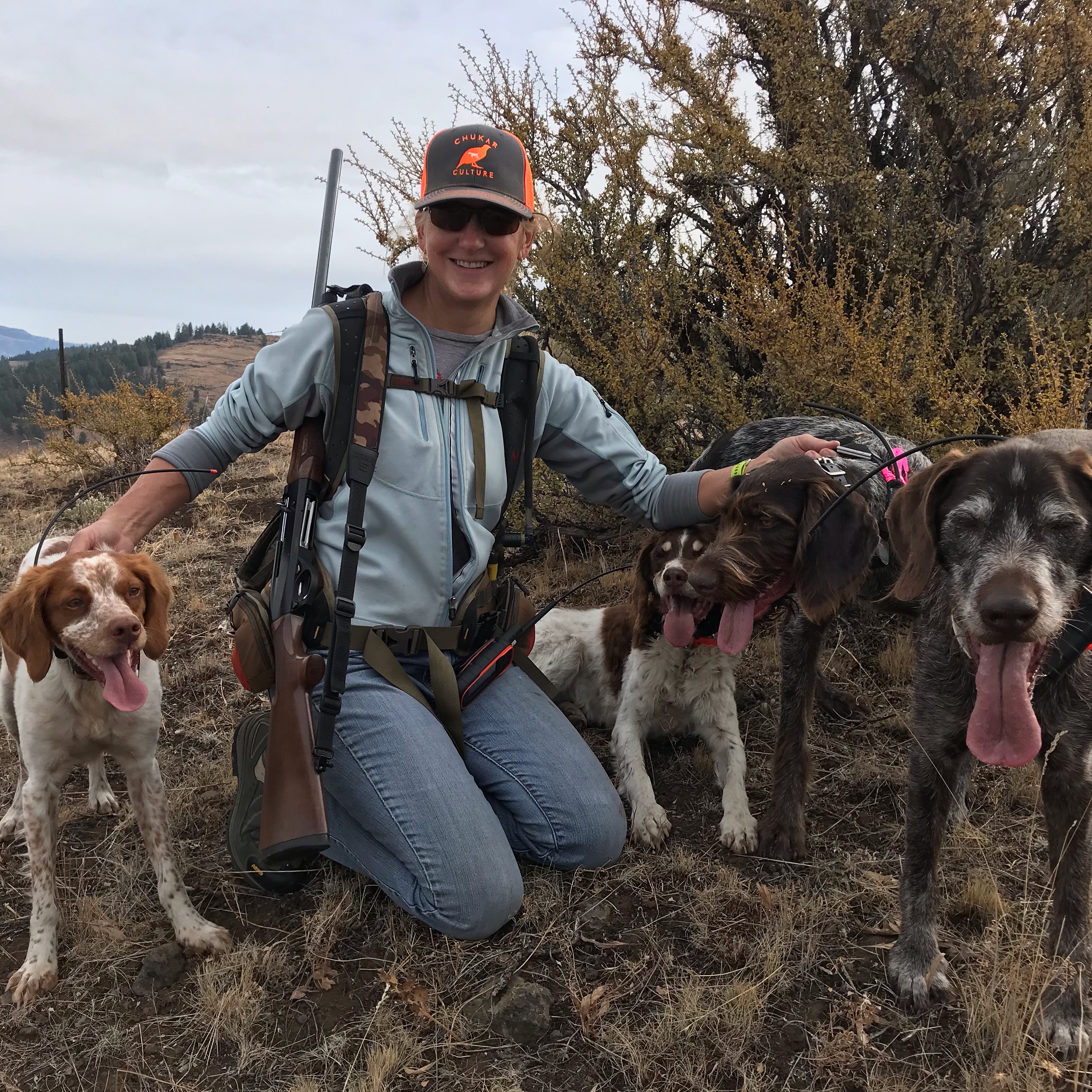
A while back we took a shooting lesson from a certified shotgun instructor. We learned a lot, it increased the number of birds we bagged, and improved the ethical component of upland bird hunting: more clean kills and fewer cripples.
The instructor, Joel Loftis, has written an impressively detailed guide aimed (pun intended) specifically at chukar hunters, and I’m pleased to offer it for sale in our Shop.
The Chukar Hunter’s Wingshooting Guide, which Joel wrote as an extended syllabus for his shooting students, includes a ton of information about vision, balanced loads, patterning, setup, gun fit, strategy, and has the most extensive bibliography of any upland hunting book I’ve seen. The guide reflects the intensity of Joel’s instruction style, is remarkably well-written, and is based on an impressively wide range of research. Chukar hunters will know that there are a few books out there on hunting this stellar bird (name the books), but none of them go into the level of detail Joel provides in this guide. Below is a photo of the Table of Contents. Check it out.
It’s on. Unusually cool weather for the opening weekend of chukar season made things more comfortable than normal, if “comfortable” is even legal to use in describing anything related to chukar hunting.
Waterdogs
We took the boat out on one of the many nearby reservoirs and found a spot that beckoned. I didn’t open with a triple on the first point as I did last year, but my shooting was better than normal; I’m not sure if it was superior focus, the bottled eagerness from having to wait 8 months to do this again, better positioning on the point (more on that below), unskilled elusive maneuvers by the young and unhunted birds, the new load I’m trying (more on that, below as well), or some of all of that. Or it could just be inexplicable. That would be fine. I like mystery.
The Aged Warrior of the Chukar Hills. 12+, going strong, kicking ass and taking names and chukar.
Leslie also made a nifty shot on a grouse-sized chukar, off of a swell point by Peat, the latter of whom chose to bypass Leslie and run over a ridge with the bird to bring it to me. I’m pleased he remembered our little chat about how I’d love it if he could help pad my stats this season: birds in the bag divided by shots fired = shooting percentage. Good boy!
Peat trying to pad my statsNifty, after a little reorganizing of the bag
Sunday we decided to try somewhere away from the water, and it held birds, too. I ended up with my first three-species bag of chukar, Hun, and quail. The wet spring and not-so-hot summer seemed to have been as easy on the birds as we’d hoped, and I was very pleased with the numbers of birds we saw in both places.
No birds in sight: notice the little things when you’re out there
This is not a complaint, because to do so would be stupid, but the percentage of first-year birds in my bag was very big and the birds were very small. Idaho did move the opener a week later this year (sort of), but in my humble opinion, even another two weeks would allow the birds to mature. I think Oregon’s season makes more sense than Idaho’s. But you don’t see me protesting by sitting out the first couple of weeks of our season. Not sure what to do with that.
Most of you probably already do this, but the last couple of seasons I’ve really been trying to make sure I’m below my dogs’ points by a good margin. If we’re climbing that’s obviously not that hard to do, aside from fighting gravity and the curse of aging cardiovascular and musculoskeletal systems. But when working a ridge or draws, and the dogs move down and find birds, I try to go really wide and down below the dogs by at least 10 or 15 yards and then slowly (and quietly if possible) close the gap. This has yielded far easier shots at birds than when I didn’t do this: downhill, curling shots with dogs in the way are nearly impossible, at least for me (and please don’t suggest the solution is to train steady to wing; we’re not going to agree on that). Ironically, when I was younger I’d obsess about not losing elevation, even on a point, so I’d go straight down to a pointing dog, and — at least 75% of the time — miss. Giving up an additional 50 feet of elevation in exchange for more humane and makable shots is very much worth it in my book. And I’m spending less on shells as my shooting percentage improves simply because of positioning.
I’m actually not spending less on shells, but buying fewer, more expensive shells. I’ve always shot cheap, lead 1-1/8 oz. 7-1/2 shells, all season, for all birds. My improved cylinder choke also never leaves the gun (except maybe for turkey season). I’ve never claimed to be a ballistics expert, or even that well educated on the matter. I’ve just used what I thought worked for me. A lot of people have suggested that #6 would be better on chukar, so I decided finally to give it a shot, but the only #6 shells I had were steel duck loads, 1-1/8 oz. I’ve only given it two days, but they worked well for me, and I’m going to try this for a while. I’ve wanted to move away from lead if possible, mainly for environmental reasons (not interested in a debate on this, either), but just haven’t done it for whatever reason. I might not stick to it, but I’m happy with the results so far. I also haven’t really done my due diligence and done the patterning and balanced load tests that Joel Loftis, the author and shooting coach (stay tuned for a post very soon on his Chukar Hunter’s Wingshooting Guide, which will be available on our website), recommends; once I do that I might have a completely different take. Still, in two days with lots of shooting I basically doubled my shooting percentage over last year, despite not shooting clays once this summer or pre-season.
So there you have it: an excellent beginning to the long-awaited season. We saw more chukar hunters in boats than I ever remember seeing, and plenty more on and around the hills, which is a good thing if we want to keep this thing going and the public land it happens on accessible. May each of you get out there as much as possible, enjoy the pursuit and your (and your friends’) dogs, and remember that it’s not just about the birds!
Someone tell Peat it’s not just about the birdsPost-opener conference in Hells Canyon Beer/Chukar Culture pub with the legend Sam
I admit it, I’m a sucker for trying to take a good shot or even a bad shot. A snapshot, that is. I always swear I’ll leave my camera or phone tucked away while I’m hunting but end up breaking my own rule. Bob even went out a couple of times without his gun and got some beautiful shots.
Tomorrow is season opener for chukar and grey partridge in Idaho. This will be our 10th year sharing stories and photographs of hunting wild birds in addition to sharing just a small taste of the culture of upland life in our neck of the woods.
A lot the hunts from last year were challenging, but we always have a fun and wonderful time when hunting alone or with family, friends, and good dogs. These are some of our favorite moments from the 2018/2019 season.
Thank you for following along on our journey each year. Maybe we’ll cross paths with some of you out there reading this right now. If we do, we look forward to meeting you.
Enjoy your season, happy hunting.
Leslie and Bob
Looking backSun and sagebrush
The low creep
In the bag
A walk for chukar with some Virginians
The wallDouble pointFinnFour pointing dog day
Pot of gold
New friends and old friends
The color of the season
Fence lineFavorite shade of blueHungryHoarfrostChargeAfternoon traverseThe long descentSamNose to the groundCovey riseInto the cloudsFocusedAged warrior
Frank O’Hara, “The Day Lady Died,” from Lunch Poems (1964)
Please, sir, I want some more…
Charles Dickens, Oliver Twist
Warning: This post is way less about chukar and more about culture, if you can call it that.
We’d probably prefer to think of the word “hunger” metaphorically rather than literally because it can represent a desire to achieve something great. Of course, as in Captain Ahab’s case, the merit of his quest was debatable, to say nothing of Jeffrey Dahmer’s. Still, absolute hunger is painful and real yet most of us don’t really know it.
But I wonder about my dogs. They might.
Peat, Angus, and before them Glenna, have all acted, all of the time, as though they were hungry. Because they never showed signs of being malnourished, I have always doubted them. Is it possible I’ve been wrong? To a dog, what is hunger? I’ll never really know.
My first dog, Glenna, began life showing no interest in food. It worried me. She was about two when that worry did a 180; a friend came to visit with his two dogs, who were very interested in their food. Glenna caught on and, soon, was food-obsessed. In her twilight years, she would stand in the kitchen, her neck sloping toward the floor, eyes raised and locked on us, and scream at us to feed her, even if she’d recently eaten. I often wondered if the megaesophagus that resulted in her early demise was some sort of cosmic payback. It’s awful to think that, but I did.
Glenna, about to yell at us.
Angus, I believe, learned his attitude toward food from Glenna, and then Peat from Angus, although Peat’s really ratcheted it up a few notches. Peat also picked up the coprophagy from Angus, who, maybe relatedly, is still the only dog I’ve had who drinks his urine.
Glenna teaching Angus how to eat woodAngus applying the principle to kibble
Before you yield to the temptation to offer me advice, I’ve tried for years to “solve” this shit-eating thing. The most comical attempt, looking back on it, was buying some very expensive powder from Drs. Foster and Smith that you sprinkled on the dog’s food to make its poop taste bad. If my reason hadn’t been clouded by my own hunger to stop Angus from this disgusting habit, I would have realized how funny the powder idea was. I mean, it’s shit. How can you make it taste worse than it already does? Needless to say, it didn’t work. Ha ha. Joke’s on me. And I didn’t learn from that, apparently: recently I purchased some (again, very expensive) probiotic powder to put on the dogs’ food, thinking it might help them more completely metabolize their meals and, thus, make the potential residual nutrition in their stools less appetizing. It didn’t work, and Peat might have developed a nasty rash from the stuff. If anybody wants it, the jar’s on top of our garage fridge.
Both dogs seem — except when hunting — glued to the idea that the world has food for them everywhere and their job is to find and eat it. Our walks are dominated by the poising of my thumb on the “tone” button (if it’s Peat I’m concerned about) or “momentary stimulation” button (if it’s totally deaf Angus I’m worried about) of the e-collar transmitter, hoping to distract the dogs from eating something I think they shouldn’t and which they think absolutely they should. It’s a perma-conflict. It makes me think of what someone once called golf: a good walk spoiled. It’s hopeless, too, because I nearly always have the wrong dog selected when one of them verges on an infraction. Peat stands on his back feet and scarfs chokecherries from overhead branches: I shock Angus. Angus stops mid-trail to inhale day-old turkey diarrhea: I buzz Peat.
Sometimes, we forget the collars when we’re home, which we always say we’ll never do again, and then we forget them again. As we did last night during happy hour, when it was 98 degrees outside and we thought we’d enjoy a beer in the shade. The dogs had had a long walk-run in the morning, gone in and out all day long, and seemed generally quite tired, and we had just fed them. Plus, when we sit around the table outside, they like to join us by jumping in the padded chairs and halfsnooze in our presence. But not this time. Clearly, they remembered something from the night before, and it wasn’t until we noticed they weren’t chillin’ with us (a matter of a minute or two) that we realized they’d headed straight for the quail nest they’d pointed 24 hours earlier. Leslie got there in time to watch Peat eat several of the eggs but somehow managed to shoo him and Angus off and recovered and replaced 9 of the eggs (we had counted 16 the day before). Leslie was more upset by this than I was (but then I wasn’t there, having chosen to remain in the shade with my new homebrew); I tried consoling her by reasoning that we can’t pick and choose which version of the dogs’ prey drive we approve of: we love and brag about Peat’s prey drive, which makes him a phenomenal hunter but which also, sadly, means we have to live with it when we’re not hunting. That very morning, Peat began the day with his usual pre-feeding charade of trying to out-cyclone a cyclone, alternating growling and attacking Angus with rapid-fire circle spinning from the bedroom through the dog door, all peppered with deafening coyote-like shrieks, and then gobbling his 1/2 cup of kibble in 4 seconds. Sometime after I’d gone back to bed (about 5:30), he counter-surfed a container of mini-cupcakes, took them outside, and ate all of them and part of the container.
Dogs pointing a quail nestPre-attack eggs…
So I guess I’m not sure where hunger ends and prey drive begins. How closely, if at all, are they related? If Angus hadn’t showed Peat his intense and nearly constant desire to eat or get fed, would Peat have limited his expression of hunger to the field? I’m under no illusion that we can change any of this (although I suspect some of you might disagree; as always, I’m open to suggestions). But, outside the annoyance of Peat’s daily insanity around feeding, I realized just the other day that I have spent the last 19 years worrying about whether my dogs are really feeling hunger. Because even just the feeling of hunger (and not actual hunger, where you’re starving literally) is painful, gnawing like heartbreak. I hope that’s not it. I don’t want my dogs to feel that.
When Peat was 7-months-old, we took him hunting with Angus to a place where his day of hunting lasted exactly 15 seconds. Upon arriving to our hunting destination, we let both dogs out of the pickup and before we knew what was happening we saw Peat streaking a 200-yard beeline to a covey of Huns that were hunkered down in the sage. Standing next to the pickup, we watched in horror as he flushed them before we could get there and then he proceeded to chase them for another 200 yards. Bob was furious and immediately banished him to the pickup and into his crate of shame for the remainder of the hunt. He sat there, staring out through the metal grates wondering what he’d done wrong.
Yesterday, I took our old Jeep out for a long drive with the dogs on dusty, washboard, gravel back roads near that place with them bouncing around in the back and thought of Peat and his rough start into the world of hunting his first season. If you’ve been following this blog since we got Peat, you’ll know what I’m talking about.
The following video is a tribute to the dogs. Most of us wouldn’t be doing this compelling sport if it wasn’t for them.