Blog

  • Youth Hunt

    Youth Hunt

    Idaho’s chukar season began on September 21. We were still fishing in Montana. On my first encounter with Idaho chukar this season, on October 1, I was hunting in a spot I hadn’t hunted before. I’d tried one other place for the first time about a week prior, but saw no birds or even turds there.

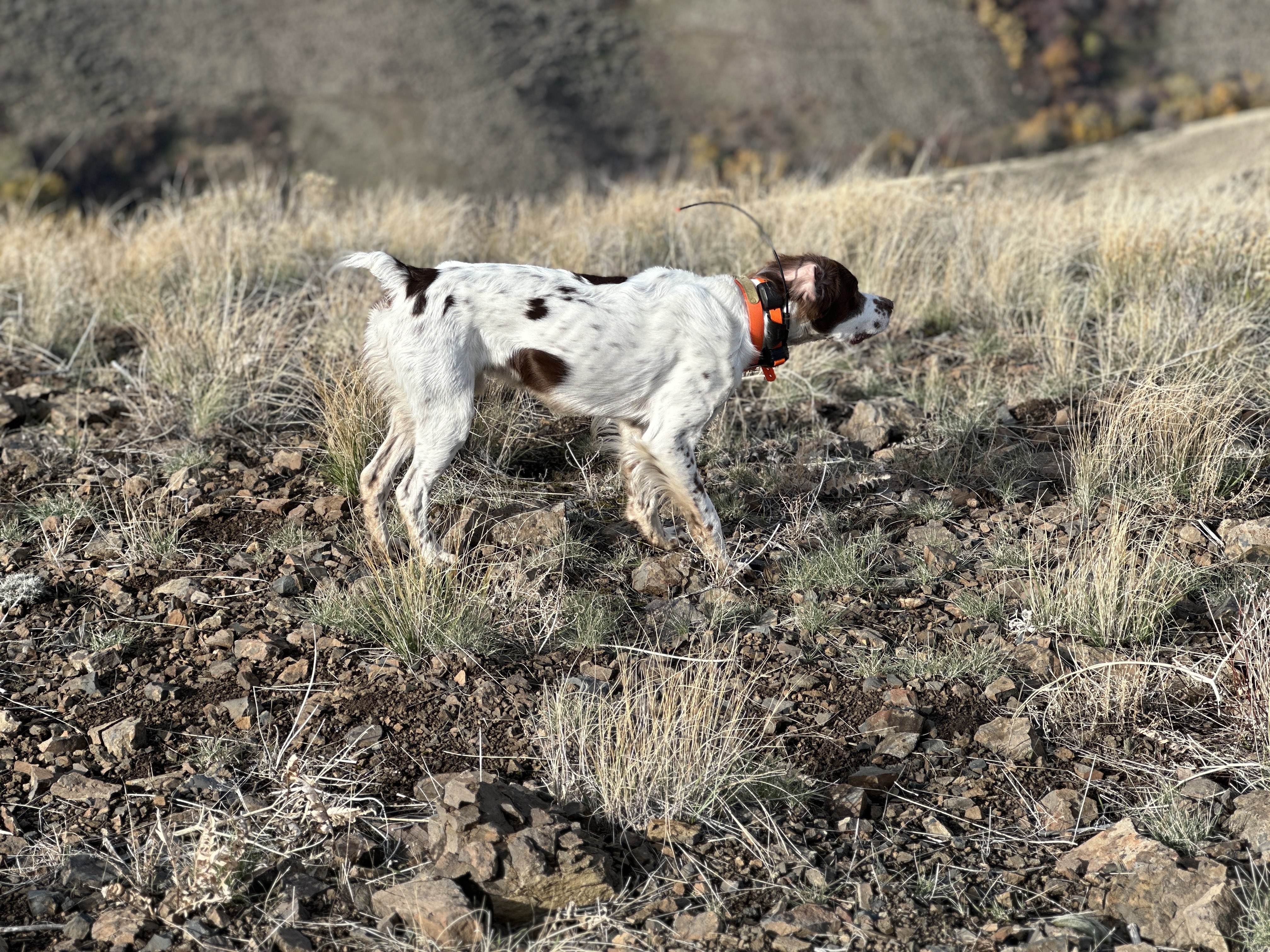
    When I finally joined the dogs after a rather epic brush-busting ascent up a steep incline, Bloom, who last season had been in the annoying habit of false-pointing several times at the beginning of hunts, went straight to what turned out to be a widespread, big covey of chukar in a roomy, shady bowl just below a ridge topped with large Ponderosa. Peat, as Angus used to do to him, initially honored and then crept past Bloom to dial in the birds’ location. As I crept close to the nearly supine, pointing Peat, the thirty or forty chukar busted in waves, from an area at least fifty yards wide, so shocking to me that I was able to manage only one prayer of a shot. Which I missed.

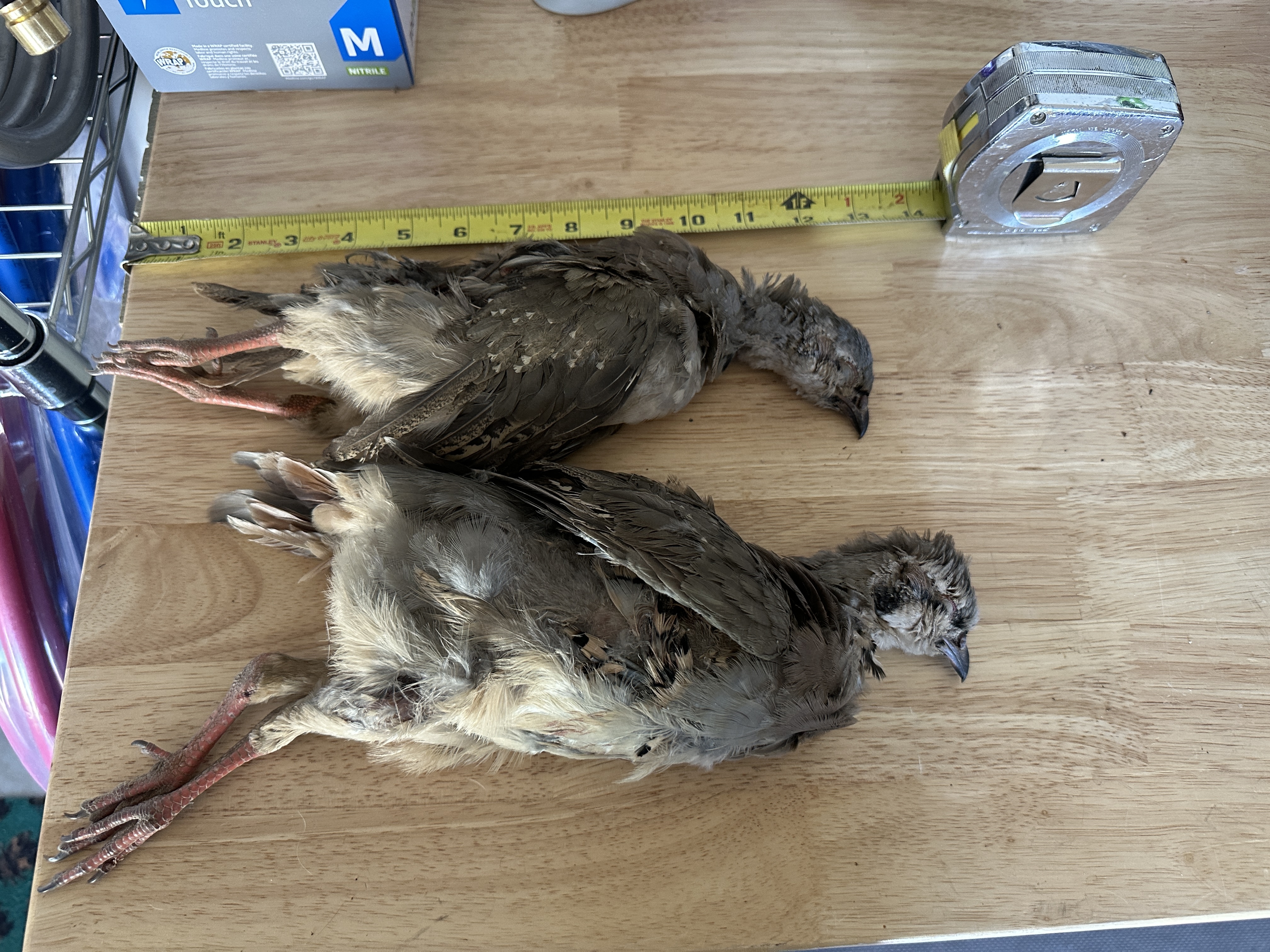
    A while later, Bloom relocated a small group and pointed them staunchly. I got one shot off and killed a bird, which Peat retrieved to me. It was a juvenile, with just a scant hint of the adult chukar trademark barred flank feathers. A few minutes later, Peat pointed another small group, and I shot one of them, which I saw Bloom retrieving toward me. I regarded with great pleasure and gratitude the balance of my dogs and today’s experience as Bloom brought the bird to me, dropping it at my feet. It was smaller than the first, not much larger than an adult quail. A few downy feathers had yet to be jettisoned. Not even a faint hint of the bandit mask or red beak.

    I’m a hypocrite in many ways, but have a long track record of hypocrisy regarding Idaho’s too-early commencement of chukar season: despite always feeling Idaho should match Oregon’s mid-October start, I invariably find myself unable to resist hunting for chukar on or near the opening of the season in Idaho.

    This day’s bag of two diminutive, juvenile chukar is just another confirmation of my longstanding belief that Idaho starts too early. There are many who will argue until they’re blue in the face against my assertion about Idaho’s too-early start to the season. Some have even thrown pop-science at me to counter-argue. I don’t even have pop-science on my side, just the evidence of my own early-season bags, which almost always contain numerous drab juvenile birds.

    In talking about this with a more knowledgeable friend, who happens (I was amazed to find) to agree with me, she made the point that the big outfitters on the Salmon and Snake that offer cast-and-blast trips in September are an effective lobbying force in Idaho’s legislature, which in turn — even more so now with the U.S. Supreme Court’s overturning of Chevron — basically runs Idaho Fish & Game (instead of science). Remembering that Idaho, not too long ago, delayed the start of chukar season and reduced the daily bag limit from 8 to 6, makes me think there’s hope it might revert to what I believe is a more reasonable approach — especially with climate change seeming to delay lots of natural development — but I won’t hold my breath on this.

    I thought about calling one of the bird biologists on the Fish & Game payroll to see what they think (I’ve done this before), and maybe they’d say it doesn’t really matter when the season starts because mortality is mortality and these birds don’t live longer than two or three years anyway, and hunters don’t really impact bird numbers over the long run. Weather, habitat, predators: those variables are much more significant than hunters. I’ve heard this before and it makes a certain amount of sense. Maybe I’d feel better about this if I had a better hand on the relevant science and it in fact showed that start dates and bag limits don’t matter. Even if that were true (which I’m too lazy right now to investigate), I’d probably still feel the same way.

    So what it comes down to is opinion, or, even less importantly, taste. Like preferring Coke to Pepsi, or Fords to Chevys. Brittanys to GSPs. I’m fine with that. But personally, I’m not fine with shooting chukar youth. It leaves a stain. But I’ll still go out, hoping my chances intercept adult birds. Hope, and hypocrisy, springs eternal and infernal.

  • Grousing

    Grousing

    I should have known better.

    As usual, I didn’t.

    Grouse in Idaho opened two days ago, so we decided on our initial attack today. Today’s high is supposed to be 96. It’s been hot, and smoke from a new fire near Cascade has choked our valley thickly after a brief teaser of a few clear days. The hills are parched and the trails talcum. Visibility is solely conceptual. But we left early, undeterred and — speaking only for myself — brain dead.

    This is the time of year I never seem to remember much. My excitement to get out with the dogs and the gun always seems to occlude the simple memory of years of early September disappointment of getting out with the dogs and the gun.

    We walked for a while on an old road that was supposed to be closed, but which vehicles had simply gone around the locked gate; onX and the USFS map show these places as non-motorized but in reality it’s a crap shoot if people comply. ‘Merica.

    After a bit, the dogs reached Pole Creek and we heard the first grouse bust of the day. My heart quickened. When we reached the tiny creek, we saw the typical nuclear winter of cattle. See the video. Or don’t. You’ve seen it before, I’m sure.

    The dogs busted a few more grouse but my heart had left the station.

    Remind me next year to read this post before I go grouse hunting again.

  • Erika

    Erika

    Thirty years ago I spent a month in Turkey. Erika had invited me to join her, and initially I thought it was a bad idea. I’d been chronically depressed and my therapist worried something bad might happen and trigger a personal catastrophe way over there. But I decided to go, and the thought of being in a different place began feeling more and more exciting.

    Erika and I shared the same birthday, hers being a year after mine. My oldest friend introduced us, thinking we might like one another. We dated for a while, but by the time she invited me to join her in Turkey things had cooled into a state I thought was undefined. Plus, she’d been gone a while.

    Hardly a day has passed since then that I haven’t thought of that trip. Talk about formative. Talk about memorable. I’ve been blessed with more than my share of stellar travels, and I think about many of those a lot still, too. But the trip in Turkey with Erika has stuck with me more than any other, and I’m not sure why.

    I’ve been thinking about it lately in terms of chukar, probably because the season’s almost here. Erika and I traveled to the eastern part of Turkey, at one point taking a fairly large risk traveling in an unmarked Turkish Army van into Kurdish territory near Armenia. Traveling through landscapes that — later — Hells Canyon would remind me of, I had never heard of chukar but am sure — now — that I had to have been looking at their native habitat.

    That van ride sticks with me. Over-filled with soldiers, who chatted nervously the entire several-hour trip, I understood nothing of what they said and was almost glad about that. Kurds had bombed a number of Turkish military vehicles on that road in the previous couple of weeks. Erika, the only female on board, was nearly fluent in Turkish and talked with some of the men. Straight-faced. I sat on someone’s lap and watched.

    But we got to our destination safely and spent a couple of nights with a group of Kurds near Mt. Nemrut. Music and dancing at sunrise on a mountain top built by a vainglorious king in 62 BC.

    Erika with Kurdish friend on Mt. Nemrut
    Sunrise on Mt. Nemrut

    Nearly everything we experienced on that trip was suffused with intensity for me. A hair-raising “cab” ride to a medieval ghost town on roller-coaster roads littered with sheep, one of which our frustrated Indy driver plowed into at high speed. A complicated, multi-person negotiation by Erika in a little town over what we needed to do to get to our hostel a few miles away. Having tea brought in a samovar to us on a silver tray by shepherds at a high mountain lake after they set up our tent for us, realizing we were beyond exhaustion. Getting lost in dense fog on a mountain peak the next day, afraid we’d perish there until we ran into a French mountaineer on a mission. Listening to Arif Sağ for hours and hours over the PA on a cross-country bus trip, not believing my ears. Somehow I got Erika to find out whose music that was. Some of my chukar videos on YouTube use Sağ’s music. Erzurum.

    The chukar hills of Erzurum
    Mountain shepherds with Erika and me in the Little Caucuses (before we got lost in the fog)

    Language has a lot to do with this intensity, with the adhesive quality of this trip’s memory. Communication. Until that trip I’d never been — and haven’t since — in a situation where I couldn’t communicate easily most of the time. English wasn’t common in Turkey, especially in the east, and Erika spoke five languages. I relied on her for everything. Movement. Nutrition. Lodging. Fun. Analysis.

    Which suggests something that looks like a trend, a fortunate one, in my life: trust in women more capable in important ways than me. I was raised from age five by a single mother who’d become a schoolteacher after her first marriage so that she could provide for her two boys. She wasn’t affectionate or textbook nurturing, but she was solid and I relied on that (she’s grown to be more affectionate with age, which I feel lucky to witness). In graduate school, I chose the one woman among my four advisers to direct my dissertation because I trusted her the most in terms of communication. The best boss I’ve ever had — my principal for the first three years I taught high school in Cambridge — was a woman, by far the most competent, fair, and reliable professional I’ve ever had the luck to work with.

    And so Erika. Soon after we met she revealed to me that a few years earlier she’d been hit by a car during a century ride on her bike, and that the majority of major bones in her body had been shattered. She’d spent a long time in the hospital. She said this matter-of-factly as she showed me some scars and her gnarled collar bones. After our trip to Turkey, we became better friends than lovers, and she continued developing her career as an agricultural economist, traveling all over the globe but also coming home frequently, often from the other side of the world, to do her share of care-taking for her cancer-stricken mother. I visited her in Mexico City, where she’d moved for a while and had a comfortable apartment. She spent a week or two with me and another friend at our cabin in eastern Idaho, fly fishing, hiking, and mountain biking.

    For years afterward, every August 26th she’d call me to wish us both a happy birthday. She did most of that kind of friendship tending, I’m ashamed to say. Once, for my birthday, she sent me a “Fly Fish Mongolia” hat from Ulaanbaatar where she was studying wheat farming. And she’d call me on that day no matter where she was, her voice joyous and always winningly sly, a soft laugh ready to pounce. Then, a year or two went by and I realized I hadn’t heard from her in a while. I did an Internet search sometime around 2010 and learned she’d passed away in 2008 from a long battle with ovarian and breast cancer. In all those phone calls she’d never once mentioned she was sick. Aside from the shock, reading her obituary was strange for a lot of reasons but one was how little I’d known about her. She was much more accomplished than I’d ever realized, which is saying a lot because — despite her definitive modesty — I always felt lazy and unremarkable around her, not from anything she did or said but simply from comparing our calendars. She was always heading somewhere far away to do something important. I was just hanging out, trying to pull my head out of my ass and finish my Ph.D.

    44 is too young. I can’t help but feel Erika was cheated. I’m still alive and have the tremendous luck to feel grateful our paths crossed. We all take too much for granted, but it seems that at least one measure of greatness in someone might come from an ability not to take much for granted. It exhausts me to imagine how that’s possible, how such people not only exist but prosper.

  • Snakebite

    Snakebite

    Camped on the Missouri River in Montana exactly one year ago today on August 1st, Bloom was bitten by that rattlesnake. It was a very hot morning in an area of golden colored stubbly grass parched from the summer heat. We’d been camped there to fly-fish and I’d let both Peat and Bloom off leash on this patch of dry earth just outside the campground boundary several times before without incident.

    Out of habit, and mostly peace of mind, our routine was (and still is) that we always put the Garmin dog collars on the dogs when they aren’t in a fenced area. I wish we had better control of them but we don’t. I always have the hand-held device for the dog collars gripped tightly in my hand or on a strap around my neck ready to audio buzz them to get their attention or for really serious offenses like the time that I caught Peat when it was too late, watching him roll and rub his entire body on a stinky dead skunk.

    The dogs in typical Peat and Bloom pent-up bird dog fashion, honed from too much time on the boat or in the pickup, get unleashed and they go balls-to-the-wall, nose skimming the ground, running like high speed freight trains. I prefer dogs with good noses but those noses can sometimes, actually most of the time, get them in trouble. In our case, unleashing the hounds is like opening the door to a free all-you-can eat breakfast buffet at Golden Corral. A few years ago, on the bank of the Missouri River over by Cascade, checking the boat ramp at Pelican Point, Peat found a ziplock containing florescent bright pink colored rotten Salmon bait discarded by some careless fisherman. He scarfed it down like he was in a Nathan’s hot dog eating contest. It happened so fast we couldn’t even react except to grab him by the collar, scold him, and put him back into the pickup. Within minutes as we were driving down the road, he was puking so violently it scared us. We pulled over to let him out to finish barfing outside and then cleaned the backseat floor mats of the pickup with our “dog vomit kit” that we try to keep stocked with rubber gloves and lots of paper towels. It wasn’t our first rodeo of dogs finding and eating nasty stuff plus puking in the car. It also won’t be our last.

    In that campground where Bloom got bit last year, the dogs were running around nose to the ground and both screeched to a halt and were curiously looking at something. I couldn’t see it at first and assumed it was just another dead ground squirrel or pile of old elk poop until I heard the rattle. Just like fast-draw Clint Eastwood in those fabulous old Spaghetti Westerns, I had that handheld that was around my neck in my hand so fast and I pressed hard with the button rarely used. The continuous shock one.

    Both dogs at once came running back to me and I remember thinking, “Thank God, nobody got bit.” Bloom, my sensitive dog, the one who yelps bloody murder when he gets the smallest needle injection at the vet, was actually bitten on the chin but didn’t show any sort of reaction when it happened. About a half hour later, he started acting odd and looking sleepy, and his chin started to swell. We searched but couldn’t find puncture marks but we knew right away he’d most likely been bit there.

    Making some quick phone calls, we found the closest vet clinic that carried anti-venom which was over an hour away in Twin Bridges. We loaded Bloom into the car and took off driving through Ennis, Virginia City, Nevada City, and Sheridan. Along the way just in case, I rehearsed in my mind what I’d say to the Montana state trooper that had pulled us over for very excessive speeding between all those towns that how dare they slow us down. It was something short and fast like “Bird dog got bit by a rattler!” I’d tell the officer and hope they’d would understand and let us go on.

    We arrived to the Vet clinic and they took him into the exam room for the anti-venom treatment. In the end, everything worked out. Bloom survived with very little complications except for some fur that won’t grow back on his chin.

    Post rattlesnake bite, 2 weeks of healing.

    First upland bird hunt of season. Sept, 2023.

  • January

    January

    I ran into a friend the other day who gave me crap for not posting anything for a while. I appreciated it.

    This used to be my favorite time of the bird season. Not as many people to contend with. Peace and beauty of a remarkably different quality. The “certain slant of light.” Snow concentrated the birds into predictable places, and they seemed to hold better.

    Now I just feel sorry for the birds and don’t have the heart to bother them. Big snow Januarys, along with very cold air and lots of wind make it hard to find bare ground and food. Their will to live far eclipses mine. I’m not sure if chukar do this, but I know ruffed grouse spend a lot of the winter in snow caves they make, which shield them from wind and much colder temps than if they were out walking around or roosting somewhere. My dogs smell them through the snow, and they’d point them and bust them, giving me another chance to miss (if it was before the end of the year; they still point and bother grouse in January). To me, that’s not fair chase.

    Being back in galliforme country this year has been wonderful. Our two-year remote yearn, idiotic as it was, helped me appreciate the good days we can get in the field here. And we got plenty — not as many as we’d hoped, but they were almost all good days. And we’re older, which should equate to more patience somehow, although — for me — it’s debatable (especially if you ask Leslie; some things do never change). The worst thing about feeling our season is done is seeing how pent-up the dogs are. But they’ll get over it. I have more things to do than they, so it’s not as hard for me.

    We aim to enter next season in better shape than we did this year. For some reason, we failed to get chukar fit by mid-September. Too much golf? Just lazy? Still, we hunted into chukar shape and were able to do some tough hikes. We haven’t practiced getting old, so feeling we are old is odd. Something else to figure out. Or just accept. I’ve been keeping busy trying to get my first real estate client (hasn’t happened yet), writing a bunch of stuff, including a short novel set in chukar country which I haven’t been able to get anyone interested in yet (not surprising, but I like it and think it’s good).

    I’ll end with this because it’s been on my mind all season: I’ve noticed more boot-prints in places I never used to see them, on ridges far from anywhere a UTV can go, which means people are spreading over more chukar terrain. I think that’s great. Get out there.