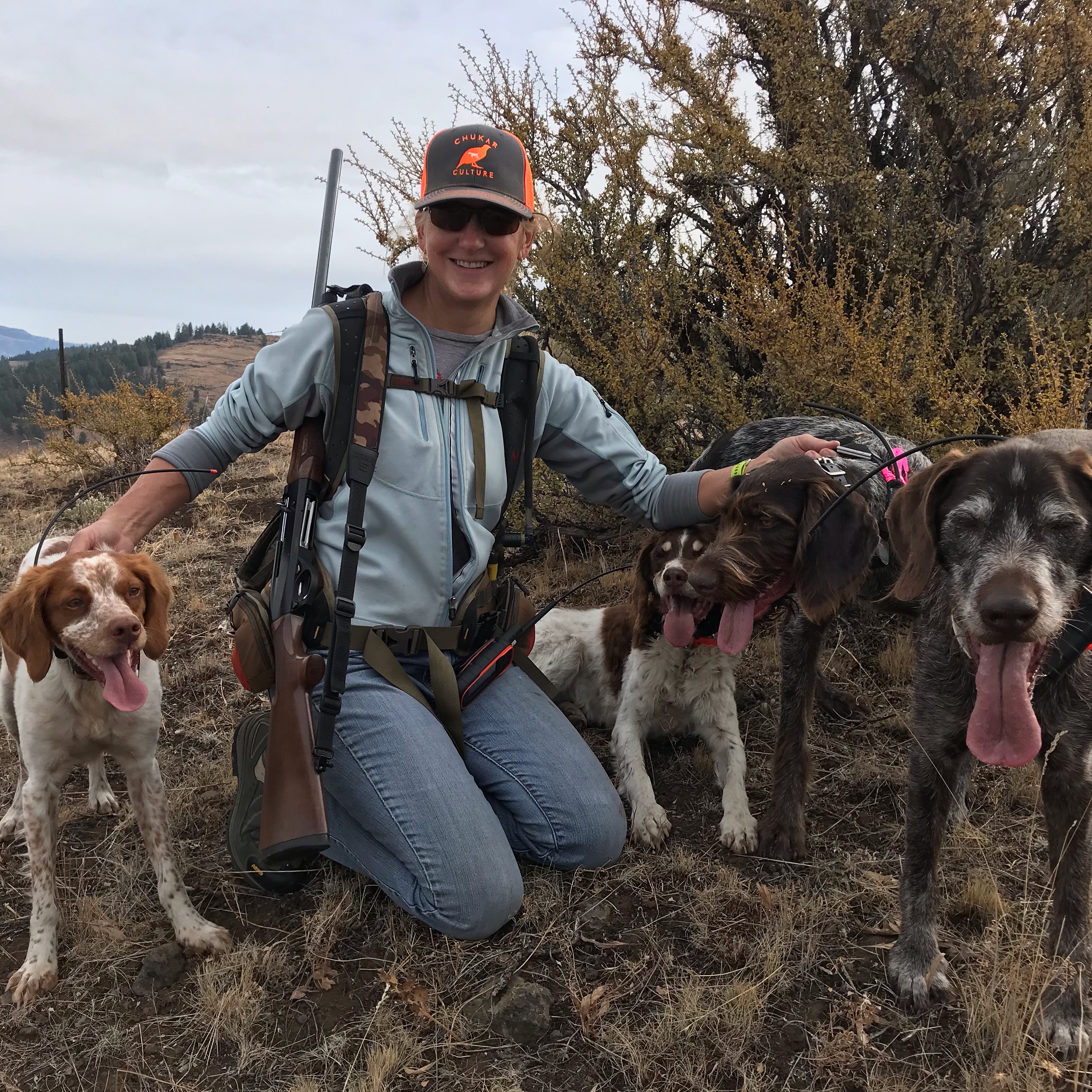
A while back we took a shooting lesson from a certified shotgun instructor. We learned a lot, it increased the number of birds we bagged, and improved the ethical component of upland bird hunting: more clean kills and fewer cripples.
The instructor, Joel Loftis, has written an impressively detailed guide aimed (pun intended) specifically at chukar hunters, and I’m pleased to offer it for sale in our Shop.
The Chukar Hunter’s Wingshooting Guide, which Joel wrote as an extended syllabus for his shooting students, includes a ton of information about vision, balanced loads, patterning, setup, gun fit, strategy, and has the most extensive bibliography of any upland hunting book I’ve seen. The guide reflects the intensity of Joel’s instruction style, is remarkably well-written, and is based on an impressively wide range of research. Chukar hunters will know that there are a few books out there on hunting this stellar bird (name the books), but none of them go into the level of detail Joel provides in this guide. Below is a photo of the Table of Contents. Check it out.
It’s on. Unusually cool weather for the opening weekend of chukar season made things more comfortable than normal, if “comfortable” is even legal to use in describing anything related to chukar hunting.
Waterdogs
We took the boat out on one of the many nearby reservoirs and found a spot that beckoned. I didn’t open with a triple on the first point as I did last year, but my shooting was better than normal; I’m not sure if it was superior focus, the bottled eagerness from having to wait 8 months to do this again, better positioning on the point (more on that below), unskilled elusive maneuvers by the young and unhunted birds, the new load I’m trying (more on that, below as well), or some of all of that. Or it could just be inexplicable. That would be fine. I like mystery.
The Aged Warrior of the Chukar Hills. 12+, going strong, kicking ass and taking names and chukar.
Leslie also made a nifty shot on a grouse-sized chukar, off of a swell point by Peat, the latter of whom chose to bypass Leslie and run over a ridge with the bird to bring it to me. I’m pleased he remembered our little chat about how I’d love it if he could help pad my stats this season: birds in the bag divided by shots fired = shooting percentage. Good boy!
Peat trying to pad my statsNifty, after a little reorganizing of the bag
Sunday we decided to try somewhere away from the water, and it held birds, too. I ended up with my first three-species bag of chukar, Hun, and quail. The wet spring and not-so-hot summer seemed to have been as easy on the birds as we’d hoped, and I was very pleased with the numbers of birds we saw in both places.
No birds in sight: notice the little things when you’re out there
This is not a complaint, because to do so would be stupid, but the percentage of first-year birds in my bag was very big and the birds were very small. Idaho did move the opener a week later this year (sort of), but in my humble opinion, even another two weeks would allow the birds to mature. I think Oregon’s season makes more sense than Idaho’s. But you don’t see me protesting by sitting out the first couple of weeks of our season. Not sure what to do with that.
Most of you probably already do this, but the last couple of seasons I’ve really been trying to make sure I’m below my dogs’ points by a good margin. If we’re climbing that’s obviously not that hard to do, aside from fighting gravity and the curse of aging cardiovascular and musculoskeletal systems. But when working a ridge or draws, and the dogs move down and find birds, I try to go really wide and down below the dogs by at least 10 or 15 yards and then slowly (and quietly if possible) close the gap. This has yielded far easier shots at birds than when I didn’t do this: downhill, curling shots with dogs in the way are nearly impossible, at least for me (and please don’t suggest the solution is to train steady to wing; we’re not going to agree on that). Ironically, when I was younger I’d obsess about not losing elevation, even on a point, so I’d go straight down to a pointing dog, and — at least 75% of the time — miss. Giving up an additional 50 feet of elevation in exchange for more humane and makable shots is very much worth it in my book. And I’m spending less on shells as my shooting percentage improves simply because of positioning.
I’m actually not spending less on shells, but buying fewer, more expensive shells. I’ve always shot cheap, lead 1-1/8 oz. 7-1/2 shells, all season, for all birds. My improved cylinder choke also never leaves the gun (except maybe for turkey season). I’ve never claimed to be a ballistics expert, or even that well educated on the matter. I’ve just used what I thought worked for me. A lot of people have suggested that #6 would be better on chukar, so I decided finally to give it a shot, but the only #6 shells I had were steel duck loads, 1-1/8 oz. I’ve only given it two days, but they worked well for me, and I’m going to try this for a while. I’ve wanted to move away from lead if possible, mainly for environmental reasons (not interested in a debate on this, either), but just haven’t done it for whatever reason. I might not stick to it, but I’m happy with the results so far. I also haven’t really done my due diligence and done the patterning and balanced load tests that Joel Loftis, the author and shooting coach (stay tuned for a post very soon on his Chukar Hunter’s Wingshooting Guide, which will be available on our website), recommends; once I do that I might have a completely different take. Still, in two days with lots of shooting I basically doubled my shooting percentage over last year, despite not shooting clays once this summer or pre-season.
So there you have it: an excellent beginning to the long-awaited season. We saw more chukar hunters in boats than I ever remember seeing, and plenty more on and around the hills, which is a good thing if we want to keep this thing going and the public land it happens on accessible. May each of you get out there as much as possible, enjoy the pursuit and your (and your friends’) dogs, and remember that it’s not just about the birds!
Someone tell Peat it’s not just about the birdsPost-opener conference in Hells Canyon Beer/Chukar Culture pub with the legend Sam
I admit it, I’m a sucker for trying to take a good shot or even a bad shot. A snapshot, that is. I always swear I’ll leave my camera or phone tucked away while I’m hunting but end up breaking my own rule. Bob even went out a couple of times without his gun and got some beautiful shots.
Tomorrow is season opener for chukar and grey partridge in Idaho. This will be our 10th year sharing stories and photographs of hunting wild birds in addition to sharing just a small taste of the culture of upland life in our neck of the woods.
A lot the hunts from last year were challenging, but we always have a fun and wonderful time when hunting alone or with family, friends, and good dogs. These are some of our favorite moments from the 2018/2019 season.
Thank you for following along on our journey each year. Maybe we’ll cross paths with some of you out there reading this right now. If we do, we look forward to meeting you.
Enjoy your season, happy hunting.
Leslie and Bob
Looking backSun and sagebrush
The low creep
In the bag
A walk for chukar with some Virginians
The wallDouble pointFinnFour pointing dog day
Pot of gold
New friends and old friends
The color of the season
Fence lineFavorite shade of blueHungryHoarfrostChargeAfternoon traverseThe long descentSamNose to the groundCovey riseInto the cloudsFocusedAged warrior
I’m seduced by landscapes. I’m enthralled by them.
Camping next to the Missouri River in Montana for most of the summer, Bob quietly tied fly-fishing flies while Angus slept near. A book sat on the table, a gift that arrived in our mailbox shortly before we left Idaho, given to him by a close friend. Not planning on looking at the book because I had brought along other things to read, I picked it up, thumbed through it, and immediately became obsessed with it. The beautifully written Landmarks by Robert Macfarlane is a gorgeous book on the language of landscapes and nature. It’s a collection of words drawn from dozens of languages and dialects of the British Isles to describe land, nature, and weather. It’s a passionate defense of nature as well as the importance of reflecting nature in language.
The book’s epigraph resonated with me and I’ve been unable to get it out of my head. “Scholars, I plead with you, Where are your dictionaries of the wind, the grasses? ” Norman MacCaig (1983)
There are too many definitions of words in the book to pick my favorites, but one that I like is zwer, “the whizzing noise made by a covey of partridges as they break suddenly from cover. “
Robert Macfarlane writes, “Without a name made in our mouths, an animal or a place struggles to find purchase in our minds or our hearts.”
The Oxford Junior Dictionary chopped words when reprinting its latest edition. Words like beaver, heron, minnow, dandelion and willow are now gone and they added chatroom, cut & paste, voicemail, and biodegradable instead. According to recent studies from The Nature of Americans, children are spending less time outdoors and in wild places.
We need to keep the words for the wild things. We need to make sure we never forget these words.
The swirls in the snow made by grasses blown by wind: anemographia.
While out upland bird hunting up and down the steep mountains, I get easily distracted. I’ll take my gloves off to touch with my bare hands the rough surface of the basalt rocks covered in patches of lichen shaded rusty orange and bright chartreuse green. I’ll gaze up into the sky to watch the bald eagles or red-tailed hawks catching the wind currents. I’ll push my way through the wild sunflowers with their brilliant yellow and delicate petals. I’ll slalom through the sea of sage with their three-lobed silvery green leaves, grabbing them in handfuls and pressing them up to my nose to inhale the bitter and earthly fragrance. I’ll stop to look at the knee-high dry grasses in the late autumn that show signs of new life as blades of green poke up through the dirt. In the winter, I’ll stop and look down at fresh snow and examine the swirls that the grasses made on the surface on a very windy day or admire the hoarfrost on a cold morning hunt.
During these moments of admiring the wild things, sometimes I forget I’m hunting and trying to keep up with the dogs to look for birds. Maybe I’m hunting for the wrong reasons or maybe I’m hunting for the right reasons? Maybe I’m hunting something other than birds.
Magical point. Hoarfrost: deposits of ice crystals on objects exposed to the free air, such as grass blades, trees, or leaves
My first dog before she haunted me. Looking out my classroom window today, the view of the opaque winter sky obscured by piling snow, I had this thought…
[This is a re-post from 3 years ago; 9 years ago today I had to put my first dog down. Glenna changed my life forever.]
When I was 37 I moved to Boise, Idaho, where I knew nobody and didn’t have a job. I rented a house, my first time living in a house since I left my parents’ house after graduating high school. It was a small house, with a small backyard closed in with a white picket fence and a one-car detached garage. Six months after moving in, I’d skin my first deer in that garage, my experienced younger brother driving from five hours away to teach me how to do it. My right index finger bears a scar from one of my slips with a sharp knife. That night, we grilled some of the meat and ate it with his wife and two boys.
I shot that deer with a friend of mine who was also on his first big game hunting trip. We stayed at my dad’s cabin in eastern Idaho, which I’d visited nearly every summer since I was 10, and whose existence and setting served as the primary reason I chose to move to Idaho. I wanted to hunt birds and big game as a resident because it was much cheaper, and Idaho had lots of public land and our cabin. Boise was a big town and I figured I could get a job and make a living.
It was a big change for me, and scary. I was lonely at the beginning when I was trying to figure out what I’d done, and why. The frame made sense to me, but the canvas was still blank. I bought a bird dog puppy from a backyard breeder in Mountain Home, my first dog, a few weeks after arriving at my rented house. The girlfriend from whom I was slowly separating helped me move from California, she helped me unpack, helped me buy sundries from Target, helped me absorb the weirdness of moving ten hours northeast. But she left after a couple weeks, and I got the puppy to stamp some kind of seal on my new life.
Glenna challenged me. I read the book my brother had used to train his remarkable first dog of the same breed. It sort of made sense, but the puppy didn’t, and I wasn’t a good trainer. A scar from her baby incisor on my left palm, near the thumb, reminds me of her jubilant puppy play. A decade after getting her, during which time I rarely hunted with her because she ran too big and hunted for herself, she was buried in my brother-in-law’s yard in the mountains not far away. Dave dug the hole, which, empty, looked excessively deep and wide, but just barely held her and her first toy, a stuffed cougar the size of a burrito. Dave had lots of experience digging dog graves, with several interred nearby. I dropped dirt as gently as I could on Glenna while my three-year-old dog Angus ran around, seemingly oblivious. I didn’t understand what I clearly saw.
Those first new months here, I told myself that this is my new life. I still tell myself that, despite all that’s happened since. It’s been sixteen years. There’s still the fluttering in my stomach, and the questions. And the images. The one that haunts me, the one that is among the richest and brings back smells and shapes and a certain humidity, is the sight of Glenna, white and orange, sitting upright patiently and eagerly from young puppy to full-grown dog in the middle of the green grassy backyard, bordered by white pickets she could easily have leaped over but never did, late in the July afternoon heat, fragmentedly shaded by huge catalpa and silver maple trees, waiting and looking and watching for a glimpse of me coming home from work on my bike.