Sometimes, the best way to define something is to begin with what it is not.
I think this is because the more stuff we get exposed to, the harder it is to distinguish between things that appear similar but really aren’t. The Internet Age has amplified this, as we all know. Social media in particular has grown into what a lot of people might call a necessary evil (although I personally think it’s very unnecessary, despite the fact that I use it). Each day more of us are seduced by it for one reason or another. And as that happens, the general discourse gets — in my opinion — degraded. This blog’s been around for about a decade, and until very recently it’s been immune to some of the ills I see in the discourse between otherwise anonymous people. “Civil discourse” seems to get rarer each day as keyboard commandos, trolls, and just straight-up assholes feel entitled to ruffle feathers just for the hell of it or, more likely, because they hate themselves and can’t think of anything better to do but project that self-hatred onto strangers.
So, to put it plainly, as far as what this blog is not:
— It is not yours — It is not a petri dish for trolls — It is not Instagram — It is not a forum for “free speech” or spam — It is not an outlet for unsolicited, uncivil discourse
What it is (as if that weren’t obvious):
— A place for my wife and me to share our thoughts, experiences, photos, and videos about chukar hunting and the culture surrounding it — A place for civil discussions in response to our posts
As I said, until very recently, the impetus for wasting bandwidth on this issue never existed here, but I feel compelled (and really saddened) now to do so because I want to make it clear that if you feel like being a jerk on this blog, I won’t give you the perverse satisfaction of publicizing your self-hatred. Sorry.
If you don’t like what I write, or what my wife writes, and want to say so, we want to hear it if you can be a person about it. I like disagreement; I learn a lot from it. But if you can’t be a person, please don’t read this blog and please don’t comment. Unsubscribe. Go spread your self-hatred somewhere else, or better yet look in the mirror and face yourself and get some help. We’d all be better off.
I’ve been thinking about reviewing this setup for a while: Garmin Alpha 100/TT 15 Mini. I wanted to make sure I knew it well enough, and that I had a definite opinion about it.
Now that I’m in my 5th season with it, I think I’m there. Before I got it, I posted some nasty comments about using, er, cheating with these kinds of things. I copped a purist attitude, basically suggesting that using a GPS collar for your dog was close to Internet hunting. I suggested that chukar hunters should keep track of their dogs, and if they couldn’t, well, there was something wrong with them, and probably something worse wrong with their dogs. I must have been in a bad mood. My students would say, “When aren’t you in a bad mood?” I’m teaching them about rhetoric, and they’re definitely getting the hang of the rhetorical question.
Anyway, I was wrong. Before I got the Alpha, one of the reasons I got in a bad mood while hunting was that I always knew where my dogs were if they were not on birds, but when they didn’t check in with me at the normal time interval (about 1-2 minutes), I knew they were pointing somewhere but I had no idea where. More often than not, I’d go the wrong direction only to watch a covey blast by me just out of range and my dogs hot on their tails. As Angus got older, but even better at finding and pointing birds, my hunting stress increased because I felt greedy about maximizing his points. With a dog that good, I felt obliged — yet unable — to be there for every one of his points. That was the tipping point for me to eat crow and get the system.
It wasn’t that hard to set it up, and once I figured out where to put it on my vest (which was harder than figuring out how it worked), my hunting stress level instantly decreased substantially. Actually, in terms of stress, it probably stayed the same, but it became almost totally positive stress (i.e., excitement). Rather than worrying about where the hell he was, the Alpha told me. I still tried to stay as close to him as always, and still took my cues from intensely focusing on his gait and tail, but when he disappeared, I didn’t have to wonder what direction or how far away he was. After getting accustomed to this, which took a few hunts, I remember laughing out loud to myself at how fantastic it was that I could actually enjoy the scenery when Angus wasn’t in my field of vision. I’d glance at the Alpha, and see that he was moving, and then go on my merry way.
Until it beeped that he was pointing: game on. Knowing where he (or Peat) was pointing allowed me to pace myself to get to him; if he was close, I’d basically run, and if he was far (200+ yards uphill) I’d run a little slower. Sure, the Alpha takes some of the mystery out of hunting, but it improved the economy of energy output, which has become more important to me as I get older and weaker.
There are lots of detailed reviews of the features of the Alpha and TT 15, so I won’t get into that too much. But I will outline how I use it not only to hunt but also to help me keep my hunting log. It took me a while to figure out my process and what settings to change so I could manage the data to my liking, so I’ll go through that here; if someone has a better idea, I’d love to hear it (I spent a fair amount of time trying to find information on the Internet, but basically struck out). To collect the data I want, I use Garmin’s Basecamp application, and created a simple Google Sheets (similar to Excel) form to chart the basics.
My Google Sheets hunting log; each season I make a new sheet (tab at lower left)
Before the Hunt
When we get out of the truck, the first thing I do is turn on the TT 15 Minis and put them on the dogs. Then I put my vest on, turn on the Alpha unit, wait a few seconds for it to boot up, and then select “New Hunt.” When it asks if I want to set the current location to “Truck” I select “Yes.” This clears the previous data that I’ve already transferred to my computer after the last hunt, and makes it easier to see my current track during the hunt (which I never, ever check, but if I were to get lost or want to find the dogs it would make it easier to see on the map screen because the previous hunt(s) wouldn’t be shown).
Select “New Hunt”When you select “New Hunt,” it asks if you want to clear previous hunt info, etc. Hit “Yes” if you’ve already uploaded the previous hunt information.Selecting “Yes” here does two things: sets the starting point for your hunt track, and will help you navigate back to your truck if you get lost. I’m not sure if it works for cars or SUVs, though. LOL.
Then I scroll down and select “Trip Computer.” I select the Menu icon, and select “Reset” and then “Reset Trip Data” and then “Clear Current Track.” Doing this restricts the data you transfer from the Alpha to Basecamp to that day’s hunt; if I do a bunch of hunts in a row when I’m away from home and don’t transfer them to my computer after each hunt, I don’t reset these things at the beginning of each hunt, and then when I transfer the data I’ll manually separate the hunts, which is not difficult.
“Trip Computer” screen: my finger’s on the menu icon…Select “Reset”…First select “Reset Trip Data”…“Yes” will reset all trip dataSelect “Clear Current Track”…“Yes” will clear the track log, which will give you a “track” for today’s hunt that you can upload to Basecamp.After the Trip Computer has been reset…
During the hunt
Once we head away from the truck I select the compass icon on the Alpha to make sure both dogs are registering; you can see thumbnails for up to three dogs on one screen, or you can change your display settings to Big Numbers (by selecting the menu icon), which is much easier to see the yardage information, but requires you to scroll through multiple dogs, which I find too cumbersome. I have to squint to read the yardage (distance each dog is away from me) with the smaller numbers but prefer to see both dogs at once on the same screen.
To make sure the dogs’ collars are being picked up, select the Compass icon, upper right…This shows Peat “pointing” 32 feet from me, and Angus 60 feet to my southwest, but heading northwest.If you press the menu icon on this screen……you can change the little dog thumbnails to “Big Numbers,” which will show one dog at a time…To see the other dogs, you scroll horizontally with the arrows above the Big Number thumbnail.
The directional arrows show each dog in a different color (Peat is green, Angus is purple), and that’s easy to read at all times regardless of whether you have the big or small numbers selected. Garmin recently added a feature to the thumbnails that shows the current direction the dog is moving, which is pretty cool. For example, if Angus is north of me but coming back my direction, the purple hand on the big dial will show him to the north, but thumbnail has a little pointer showing him moving south, and his yardage will be decreasing accordingly. I like this little update because it helps me see patterns in how the dogs hunt, which can allow me to anticipate where they might be going and decide if I want to buzz them to come back or change the direction I’m moving.
When the dogs stop for more than 5 seconds, the Alpha vibrates and beeps and a message saying “Angus on point” comes up. If they remain on point, the dog’s thumbnail shows an icon of a pointing dog (cute), and shows the yardage. Peat stops a lot to admire the scenery (or eat cow manure or worse), so he generates a lot of false alerts. Angus seems to move constantly enough so that when I get an “Angus on point” message, it’s almost always legitimate.
Three dogs showing on small number setting; Champ is pointing, and the other two dogs are moving. This Garmin photo is before they updated the moving dog icon to the little directional arrow.
The pointing dog’s (or dogs’) hand on the dial points me in their direction, and I high-tail it to him, checking the yardage occasionally, and making sure the pointing dog icon still shows; sometimes they’ll start moving again and there’s a little emotional deflation when I see the tiny directional icon and changing yardage which indicate the dog is moving again. In open country, of course, it’s easier to pick up the dogs visually than in heavy sage and bitterbrush, or in tightly undulating or rock formations, so my reliance on the Alpha varies depending on the terrain.
The only other thing I regularly use the Alpha for during the hunt is to correct the dogs, usually to try to get them to come back to me. For Peat, this means beeping him, and for Angus — since he’s deaf and can no longer hear the beep — giving him a small electrical nick. You can program the three buttons at the top to do several different things, at different stimulation levels for different dogs. This is where the second “T” in the TT 15 comes in: TT stands for “track” and “train.” Thanks to Garmin buying Tri-Tronics they were able to incorporate e-collar functionality into the GPS tracking, which means we don’t have to force our poor pups to wear three collars on a hunt.
For each of the three buttons at the top, you can select from M (momentary stimulation), C (continuous stimulation), T (tone), or V (vibrate), and adjust the level of stimulation (only for M or C; tone and vibrate are at a fixed level).
Occasionally I’ll look at the map icon to check if I’m still on public land, but now that I have OnX on my phone, I usually use that since the screen and resolution are better, and it has the landowner information on it.
After the Hunt
When we get back from hunting, I plug my Alpha into my laptop, open Basecamp, and transfer the data from the Alpha into Basecamp. Then I look at the left column and double-click on the “current track” from that day’s hunt, which gives me the mileage, the duration, and the elevation gain, which I enter old-school style into my Google Sheets hunting log. Then I’ll open the track for each dog for that day, and enter their data (mainly the distance) into the hunting log. I used to mark coveys on the Alpha during a hunt, but don’t bother doing that anymore, mainly because it doesn’t matter in terms of planning a hunt, and it’s kind of cumbersome: the little bird icons end up dominating the map screen (I think I stopped doing this after marking over 100 coveys). The Basecamp app doesn’t really excite me, but honestly I haven’t spent a lot of time trying to figure it out. It’s free, and it allows me to transfer my data to the computer. You can save your tracks and other data as GPX files to use with other applications, but I don’t have the time to mess with that too much. OnX has a tracking feature that looks pretty cool, but I haven’t used it yet, although a friend easily sent me a waypoint from a spot where she found some birds…
Annoying Things About the Alpha
Aside from the high price tag, the Alpha has only one really annoying thing that I haven’t figured out how to fix: whenever I hunt with Leslie, and we get on different sides of a ridge, the Alpha sends warning messages and beeps fairly frequently, saying that we’ve lost communication with each other and with whatever dog isn’t near the respective Alpha. The warning is the same beep and vibration that you get when the dogs go on point, so I constantly have to look at the Alpha screen to see if Peat’s pointing or if I’ve lost touch with my wife. (There has to be a joke in there somewhere, but I’m not touching it.) If anyone has a suggestion on how to remedy this (the Alpha thing, not my marriage), I’d love to hear it.
Overall
I love this thing. It’s made my hunts more enjoyable and relaxing, and I’ve had way more action with the dogs because of it. It’s held up well (so far; mine is in its 5th season, Leslie’s is in its 3rd). I’m sure there’s more we could do with it; I know I’m not using all its functionality, but haven’t spent a ton of time with the manual. I purchased ours from Gun Dog Supply, which has been an excellent resource for dog stuff. They ship super fast, and have been very gracious handling the few warranty issues we’ve had with Garmin products. One of the reasons I originally went with Gun Dog Supply is that you can choose the collar strap color with the TT 15 or TT 15 Mini, which Garmin or any of the vendors on Amazon do not offer. Gun Dog Supply also has some really thorough product videos that have helped me choose between one thing and another over the years. (I’m not affiliated with Gun Dog Supply, and don’t get any discounts or free stuff from them, although I wish that were the case…).
[UPDATE: This is a re-post from almost exactly a year ago. I don’t mean to be snarly, but I get emails every day from people wanting to know where to find chukar. I guess this surprises me a little because I must have assumed that people realize chukar hunting is mostly about exploring public land and learning — for themselves — where the birds are. Here’s my response — in advance — if you send me a message asking where to go:
Thanks for your message. I’m seeing exponentially more hunters in places I never used to see anyone. That’s good (for hunting/public land support) and bad (for me and the solitude I used to have while chukar hunting, which was one of the main attractions for me). I also get messages like yours nearly every day. And I’ve written about this more than once on the blog: chukar hunters know that the birds are where they are, which often is the opposite place the same birds were yesterday. All that being said, I’d say that with all the unseasonably early green-up they could be anywhere. I’ve already had days this season where we saw zero chukar where we had seen many coveys 5 days prior. With two amazing dogs on a long hunt in the best spot I know, last weekend I got one bird. Meanwhile, a friend of mine, with no dogs and a wee OU, limited in an hour in a spot I thought was garbage. The short answer is, I don’t know what to tell you (and probably wouldn’t if I did). Honestly. I’d just look for green up (it’s not everywhere); that’s where we’ve found birds, and not necessarily super close to a water source. Personally, if I could afford it, I’d be hunting in eastern Oregon rather than Idaho based on the reports from last weekend’s opener there.]
One thing I love about hunting chukar is trying to find the birds. That involves working with my dogs, looking at maps, doing lots of exploring (often in vain), figuring out why birds are where we do find them and why they’re not where we don’t. It’s a mysterious thing, and — for me — defines chukar hunting. It’s not pheasant hunting, and it’s not quail hunting, and it’s not sharptail hunting. It’s definitely not grouse hunting, although the big ones are sometimes a bonus I don’t pass up when they present themselves. And I usually miss those. But all of this keeps me coming back.
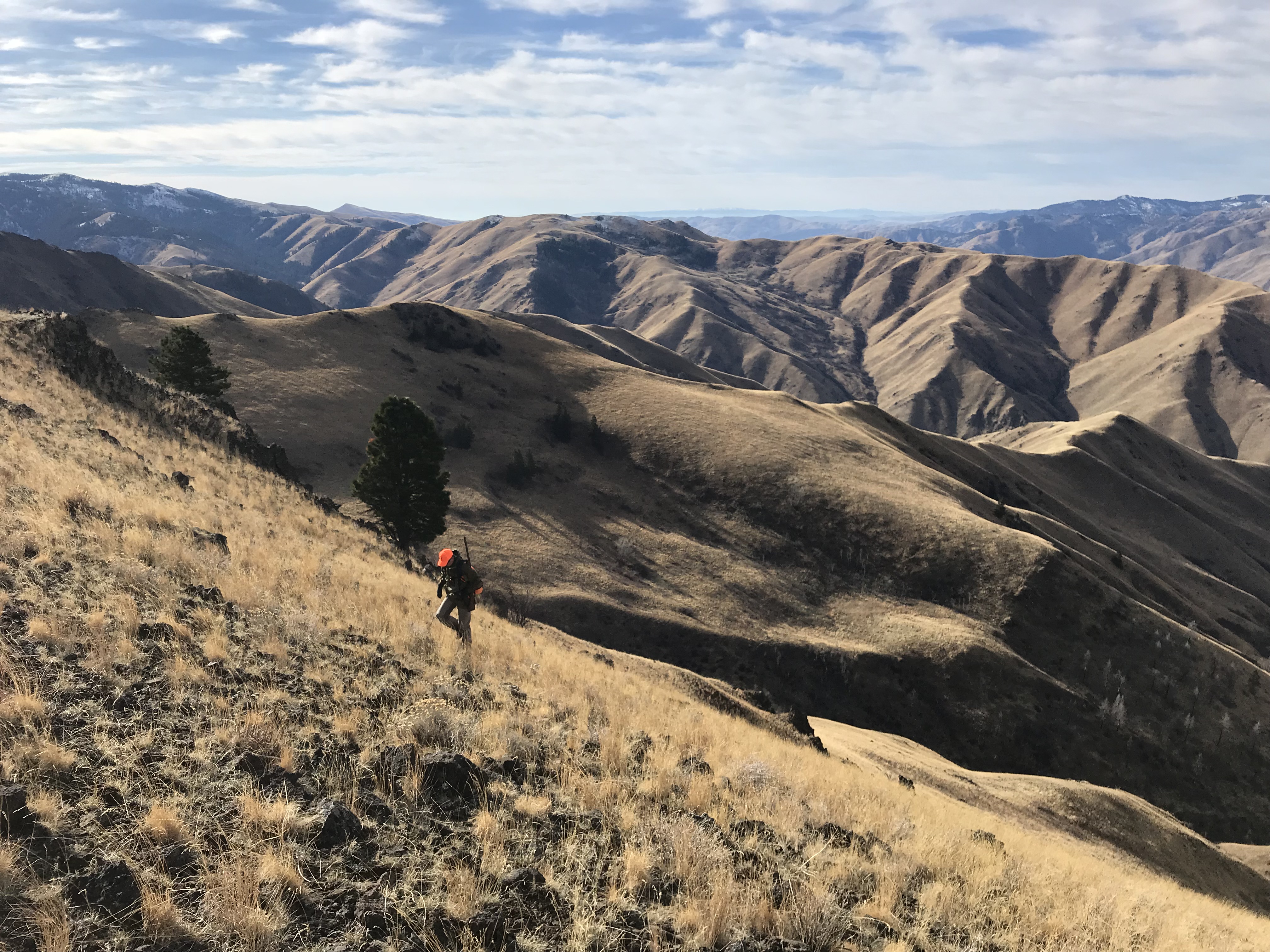
This became one of my favorite spots last year, which I discovered while grouse hunting. This year, at least right now, there ain’t a chukar anywhere near it, probably because it’s way too dry.
Another thing I love about hunting chukar is tempting fate: sometimes I try a new spot that looks terrible just because I think it might actually be good; lots of evidence continues to amass supporting the concept that I have my head up my butt so — as George Castanza did for a while on Seinfeld — sometimes I like to try the opposite of a good idea.
This might look all the same, but there are lots of birds in some places and none in others. As the annoying aphorism goes, “That’s why it’s called hunting.”
Which brings me to the main point when it comes to addressing a question I’m getting more often on this blog: chukar are where you find them.
The act of finding chukar: not always where you look.
Even if I told someone exactly where to look for the birds (something I’ve told friends in the past), chances are they won’t be there (my friends confirmed this). Moreover, I like getting skunked without running into other hunters, and have had good luck doing just that for the past two decades and I’d prefer to keep it that way. And more moreover, there are no such things as “secret spots” anymore; anyone can get a digital topo map app and find all the telltale signs of chukar habitat if they spent 10 minutes reading about it on this or any other of the great bird hunting blogs out there; if you’ve watched any of the dozens of videos I’ve posted on the blog or my YouTube channel, you might have noticed we don’t go out of our way to disguise the locations we hunt because it’s not that hard to figure it out. But there’s no sure thing, which is why I think chukar hunting is a good metaphor for life; if one wants to be assured of shooting chukar, a game farm would be the best bet.
These birds will usually be here.
So do yourself a favor if you want to be a chukar hunter and get out there and explore all the amazing public land while it’s still open to us all. Find the birds yourself and you’ll be prouder for it, and in better shape because of it.
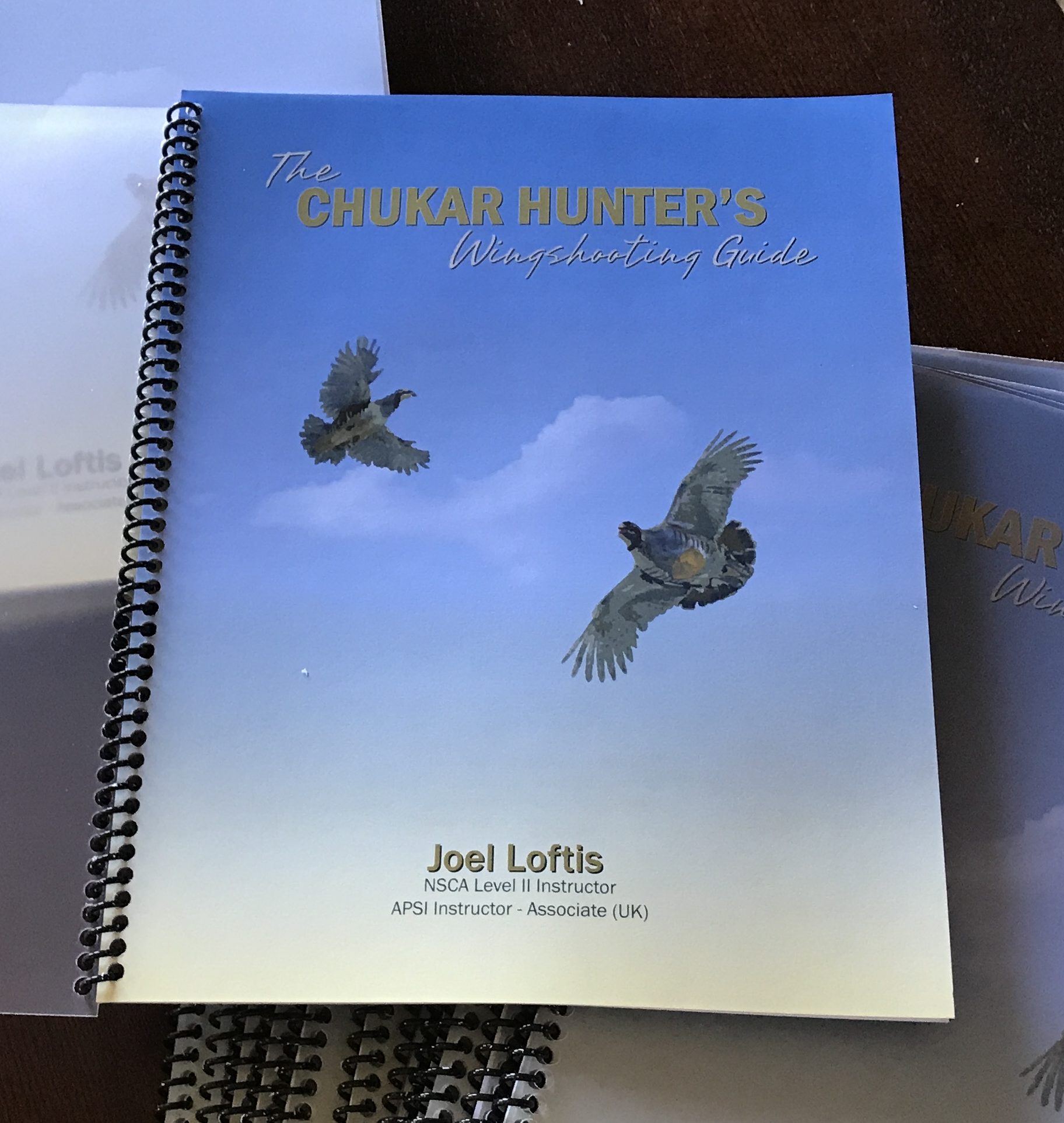
We’ve almost sold out of Joel Loftis’s The Chukar Hunter’s Wingshooting Guide, and I’m curious to hear any feedback about it. Leslie has been reading it and keeps telling me things she’s doing differently because of stuff she’s learned from it. So, if you feel inclined, we’d love to hear any thoughts anyone has about it. (I’m also trying to decide if we should order more of them…)
I just cleaned 20 birds (chukar, Huns, and dusky grouse). As I’ve mentioned before on this blog, I age my birds before cleaning them, sometimes for up to 3 weeks, so they tend to add up when we get around to cleaning them. They go from Peat or Angus’s hand to my Badlands vest to the fridge in the garage. This has worked well for us for years now, and we’re even alive to talk about it. I believe the meat is much tenderer this way.
Today’s victims (collected from the fridge, not the field)
The thing that was different today was that in those 20 birds, there was hardly any damage to breasts or legs. A few breasts had a pellet, but only one, and the legs were mostly clean. I wish I could say that this is because I’ve progressed in my shooting so much that I am mainly killing the birds with head shots. I’m probably doing more of that than before because of some changes I’ve made to my mount and leads on crossing shots. But the only thing I can point to that gave us much cleaner meat today is that I’ve basically switched to bigger shot. Number 6 steel to be exact; I mentioned this in a recent post, but the proof is in the pudding (bird meat). And maybe someone can educate me otherwise, but I also think that the steel stuff, although lacking the ballistic superiority of lead, might leave cleaner meat because it’s harder and rounder than the lead pellets that deform easily. Joel Loftis’s informative The Chukar Hunter’s Wingshooting Guide suggests as much.
I recently talked to Joel, and he’d spent a lot of time (and money) testing out some new shells, and his favorite was the super-expensive Kent Bismuth Upland Shotshells, specifically 12-gauge #6, 1-1/16 ounce, 2-3/4″, 1325 FPS. Several days after he mentioned this, I suffered a moment of insanity that lasted long enough for me to order some online (at $32 per box; yes, per box, not case). I’ll report on how they work for me if I’m lucky enough to hit anything with them once they get here from Mars or wherever they get bismuth, whatever that is. I keep thinking it’s made from expired Pepto Bismol. Maybe it is.
I also got some of the Winchester waterfowl loads I’d been shooting well with and which did little damage to our meat, which are only $7 or $8 a box, but whose ballistics apparently can’t come close to the bismuth puppies. I keep hearing the words “diminishing returns” in my head.
Speaking of that, our supply of Joel’s wingshooting guide is diminishing. I never thought I’d write this on this blog, but “get yours while supplies last.”
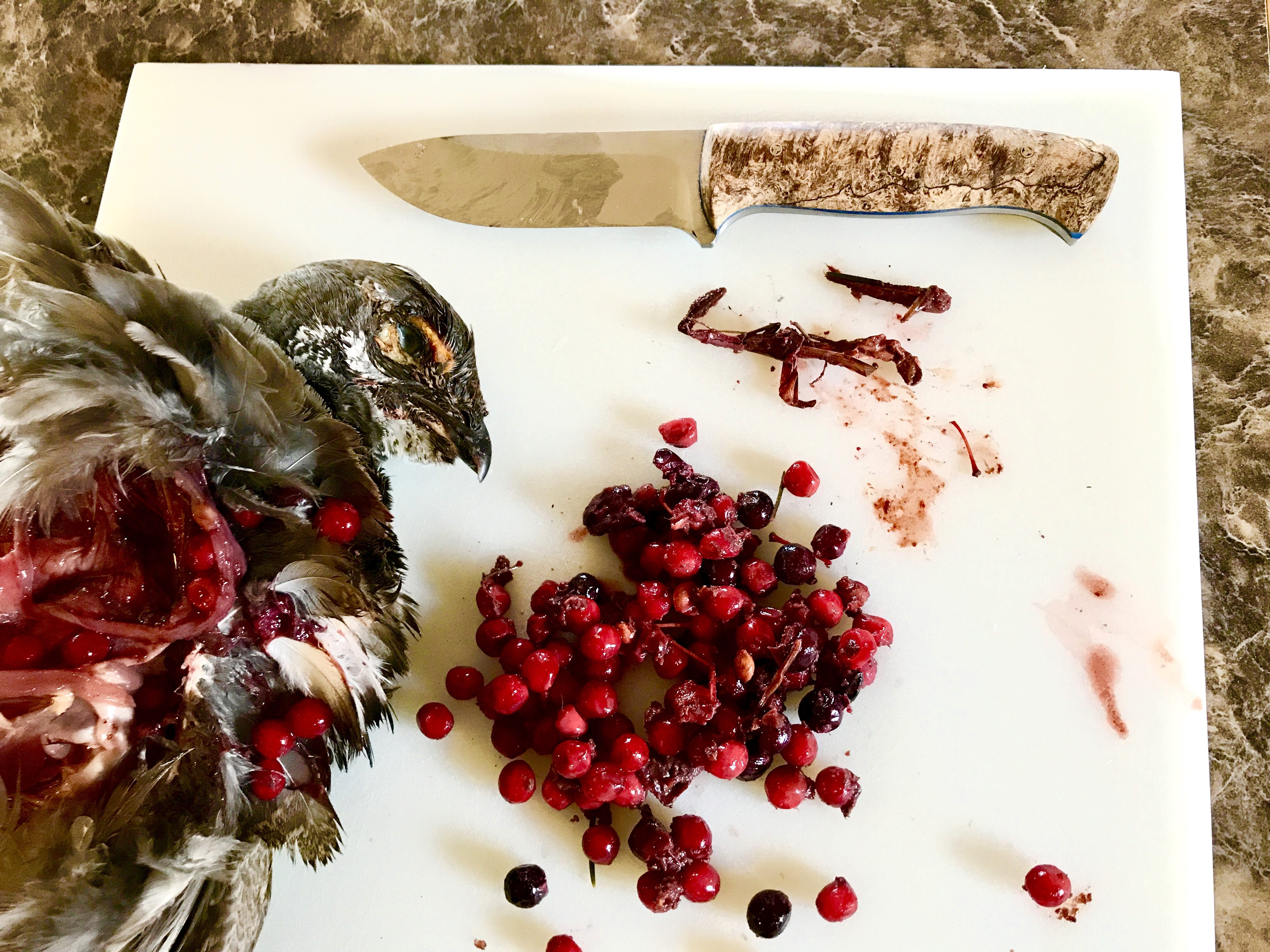
This dusky grouse crop contained (from top) a grasshopper, praying mantis, berries, and fir needles.This is one of the few breasts with any pellet damage out of today’s batch of birds