

Since my beloved Asolo Cotopaxi boots bare-treaded out on me at the beginning of last season, I’ve been searching for a suitable replacement. Last year I wrote about some boots I tried, and they got me through the season. But I wasn’t satisfied. So I kept looking. Key ingredients for me are sole stiffness and ankle support, both equally important. Next in line are (more or less in this order): narrow Vibram sole (not particular about traction pattern), Gore-Tex liner, full rubber rand, easy lacing system. Fit is an obvious necessity, but everyone’s feet are different, so the lasts that each manufacturer uses are going to work for certain types of feet and not others. Fit — as far as boot features go — is a non-issue; you gotta find the maker for your own personal foot.
My feet are really wide in the front and very narrow at the heel. The Asolo Cotopaxi were the best boots in the world for me because they were really tall and stiff (amazing ankle support from the 10″ top, mounted on a mountaineering platform), but they did cramp the front of my foot a little bit. Convinced that boot height was the key to protecting my glass left ankle, I bought a pair of Zamberlan insulated hunting boots last year. While they are Cadillac comfortable, the soles are not nearly stiff enough for chukar hunting and the insulation, even in sub-zero temperatures, was too much. I then tried a pair of mountaineering boots that didn’t really fit my feet (and was able to return them, thankfully).
Enter the La Sportiva Gore-Tex® Trango S Evo Mountaineering Boots. When they arrived I put them on and wore them around the house for 8 hours. I did some yard work, drank a beer, played with the dogs, sprayed some wasps, hit a few golf balls, graded some student papers, basically replicated your typical chukar hunt. After 8 hours my feet were happy. So I kept them. On my first hike I tested their side-hill worthiness, focusing on the ankle support. I was impressed, despite these boots being about two inches lower than the Cotopaxi boots: the ankle collar is heavily padded and somehow really stiff, with hardly any lateral give. At this point in the season, I have 34 miles, 24+ hours, and 9,000 feet of climbing in these boots. No blisters, no sore feet, no complaints. I’m surprised I like them so much. I wish they were taller, but, frankly, I’m starting to rethink the height thing.
One reason for the re-think is that the Trangos are unbelievably light: my size 42 (Euro sizing) boot weighs 26.7 ounces. My first Asolo boots (the ones I destroyed my ankle in) weigh 30.4 ounces each. The Cotopaxis weigh 32.1 ounces. And the Zamberlans weigh 36.5 ounces. The differences between these boots might not seem significant, but when you consider you lift each foot about 750 times per mile of chukar terrain, that’s a difference of about 460 pounds of lifting, per mile per foot, between the Trango and the Zamberlan. On yesterday’s 6.6 mile hunt, if I’d worn the Zamberlan boots instead of the Trangos, each of my aging chicken legs would have lifted 3,032 more pounds. That’s better savings than K-Mart Blue Light Special Savings. If I really wanted to get depressed, I’d do this same calculation for how much more I weigh this year than last year at this point in the season. But for now I’ll focus on the boots. They make me happier than my growing gut.


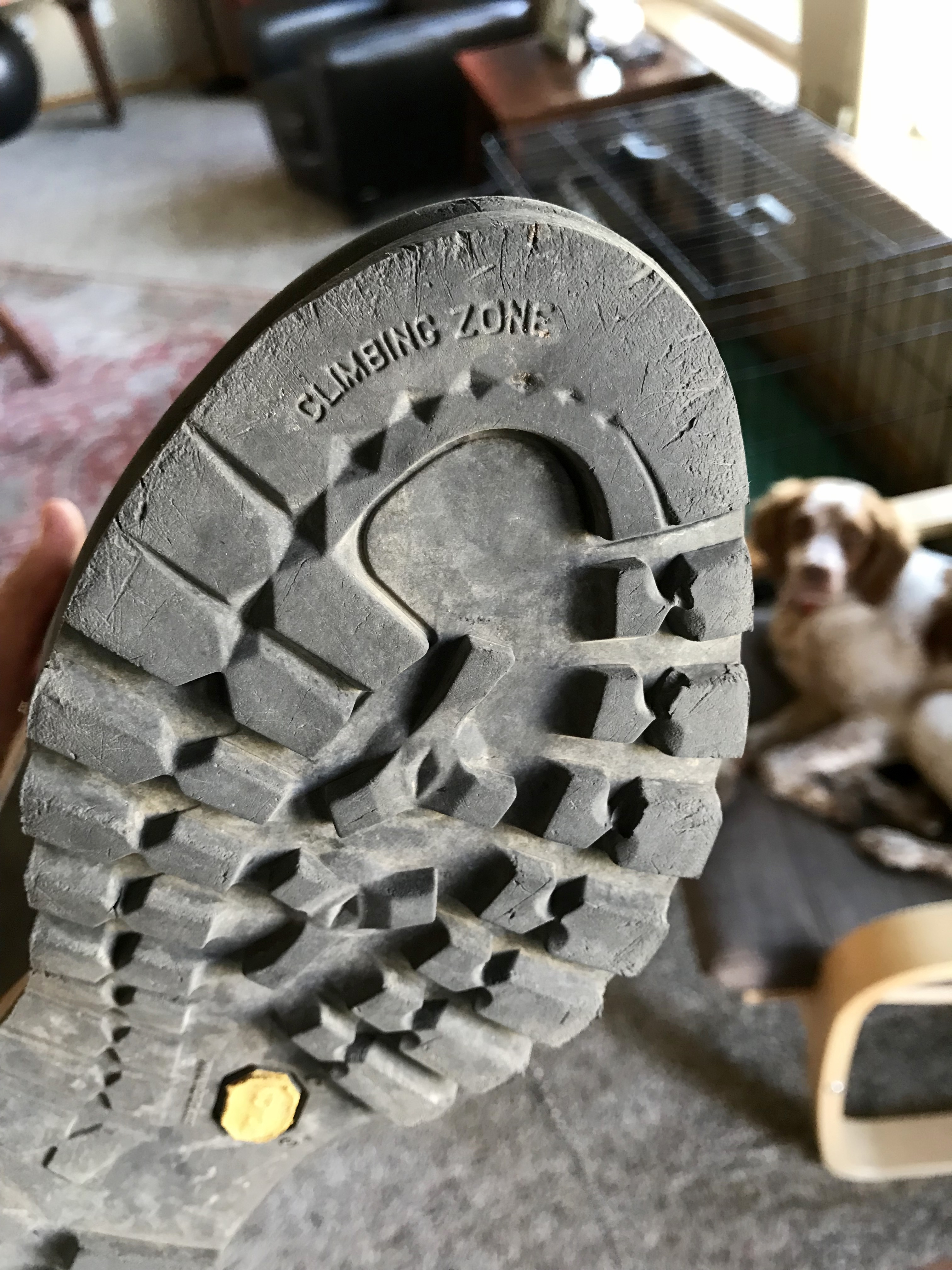
Not everything is super-swell with the Trangos, however. The soles are wearing a bit faster than I’d like; since traction is pretty important in chukar terrain, you need some well-lugged boots. But it’s a trade-off to get a rubber compound that isn’t so hard it will slide off rocks instead of grabbing them, and these soles do well in that regard. And the colder it gets, the harder and slicker that rubber gets, so there’s no miracle material for soles as far as I know; it would be lovely to have a thick-lugged sole that was grabby in any temperature and never wore out. Something for NASA to think about.

The only other thing so far that isn’t a total positive for the Trangos has to do with the fact that they’re meant mainly for use in snow and above-the-timberline activity. This means that in chukar territory these boots collect lots of cheatgrass seeds (see photo). Yes, cheatgrass seeds weigh something, but not enough to worry about. The concern here is that if you don’t periodically clean those burrowing seeds out of the tongue area of these boots they’ll penetrate the Gore-Tex liner and end up making their way inside and impale your fleshdogs. I’m not certain if this is even possible, and it’s really not that big a deal to clean them out of the tongue area (although it did take some time and tweezers).

Time will tell if this is the boot for me. I wore the Cotopaxis for 7 full seasons. I doubt these will beat that, but I’d be thrilled if they made it three seasons. If my feelings change about these boots, look for an update. As always, I welcome comments.
Based on my initial enthusiasm, my wife, the most finicky-footed creature in human history, decided to try a pair. After one hike, her jury’s still out. I like the women’s color better, though…


Chirp away