Tag: upland hunting

  • All Imperfect Things

    All Imperfect Things

    I got a sick queasy feeling deep in my stomach as we detoured and drove into rural Council, Idaho. The curbside spot right out front of the local veterinary office was the exact spot where we’d parked the bright red Jeep two years before and it was empty and waiting for us. Just like the white crosses along the highways in Montana marking highway deaths, that spot reminded me of the death of Angus that occurred at that exact spot when we drove him there when his cancer could no longer be stopped.

    Nothing bad happened to the dogs to prompt the detour and vet visit that day; we went there to get rattlesnake vaccinations since we had heard reports from other chukar hunters that they have been seeing a lot more rattlesnakes than normal. Despite the controversy whether or not they work or not, the vaccinations might buy us valuable time to get our dogs to the vet in an emergency. Peace of mind if you want to call it that.

    Bob and I each took turns taking one dog at a time into the vet exam room. I took Bloom first. A specimen of pure athleticism and muscles pulled me on his leash and dragged me into the tiny exam room. He’d only been inside this small room one other time, when he was 8 weeks old, so he wasn’t afraid of this place like dogs that make repeat visits.

    I lifted Bloom onto the exam table. He shrieked loudly as Dr. Gardner suck the tiny needle into the area where he’d pulled up the skin on his neck and injected the rattlesnake vaccination. I was embarrassed by his behavior and apologized and blamed his genetics and reminded Dr. Gardner that Angus did the same thing whenever we took him there after several barbed wire injuries needed stitched up, his yearly vaccinations, and nail trimmings. Dr. Gardner remembered, and Bloom — just like Angus during nail trimmings — required all hands on deck including the receptionist to hold him down and try to keep him from clawing his way off the exam table. Bob was outside on the sidewalk waiting for it to be Peat’s turn and heard Bloom screeching at the top of his lungs. He told me later that he wondered if they’d decided to do open heart surgery on him without anesthesia. Peat’s turn wasn’t much better but we were both glad to get that out of the way.

    The next day we decided to hunt in a place we’d gone several years ago. The pullout where we parked near the river to begin our hunt was scattered with old dried up goat heads. Nasty little things, and before we even started we were pulling several of their spiked seeds from the dogs pads as they stood on and hopped around on three legs. Cruel and imperfect plants. In the ecosystem where all flora and fauna have a purpose, I’m not sure what good they do?

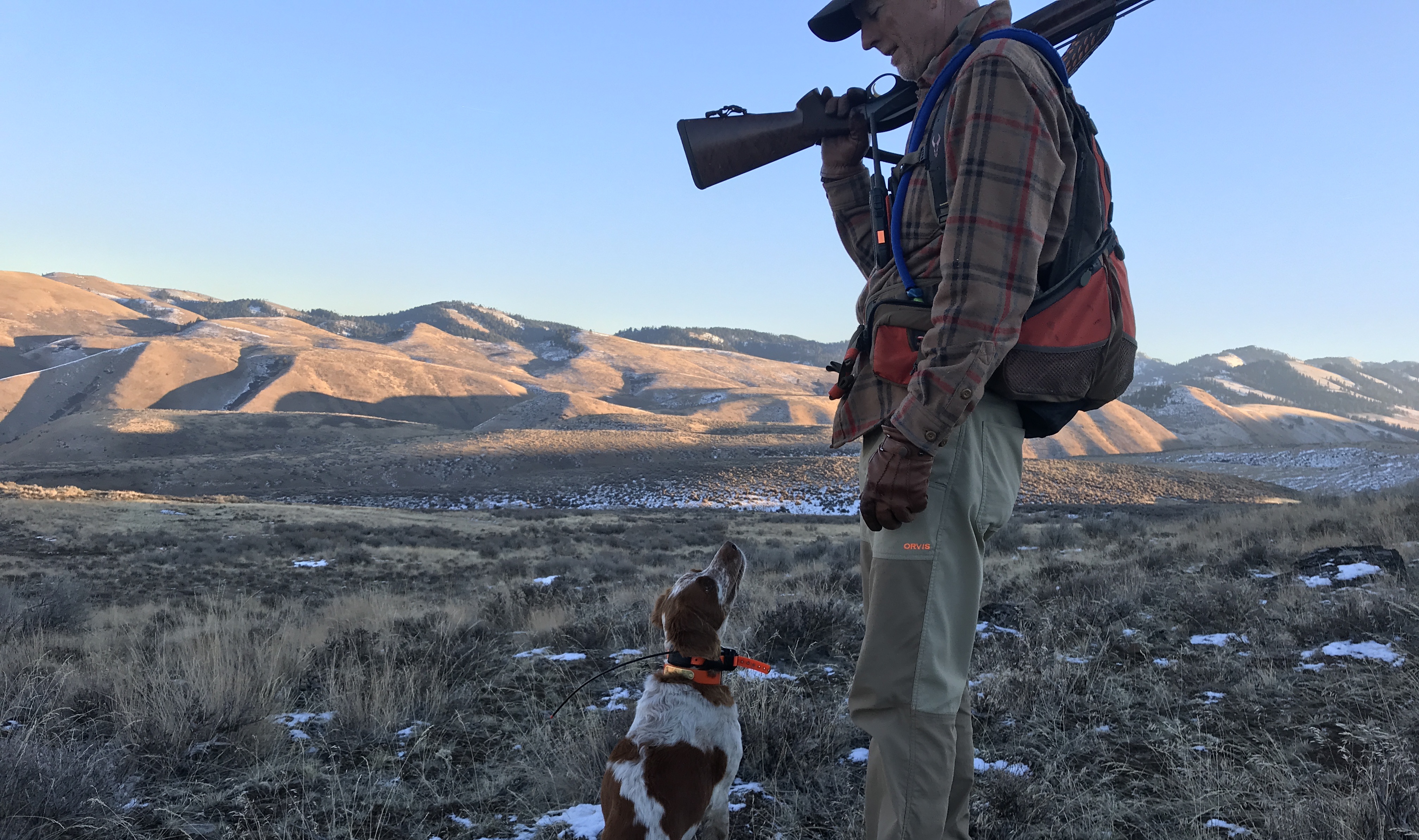
    We headed up the rocky slope while there was still shade on this part of the mountain and before the October sun peeked over the ridge. The soil was parched and cracked, and the grasses and end-of-season arrowleaf balsamroot crunched underneath my boots. We both thought it was ridiculous and pointless hunting so early in the season where there wasn’t any green-up and it hasn’t rained for months. About an hour into the climb both dogs seemed to sense birds but had trouble pinpointing them in such dry conditions. A covey of Hungarian Partridge that was probably walking uphill busted wild way above us and flew down the ridge out of sight. It was a good sign despite the dryness and not being close to the water that we managed to see some birds. It was a long way down to where the huns flew so we kept going up and hoped to find them on the way down.

    Half way up

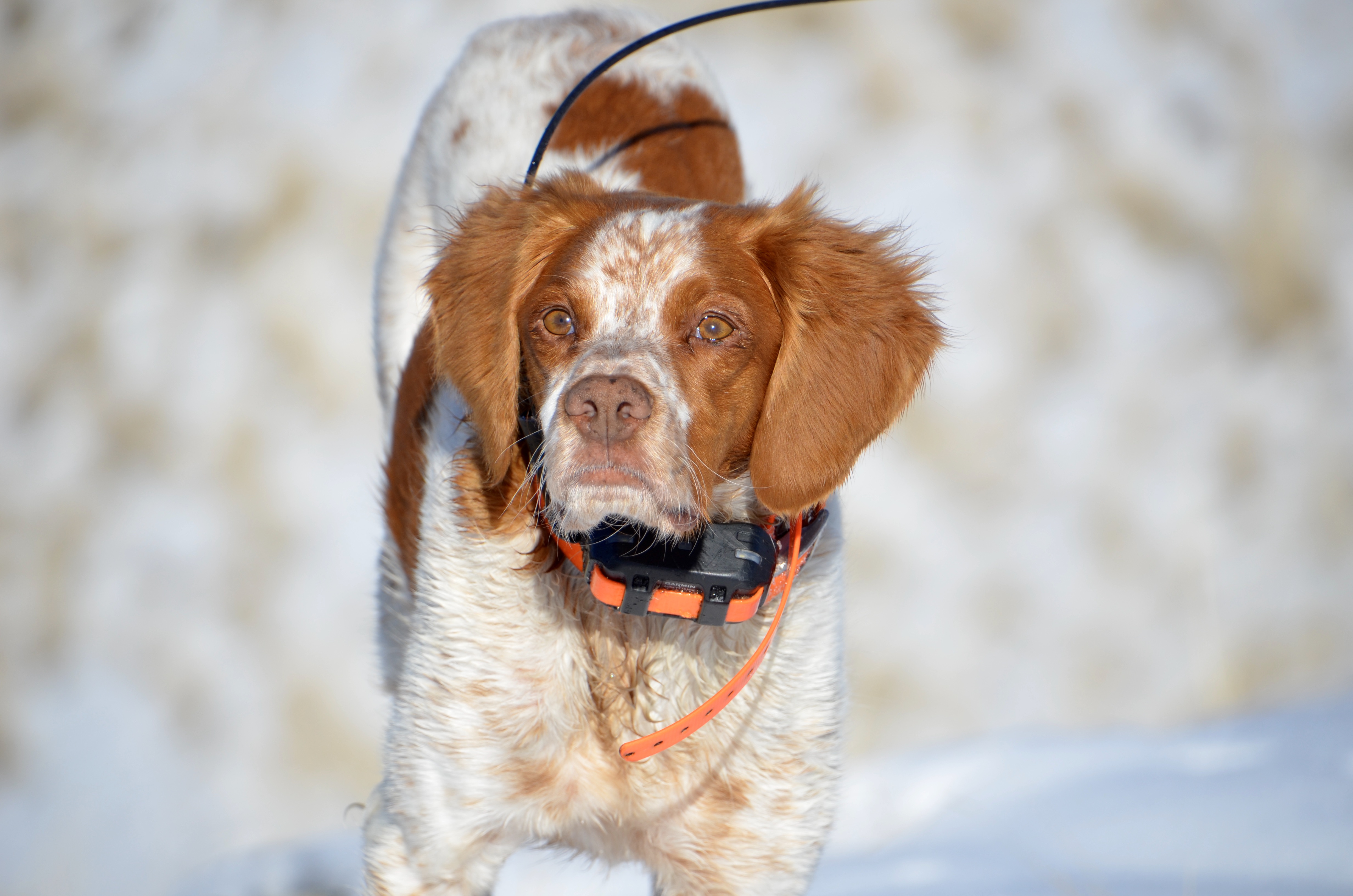
    Bloom with his long legs and spanning gait ranges bigger than Peat but he’s still inexperienced, young, and insecure and will check back constantly for my whereabouts, and when he doesn’t we have to second guess if he’s onto birds. He’s got his faults and is a strange dog still figuring out the world. It will sure be exciting when he does.

    Beep!

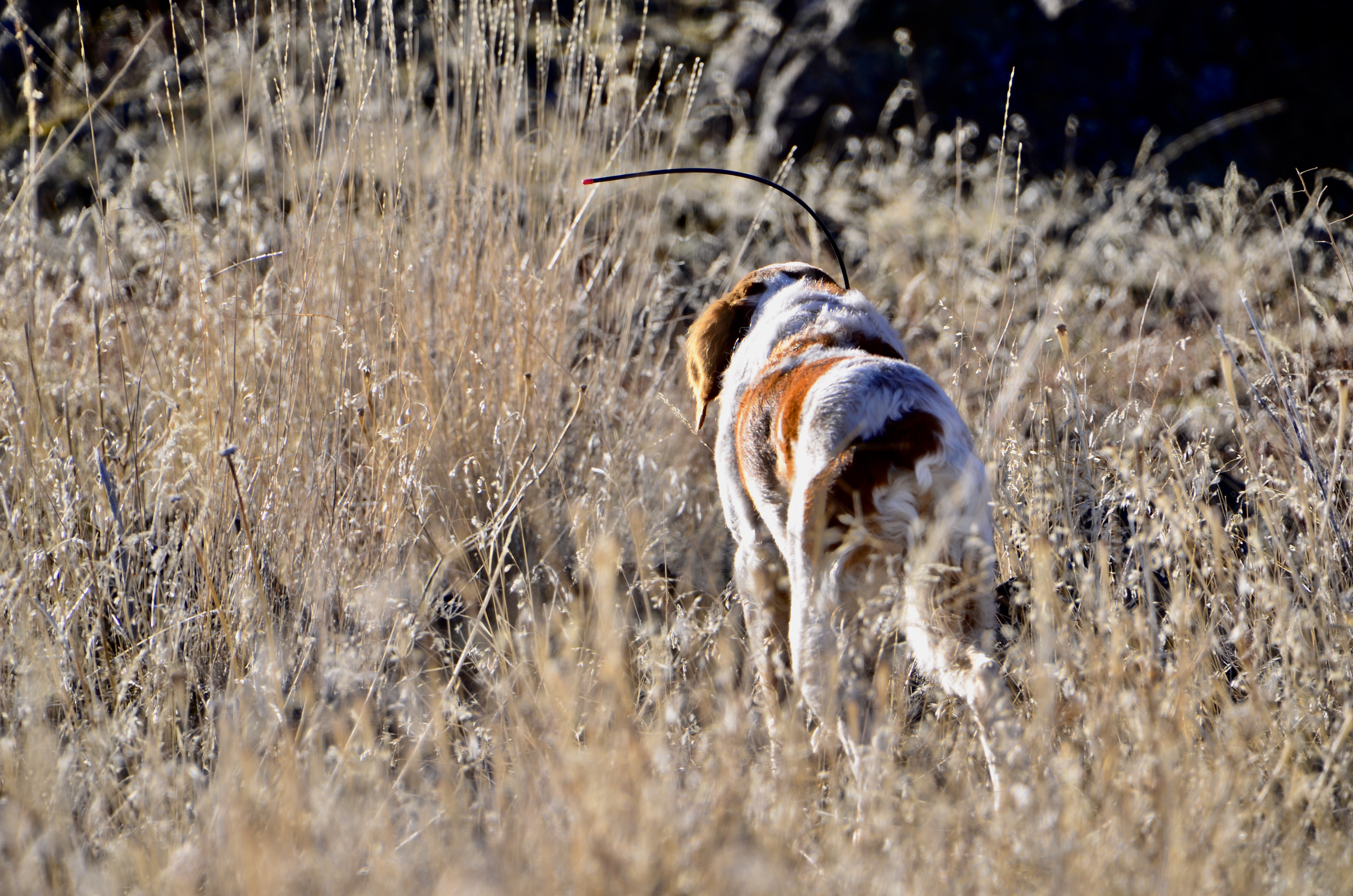
    I scanned the tall grass looking for Bloom who I’d just seen ahead of me but couldn’t see him. My Garmin handheld strapped to my hunting pack beeped again, I squinted at the screen which was hard to read with the glare of the sun: Bloom on point 35 feet. I looked around and still couldn’t see him. Bob who was just above me yelled “Can you see him?” I answered back ,”No.”

    I spotted something white buried deep down in the golden grass, I couldn’t even tell what it was. Bob yelled again “He’s right there! Can’t you see him, get up there, get ready!”

    I hesitated. My mind was playing tricks on me and I wasn’t even actually sure that he was pointing birds because Peat, who normally backs Bloom, was still running around. As I got closer, he was sprawled on his stomach in an awkward position flat on the ground. I didn’t know what to make of what I saw and I couldn’t tell if he was breathing and thought maybe he’d been bitten by a rattlesnake or caught in a trap, or something else bad happened.

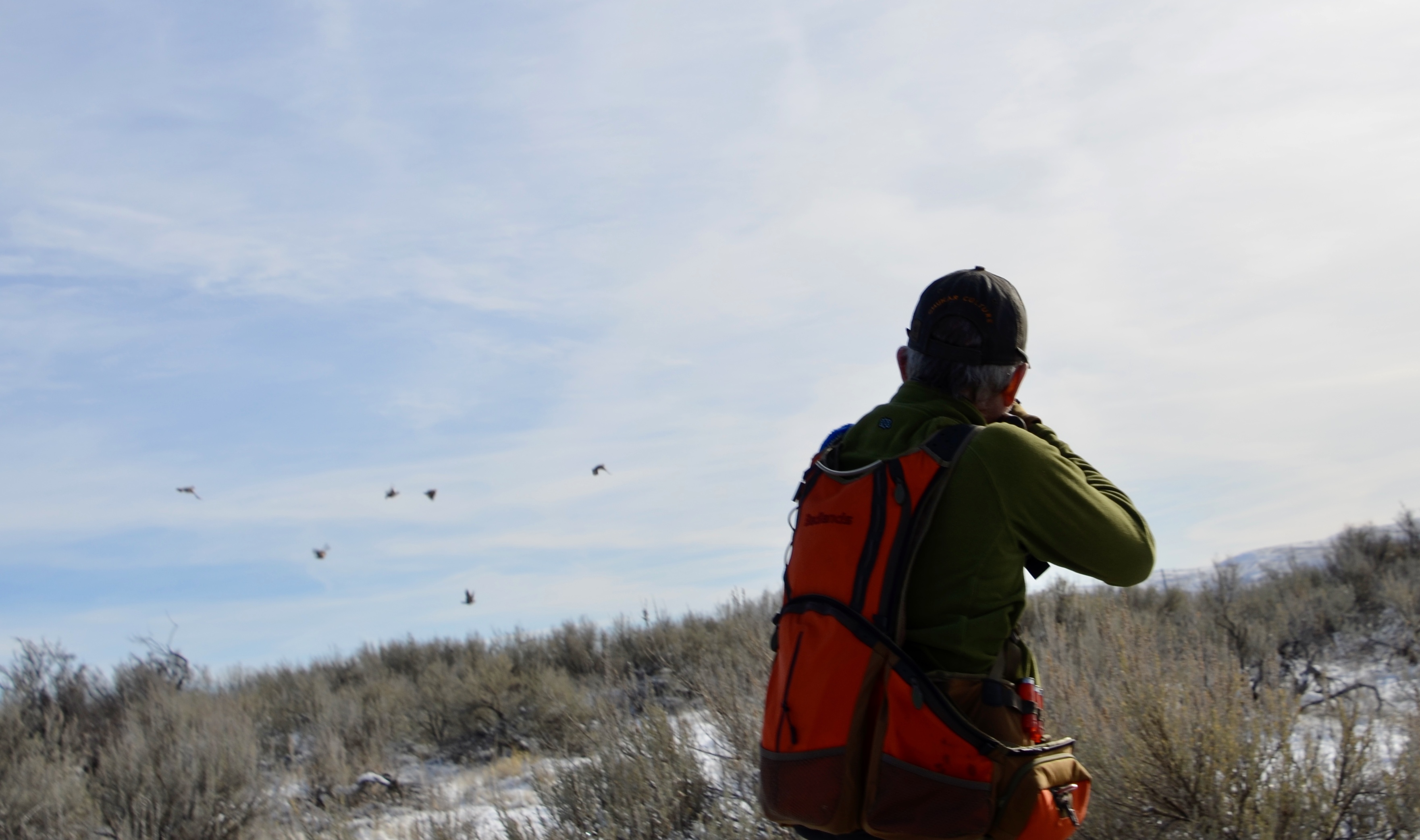
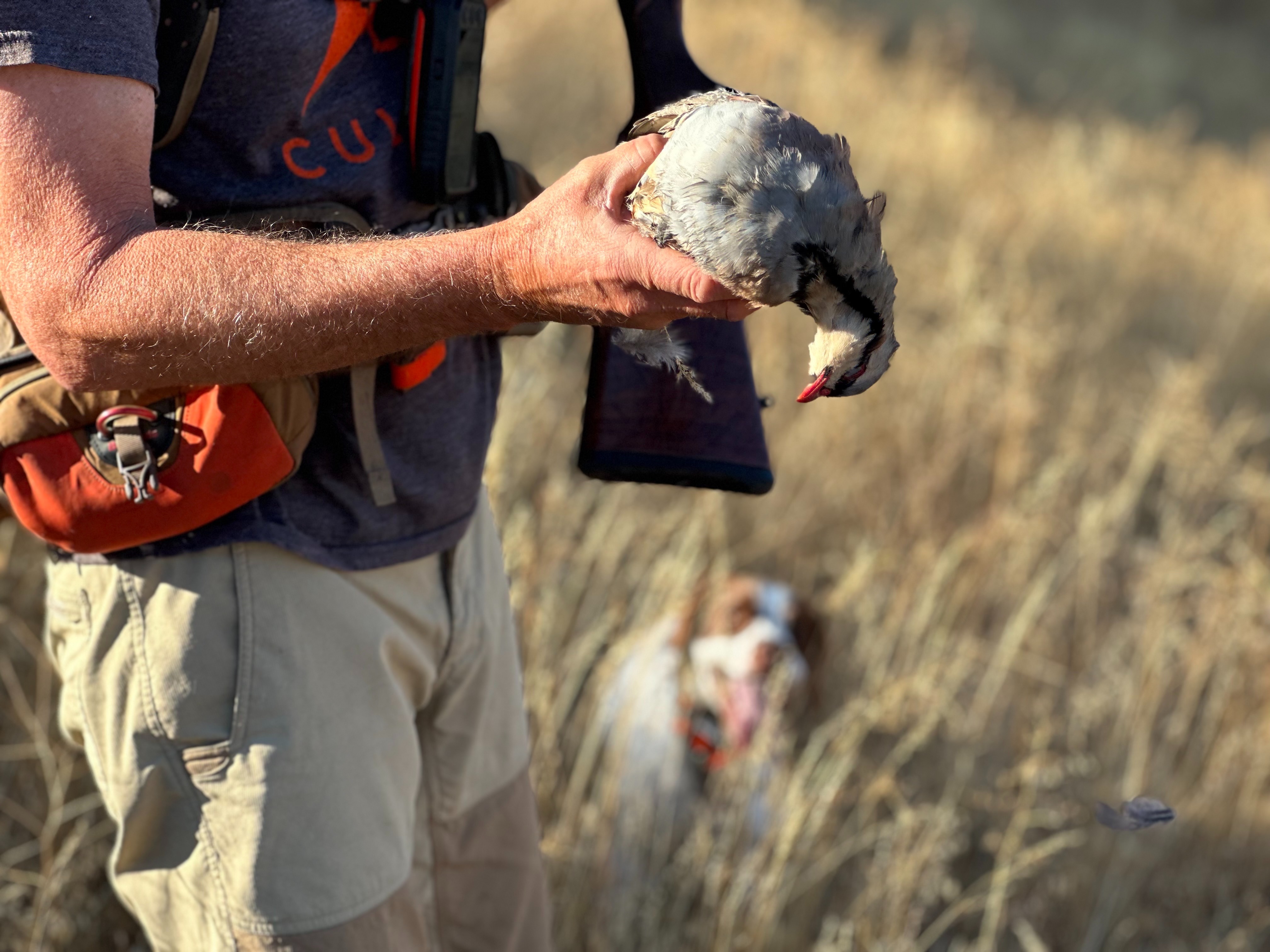
    I moved even closer and could see that Bloom was shaking. I thought to myself, surely if he’d been bit or something we would know it. Suddenly, a covey of chukar exploded just in front of him. Instinctively, I mounted my shotgun and fired one shot but the birds were almost too close and I missed the one I’d picked out. Bob, who was above me and to my left, fired simultaneously and I saw a chukar fall to the earth. Bloom sprung up from the ground, found the downed bird and quickly put the chukar in his mouth while both of us were praising him. It wasn’t a perfect text book point and we’ve never seen him do that before, and even on the retrieve he dropped the chukar from his mouth while jumping over the grass to Bob like a mule deer.

    We both agreed that in 10 years when we’ve forgotten the details of each point, bird, retrieve over the years, we’ll always remember this one. This imperfect crazy day that Bloom found, pointed, and retrieved his first chukar without any help. And on his belly, no less!

    It was starting to get really hot outside and we slowly descended back down the mountain finding game trails to make the downhills easier to navigate. We got back to truck camper and I tied up the dogs up to the camper in the shade next to me and sat atop our school bus yellow wooden stepping box outside and removed my sweat-soaked leather boots and wool socks and then went inside and started making some sandwiches. From inside, I noticed a gray pickup slowly drive past us then stop and then back up and stop again. The two occupants got out. One of them approached Bob, who was sitting down outside in a camp chair, and introduced himself because he’s recognized Bob and the dogs from reading our blog. Tim and his brother both upland hunters chatted with us for a while while we exchanged stories. It was nice to connect in person with other chukar hunters.

    Right after Tim and his brother left, we sat down to eat our sandwiches. Suddenly a small snake with diamond patterns on its back crawled swiftly out from underneath the yellow box I’d just been sitting on. We both jumped up from our chairs and I grabbed the dogs’ collars and pulled them away from the serpent. It was a baby rattlesnake, and we both couldn’t bring ourselves to kill it and watched slither away and disappear. Why would we end its life when it wanted nothing to do with us?

    All imperfect things have a place in this world.

    The retrieve after the imperfect point
    Bloom’s Day
    Dogs doing their Dorothea Lange look
  • Dreams

    Dreams

    I can’t imagine being an insomniac; sleep has never been a problem for me. Almost every night like clockwork Bob wakes up around 2:30 or 3 and turns on the bedside lamp and starts reading a book and will read for at least a couple of hours. Most nights, I’ll wake up, glance at him and roll over and go back to sleep, but last night I woke up and stared at him in the glow of the light. I squinted to see what he was reading because it’s usually something different each night. He was reading a book of poems by Wallace Stevens. He turned off the light and said, “I remember the poem.” I said “What are you talking about?” He then started reciting the poem out loud and it ended with the words:

    Of the January sun; and not to think
    Of any misery in the sound of the wind,
    In the sound of a few leaves,

    Which is the sound of the land
    Full of the same wind
    That is blowing in the same bare place

    For the listener, who listens in the snow,
    And, nothing himself, beholds
    Nothing that is not there and the nothing that is.

    I whispered to him so that I wouldn’t wake up Peat who was nestled in between us still sleeping. “That’s a really lovely poem, thanks for sharing.” I tell him goodnight for the second time and I toss and turn and try to get back to sleep and start thinking of frost, the boughs of pine-trees crusted with snow and junipers shagged with ice and spruces rough in the distant glitter. I start thinking about how much I miss being on the mountain, so I start retracing my footsteps, my path up and down, one slow step at a time, the upland version of counting sheep I suppose, and think about a season that went by so fast that it almost seems like it never happened. I turn over one last time and reach over to stroke Peat on his back. I can hear him sigh, and then I fall asleep and start dreaming.

    I dream of zigzagging through miles of golden bunchgrass, lichen covered rocks, and dense Antelope bitterbrush and sagebrush forests so thick where sometimes I’d lose track of Bob and Peat. I dream of traversing huge wide open landscapes and the unknowable vastness of it all, and creeping across steep scree slopes while trying not to slip, and how it always seemed that Peat would point on just the other side of a barbed wire fence that I’d have to cross over or crawl under. I dream of those hot and smoky and super dry early season conditions where I ran out of water a couple of times and that covey of chukar that busted wild over my head and we didn’t even know it until we got home and saw the photo. I dream of borrowing beautiful young Custer and how much fun and exciting it was to hunt with two dogs again and also to hunt with Peat’s dad, Sioux, the Mouritsen family, and other Sunburst Brittanys.

    I dream of trudging through knee-deep snow covered with hoarfrost just to get to the top of the ridge and not finding any birds after all the hard and painful work just to get there. I dream of those staunch points and retrieves, and missed shots because my fingers were so bitterly cold to the bone that I couldn’t take the safety off when the birds busted. There is also in my dreams that somber exhilaration when everything finally does come together. I dream of Bob finding a matching set of deer antlers that are such an amazing part of nature, and on another hunt seeing a Peregrine Falcon cruising overhead just before it swooped down and carried off that chukar Peat was pointing. I dream of hunting in late November when the sun sets so early and seeing the pink alpenglow on the distant mountains and how I was so happy and relieved, still over a mile from the pickup, that Bob was the one who’d packed a headlamp in his hunting pack .

    I dream about busting through the thick brush in a deep draw and being tripped, tangled and caught by brambles and branches, and on so many hunts in December and January sliding on my butt on the icy, slick, and muddy slopes and watching Bob do the same thing.

    I dream about the old rattlesnake skins on the mountain left behind like ghosts. I dream about those yellow shotgun shells Bob so lovingly made for me with just a wee teaspoon of Angus’s ashes carefully put inside each one so I could spread his ashes in all of my favorite hunting spots. And the favorite thing I dream is how, just before going to sleep after a day on the mountain, the sweet but spicy and bitter smell of sagebrush lingers on Peat’s fur and which I inhale when I kiss and bury my face in his head and neck.

  • The Beautiful Familiar

    The Beautiful Familiar

    “Come on dogs, let’s go hunting.”

    Not just one dog but two. Not much more work having two. They get fed at the same time, go to bed at the same time, and adapt to each other’s miscellaneous routines at home, like, for example, keying off of each other when it comes to hearing something outside, both of them to end up running full speed through the kitchen and out the dog door barking their heads off. We’d gotten use to having two dogs around all the time at home and on the mountain. The one thing that I loved most about having two dogs was watching them hunt together.

    Last June when Angus passed away from cancer it was an adjustment, and a void for everyone, including Peat who now has to do all the work by himself finding the birds. It wasn’t that he was lazy, but he was smart. He was like one of those co-workers that we’ve all had at one point in our lives, the ones that sit back and watch everyone work and then when the donuts arrive from the boss on Friday rush to thank everyone for a good job, and he’d be first in the break room to get the only maple bar. Peat would be the first on the bird for the retrieve, a covey of birds that he didn’t find in the first place but he’d bring the chukar to hand and get all the immediate praise that followed while Angus continued to hunt.

    Peat this season was definitely forced to step up his game by being the lone dog. His average mileage used to be three times ours, now it’s four times. He can find birds and he’s the relocation specialist but his nose is either super sensitive or not fully refined because he’s really cautious on pinpointing the covey’s location and getting close enough. The birds are either just very jumpy and busting wild for other reasons. I don’t know if it’s because he spent so much time as the co-pilot.

    The main thing I’ve missed this season is watching him honor another dog. Peat in action is a beautiful, mesmerizing and sometimes funny sight to behold. It’s by far my favorite part of seeing a pointing dog work. Looking back, I think he purposely let Angus find all the birds just so he could honor him. They had a beautiful relationship.

    Before the season started, we stopped by to visit Angus and Peat’s breeder, Katie and Gabe of Sunburst Brittany’s and I casually suggested that maybe they could loan us one of their dogs. I wasn’t entirely serious and thought that it was stupid to even suggest in the first place, but in November they lent us and entrusted us to keep Custer, their young liver and white American Brittany for a few days. I was excited to have another dog to hunt with again, and I was equally excited just to have the presence of another dog in the house.

    One-and-a-half-year-old Custer arrived, and from the get-go it was evident that he hadn’t been around cats before. He went on point when he saw Seamus for the first time. Peat soon took notice of what was happening and acted like he’d never seen a cat before, either (despite getting his ass kicked by Seamus on his first day with us almost 6 years ago!), and both dogs chased Seamus and both got a full set of claws in their furry snouts. From that point when Custer wasn’t tethered to me, he was in his crate on the floor. My 15-year-old cat continued to taunt him by sauntering past his metal crate door within an inch. Cats are masters of intimidation. Trying to train Custer, a kennel dog, to be a house dog that lives with cats in one day so he could be loose in the house was very optimistic.

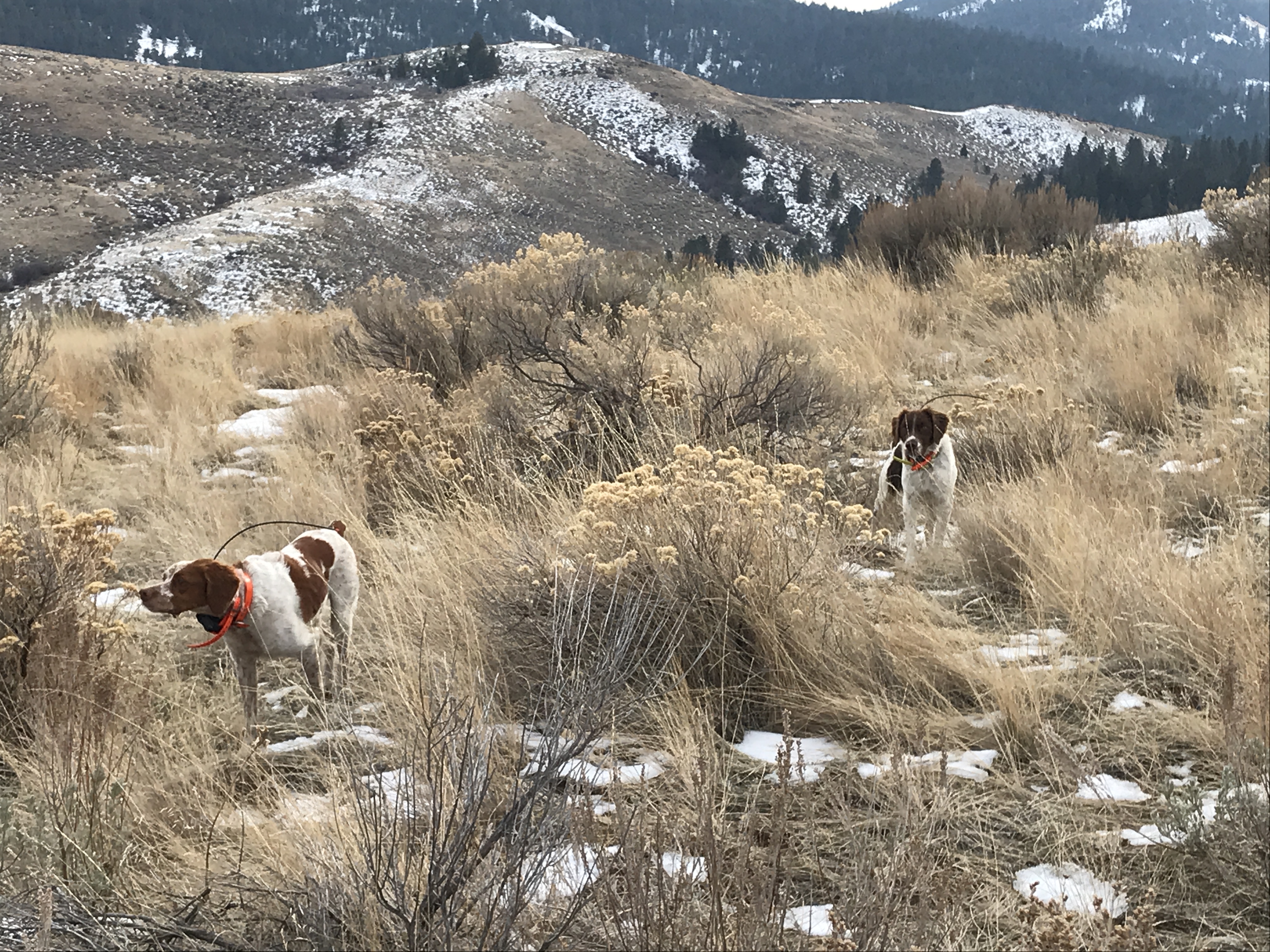
    The following day, to give the cat a break from all of us, we took Custer out hunting with Peat to a place on some BLM land not far from where we live. We started out initially wanting to have Custer only hunt with me but realized that he hadn’t bonded with us yet and he wanted to hunt with Peat. About 20 minutes into the hunt, my Garmin beeped that Peat was on point. I headed his direction and could see Peat pointing and Custer honoring him through the tall bitterbrush. It almost brought tears to my eyes seeing two dogs working together again. Instead of getting into position to shoot, I pulled out my phone to photograph and capture the moment.

    Custer honoring Peat for the first time.

    The next covey of chukar we found, Custer was the first one to point. I slowly got into position and out of the left corner of my eye, I could see Peat running full speed right past him! Instead of honoring Custer, Peat ran right through the covey and busted them. Freaking Peat! I don’t know what he was thinking. I’m no dog psychologist, but on the next covey Custer found later in the hunt, Peat honored him. They took turns on a couple more coveys and we hunted with both dogs together at least six more times before returning Custer back to Sunburst. We would have preferred to have kept him longer if it wasn’t for the cat. I love my cat. That darn cat.

    It was a beautiful thing to see Custer, Angus’s nephew, move with the same show-dog gait as Angus. He’s got the same sweet personality, and whisky colored eyes, and is a natural on the chukar hills. Custer is a miracle and a bright hope for the future where next spring a new puppy will be in our lives or maybe one of them will be in yours.

    Merry Christmas and Peace on Earth. Enjoy the video!

    Custer backing Peat again.
    Sunburst’s Custer and Peat, November 2020.
    Peat honoring Custer on some chukar. December 2020
    Custer post retrieve
    Angus and Custer, January 2020
  • Black Friday

    Black Friday

    Yesterday, Thanksgiving, we hunted a beloved area that got burned in a big fire that started on Labor Day. We weren’t sure what to expect, but have been anxious to see it up close for a while now. From the road, you can only see so much.

    Inside it, the devastation was both unsurprising and heartbreaking. Along the creek, you could see temperature changes in the fire’s path, and the flames’ duration from spot to spot. I found myself weeping at times, and terrified when imagining what it might have been like to be there as the inferno navigated its way up the canyon. I felt grateful that the birds and mammals who called that place home are stronger and swifter and smarter than we are. I’m assuming they moved and hope they’ve found suitable habitation.

    One of the reasons we chose this place was that I hadn’t bagged a grouse this year. Up high, fir stands in tight draws usually housed good numbers of dusky grouse, the biggest bird we hunt (although next year I intend to hunt sage grouse for the first time). Within five minutes I killed probably the only pair of ruffed grouse left down there. Gorgeous creatures, but the remorse I used to struggle with blind-sided me while looking at their feathers and blood dripping from their beaks before putting them in my bird bag. Clearly, and gratefully, only a temporary resolution.

    No sign of chukar in the usual places on the way up. At the top, in the forest, the fire had been greedy thinning the undergrowth, and the large population of dusky grouse had obviously flown the coop. We angled up higher to more open areas whose robust blankets of bunchgrasses were toast, singed into a blackened crewcut. These rolling slopes covered in bunches of grass had made oases for chukar, provided protection from raptors, and now were desolate, bereft of blades.

    At closer look, though, a happy sight: almost undetectable sprouts of green emerging from the scorched tufts. I wished I was a botanist so I could predict how long it would take these beautiful plants to reach maturity again and stand firm against the noxious invasion of medusahead, spotted knapweed, rush skeletonweed, and star thistle (among others) that seriously threaten this unique but delicate habitat. I’m eager for spring so I can see how these grasses have fared. I love them. I named one of my favorite beers after them (Bunchgrass Rye IPA).

    On one knob that pre-fire was dense with sagebrush, large charred polka-dots showed only the charcoal base of these important and gorgeous plants. Another happy sight, though: in several of them, healthy deposits of chukar poo. Chukar have been there, but we didn’t see any and Peat didn’t find any on our 6-mile (and his 20-mile) hike.

    The terrain lured us farther and higher than we’d intended, and on a snowy north-facing slope we found fresh dusky grouse tracks. Seconds later, Peat pointed into a stand of conifers. Two of the pterodactylic galliformes launched simultaneously. Leslie and I each shot at the only one without trees in its way, and we each killed it with shotgun shells I’d loaded containing some of Angus’s ashes. He loved grouse hunting.

    On the way down, it was fascinating to see springs in places whose pre-fire plantlife concealed. There was much more water on this terrain, coming out of it, than I ever dreamed in the decade I’ve hunted there. It shouldn’t be surprising: this high desert landscape is stingy with water, so pockets of large plants on the otherwise arid land should signify a spring. Plant-bare, though, you can see it now. But the lack of cover at these springs meant we wouldn’t see any birds that used to chillax there.

    Bagging three birds on this hike, despite the remorse, helped make it feel successful. I suppose I should assign more success to the fact that some of the vegetation is rebounding already. But the completely toasted creek bottom dampens the hope for recovery, there at least, because — unlike Hart Crane’s river — the fire did not quickly flee that particular watery spot. Fire and water, hope and sadness. Life.

    An early ruffed grouse gift
    Pick up your &%$@!# shells!
    Bunchgrass comeback
    Phoenix
    Other resurrections
    Signs of life and death
    First dusky of the year (actually, only 1/2: Leslie & I both killed it)
    Big birds with excellent, appreciated protein
    Angus’s legacy
  • Home Movies

    Home Movies

    After the light came

    We got an early start and headed up the mountain in the dark wearing headlamps for the first part of the climb. After about an hour of zigzagging up the mountain the sun started to rise in the distance. Some parts of the climb were super steep and I ended up having to grasp some clumps of bunchgrass and branches of sagebrush to pull myself further up. Legal shooting hours were one half hour before sunrise but Bob’s goal was to reach the top of the rocky ridge and not start hunting until the downhill. This was early fall and still pretty warm outside during the day and he was hoping that the birds would be heading up after spending the early morning drinking water down by the river and, as they say in cowboy movies, “Head them off at the pass.” This was my first time hiking for chukar with Bob and Angus and this whole world of seeing things off trail was new and exciting.

    Bob asked if I’d carry our video camera to record some of the hunt that day. I’d never used our video camera before and he showed me how to operate it the night before. He told me that the red light meant you were recording and the green light meant it was stopped. Besides negotiating new terrain and trying to keep up with Bob and Angus, my job was also to stay out of the way and be ready to film at all times. When something would happen which I wasn’t anticipating because I didn’t understand what was going on, Bob would signal me that Angus was onto birds or he was on point so I could start filming. With so much going on in my mind that day, operating the camera and pushing the correct button was the opposite of what Bob told me and that the green light meant go. Unbeknownst to me, I spent most of that day recording the ground thinking the camera was turned off.

    Angus pointing chukar
    Angus strikes a familiar pose. This was the first time I saw Angus point.

    The descent on this first chukar hunt was equally challenging and it was easier on my legs to go up than down. Chukar country is steep. We stopped on the way down and I took off my backpack to get something out of it and sat my pack on the ground. Before I knew it my pack was somersaulting down the hill. I stood there and watched in disbelief not being able to do anything about it and thanked my lucky stars that it was still zipped up and that we were heading downhill in that direction anyway.

    When we got home Bob sorted through at least an hour of footage of nothing but the moving ground and dizzying images of boots. I was embarrassed by my lack of getting something on film but he found at least a couple of minutes of hunting action and he made a short video and uploaded it to YouTube. The name of the movie was “Another Chukar Hunting Adventure with Angus.” Back in 2010, YouTube was still fairly new and there weren’t a whole lot of chukar hunting videos out there. Anything was better than nothing, we thought, and we even got some positive feedback on the video and not too many thumbs down. I agreed to carry the camera the next time we went out, and the next and the next and that continued for another seven years until I finally got tired of following Bob around the mountain with the camera and got a shotgun and started hunting myself.

    I call our YouTube contributions “home movies” because they’re not professional quality by any means. Over the course of those seven years of filming, my fitness improved and usually I was able to stay with Bob plus anticipate when something might happen, and I learned to try and hold the camera still and slow my breathing down or hold my breath while filming so we wouldn’t have so much heavy breathing but that wasn’t always easy.

    During this down time we’ve all been having the past month, I’ve been going back and rewatching some of the videos we made over the years. A virtual rabbit hole of good times spent on the mountain. This first video, Another Chukar Hunting Adventure with Angus is the movie made with the footage from my maiden day on the mountain. I’d never seen chukar hunting in person or a pointing dog working until that day and immediately knew that it was something special.

    This next one, How Not to Handle a Hun was made in 2013. We took “The Kid” Jarret hunting and he learned that not all birds are retrieved dead. It was a good learning experience for him and me. It’s something that carried over when I started hunting. My first Hungarian partridge that Angus retrieved for me during my first season wasn’t dead. I had to deal with it and it’s not pleasant but it’s part of upland hunting.

    Chukar Hunting Retriever Man was filmed on the 2016 season opener with our friend Cameron. We lost one of the birds on a rocky cliff down by the water and Angus couldn’t get to it. We decided to go back and get the boat and motor back upriver to find it. While Cam was retrieving it up in the rocks, Angus ate Cam’s roast beef sandwich. We still laugh about it.

    Shit Chukar Hunters Say was my idea back in 2013. I’d seen something called “Shit Cyclists Say” and wanted to make a chukar hunter version of it. We made it with our friend Greg on the hill behind our house. We didn’t really have much of a script and Bob and Greg did a wonderful job ad libbing.

    Public Land Chukar Hunting in Idaho. We went hunting in a place we’d never been before back in 2016 and at a place we really didn’t expect to find chukar but did. I really like this video because it was the first time Bob did a voice over and I love that about it. (He made this video as an example for a video project he had his students do.)

    A Walk for Chukar is one that I made myself last year when learning how to use iMovie. It celebrates the landscapes where these birds live. I love this video and can watch it over and over.

    This last video, Another Chukar Hunting Adventure with Angus, 2020, is footage from this past season 2019/2020. I just made it this week. We used the same music from that first one made in 2009, and the only thing that is different is location and all three of us are much older.

    Looking back at these and watching them, there is one thing that resonates with us, inspires us, and makes us look forward to next season are these beautiful places in the chukar hills.