Tag: upland hunting

  • Grace

    Grace

    Unmerited favor.

    I’ve gotten out quite a bit so far this season. The weather’s been good. We recently took a trip to what — in years past — had been the best place I’d ever hunted chukar, for many reasons. We’d looked forward to it for nearly a year. But for whatever reason the hunting was terrible. Or I should say that the bird count was terrible; the hunting was excellent as it usually is when compared to not hunting. But in more miles than normal we saw a small fraction of the number of chukar we’d routinely seen in the area.

    Still, six or seven weeks into the season, it’s been good in many ways. Stats. Because of the nerdy log I keep, I can see that — so far — it’s taking me less time, distance, and elevation to bag birds than it ever has (my duration, elevation gain, and distance hiked, however, are significantly down — which I attribute to age; you can’t win ’em all). My shooting started out much better than average but — with yesterday’s atrocious performance, perhaps attributable to our first outing in Hells Canyon this season, on jumpier (probably much more frequently hunted) birds — it’s back down to my “normal” (but still unacceptable) 35-ish percent. Most of the 23 hunts I’ve done this season have been in completely new places, closer to home, found on onX; I’ve looked for public lands that — on the computer — looked like they should have chukar, and every single one of them has, sometimes with very good numbers of birds, and usually these have been places that I doubt many — or any — people have looked for chukar (they tend to be places that a UTV can’t get near). The conclusion that I make from these interim data is that — finally — it seems I’m getting more efficient — dare I say better? — at finding and hunting chukar. I could go on about all this. But…

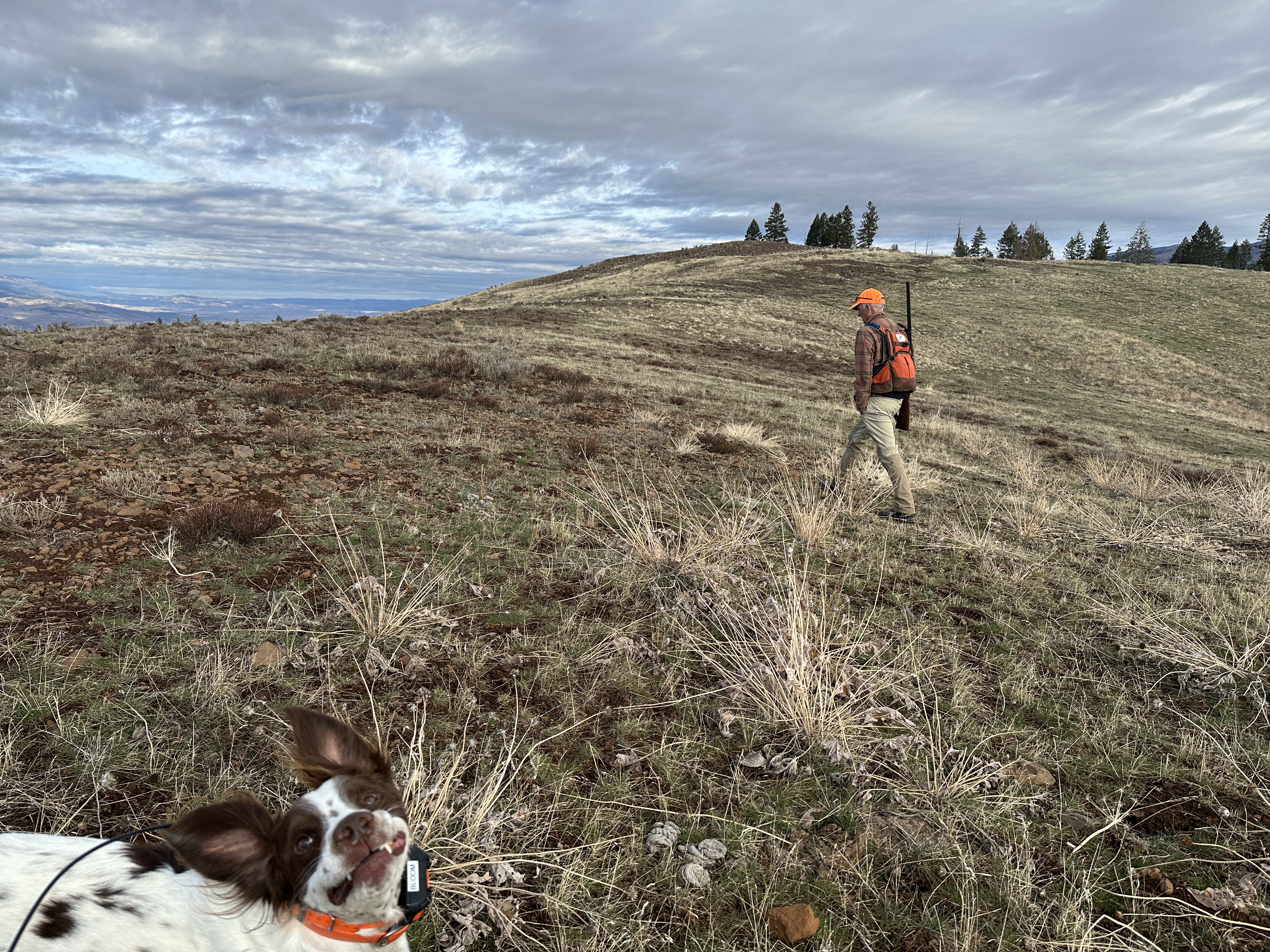
    A person wearing an orange hat and backpack walks through a grassy field with two dogs, amidst rolling hills under a clear blue sky.
    Pretty over-grazed and overly flat terrain, but we’d never been here and didn’t see sign of others, either. And there were lots of birds. Plausible conclusion: the lack of homo sapiens is a good indicator of game bird presence.

    One of the best things for me this season has been hunting with nearly-eleven-year-old Peat. Five times now he’s chased down chukar that I knocked down, disappearing for quite a while, and come back with them. Yesterday, for the first time this season, Peat disappeared after a bust in which I was able to whiff three times with no visible evidence of having even ruffled any feathers. It was one of those “I can’t believe I didn’t hit anything!” busts. But he came running back to us at least five minutes later with a chukar in his mouth. One of every seven birds I’ve bagged this season has been courtesy of Peat’s hard work after the shot.

    A dog carrying a chukar bird in its mouth, surrounded by rocky terrain and sparse vegetation.
    Peat with the chukar I didn’t know I’d hit

    The Hard Work Before the Shot award will without question go to Bloom. He covers much more ground than Peat does. Bloom averages more than four times what we cover, while Peat does almost three times our distance. Bloom in 18 hunts with me so far this season has run 272 miles, while Peat, in 22 hunts, has covered 237. We’ve noticed that when we all hunt together, Bloom tends to false point fairly often, especially at the beginning of a hunt. He definitely improves as the hunt goes on, but it’s almost like he’s trying to impress Peat, whose favorite thing in life is to honor another dog’s point (see my YouTube channel for many examples of this). Usually, Bloom’s first point of a hunt is several hundred yards uphill from where we’re just getting acclimatized, and we book it up to him, sometimes after he’s been stationary for up to 20 or 30 minutes, and as soon as we get up to him, he bolts. I’ve started calling it a “self-imposed whoa,” which is weird because Angus, who never once false pointed, always pointed with this very un-stylish posture (Angus is Bloom’s great-uncle). But as the hunt progresses, he seems to get more and more solid locating and pinpointing birds, which is really great. He tends to leave the retrieving and tracking duties to Peat, so it’s a good division of labor. I will say, though, in the couple of hunts I’ve done alone with Bloom that he has not false pointed even once, and has been an ideal hunting partner. It’s almost as if he’s trying to tell me that I can still do this when Peat is gone.

    A brown and white dog running through dry grass while carrying a bird in its mouth, with another dog in the background.
    Bloom doing his thing, whatever that is.
    A dog with a collar standing on rocky terrain, observing its surroundings in a grassy field.
    Bloom’s “self-imposed-whoa” posture
    A dog with a white and brown coat, wearing an orange collar, stands on rocky terrain in a grassy landscape, with hills in the background.
    Bloom in a “real” point (birds were there)

    Maybe the best thing that’s made this season, so far, really good is Leslie. I’m not sure about saying this because I realize it might make me look like much more of an ogre than I think I am, but she’s done two things differently this season than she’s done in the eight seasons since she started hunting. First is insisting I go alone with Peat every once in a while. As I’ve said, that’s been beautiful; I think it’s been beautiful for both of us because she’s gone by herself with Bloom several times and has really enjoyed that. Second is, when we all hunt together, she agrees to go where I want to go, and the discussions about the route we’ll try to take get vastly reduced. I’ll be honest here by saying that the main reason I have liked hunting for the 25 years I’ve been doing it is that when one is really hunting everything else disappears, including language and everything that stems from it. There’s nothing else like that for me (except, maybe, playing music). This, for me, makes it necessarily a solo endeavor. Any “foreign” intrusion on that — whether it’s your wife or best friend or boss or whatever — mitigates the escape from everything that is crucial to liking it, to wanting to hunt. So the thing I think I’m most grateful for this season, among many great things, is Leslie’s realization and appreciation of how and why I like hunting. It’s allowed me, for probably the first time since she began hunting (which was a huge step for her for many reasons), to sincerely enjoy hunting with my wife. I realize her sacrifice here, and that, as I said, I might look bad in the equation, but I’m just trying to be honest.

    A woman kneels in a grassy area, smiling while holding a chukar bird in her right hand. Two dogs are positioned nearby, one is a brown and white dog and the other is a tan and white dog. The background features a mountainous landscape.
    Leslie on a recent hunt

    Finally, the other thing that’s made the season so far very good for me has been the book. Many of you have bought a copy of Chukar Culture: Memory, Dogs, Paradox, and for that I’m very grateful. I’d love to hear what readers think about it, so if you’ve gotten a copy please don’t be shy sharing your thoughts with me. I’m trying to figure out how to market it better, but am kind of stymied there (i.e., I’m open to suggestions!).

    Book titled 'Chukar Culture: Memory, Dogs, Paradox' by Robert McMichael, featuring a dog holding a chukar in a grassy landscape.

    Speaking of merch: hats, shirts, and hoodies are coming soon. I will post here when they’re live.

    Thanks for reading, as always, and may your season be filled with as much world-cancelling experience as you’re looking for.

  • Podding

    I was lucky enough to guest on Scott Linden’s excellent podcast “Upland Nation” this week. He asked great questions, and I think it went well (I didn’t hate the sound of my voice more than I normally do). Unfortunately, I think the pressure got to me and I really shorted talking about our dogs and about the paradox of killing something you love, which are the two words in the subtitle of my new book, Chukar Culture: Memory, Dogs, Paradox. If you’re interested in those topics, the book rather focuses on them.

    Still, I’m grateful Scott wanted to include me on his show. Anyway, here it is:

    Podcast episode titled 'Chukar culture' featuring a guest who coined the term, with a scenic mountain background and a host holding a bird.

    In other things chukar, we’ll soon post the winner’s best retrieve story, and in a week or so should have a new bunch of Chukar Culture hats. More to come.

  • Hope

    Hope

    My morning ritual every day like clockwork is getting roused out of bed much earlier than I want. Usually the culprit for the rude awaking is Peat because his internal clock tells him it’s time to get fed. Bloom on the other hand is just an innocent bystander to this stupidness. Believe me, we’ve tried to ignore Peat and make him wait to get fed and have even stooped to the level of getting out of bed and putting Peat and his unwilling accomplice Bloom in the car in the garage just to get one or two more hours of shuteye. Bob and I are hoping that moving the clocks ahead one hour this weekend will result in Peat waiting to harass us at 6:00 a.m. on Sunday morning instead of his usual 5:00 a.m. wake up call. I know this whole problem could be easily solved by just stuffing them in crates in another room all night but we like our dogs to sleep with us and don’t plan on depriving ourselves from this pleasure anytime soon.

    After the dogs scarf down their kibble, I let them outside in our fenced backyard. While I’m waiting for them to finish doing their business, I make my coffee and then let them back inside. I grab my laptop and sit down on the couch with Peat curled up next to me on my left and Bloom on my right. I read my email and the news. While all this is happening, Bob is still in bed because he’s an insomniac and is usually up half the night reading and gets his best sleep after I get up.

    This morning, my mother-in-law Barbara who is an avid bird-watcher, had emailed me a link to a bald eagle nest live camera the night before. I clicked on the link and found myself mesmerized and watched an eagle on the nest, feathers blowing in the wind while sitting 145 feet up on a Jeffrey Pine Tree.

    At one point, the eagle named Jackie got up and left the nest for a minute. I could see two small chicks and one unhatched egg. I found myself being very excited and moved by seeing this because apparently, according to Barbara, last year the same pair set up home here had eggs that didn’t hatch.

    The exact location of the eagle nest and camera is not disclosed to protect the eagles, which makes sense; humans should be considerate to the eagles and nature.
    Later this morning while watching, Jackie’s mate Shadow showed up and by now 50,000 people were watching the live stream.

    A couple of days ago, Bob and I took the dogs out for a hike down in Hells Canyon. Bloom and Peat pointed a pair of Gray Partridge. I asked Bob if he knew if the huns or chukar were already pairing up to breed. He thought it might be too early.

    It made me think more about wanting to know more about chukar and Gray Partridge nesting. I remembered years ago finding a study about Hells Canyon chukar and luckily found it again. The 114-page report written in 2001 for Idaho Power is called “Assessment of Chukar and Gray Partridge Populations and Habitat in Hells Canyon.” The link is below:

    https://docs.idahopower.com/pdfs/relicensing/hellscanyon/hellspdfs/techappendices/Wildlife/e32_07.pdf

    If you hunt chukar or Gray Partridge the report is interesting and valuable. Jim Posewitz wrote in his book, Beyond Fair Chase, “Learning about wildlife must begin before your first hunt. The learning process will allow you to become a more understanding and ethical person, and it also will help you become a more successful hunter.”

    Here are some facts about breeding and nesting from the study if you don’t have time to read the whole thing.

    Chukar: Pair formation starts March-April. First eggs hatch March-April. Incubation of eggs 23-30 days. Chicks are capable of flight at <2 weeks of age and appear similar to adults by 18 weeks. Nesting period may extend over 5 months with hatchings from early May-August. During the study 23 nests were found. 87% were on south-facing slopes. The nests were often located within 183-366 meters of water. Rock outcrops were the most prevalent place for nests (56%) followed by grass forbs at 26%.

    Gray Partridge: No information on gray partridge nests in Hells Canyon or other canyon grasslands is available in the report. Based on studies for agricultural landscapes, dates for pair formation vary from region and weather conditions but usually January-February. Female chooses Male. Established pairs may remain together for life. Egg laying begins April-May. Incubation 21-26 days. Chicks are capable of short flights in <2 weeks and longer flights by 6-8 weeks.

    Sometimes it’s unavoidable but we try to not hike with the dogs off-trail in the spring in areas where we’ve seen chukar or huns during hunting season. Just like with that pair of eagles, we should try as much as possible not to disturb nesting areas. I suppose if you find yourself in the chukar hills with your pointing or flushing dogs this spring, avoid south-facing slopes with rock outcrops near water.

    Emily Dickinson wrote “Hope is the thing with feathers, that perches in the soul.” I find this to be very true.


  • The Fire

    The Fire

    “God gave Noah the rainbow sign,
    No more water, but the fire next time.”

    –A.P. Carter, “God Gave Noah The Rainbow Sign

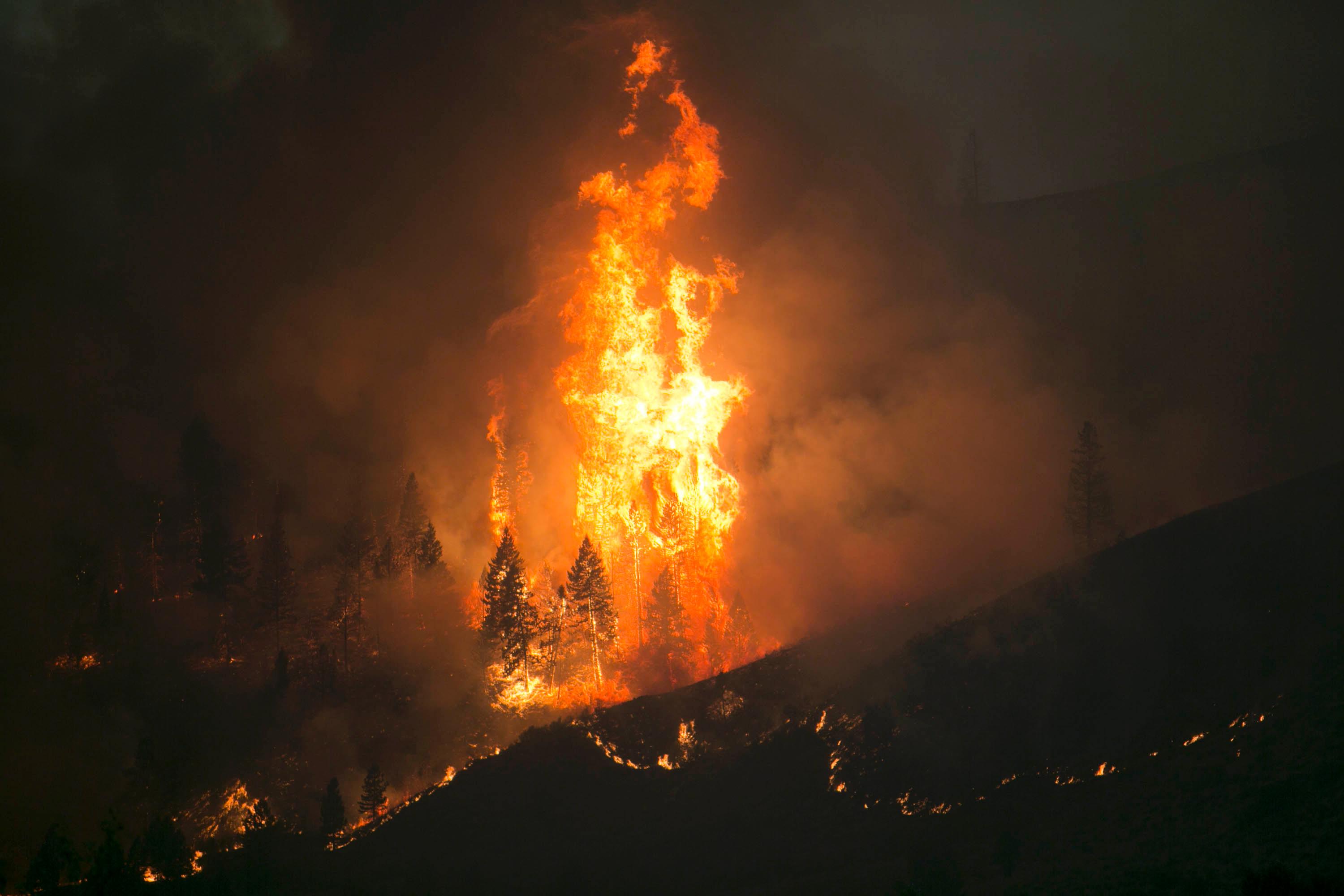
    This summer, chukar country was on fire. All of the places, and more, that we hunt have been burned. North, south, east, and west of us. Like most chukar hunters, I wondered about the birds, how they were faring, if this year’s chicks were old enough to run or fly to pockets of safety. Bird numbers have been mostly good this season, but a huge chunk of our favorite spots are now toast.

    Most of the fires started from lightning. Much of the fuel that allowed them to spread, and to continue growing, is invasive annual grasses: cheatgrass, medusahead rye, and ventenata. The “range,” composed largely of extensive tracts of public land (mainly BLM), is now “currently defined by ecosystem dysfunction, social upheaval, and a warming climate.

    We want to point fingers, but that does little good. In many of these places, it’s too late to stop the takeover of these destructive annual grasses, brought here from far-away places by feed for cattle. The pre-livestock perennials that kept the range “healthy” (a relative term) can’t compete and — in many places we hunt — are already gone forever. Bitterbrush and sagebrush, two of the most important perennials for a host of creatures endemic to the range, can’t survive the increased heat, frequency, and duration of today’s range fires. Same with the native bunchgrasses. In some of my favorite former chukar haunts what once plumed vibrant seas of multi-shaded green and gold now is a monochromatic moonscape of charred earth. Yesterday we happened to find ourselves descending into a bowl that once was filled with sagebrush and numerous partridges but now, four years after a big fire there, was choked solely with 4-foot-tall dried grass that completely hid our dogs. Sage and bitterbrush rarely come back once they burn hot. The invasive grasses all but guarantee more frequent fires on the range.

    The obvious irony is that chukar love the fresh, abundant shoots of these invasive grasses. The fall rains that bring “greenup” signal good bird numbers in lots of places. Doubling this irony, of course, is that this beloved bird is itself invasive. So why do we care?

    The answer is obvious and needn’t be stated. Less obvious, maybe, is that an even bigger threat to these public lands is the continuous attempt by robber barons to transfer them to the western states. We’ve been able to continue indulging our chukar hunting passion, despite the fires, because of the abundant choices of BLM and NFS land in Oregon, Idaho, Nevada, Washington, Wyoming, Montana, and Utah. Closest to our home, thanks to Idaho’s repugnant trespass law of 2018, hundreds of thousands of acres adjacent to NFS and BLM land have been purchased and closed off, including (illegally) some public roads, by the notorious Wilks Brothers from Texas, a state with almost no public land. (Look on onX, for example, up the Middle Fork of the Weiser for “DF Development LLC” land, which is one of the Wilks Brothers’ land businesses.) The Wilks Brothers acquired much of their holdings by purchasing Idaho State lands, which the state is required to sell, which is what everybody knows they’ll do with any federal land that gets transferred to the state. Do you want to be like Texas, where you have to be rich in order to hunt?

    The latest legislative assault on public land is happening in Utah, in which a small faction of sycophants to the American Lands Council (funded largely by the Koch Brothers) is using unconstitutional boilerplate arguments paid for by taxpayers to argue that all federal land in Utah should be transferred to state control. The only way they’ll succeed is if the state’s constitution is amended, which is their aim. Most western states have an almost identical constitution which stipulates that citizens of those states “forever disclaim all right and title to the unappropriated public lands” in the state. Courts have, until now, rejected these lawsuits as unconstitutional, but with the shift in the composition of the U.S. Supreme Court, along with numerous federal courts throughout the U.S., it’s possible that one successful challenge — maybe it’ll happen in Utah soon — will lead to a domino effect vaporising federally held (i.e., truly “public”) land in the west. For anyone who uses these public lands, that would be worse than any fire. If you believe in contacting your state representatives to express your opinion, Idaho Wildlife Federation has made a snazzy form for sending an editable comment to Crapo, Little, Risch, and Fulcher that encourages them to disavow Utah’s current effort to transfer its public land to the state. I did it, and am sure I’ll get the typically condescending response from Risch’s office. Can’t say I didn’t try…

    For an excellent, recent overview of where we are and how we got here, see the video below, in which Walt Dabney, former National Park Service Superintendent and Texas State Park Director, discusses the history and future of America’s public lands.

    Finally, with regard to the Hercules project near Cambridge, which is now being called, by Hercules, the Barrick Project, foreshadowing a transition from exploration to actual mining, there’s more information. I personally haven’t been able to stomach going back to the area after my visit last year, but Leslie and I hunted across the canyon from it and were stunned by how many new roads they’ve carved into the publicly owned land there, mostly on the Andrus WMA but extending now into USFS land higher up. Perhaps even more dire than increased fire vulnerability or transfer of public lands to state ownership, mining rights threaten the actual earth itself. The Idaho Conservation League just released a comprehensive report on mining in Idaho, which details current projects and past environmental impacts of mining in the Gem State (click the image below to load the report). Like fire itself, which is both real and metaphoric, verb and noun, mining is something everyone who values public land should know something about and not take for granted.

  • Where They Are

    Where They Are

    [I just found this in my “Drafts” folder. It’s from two years ago when we were still looking for a place back in chukar country to move to. I thought I’d posted it but for some reason didn’t, probably related to a family emergency that, along with the person it centered on, passed about a year ago.]

    We drove nearly a quarter of a million miles looking for birds this season. I don’t have the exact figure. We hiked 51.4, which was at least twice what we did the previous season (I didn’t even bother keeping records), but more than 160 fewer miles than our last big season (2020-21). Those are all the numbers I feel like sharing now. Maybe next year I’ll geek out a bit more on that score.

    At the beginning of one of those long, multi-state drives, in December I think, we left our house at the ultimate northwest point of the contiguous United States and drove nearly 30 miles going 25 mph along the undulant serpentine highway fronting the Strait of Juan de Fuca (also known as the Salish Sea) before realizing that I had forgotten my boots. So we went back and got them. The fog had burned off on the redux. “Worth waiting for, huh?” it seemed to say.

    For years I’d wanted to hunt chukar in Nevada. And never had. So this year, we went down there, armed with some beta from a cyber-friend we ended up meeting for dinner in Winnemucca. We’d reserved a room, on his advice, at Scott’s Shady Court, and when we crossed its threshold we time-traveled back about a half-century. Our suite was big and roomy, and cheap, and the dogs loved it, but there weren’t any grounded outlets so I couldn’t charge all our shit. Anachronism much? Anyway, before dinner at the fabulous (for real) Martin Hotel, we headed to Wally World to buy licenses to add to our Idaho, Oregon, Washington, Montana, and Wyoming bird licenses this season. It was a typical Wal-Mart experience: walk around ’til you find someone who looks like they work there, ask for help, and have them ignore you but walk away and use their radio to ask someone to come to the _____ department and help a customer. The five minutes that elapsed before an associate arrived were spent by me thinking I should have just tried to get my license online. The young man entered the space behind the counter near all the guns and ammo (they lock that up now, too), and began logging into the computer. There was another guy with him, also with an associate’s blue vest and nametag with the smiley face on it. Together they appeared to will the keypuncher’s access to the system. Several minutes and dozens of keystrokes later, the keypuncher looked up for a brief moment, not at me but in my direction, and announced that he couldn’t remember his login information. I looked at him and asked if he could call a manager. “I am the manager,” he replied. The ensuing conversation made it clear that I would not be able to purchase a license at Wal-Mart that evening, but that I could come back at 8 a.m. the following morning when another manager who could probably remember his or her login would have taken over. On the way out I made a brief stop at the customer service desk for a second opinion, which verified the first one.

    At the Martin Hotel, sitting with strangers at the long family style dinner table, before our friend got there, while pretending to peruse the menu, we eavesdropped on our table-mates’ conversation about lining up immigrants, shooting them, and letting them fall into a mass grave. “Where would be a good spot for that?” one of the others asked earnestly. Then our friend arrived, and on hearing the account of the Wal-Mart license experience, was initially aghast but then said that unless we had a physical copy of a certificate showing we’d passed a hunter safety course we would not be able to buy a license in Nevada. It was my turn to be aghast, which I was; none of the other five states had such a requirement for people of our advanced age and inestimable experience. Chock this one up to an overabundance of faith and not doing adequate research: the next morning we drove north out of Nevada, our Silver State Chukar Virginity intact. As we crossed from Nevada into Oregon, Leslie said, “We should call it ‘No-vada.’” [NOTE: We’ve since figured out what we need to do on the license front, but have yet to make it there. Soon, I hope.]

    Like Moses, we wandered a lot in the desert looking both for birds and a new place to live. Wyoming was different for us, and revelatory in several ways. The red landscape around the Wind River range struck us positively, but the prickly-pear cactus stuck our dogs’ feet negatively. Still, after a wonderful morning in and around Lander, we did laundry in Pinedale and talked with an octogenarian man who’d raised ten kids in a log cabin nearby with no running water or electricity; each of his kids had long since graduated from a prestigious university and gone on to do big things. We camped at Ten Sleep Brewing Company, initially setting up in the wrong campground, to be kicked out by a rancher who owned what was the glitzy but empty level concrete pad expensive campground right next to the brewery campground but with no distinguishing signage. We found our sloped grassy/muddy tiny spot not long thereafter, which was okay. Better than okay was being awakened the next morning by chukar calling from a rocky outcropping above the brewery. The dogs were lit running through the network of red arroyos and over terrain that must have registered a lunar difference if they’d even paused for a second to contemplate. I’ve never hiked in anything more beautiful, but no birds were found by us despite a couple hard points by Bloom. On our way out of there, we (I) of course got lost, which I truly enjoy but Leslie does not. An unexpected joy, for us both, was that, while we sat pulled off to the side of the road, a FedEx truck passed us, braked, reversed, and the driver asked us if he could help direct us somewhere. His friendliness and easy-to-follow directions gave me a warmth for humanity. About thirty minutes later, we came to an intersection on the still-gravel road that we wanted to analyze, and — you guessed it — the same driver came past us, stopped, reversed, this time getting out of his truck and walking back to us in case, I don’t know, we might have something as novel as a map to look at (nope; just the “smart” phones). Anyway, he suggested the best route to Cody, and we were on our way, but not before my typical question to strangers in chukar country: “Do you by chance hunt chukar?” He said no, he didn’t have time, which I thought was a good answer, whether or not it was true.

    As it’s no doubt obvious by now, we’re both beerhounds, and the more cynical out there might view our house-seeking/chukar-hunting itinerary as a thinly-veiled excuse to visit brewpubs throughout the intermountain west and Pacific Northwest. Joints including but not limited to ones in Prineville (OR), The Dalles (OR), Walla Walla (WA), Lewiston (ID), Clarkston (WA), Ontario (OR), Mitchell (OR), Ten Sleep (WY), Sheridan (MT), Lewistown (MT), Ennis (MT), Victor (ID), Spokane (WA), Baker City (OR), Enterprise (OR), John Day (OR), Salmon (ID), Driggs (ID), Olympia (WA), and Troutdale (OR) sold us IPAs. And, in the ill-fated Winnemucca leg, we were gifted with some fine brews by Alectoris Aleworks! With Hells Canyon Beer about to embark on its third iteration, we realize we actually might be a Beer Club with a Chukar Problem.