Tag: upland hunting

  • Shadows

    Shadows

    When it comes, the Landscape listens —
    Shadows — hold their breath
    –Emily Dickinson

    Like Men and Women Shadows walk —
    Upon the Hills Today —
    –Emily Dickinson

    Every picture has its shadows
    And it has some source of light
    Blindness, blindness and sight
    –Joni Mitchell

    Life’s but a walking shadow, a poor player,
    That struts and frets his hour upon the stage,
    And then is heard no more. It is a tale,
    Told by an idiot, full of sound and fury,
    Signifying nothing.
    –William Shakespeare’s Macbeth

    Hunting chukar is a privilege, a hobby. Nobody hunts chukar because they must. If your life depended on it, even if you shot 100%, you’d die of malnutrition. Calorically, it’s way less than a zero sum game. On this 95th anniversary of Black Tuesday, that’s food for thought.

    I started this blog about 15 years ago, after I’d lost my job and had more time on my hands. My first chukar hunt happened ten years earlier, in the fall of 2000, thanks to the generous father of a co-worker. He and his Lab had picked me up in the dark in his Bronco, never having met me or my puppy Glenna, and drove about an hour outside of Boise. He’d told me to bring waders. We linked arms, started across the swift river, hoped the dogs would figure it out, ditched the waders on the opposite bank, changed into our boots, and headed uphill. My youthful enthusiasm and Glenna’s natural ability impressed him, but we never went with Rich again. I’m not sure why. I think I got one bird that day. But, as I’ve written about before, Glenna — for whatever reason, probably my fault — began hunting too much for herself and diminished my desire to chase birds.

    I started really becoming obsessed with this privilege when I moved to Cambridge in the summer of 2012. It served to stabilize me through the first several years of my new teaching career there, and soon became my favorite thing in the world. Even though my first glimpse of Cambridge was colored by the pawn shop’s astonishing storefront, lowlighting the deplorable ‘Murica mentality of its owner (who’d been the high school art teacher before the district cut the art classes because of Idaho’s deliberate underfunding of public education), being able to go hunting after school and on the long weekends (ours was a four-day school) really helped me to develop a stability and contentment there. And as teaching became easier and more fulfilling, so did chukar hunting. Funny how that works.

    The former high school art teacher sitting on the bench in front of his pawn shop in Cambridge, July 2012. (Enlarge the photo to read the signs.)

    So my first four seasons there became more and more joyous. My youngest group of students had become seniors, and in the spring of 2016 they asked me to give the Commencement address, an honor which moved me tremendously. But in November 2016 the shadows started becoming more of a factor, darkening the landscape. It took awhile to notice. Incredulousness played a big part. Teaching critical thinking skills seemed increasingly important, but began taking a toll on my demeanor. When I refused to answer a question about the recent election, one of my best students said, “I’ve been waiting since kindergarten for a new president but I didn’t want this one!” Not by nature a tongue-holder, saying nothing about any of this at school took more out of me than I’ll ever know. By 2018 I realized I’d transitioned from a merely negative person to a constantly angry person. It’s been a while now. Nearly ten years of watching the normalization of hatred and division, the disrespect for the rule of law, and now the threat of a complete dismantling and destruction of this country’s admittedly flawed but hopeful foundation looms so large for me and tens of millions of others that every day every thing is laced or suffused with dread. Including this privilege of walking around public land (who knows how long that’ll last) searching for game birds with my dogs and wife.

    So it would feel ignorantly irresponsible of me not to say that I’m voting for Kamala Harris and to encourage everyone I know to do the same. Actually, I voted early. It was easy for me. I know it’s not for many. As I’ve written here and elsewhere, strong women have been a formative part of my life from its beginning. This shouldn’t strike anyone as irrelevant to this blog: it’s been a satisfying impossibility for me to separate chukar hunting from everything else and vice versa. Worry, dread, shadows all play their part at some point in every outing; the ups and downs of any hunt reflect life in reassuring ways. But when those dark things spread so opaquely over everything they demand all of my attention, paralyzingly so. The thing that saved this country in the fallout from Black Tuesday, after so many people died and suffered needlessly for years because of the un-democratic power and greed of a few, was FDR’s New Deal, which is the model for what Biden’s done to rescue the economy from his predecessor’s grift and graft. Harris, obviously, will build on that success if she wins. But there’s more to this than just “the economy, stupid.” Obviously. There’s the abyss, which is always all shadow.

    Stupidity is one thing. Ignorance is another, and it is truly deplorable. Our dogs and the birds we chase, god love them, are stupid, but their instincts — at least on this playing field — are smarter by far than ours. Their lacking of the anatomy that makes us intelligent is the basis for our love of them: dogs, for one, can only do what’s right and good. Ignorance, on the other hand, is having the ability to know the difference between right and wrong and choosing not to give a shit, choosing not to pay attention. There is only one right choice out of the two we have for who leads this country. The wrong choice is simply, obviously, wilfully ignorant. I know there are many who think, like Macbeth, that it doesn’t matter. Even a smarter writer like Emily Dickinson thought that

    Diadems – drop –
    And Doges surrender –
    Soundless as Dots, 
    On a Disk of Snow

    but I like to think she wasn’t as serious about that as she was about shadows holding their breath. I’m holding mine. Don’t be ignorant. Do the right thing.

  • Younger

    Younger

    Just got home from a great week hunting chukar in Oregon. We were blessed with mostly good weather, and my shooting actually seemed to get better. Imagine that. To be honest, I’d switched from the #7 steel Rio shells (1-1/8 ounce, 1350 fps) that were sent to me in error last season (I’d ordered #6, but they wouldn’t take them back) to some lighter target #6 steel loads (1 ounce, 1365 fps) I’d brought as backups. Who knows? Biorhythms? Planetary alignment? Jerky? Payday bars? A penchant for Joni Mitchell?

    The revelation of the week, for me, came accidentally. Peat, who’s now nearing 10, is wearing out and it breaks my heart. He was limping badly from some abrasions on his pads and also the arthritis or tendonitis that has crept up on him the past few seasons after tough hunts. To call this an accident is dishonest, but I’m still gonna call it that. I was hoping to take Peat for a fourth straight hunt, seeing as it would have been our last day on this trip. But he wasn’t up for it. He didn’t even get off the bed in the camper when I walked out the door with Bloom. Leslie had very kindly encouraged me to go alone with the younger dog. Her dog.

    I didn’t have high hopes for the hunt. I’d never hunted alone with Bloom, who’ll be 4 next March. His nose has always seemed to be almost too sensitive, leading — we’ve theorized — to lots of false pointing. But he’s also found us a ton of birds. Peat, whose favorite thing in the world has always been backing another pointing dog, and, as Angus did with Peat in his early days, seems to have gotten comfortable letting the younger dog do the most work. My log shows Peat barely outrunning Bloom their first season together, then Bloom besting Peat by about a mile or two per hunt, and this season so far (after 17 hunts) Bloom is outrunning Peat by 3 or 4 miles. Bloom is an athlete, a freight train of uncut and solid muscle, and runs 4 to 5 times what we hike. Peat’s a finesse hunter, and has always “only” averaged about 3 times our mileage. The upshot of the discrepancy in the ground each dog covers is that I’d never really paid careful attention to how Bloom hunted, only noticing that he covered much more ground than Peat did. Still, when Peat points it’s a sure thing. I’d gotten used to 50-50-ing Bloom’s points, and focusing mostly on Peat.

    But hunting alone with Bloom the other day let me see him work more clearly. Before too long, it had become obvious how utterly methodical he was. He’d almost intuit the path I moved along, and would run ovals apexing at almost exactly 200 yards in front of me, then circle around just behind me and start another oval. He did this for 3 straight hours, deviating only when chukar scent pulled him “off” course. Which happened five times, resulting in four shots and three bagged birds. My “best” hunt (as far as numbers go) this season.

    Bloom seemed to appreciate the simplicity of our hunt, too. He didn’t have two hunters and another more experienced dog to contend with. It was reassuring, in a bittersweet way. It was almost as if we both responded to being able to focus better on the task at hand, where the sum of the affair was greater than its parts. How sweet. But the bitter part remains. Anyone who’s had multiple dogs knows this game: you favor a certain dog and then he or she starts showing the inevitable decline that comes with age. The cloud moves in. I’m at the point where I can, finally, hunt more consecutive days than Peat can, but I know it won’t last long, both because of my age (And if no other misery yet age?) and because of his. We look for things that might mitigate this sadness, and a younger dog improving, or just being able to appreciate him without comparing him to an older, more beloved beast, certainly doesn’t hurt.

    I’m glad Leslie encouraged me to take her pup out, and that she sacrificed a gorgeous late October day (the day before her birthday no less!) to stay at camp with Peat.

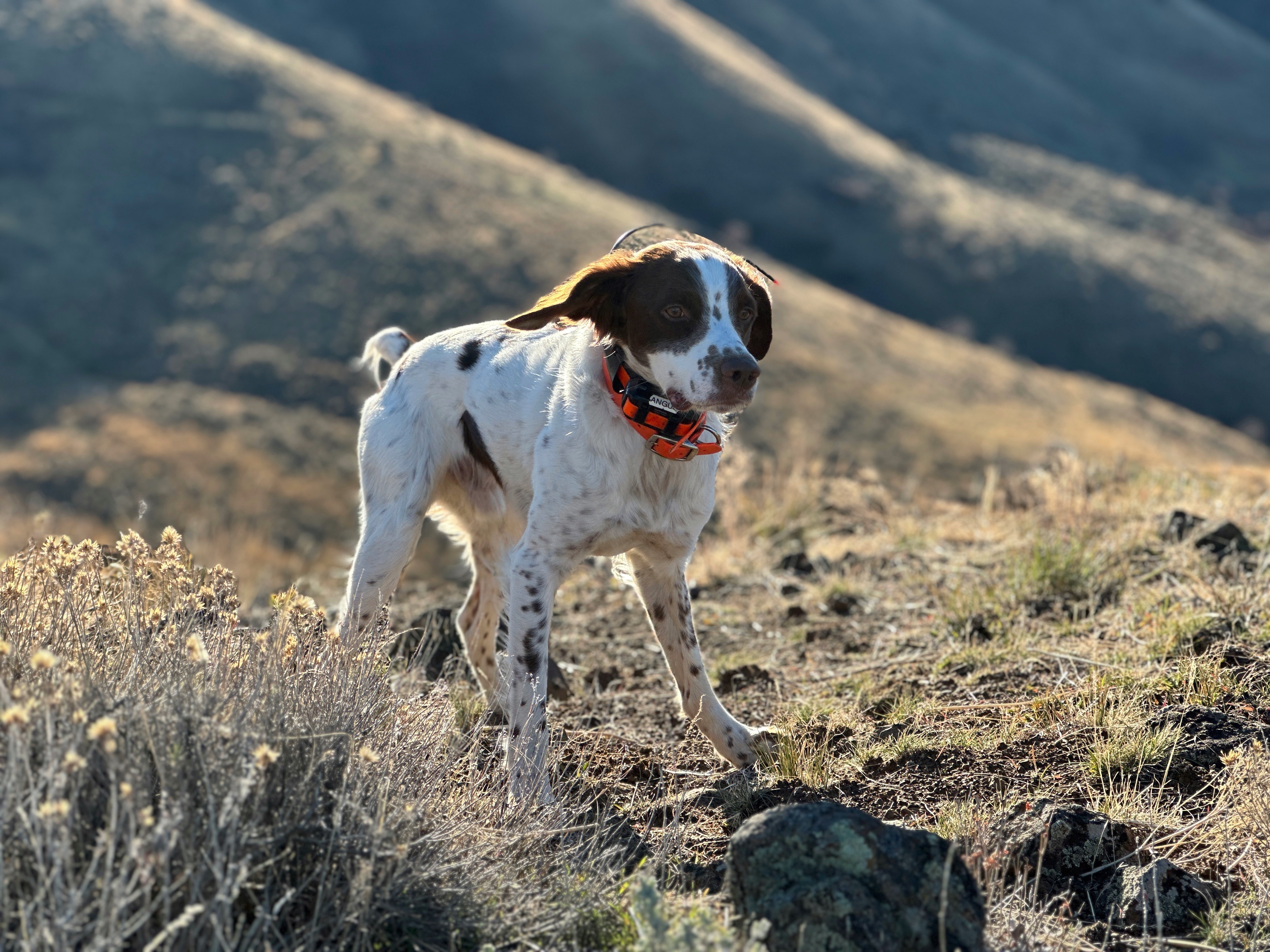
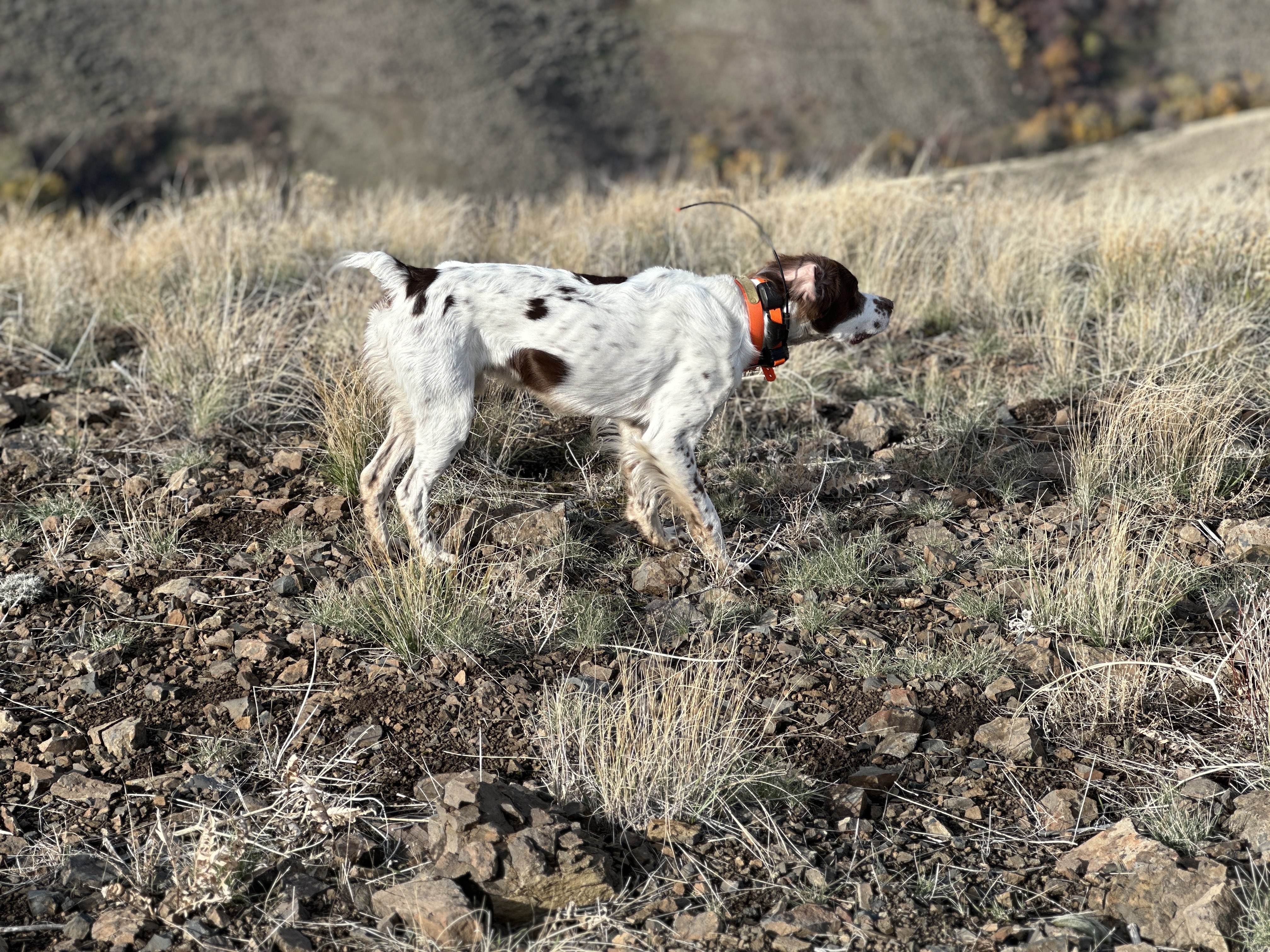
    Bloom pointing stylishly (note his tongue). He seems to like it this way.
    Just checking to make sure I’m still there
    Bringing home the bacon
    Bloom’s most similar behavior to his great-uncle Angus: retrieving a bird to the closest sagebrush shade to me. He runs hot.
  • Will

    Will

    Will you go to lunch.” — Kevin Spacey as Williamson, Glengarry Glen Ross

    If others have their will Ann hath a way.” — James Joyce, Ulysses

    “Jem and I were accustomed to our father’s last-will-and-testament diction…” Harper Lee, To Kill A Mockingbird

    The will to live, which forms the inmost core of every living being, exhibits itself most conspicuously in the higher order of animals, that is, the cleverer ones…” — Arthur Schopenhauer, “Psychological Observations” (1817)

    I had this thought last night: “There are four dead birds _________ in my refrigerator.” I couldn’t think of any present participles. Actually, I could, but they didn’t make any sense, their cognitive dissonance was too great. The idea doesn’t really need a participle but, you know. Habits of language. Then I wondered why I was having this trouble. And it occurred to me that death can not be a state of existence that warrants any present anything, participles, verbs, presence. It’s the absence of being.

    I would say that chukar are among the “cleverer” animals, so when their will to live is extinguished by a mortal wound caused by some number 6 steel shot fired from my gun, that bird is from that point forward verbless, regardless of whether it’s in my fridge or freezer, or even taxidermied on a beautiful mount that hangs on the wall. Its being no longer is, which includes its will to live. Or, as John Cleese described his dead parrot to the falsely incredulous pet shop owner, “This is an ex-parrot.” And I did that.

    This all might seem pretty basic. But it wasn’t to me, and still isn’t. The problem intensifies, of course, when it’s turned onto me and my mortality. What’s the connection between all of our individual mortalnesses and this hobby of ours, trying to bag birds, trying to create ex-chukar?

    The phrase in the regulations sheds some light on this: “reduced to possession.” When we will it and execute it properly, the chukar’s will to live (our idea) is not actually reduced, is it? Instead, it’s eliminated. But what the regs mean is that — like the word they also seem to love, “harvest,” as if we’re talking about corn here — we’ve merely diminished the animal’s state of existence. One could also argue that the regulations’ language here simply marks the difference between a daily bag limit and how many previous days’ harvest one has in possession. Regardless, it’s dishonest language. The discrepancy in meaning between “reduced” and “eliminated” is our (as the putatively cleverest of the animals) inclination (or will) to minimize or obfuscate the fact that we’ve asserted our will over another creature’s and rendered it a former being. Further, it’s generally assumed that asserting our will over another creature’s — as long as they’re “lower” than us — is normal, okay, unproblematic. Ortega y Gasset’s Meditations on Hunting, probably the most-cited writing on this subject, normalizes this hierarchy in a specist and specious argument (which is why I have no use for it).

    Another aspect of the phrase strikes me, too: “possession.” When we possess the chukar, it’s not only dead but no longer free. We own it. But can something dead be owned, possessed? Grammar says no. Still, our will prevails. (I’m aware of my cultural bias here, as a non-Native Western European: Native American cosmology and ontology have much different takes on all this.)

    But, despite the linguistic obstacle, who can do this to us? How are we reducible to possession? That’s not a real question. We all know the myriad answers to it. Some eliminations are accidental, some intentional, and some just are as a matter of course (dying of old age, for example). Or, for some, it just comes down to God’s will. Not sure what to do with that, aside from saying that we’re assuming the status of God when we “harvest” game (Gasset would have no problem with this). But it’s ironic to me that we cleverest animals have mucked up our wills to live far beyond the less clever but still clever enough to will a life. Maybe in Schopenhauer’s time humans’ will to live was pretty uniformly “conspicuous.” Existence was harder then, and humans, regardless of economic or social status, spent enormously more time than we do on subsistence-related endeavors. Food, shelter, clothing. Now, we have Amazon and Blue Apron. So our wills to live have been diminished somewhat, at least for those privileged enough to have a relatively easy life. I’d say that anyone who hunts for sport (as opposed to necessity) falls into that category.

    If you’ve read this far you’re probably going, “Where the hell is he going with this?” For me, all this comes down to the question, Whose will to live shall prevail, and why? Clearly, we humans think our wills are superior to animals’ and therefore, duh, shall prevail. But I don’t actually buy that, although — hypocrite Me — I act on it at least fifty times a season. First, the concept of superiority, or hierarchy, is entirely ours, which is self-proving. “Fair chase” is probably the best known and most relied on ethical justification of this hierarchy, but in truth there’s nothing even remotely fair about it. It’s not a level playing field. Animals have no conception of the food chain, despite being programmed to fit in the various slots human analysis has constructed through observation over the millenia. This reminds me of the trouble Noah Lyles got in during the Olympics for criticizing the “World Champion” concept in American professional sport for assuming the U.S. equals “the world.” So yeah, bias is a bitch, and hackles will be raised when it’s called out. So I expect something.

    A lot of this has to do with my metastasizing distaste for tailgate shots, which I wrote about not too long ago. “Look what I did!” Poses with dead game and their killers litter social media. Despite what Gasset says, there is nothing noble about “tradition,” which has been used for nefarious purposes forever. Why the need or desire to associate oneself with an ex-chukar and share it with the world. Penance? Pride? A cry for absolution? Atonement? Adulation?

    When I kill a bird I feel guilty as hell. I think of the family I took it from. I think of the life it was endeavoring to live, the succulent blades of grass I found in its crop as I cleaned it (the vocabulary of all this rocks me). I think of the covey bust and its communal expression of the will of each of its members to live, and live together, going forward, fearing the demise of their lives, of being eliminated, of not wanting to be eliminated. I think of fear as a killer and a saver of life, and the crap shoot as to which it is in any given situation, and how my participation in this particular situation radically influences that outcome. I think of the things I share in the chukar’s fear, of my own fears about mortality, whether caused by an external force or not. I think of the dogs, and then I can barely take it, in good ways and bad.

    And I will do this. Until I won’t.

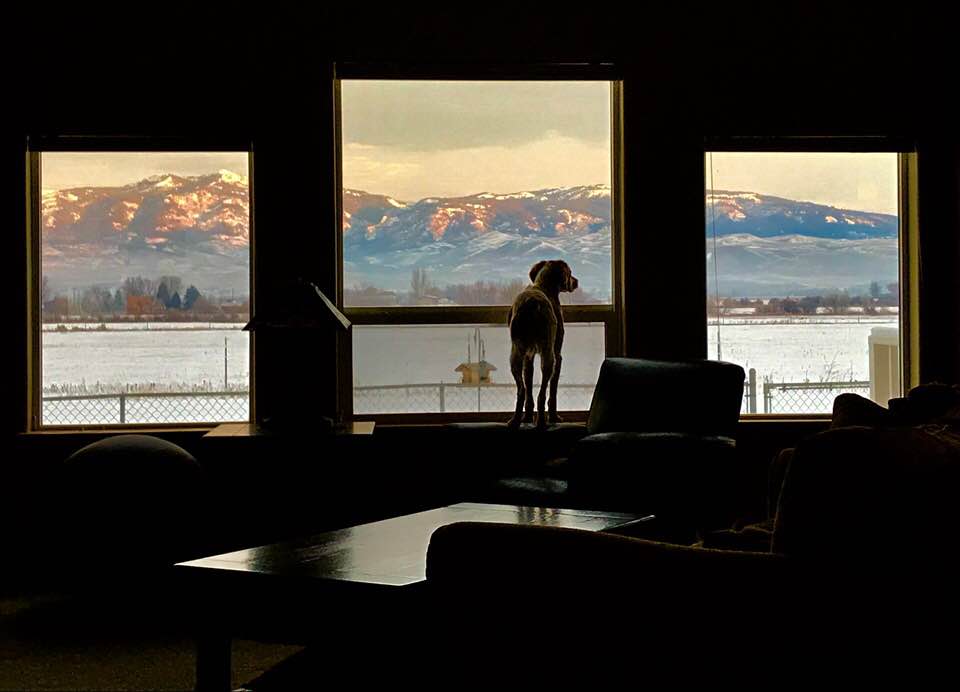
    Peat looking outside in Cambridge

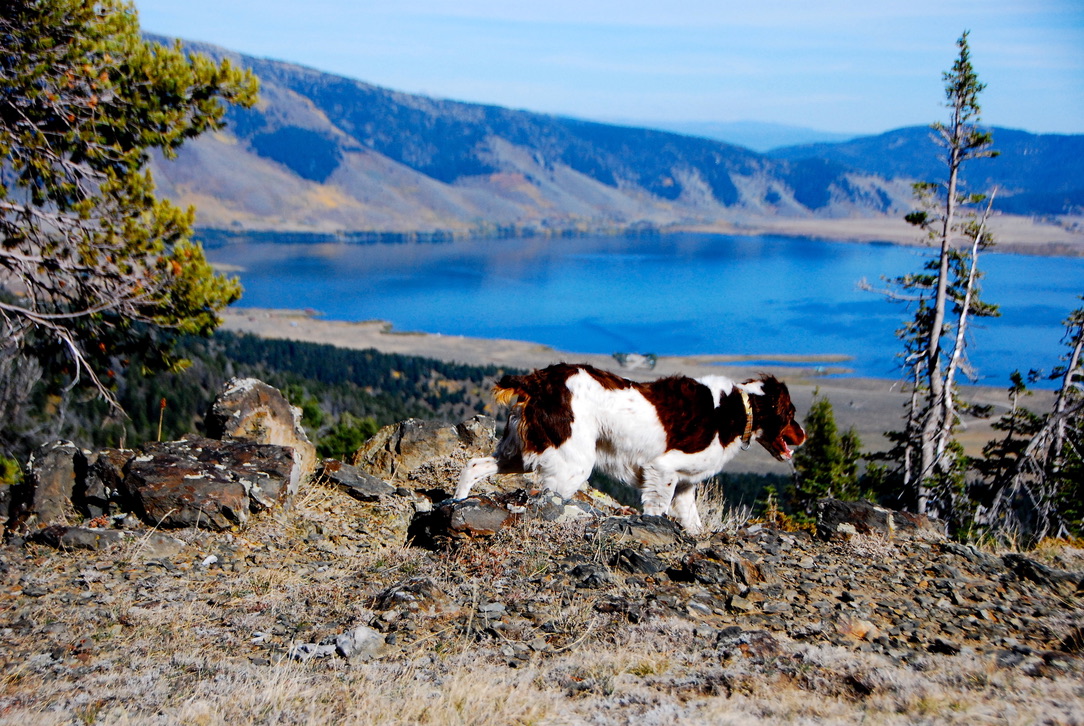
    Angus, about ten years before we laid his ashes in exactly this spot, on Schoolhouse Ridge, overlooking Henry’s Lake, on the Continental Divide.

  • Praising Canines

    Praising Canines

    Our little burg has a “town square” group on Facebook. Notices of dogs running loose, accompanied by blurry photos, is probably its most common theme. Often, follow-up posts report that the mystery dog’s owner has been found and that the dog has returned safely to its home. Very occasionally, as happened yesterday, someone reports a dead dog. A close-up of creamy and mocha short-haired fur, a Christmassy collar with little bells on it, and lots of small black and white-tipped porcupine barbs. No face or even an indication of breed. Not necessary. Someone’s beloved pet, judging by the remarkable collar. Most people who respond do so empathetically, posting a “sad” or “caring” emoji. Sometimes the keyboard commandos come out, though, as one did in this case, chiding the author of the post for not including a “better” photo of the whole dog. But when it comes to dogs, the better angels win and these j-holes get put in their place publicly. Which is gratifying in a way because people seem compelled to affirm that these creatures really are our best friends. You get it.

    I was a cat-person, childless, until age 36. My first dog was Glenna, a backyard breeder’s last Brittany puppy out of a litter of ten. I think she cost me $300. After she passed at the early age of 10 from megaesophagus I tracked her life’s vet bills (I’m one of those organized OCD types): it was more than $10,000. If I’d never gotten another dog after her — the thought had settled in me for a while there — I wouldn’t be writing this. My time with her would have been written off as a failed experiment. Glenna was a good test for a first dog: headstrong, increasingly irritable as she aged and was overtaken by her discomfort from having an esophagus that went on strike: her food just piled up in her throat, created a lot of foam, and the bolus (a word I’d never heard of before this) would get coughed up spectacularly in stages, piles of sticky white foam surrounding still-dry kibble. Gruesome, and emotionally wretched. The pounds slid off her and I finally had to end her life.

    Fortunately, we’d gotten Angus when Glenna was 7. If you’ve followed this blog, I don’t need to say anything else, but you might want to see Leslie’s post from 2019, “Saved by a Dog.” Then, later than we should have, we got Peat when Angus was 8. But if we hadn’t gotten him then, we wouldn’t have, and we might now be dogless. I was convinced Peat was the Devil. Initially. Well, for about three years. Now that we’ve had almost ten years to adjust to him (he hasn’t changed at all), he’s just adorable. At least we think so. Maybe our lack of friends has something to do with that. Peat. My nephew put it well when introducing Peat to a friend of his when we were all about to float the Missouri this summer: “He’s a 10-year-old that acts like a 2-year-old.”

    Now we have Bloom, who’s 3. Bloom, Peat, and Angus all came from the same breeder. They each couldn’t be more different from the rest. Each has been the world. Bloom, by design, is more Leslie’s dog. I’ll let her write something much better than this about him. She has the knack, and he’s worth some buckets of words.

    Peat and Bloom hunted with, for, us yesterday. It was hot. Early season, where there’s no water anywhere and we might as well have been in the Australian Outback. Within the first five minutes, Peat pointed a covey of Huns. Bloom pointed something else, closer to me, about 50 yards away. Peat’s covey went up and Leslie took one shot, killing two birds. Bloom’s birds didn’t materialize. Halfway through the hunt, both dogs started slowing down, hop-scotching from bitterbrush to sage in search of shade. We took a break, gave the dogs some treats to go with the mass quantities of water they’d been drinking, hoping they didn’t get hyponatremia. I ate a Payday. We did a 180, and the sun was, finally, at our back. Peat got a second wind and hunted hard all the way back to the truck. But we encountered no more birds.

    I probably have a few more seasons with Peat, and each will be diminished somehow. If I’m lucky. I can’t really face it. Don’t want to. Yesterday tried to get me to glimpse the future. When Angus was a puppy, even before I started really hunting with him (I had to wait for Glenna to die, when he was 3), I’d begun grieving his death. It was stupid, but that’s what I was called to do with him. Peat guaranteed I wouldn’t do that, and before I knew it (he was a little more than 3) I was hopelessly in love with him. I’ve never experienced anything like it. He’s a cartoon. There’s nothing remotely noble about him, and he doesn’t give a shit. I suppose, then, he’s like me.

    But I do give a shit. That’s what makes him better than me. I shouldn’t. Dogs do that: no matter what they’re like they make you wish you were better, wish you were more like you think they see you. If you give a shit, that means there’s something not quite right with you. Dogs don’t have that burden. They just want to connect. That’s all that matters. Thank god. Dog.

    Glenna teaching the puppy Angus about sticks
    One of my favorite shots of Angus
    Leslie taking a break with Bloom (wearing Angus’s collar)
    Peat looking at the future (Bloom)
    Peat. MENSA Dog.
    Leslie and Angus in a happy place
    Peat, pointing with a tibia, and style
    Spring in Cambridge with Angus and Peat
    Peat, in my classroom, showing Angus where chukar originate

  • Youth Hunt

    Youth Hunt

    Idaho’s chukar season began on September 21. We were still fishing in Montana. On my first encounter with Idaho chukar this season, on October 1, I was hunting in a spot I hadn’t hunted before. I’d tried one other place for the first time about a week prior, but saw no birds or even turds there.

    When I finally joined the dogs after a rather epic brush-busting ascent up a steep incline, Bloom, who last season had been in the annoying habit of false-pointing several times at the beginning of hunts, went straight to what turned out to be a widespread, big covey of chukar in a roomy, shady bowl just below a ridge topped with large Ponderosa. Peat, as Angus used to do to him, initially honored and then crept past Bloom to dial in the birds’ location. As I crept close to the nearly supine, pointing Peat, the thirty or forty chukar busted in waves, from an area at least fifty yards wide, so shocking to me that I was able to manage only one prayer of a shot. Which I missed.

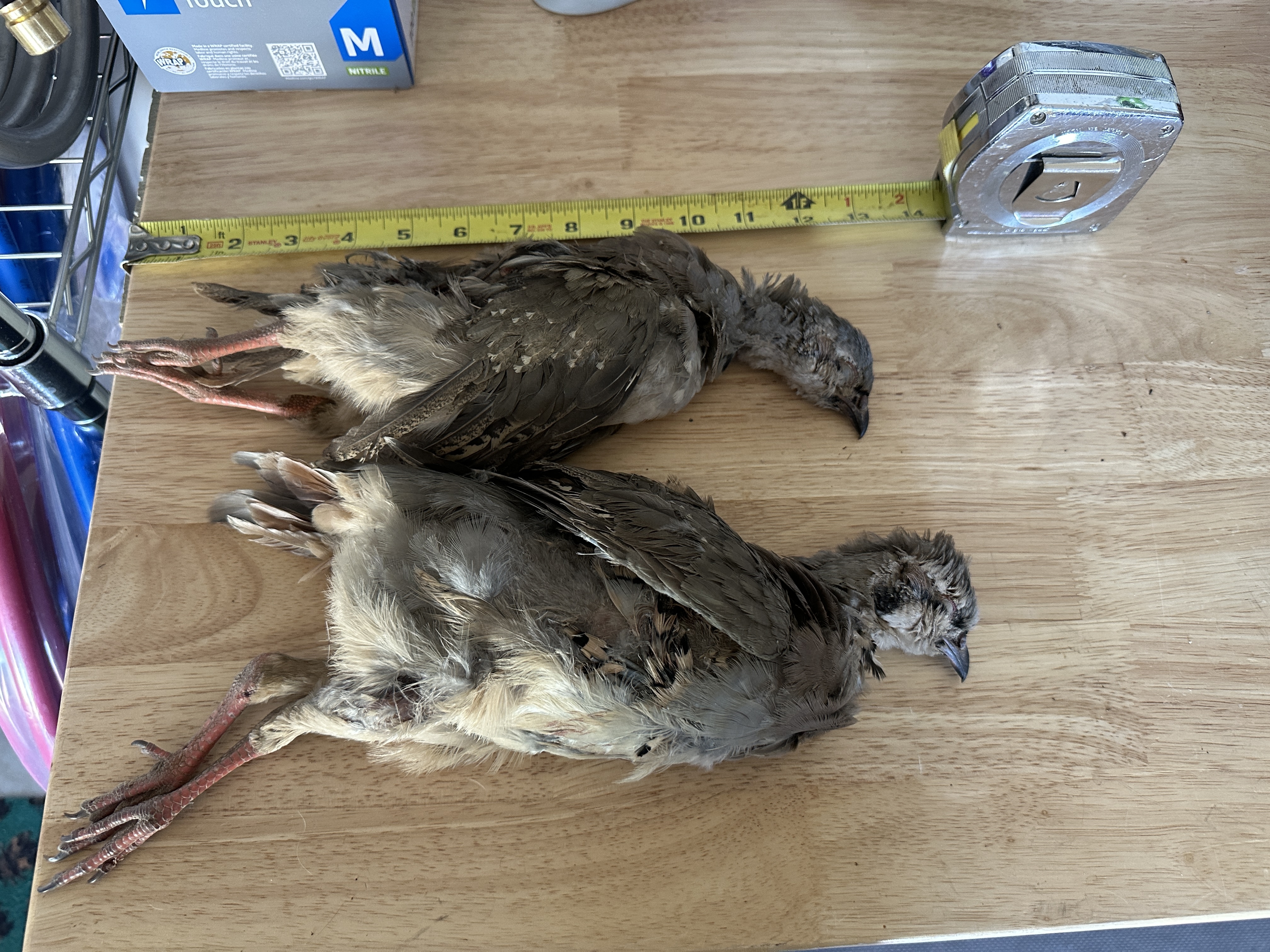
    A while later, Bloom relocated a small group and pointed them staunchly. I got one shot off and killed a bird, which Peat retrieved to me. It was a juvenile, with just a scant hint of the adult chukar trademark barred flank feathers. A few minutes later, Peat pointed another small group, and I shot one of them, which I saw Bloom retrieving toward me. I regarded with great pleasure and gratitude the balance of my dogs and today’s experience as Bloom brought the bird to me, dropping it at my feet. It was smaller than the first, not much larger than an adult quail. A few downy feathers had yet to be jettisoned. Not even a faint hint of the bandit mask or red beak.

    I’m a hypocrite in many ways, but have a long track record of hypocrisy regarding Idaho’s too-early commencement of chukar season: despite always feeling Idaho should match Oregon’s mid-October start, I invariably find myself unable to resist hunting for chukar on or near the opening of the season in Idaho.

    This day’s bag of two diminutive, juvenile chukar is just another confirmation of my longstanding belief that Idaho starts too early. There are many who will argue until they’re blue in the face against my assertion about Idaho’s too-early start to the season. Some have even thrown pop-science at me to counter-argue. I don’t even have pop-science on my side, just the evidence of my own early-season bags, which almost always contain numerous drab juvenile birds.

    In talking about this with a more knowledgeable friend, who happens (I was amazed to find) to agree with me, she made the point that the big outfitters on the Salmon and Snake that offer cast-and-blast trips in September are an effective lobbying force in Idaho’s legislature, which in turn — even more so now with the U.S. Supreme Court’s overturning of Chevron — basically runs Idaho Fish & Game (instead of science). Remembering that Idaho, not too long ago, delayed the start of chukar season and reduced the daily bag limit from 8 to 6, makes me think there’s hope it might revert to what I believe is a more reasonable approach — especially with climate change seeming to delay lots of natural development — but I won’t hold my breath on this.

    I thought about calling one of the bird biologists on the Fish & Game payroll to see what they think (I’ve done this before), and maybe they’d say it doesn’t really matter when the season starts because mortality is mortality and these birds don’t live longer than two or three years anyway, and hunters don’t really impact bird numbers over the long run. Weather, habitat, predators: those variables are much more significant than hunters. I’ve heard this before and it makes a certain amount of sense. Maybe I’d feel better about this if I had a better hand on the relevant science and it in fact showed that start dates and bag limits don’t matter. Even if that were true (which I’m too lazy right now to investigate), I’d probably still feel the same way.

    So what it comes down to is opinion, or, even less importantly, taste. Like preferring Coke to Pepsi, or Fords to Chevys. Brittanys to GSPs. I’m fine with that. But personally, I’m not fine with shooting chukar youth. It leaves a stain. But I’ll still go out, hoping my chances intercept adult birds. Hope, and hypocrisy, springs eternal and infernal.