Tag: chukar hunting

  • The Face of Death

    The Face of Death

    “Maybe we fear that the work we depend on images to do for us — the work of immobilizing, and therefore making tolerable — will be undone if we throw the image back into the flow of time.” — T.J. Clark, The Sight of Death (8)

    “I think we hide, necessarily, from an understanding of what is most to be avoided in the sight of death.” — T.J. Clark, The Sight of Death (227)

    What is the “face of death”? We’re in a sport that makes us face death whenever we’re successful. And instead of shying away from it, discomforting as it might be, we photograph it, and most of us post the photos for others — friends and strangers alike — to see.

    Why do we do this? Where does our current publicization of this taking of life fit on the continuum of monumentalized, frozen-in-time death? If T.J. Clark is right (and I’m inclined to agree with him, except maybe for the “necessarily” part), we take and share these photos of our kills both to acknowledge and avoid understanding what we’ve done. I have to think there’s something in our DNA that compels us not only to record the fact of our death-causing (and even death-gazing) but also to share it so we don’t have to think about it too much; McLuhan’s “the medium is the message” rings in my head. This compulsion might be limited to those of us outside the hunter-gatherer lines; even though we’re hunting, we don’t need to and neither have our ancestors for thousands of years. In fact, the compulsion might be because hunting isn’t necessary for our survival. It might be compensatory somehow.

    I’ve written about Brightman’s Grateful Prey before, specifically how traditional Cree animal-human (prey-predator) relationships differ from those of Invader/Agricultural traditions (i.e., most of us who are not Native Americans or First Nations people). I’ve tried to fit the imagistic depiction of prey into the Cree system but can’t, nor does it fit in Hugh Brody’s account of Inuit hunting culture, which I’ve also recently mentioned. For hunter-gatherers, at best, static portrayals of a formerly alive thing are disrespectful. At worst, they’re like putting a curse on yourself. But that’s a different tradition, different culture than this. So let’s see.

    Even without doing a thorough historical analysis, it’s fair to say that there are a couple major (let’s call them “Western,” as in Western European) traditions in how dead prey get represented. One, for lack of a better term, might be called the “Still Life Tradition,” and the other the “Hero Shot.” In super simple terms, “still life” images foreground the prey as objets d’art (removing, mostly, the hunter), and the “hero shot” foregrounds the hunter and/or his “achievement” (dead prey). I’m going to talk mostly about the Hero Shot, but I’ve included some fantastic “still life” paintings, too, mainly because they’re amazing (you’ll know why).

    Classic Hero Shot: hunters posing with their alectoris prey, Spain, 2014
    An older version of the above shot, also in Spain, 1959
    Solo Hero Shot: 1937 photo of a young Australian bird hunter with his day’s take.
    A more creative Hero Shot, 1940s, Australia, by the same photographer as the above photo (looks like some sort of snipe)
    1912 Hero Shot, including dogs (no location indicated)
    1903 group Hero Shot, Nome, Alaska (ptarmigan)
    Still Life: Jan Fyt, “Dead Partridges with Hound,” 1647
    Paul de Vos, “Hunter and Dogs by a Table with Dead Game and Fruit,” Flanders, 1640s or 1650s.
    Hendrik de Fromantiou, “A Still Life with Dead Partridge, Pheasant, and Hunting Gear,” Holland, 1670. View this full size for impressive feather detail on this perdix perdix specimen.
    Carstian Luyckx, “Gentleman hunter with his pack of dogs and hunting trophies,” ca. 1650-58, Belgium.
    John Constable, “Study of a Dead French Partridge,” circa 1830-1838. Constable was my favorite artist when I was young, mostly because of his romantic, highly detailed landscapes such as “The Hay Wain.” I was surprised to find this relative of alectoris chukar among his works.
    My favorite kind of Hero Shot, for the true hero of the affair, although he (the bird dog) has relied on me to do the killing, the middle part: he found it, I shot it, and he retrieved it.
    The Solo Bird and Hunter Hero Shot, on location
    My last “tailgate shot” (2017): to me, it’s appropriate that the drone I found sits alongside the chukar because I think it accentuates the undesirable “out-of-place-ness” of this type of image. I see a huge, distasteful imbalance between technology and nature here.
    Classic “tailgate” Hero Shot with dogs, hunters, and prey arranged with heads hanging off the edge of the tailgate. 2016.
    One of my favorite all-time dead-prey photos. Angus, who never stopped hunting is still hunting while Peat poses with a bird that came out of the conifers on an after-school hunt in a place I thought I’d only find grouse. Adding to the image’s dearness to me is the history of Peat’s initial reluctance to retrieve and radical, sudden change of course, becoming a flawless retriever to this day. It’s one of the purest gestures of reconciliation I’ve known, even though he’s “just” a dog and probably doesn’t think of it like that.
    4 years in the making: The Kid with his first chukar, after trying hard for most of 4 seasons with me, he finally got one (he actually got three that day). Doesn’t speak much for my guiding abilities, but a worthwhile Hero Shot.

    Chukar hunting is hard, and bagged birds come at a price, whether it’s the calories you burned in the pursuit, the abrasions on your dogs’ pads, the pride you had to swallow when you couldn’t get up the hill to your dog’s stealthy point in time, or the axle you broke trying to get just a little farther up that nasty road. Lining birds up on a tailgate for a photo, with your amazing dog whose praises you’ve made a habit to sing and your best human buddy you’ve shared the challenge with, makes a certain amount of sense. This photo is not intended to say, “Screw these stupid birds, I’m glad they’re dead and I’m gladder I killed them.” It’s not meant to say, as the truly stupid saying about chukar hunting goes, “The first one’s for fun, and the rest are for revenge.” Rather, it’s meant to say, I think, “I respect these birds, love where they live, admire beyond description my dog’s singular flotation of the whole proposition, and am grateful for the opportunity to hunt them.” It says, “Chukar are beautiful, and a worthy pursuit, and I’ve hunted them fairly, ethically, and shot well enough to harvest some of them, who — I admit — gave their lives in exchange for all of the above.”

    So, going back to T.J. Clark’s thoughts about these images of death, the faces we see probably daily (at least during bird season) of these multitudes of expired prey, I still can’t help wondering what we’re avoiding, “what is most to be avoided in the sight of death.” I do think something’s not being said here, whether it’s in the image or outside it, behind it, surrounding it. What, for example, really, is remorse? Pity? Sorrow? Projection? Reciprocity? Do those register? And, if so, since they’re all necessarily (aha!) irreconcilable (unless you commit suicide every time you kill a bird), where do they go, what do they do to us, what can we do with them? And how can we participate in a tradition (whether it’s a Hero Shot or a still life) saturated with adulation but based entirely on death that’s not our own, without avoiding something important? Is that possible? Does it matter?

    On a very crass and basic level, what we’re doing is trying to connect (with others?) and using the death of birds to do so. Somehow, posting pictures of bird dogs pointing or of the sun rising beautifully over a ridge just doesn’t garner the same kind of response (or we think it won’t) from whomever we’re trying to connect with. The result rather than the experience. The bottom line. It used to bug me when I’d go back to work on Monday and the dudes who didn’t chukar hunt would ask, sincerely, “How many birds did you kill this weekend?” Once I answered, “None, but you should have heard the wind carry a slow sound in the hawthorn.” Connection aborted.

    One of the loveliest poems I know is Robert Burns’ “Song Composed in August,” which situates bird hunting naturally in the middle of courtship:

    Avaunt, away! the cruel sway,
    Tyrannic man’s dominion;
    The sportsman’s joy, the murd’ring cry,
    The flutt’ring, gory pinion!

    Part of what I like about this is that it just puts it out there, this is what we do, they’re birds, they’re beautiful, and some of them, when we’re not trying to get laid, we kill. Chalk it up to “tyrannic man’s dominion” and the “joy” of sportsmen. We hear and see and might even be the cause of the murderous gore, and then get on with things. This, it seems, is exactly in the right cultural milieu. Harvest. Death isn’t really faced because it doesn’t have to be (as long as it’s not your own, and even then…). So, killing birds — and posting photos of them — isn’t the end of the world. Unless you’re the bird. I just think, aesthetically, that photos of dead birds look way better in natural settings (rocks, grass, dogs’ mouths) as opposed to tailgates or (the absolute worst) impaled on barbed wire. But that’s just me.
  • Climb

    Climb

    I used to be an athlete a long time ago.

    In the summer of 1989, I watched the Boise Twilight Criterium bicycle race as men rode their bikes at lightning fast speed on laps downtown. I was smitten by the action and excitement. That same month on NBC Sports I watched Greg Lemond win the Tour De France (by just 8 seconds, over a Frenchman no less!) and decided at that exact moment that I wanted to race bicycles. Not having any money at the time, I borrowed $275 from my Mom to buy a used road bicycle, and by September of that year I entered my first race, the Bogus Basin Hillclimb, a 16-mile uphill race, and came in 3rd place for women.

    Wanting to get better at bicycle racing, I asked for training advice from a local Boise cycling legend named Bob Hoene who had won the Bogus Basin hillclimb many times. I remember him telling me something like this: “The best way to know just how far to push yourself is to ride up Bogus as hard as you can until you puke. Once that happens you’ll know your limit.” Later that week, I rode up Bogus with him and puked at milepost 1.5.

    I never amounted to be much of a climber and preferred racing on flatter ground doing time trials or criteriums. In the 1990s, before the promoters of the Twilight Criterium decided to include a separate women’s race, I competed with the men. I loved every adrenaline rush minute of it and even crashed out once. Just like in chukar hunting, I wasn’t intimidated being in a sport mostly dominated by men.

    Twilight Crit start; that’s me in the center with the red helmet.

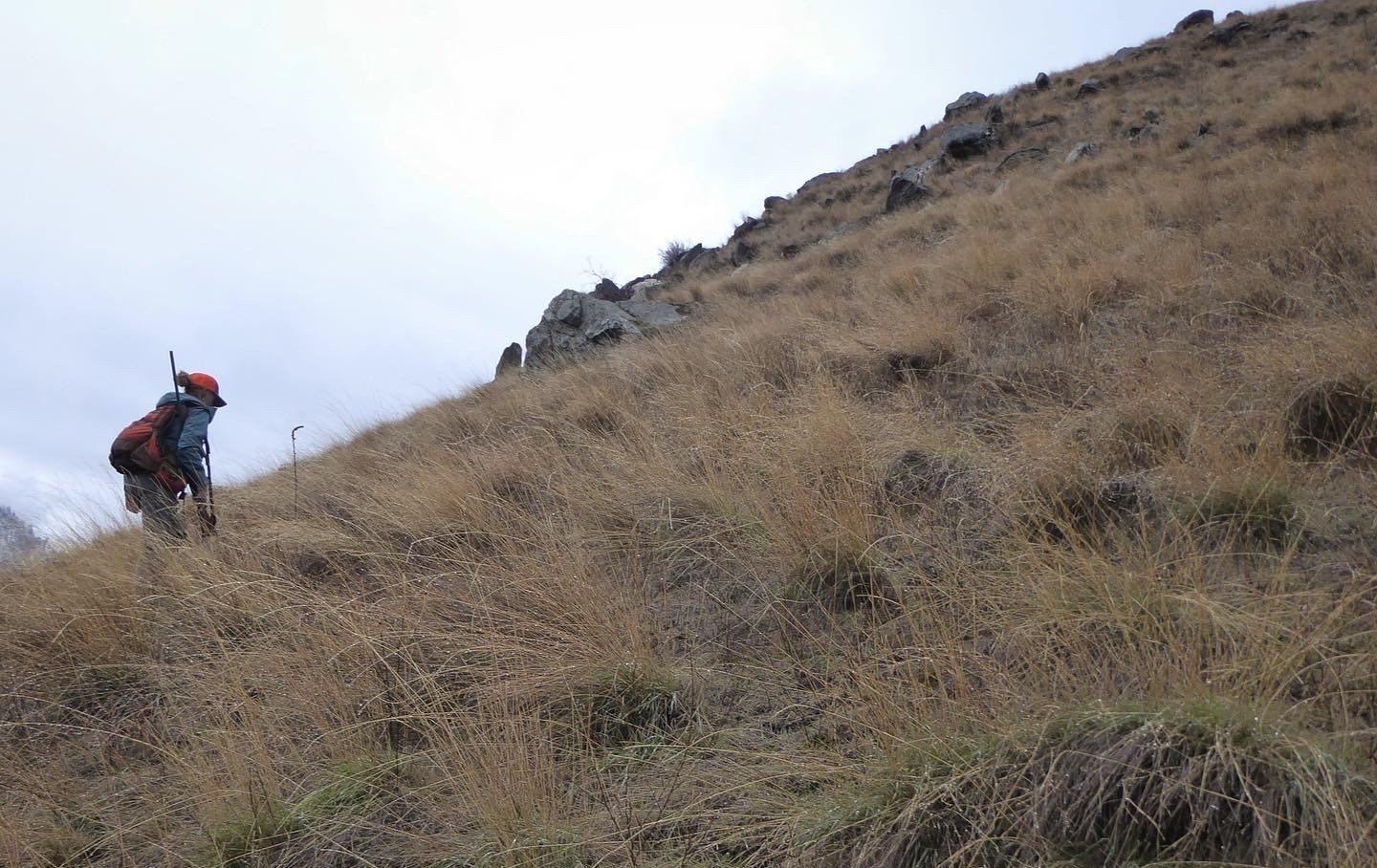
    I didn’t purposely seek out or want a dog that covered a lot of ground, but yesterday Bloom went on point 256 yards straight above me. I cursed when my Garmin alerted me to this. Every 20 steep steps or so, I stopped, caught my breath and pulled down my fogged-up glasses, checking the Garmin every few seconds hoping he wasn’t on point anymore. But he was. I kept going and felt light-headed and was on the verge of vomiting. My thoughts on the climb up to Bloom made me think about Bob Hoene and my ride up Bogus Basin with him 34 years before. It probably took me another 10 more minutes to reach a place on the climb where I could see Bloom but he was still 75 torturous yards away. After all these years, I still hate climbing but I couldn’t stop because one must always honor the point.

    I hadn’t thought about Bob Hoene for years but now wonder what happened to him? I hope he’s still racing bicycles. Sometimes, I wonder what will become of me.

    My nemesis climb. Bogus Basin prologue start for the International Women’s Challenge stage race, 1993
    Powerbar Women’s Challenge, 1994
    Meeting the great Greg LeMond
  • December Chukar Hills

    December Chukar Hills

    The two years we lived in Washington, as I’ve said here before, were not the easiest two years for us. We missed the chukar hills, empathized with our dogs’ longings for open hills of bunchgrass and sage, and just simply were unable to ignore the call to the hills. Local surrogates paled in comparison. When we returned to those hills last February, they were buried in snow. So we had to wait. Now that the snow’s here again, we’re recalling the patience required but it’s easier being here, no longer two days’ drive away. I’m busy trying to gainfully employ myself, and I’m liking the challenge and channeling some of that into the new blog/website. But the industry’s hurting, I’ve yet to land a client, and so am doing what I do (when I’m not hunting): reading and writing on topic. Here’s my latest:

    I did get out with Peat into the chukar hills for a long hunt yesterday. December 5th. T-shirt weather in the midst of lots of precipitation. Gorgeous. Not as much action as we’ve typically seen in this above-average bird year, but enough. Bizarrely, even though I filled my 100-ounce Cambelbak bladder, I ran out of water (three miles from the truck). A first for December. Still, stellar day.

  • Legend

    Legend

    50 miles from home, I realized that I forgot to pack my extra shells for our hunting and camping trip. I sat there for a few minutes in the passenger seat in silence and mad at myself at my unthinkable mistake and embarrassed to say anything to Bob. I wanted to run off and hide.

    It wasn’t totally unthinkable. It wasn’t like we forgot the shotguns or our boots this time. A couple of years ago, heading down the road for an out-of-town hunting trip we were about 45 minutes from home when I realized that both of our hunting boots were still on the boot warmers in the garage. We immediately turned around and went back to get the boots which made for a very uncomfortable and quiet detour back home. We swore from that moment on that we’d always have a check-off list for packing.

    I fessed up about my stupid forgetfulness just before crossing the border into Oregon and the big to city to us, Ontario. We exited into the parking lot of the Walmart, parked and headed into the far back corner of the store to shop for shells and to also look for a cheap dog-proof cooler (or in our case Peat proof cooler without zippers like the soft sided ones have). The Walmart Superstore wasn’t so super when we discovered they didn’t sell ammo anymore and the cooler selection wasn’t very impressive. We left empty handed.

    We then drove all the way across town to a couple of other stores that were open but their selection of 20 gauge shells for upland was pretty dismal or non-existent, focusing mostly on waterfowl shot. On the bright side, at least we found a small Igloo Playmate plastic cooler at Bi-Mart and were fairly confident Peat shouldn’t be able to figure out how to open it.

    We forged ahead and originally wanted to stop for a quick hunt somewhere in the desert along the way but it started snowing sideways and then it rained. Not the best hunting weather for us or the dogs. Once we headed south the clouds opened up and we could see blue skies.

    Arriving to the campground in the late afternoon we set up camp. I pulled out my pack from the pickup and opened up the shell pouch to see what exactly was in there and analyzed the situation in my head. Okay, I rarely shoot more than once on a covey and I’ve got 12 shells so that would last maybe four hunts if I only shot three times per hunt. Of those shells three of them were Angus shells that Bob hand-loaded four years ago and they’re filled with some ashes from our Brittany named Angus who died four years ago. I’ve been carrying them around for good luck ever since.

    Good luck Angus shells.

    It wasn’t going to be the end of the world to only have 12 shells but I’d definitely have to be discretionary in my shooting and not waste any shots unless it seemed like it was a sure thing which in the chukar hunting world is totally laughable.

    Just before dinner, we met a fellow hunter in the campground who had been out the previous two days and according to him, the hunting was terrible and he hadn’t seen many birds. It was ridiculous but I was actually relieved to think that chances of shooting would be limited.

    The opposite turned out on our first two days of hunting. It was really good, and the dogs found plenty of birds. We were pleased. Thrilled.

    On our third day of hunting we found an area to hunt that looked good on the maps but in person it wasn’t very promising and no visible water sources were nearby for miles even though the map showed what looked like a small pond which was now drier than a bone.

    Bob and I decided to stay together since I was down to my last three shells, all of which were Angus shells. Not very long after we started our hike from the pickup the dogs started finding birds but I couldn’t get a good shot and passed on ones that were borderline too far away. Towards the end of the day the dogs found and pointed one last covey of chukar up in the rocks above us. Bob got up to them first and they erupted and flew downhill towards me. I quickly mounted my gun, shot, and hit one on a crossing overhead shot. Bloom hauled down the hill past me to retrieve it and beat Peat to it. On the way up heading towards me with the chukar in his mouth, Peat snatched it away from him and continued to run past me taking my chukar to Bob as if I didn’t exist.

    The only other times (yes, plural) Peat stole a bird from another dog was back in 2015 when he was eight months old. Instead of simply attempting to retrieve them, he watched Angus do all the work of finding, pointing, and holding the birds and then would take the bird Bob shot from Angus’s mouth on the retrieve and go off and eat it. He did this for the first 6 birds Bob shot that season. Angus, gentlemanly at the wrong time, didn’t put up much of a fight. Bloom, like his blood relative Angus, didn’t either.

    Peat’s first season was frustrating, legendary, but epic in its own twisted way. Luckily after the sixth time stealing a bird from Angus, a switch turned off or maybe on in his brain and he started retrieving them directly to us and didn’t stop to eat them.

    On the morning of what would have been our fourth hunt in Oregon, we woke up early and noticed a flat tire on the pickup. It was no surprise with all the rocky backroads we’d been driving on the day before. It was 10 degrees outside but at least it we were parked on a flat piece of ground and not pulled off on a shoulder of a busy highway. Bob changed it but now without a spare tire and with the nearest tire repair shop 60 miles away we decided pack up instead of hunting and head home rather than risk being stranded out on some remote rocky and gravel road without cell phone coverage.

    A couple of days after arriving home and anxious to head out again, I went for a solo hunt with Bloom at a place where I’d been before. 20 minutes into the hunt Bloom went on point below me and held them until I arrived. The covey of maybe 15 birds busted and flew downhill. I shot one chukar, it tumbled to the earth, and Bloom retrieved it right to my hand. I was elated! I searched around and found my bright yellow shell on the ground and picked it up and looked at Angus’s name on it. It was an emotional moment. The place where this happened was almost the exact spot where I shot my first chukar back in 2016 that was pointed and retrieved by Angus.

    Divine Intervention?

    Bloom with his super sensitive nose is still figuring out this game but with each hunt he’s getting better. Yesterday, hunting solo with him in a new spot, I thought it would be too windy to find anything but I remembered my friend and longtime hunter Sam telling me years ago, “Birds are on the ground and their world is much calmer; it’s not as windy down there.” Bloom tracked down birds just below tops of ridges in the frigid and howling wind and went on point on at least 6 different coveys and a couple of solos. I didn’t think that I would be able to shoot with my fingers being bitter cold to the bone but it’s funny how you forget the coldness when your dog goes on point.

    Bloom has a lot to live up to with his legendary genetics and with our high expectations but after the last few hunts and seeing him work, he’s going to be fine.

    My first chukar (2017), compliments of Angus (and Peat)
    Bloom pointing a covey of chukar yesterday.
  • Control

    Control

    …I went hunting wild,
    After the wildest beauty in the world,
    Which lies not calm in eyes or braided hair,
    But mocks the steady running of the hour…


    —Wilfred Owen, from “Strange Meeting

    Hunting’s beauty lives wildly between control and chaos. What do you control? How do you deal with chaos?

    We have expensive, complicated electronic devices that tell us where our dogs are and track a ridiculous amount of data. They give us a sense of control. We got them because we disliked the chaos of hunting without them. I might argue they allow us to focus more on the beauty of hunting. The liminal.

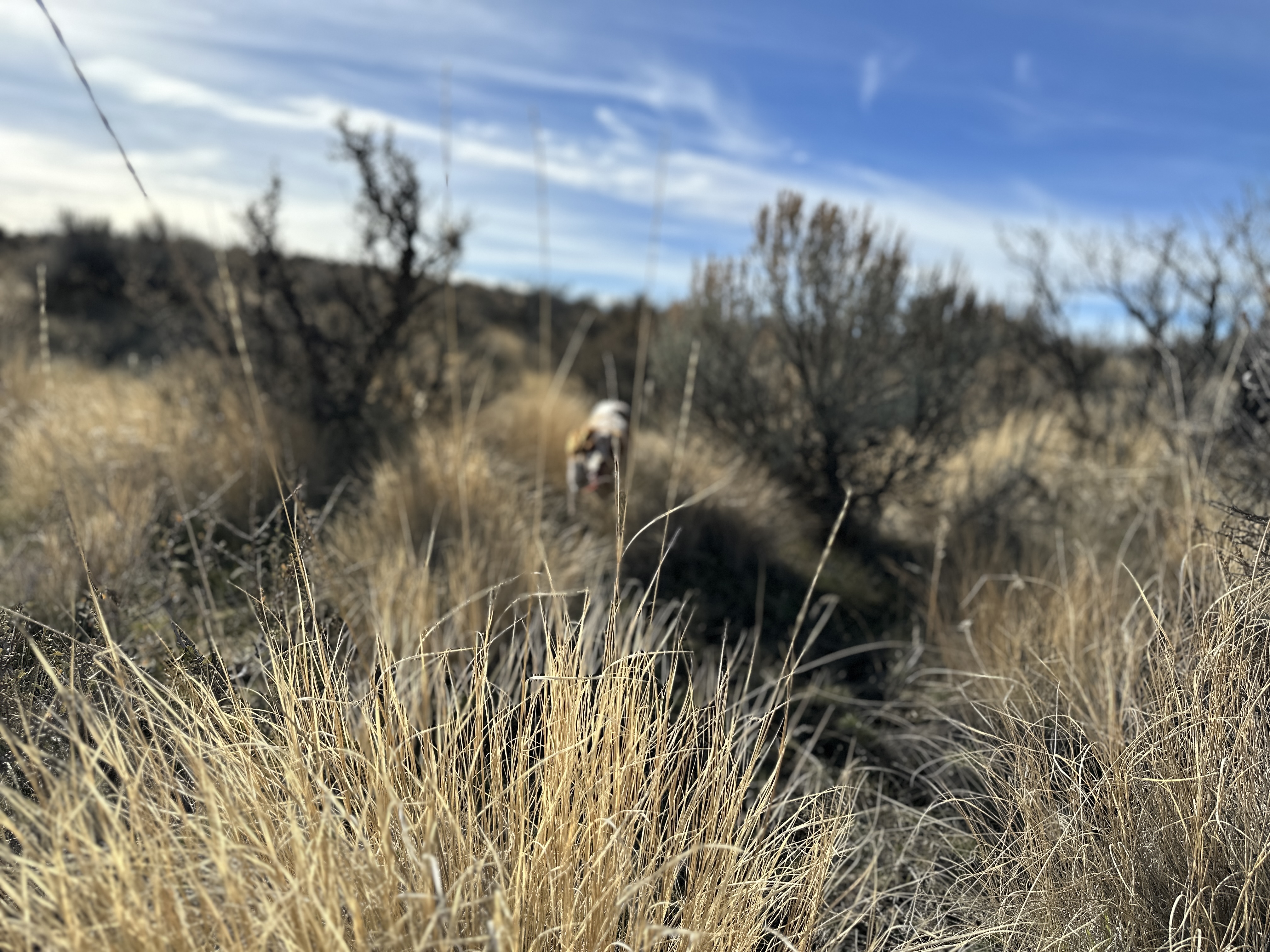
    The dogs are licking their wounded paws. We failed to notice Bloom’s abrasions and Peat’s broken toenail at the quick until it was too bloody late. Both are on the DL now, in the best chukar country I’ve ever seen. It just seems endless. I don’t want to hunt without a dog, so we’re going home early. Spoiled stupid. Poor dogs. We should have done better by them. Running on a golf course every day, we now realize, has not toughened their pads the way the gravel trail we used to live near did. Good to get that learned.

    Peat too is a control freak. Bloom’s still figuring out how he feels about retrieving. Rough and labyrinthine at best. I know Peat notices. I winged a bird that both dogs saw hit the ground running. They competed in catching it, which Bloom did, besting Peat in that rodeo, then beelined past me toward Leslie, then away from her, bird clamped hard in his mouth, and then dropped it minus a massive mouthful of feathers and some back skin. Peat watched. A few minutes later Leslie knocked one down and Bloom quickly found it. Heading back up the hill toward Leslie with it, he dropped it a couple times, took it behind a big rock. Soon Peat emerged with the bird, ran straight past Leslie, and brought it to me.

    As a pitcher, I could appease my need for control of the game but always failed to realize and appreciate the supreme irony of struggling to throw strikes, which an external force (the freaking ump) controlled. This little nugget of life has, of course, stayed with me. All of it, especially the illusion. Rarely still am I able to see its beauty.

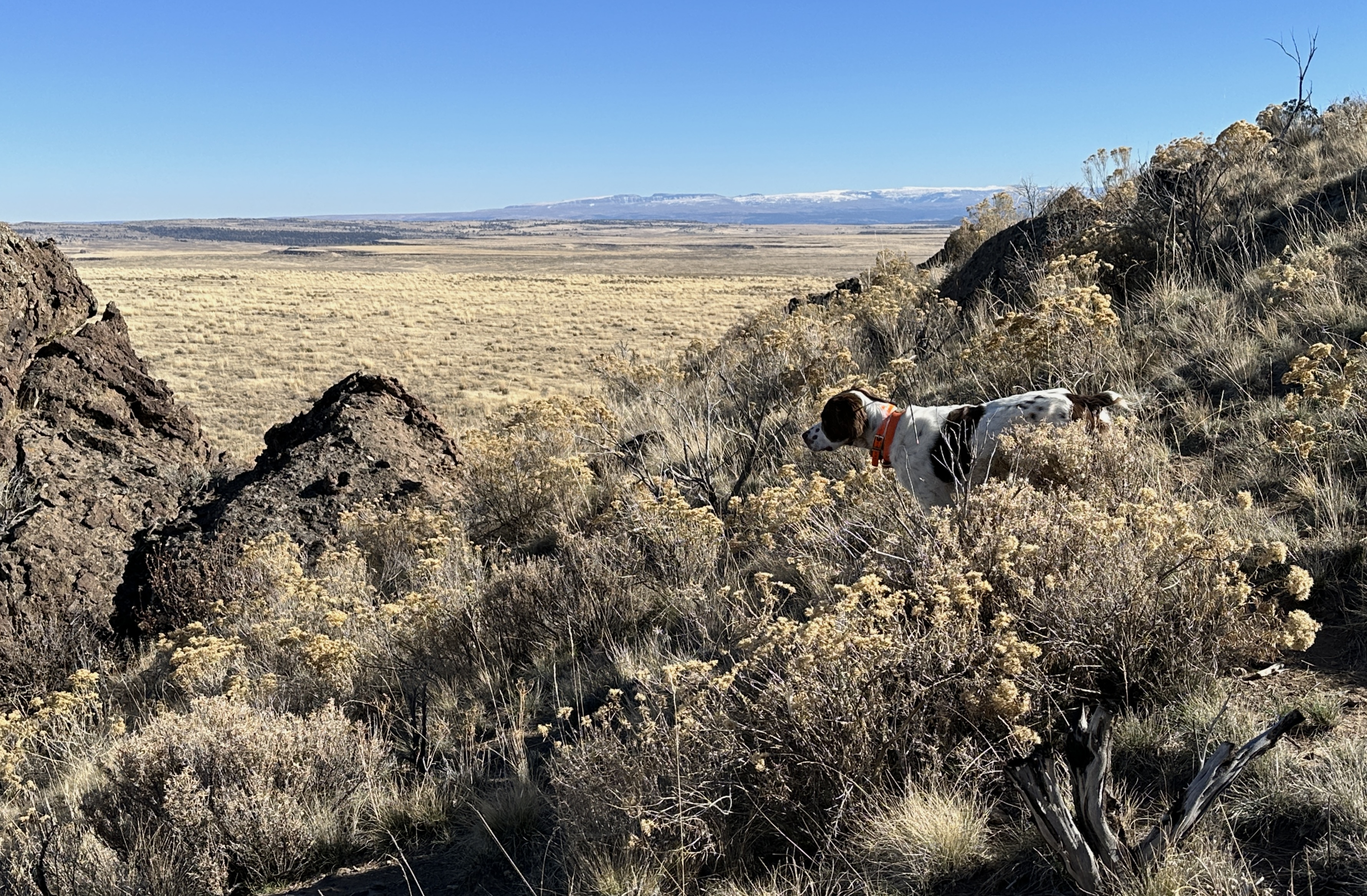
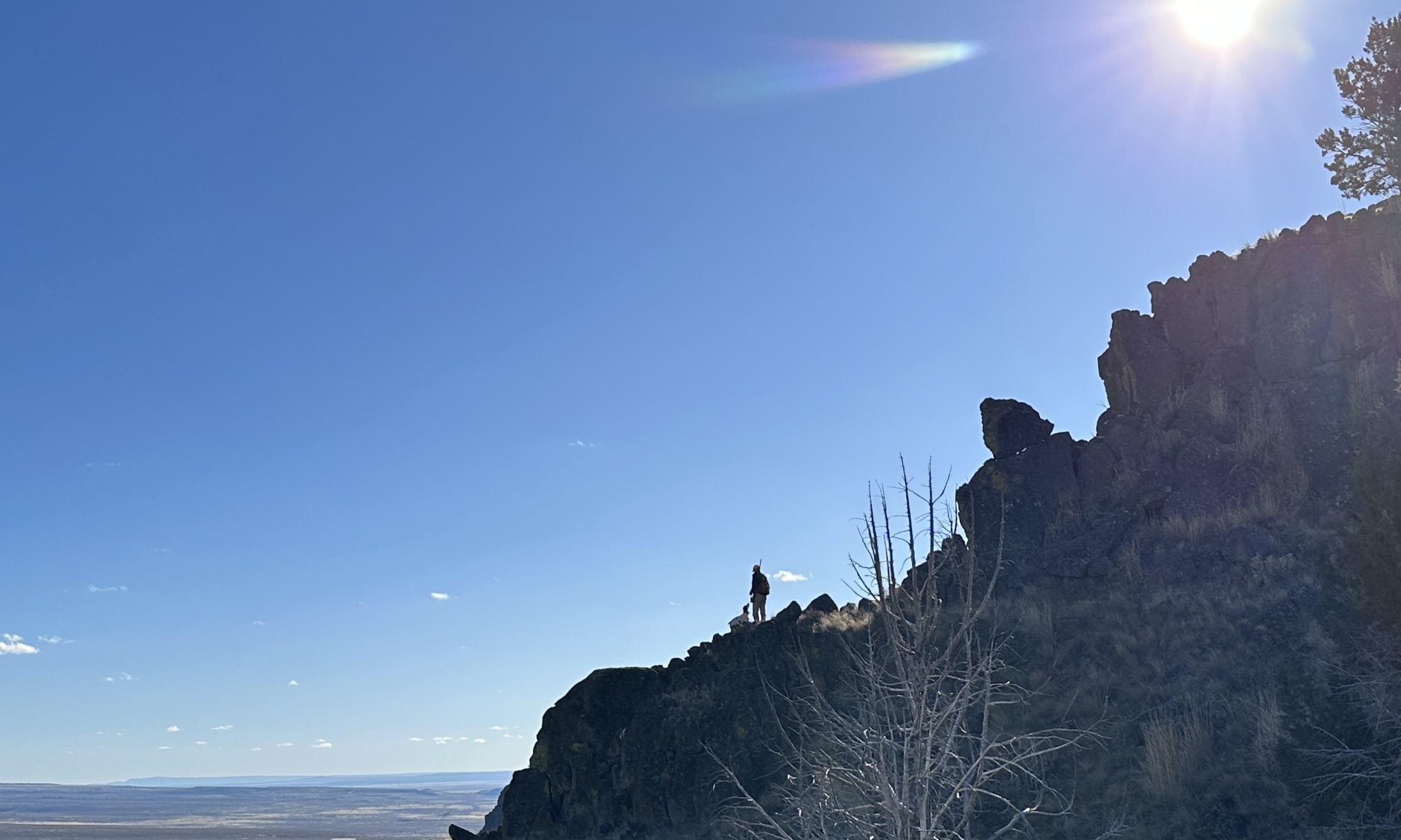
    The place we’ve been this week, whose exact location naturally I will not specify, is magical. But most chukar terrain seems that way to me, especially when I’m in it, and it varies dramatically. There’s a lot of beauty in that. But even more, the beauty seems to lie in what all those places afford, with or without lots of birds: a setting for an activity that “mocks the steady running of the hour.” We choose the place but have no idea what will happen, where we’ll go, or how long it will take. It’s the wildest.