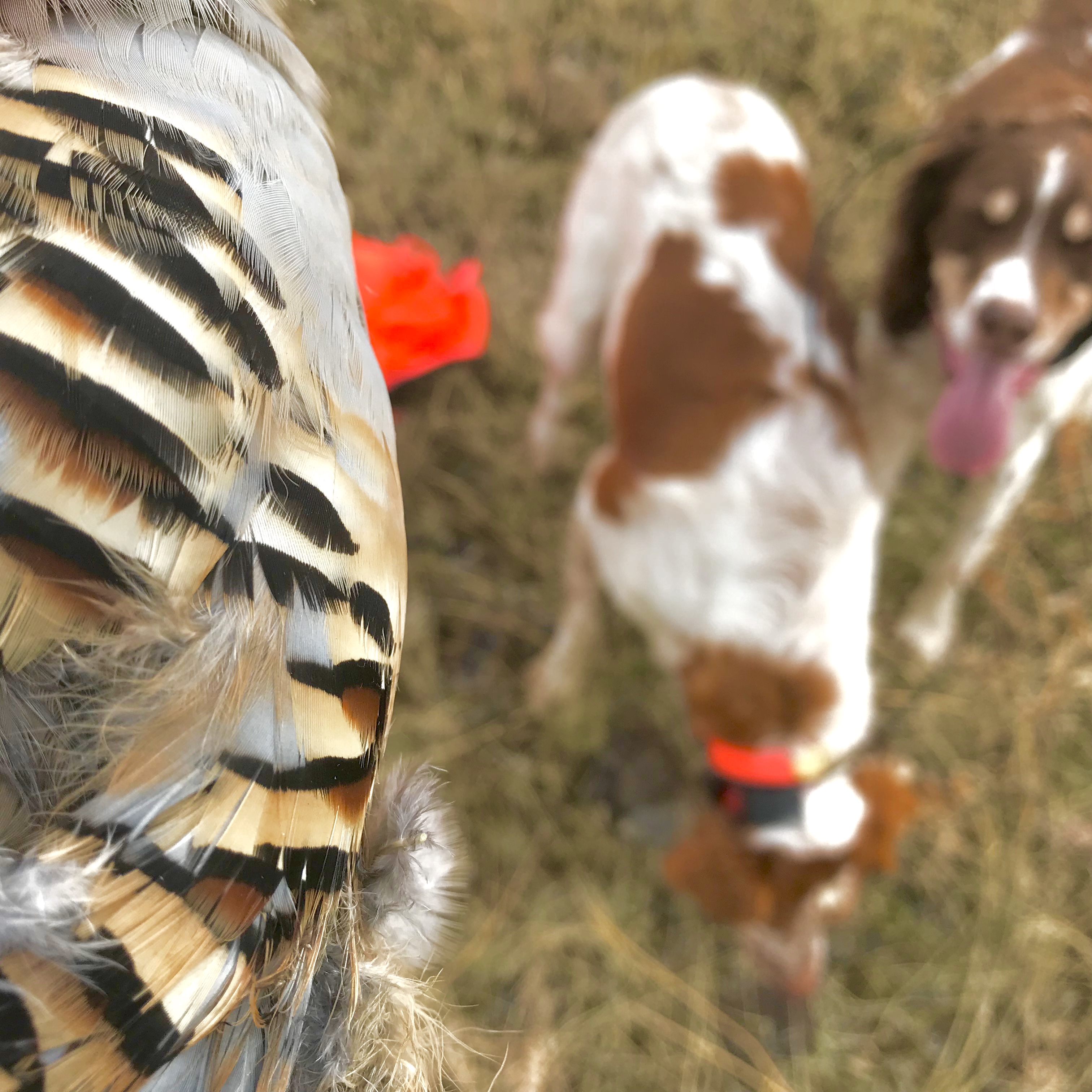
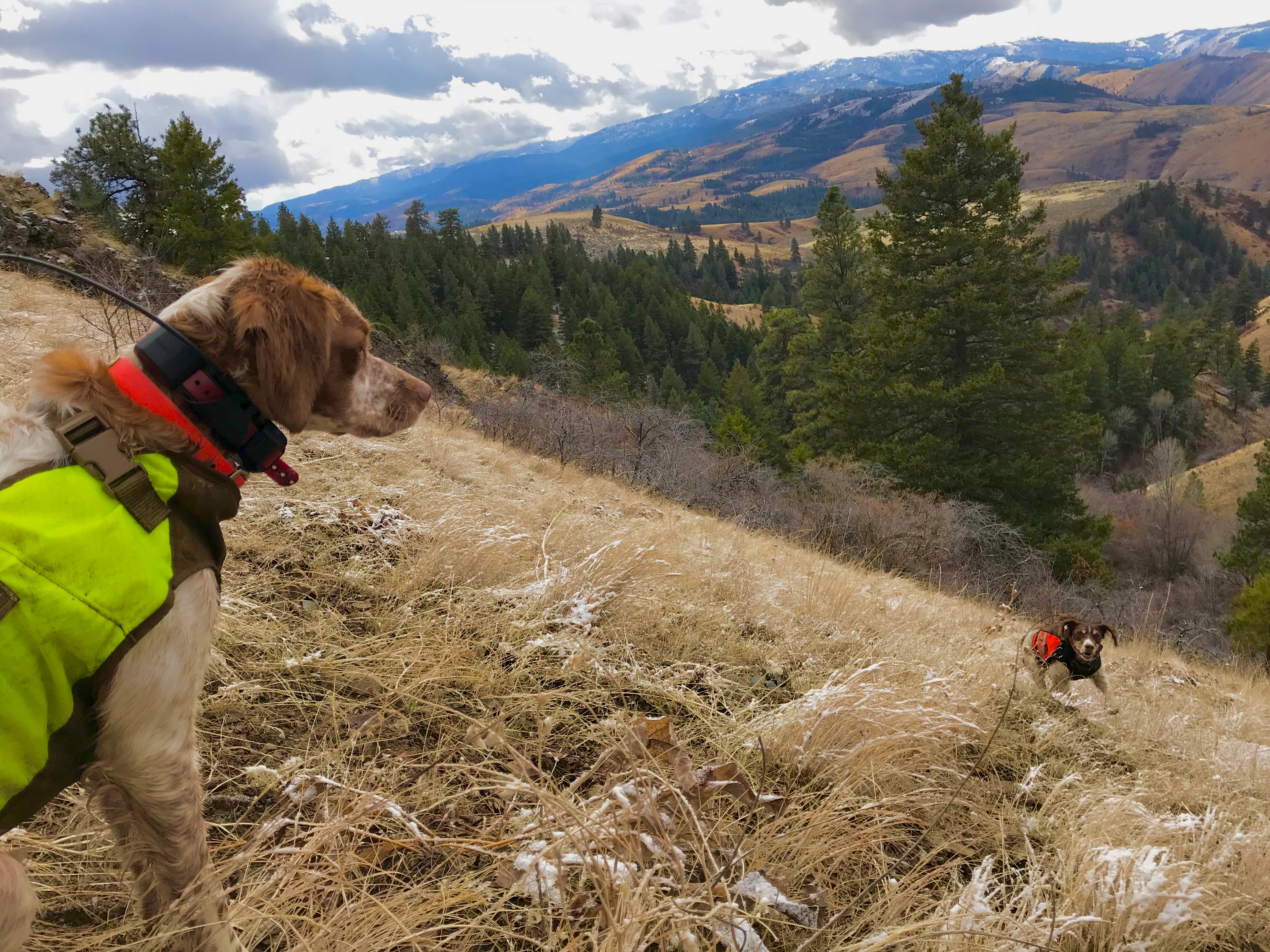
They said it couldn’t be done. They said it was impossible. They said, well, they said lots of things I can’t repeat. But the one thing they didn’t say was, “She’ll never give up because she’s as stubborn as an Appalachian mule.” So today, Leslie proved them all right and wrong and bagged her first chukar. Two months into her first season, at age 55 and never having shot a gun until August, any chukar hunter will tell you this is an accomplishment-and-a-half.
Both dogs were birdy, and Leslie was above me. Peat flushed four chukar just in front of Leslie, who – because she has learned to decipher the degrees of birdiness in our dogs – was expectant. I saw the birds go at the same time I heard the shot, but didn’t see it fall. It took Leslie a few moments to say to me, “I think I got one.” It was almost as if she couldn’t believe it. Then Angus made a beeline down the slope and lifted his head with a mouthful of feathers. Initially he headed to me, but Leslie called him and he changed course and brought it right to her hand. What made me feel even better than the pride I felt for Leslie was seeing her smile, like a curse had been lifted. She looked at the bird, which she’d killed instantly with her 20-gauge, 1 oz., 7-1/2 shot load, and thanked it for its life, something I’ve gotten away from doing, regrettably.
Chukar Country Trifecta
We continued on for another 2 hours or so, and she got off a couple more shots but didn’t connect. I managed a Hun and a Dusky grouse, so a three-species day in mid-November on a year that was supposed to be meager from last winter’s massive snowfall ain’t bad. Yesterday was a good day, too, in another spot where we saw lots and lots of chukar and bagged a couple. So there you have it!
This post might seem off-track to some readers, and for that I apologize. But one of the reasons I changed the name of this blog earlier this year is because I wanted it to be more about the culture surrounding my favorite pastime than solely about chasing chukar.
Where we live, our “setting,” is a fundamental part of our culture, and the people who live here are an important part of that setting. We often feel like strangers in our new home (“new” is relative; I’m in my 6th year here, which is new to many, but then those who’ve lived here for seven generations are “new” to the Indians). We get that, and are fine with it. Actually, I’m more than fine with feeling like a stranger sometimes because it makes my interest in other people here seem more natural to me; I’ve always been curious about people I don’t know. What a perfect scenario for a teacher who’s blessed with a situation that allows him to create his own curriculum. Two or three years ago, I lucked into an 8th-grade class full of plucky, wonderfully positive, excitable kids who thought it would be cool to write an oral history of some of the long-time residents of this area.
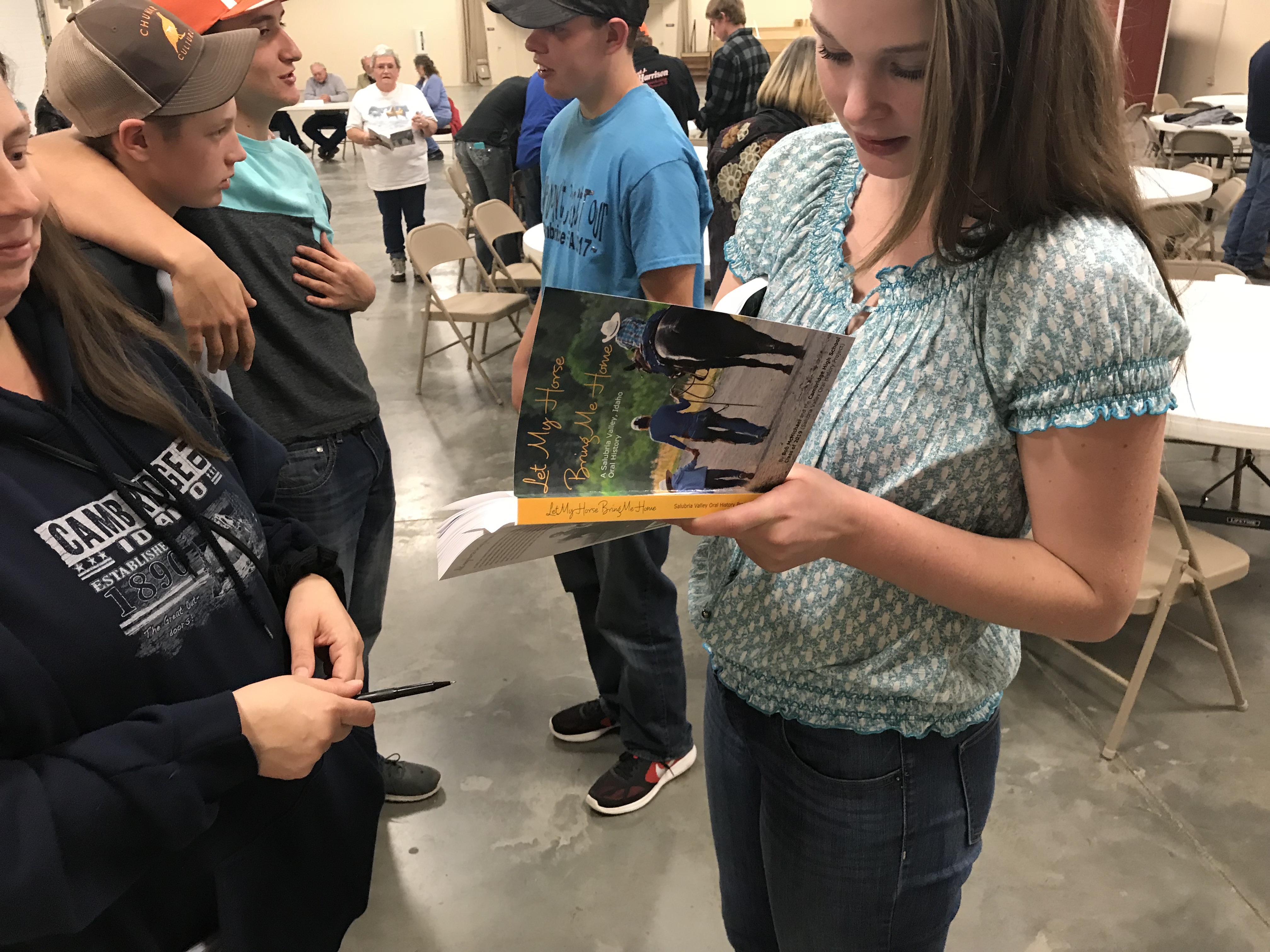
Let My Horse Bring Me Home: A Salubria Valley, Idaho Oral History is that book. It took a while to finish it, but it’s out now (and available for purchase in the Chukar Culture online shop). This is the first book for my fledgling Chukar Culture Press, which I started as a way to raise money for publishing projects I’m doing with my students. I received a couple of grants to pay for the printing of Let My Horse Bring Me Home, and I have another small grant toward the next book, which will be a sort of primer on agriculture in our little valley aimed at those who drive through here regularly but don’t know much about what they’re looking at. Many of my students are from farming and ranching families, and they’ll be researching and writing this book, teaching and learning together with students who live here but don’t have first-hand experience.
Tonight we celebrated the launch of Let My Horse Bring Me Home, and brought many of the interviewees, all of the student authors, and numerous others in the community together to celebrate the documentation of ordinary life. It was a moving experience for me to see people of many generations come together to laugh, weep, and share. And eat amazingly tasty cupcakes. I love my job because of the people I’m able to connect with through it, and all of this provides my base, from which I launch my own particular forays into chukar habitat. We all have bases. They’re worth noticing, and honoring somehow. I feel blessed to be a part of something bigger and still feel like an individual. I hope my students can achieve this for themselves, and I realize it might be easier said than done in our world today.
We’ll see where this goes. In the meantime, here’s a video about the book, featuring excerpts from the interviews my students did, along with photos from the book. Enjoy!
It’s been a while since I posted, so I thought I’d check in and say that we’re still hitting it hard. We’ve tried lots of new places this season, and revisited some old ones, with mixed results. Last week I hunted four days in a row for the first time ever. Angus had to sit out two of those, but he distinguished himself on his two hunts, one of which far exceeded the most climbing we’ve ever done. The briefest of those four, probably my last after-school hunt of the season, was perhaps the most interesting, with Peat pointing four times in the first 20 minutes, and me ending up with a ruffed grouse, two Huns, and a huge 4-point mule deer shed in classic chukar country.
My brother, who recently enjoyed an epic dog-less chukar experience on the Main Salmon, visited for a couple hunts — one of which (the heavy climbing one) featured lots of birds sighted but few bagged, and the other in some spectacular country apparently barren of birds. We had a sad encounter with a bird hunter who flagged us down to tell us to be on the lookout for his 13-year-old GSP, “Gopher,” who he’d lost the previous evening and presumed was dead. Makes you think.
Yesterday, after a nasty head cold week, and still not feeling well, I went out with the two dogs for an easy walk with the gun, mainly to alleviate Peat’s stircraziness. I have no idea why, but it turned into my longest hike of the year (8.25 miles), with way more climbing than I would have liked. I fired once and missed a single pointed chukar, and saw two small-ish coveys that busted wild. Old Warrior Angus ran 20 miles, eclipsing Peat on this hunt by 2 miles, which is weird; it’s been the opposite all season, but might be because Peat has a little cut in one of his pads.
And the weather has changed. We’re not sure what the balance of the season holds. I’m hoping we get more of a season than last year, when we were done by mid-December because of the weather. Word in the valley is that this winter will look a little heavier than last year. I’m betting we’ll make at least one more trip to lower elevations to look for more populous habitat.
Leslie’s still in search of her first chukar. And she’s still eager. Stay tuned.
If you count calories, weigh your gear, track your vertical, get weepy at the word “minimalism,” or fancy a lightweight pack/vest for chasing chukar, the Eberlestock Mini-Me might be worth a look. Leslie has donned it exclusively for her debut season as a hunter, and – as far as I can tell from her notes – gives it a thumbs-up. After twenty outings, here are her thoughts.
Pros
Lightweight: at 3.5 pounds (dry), it’s easily the lightest thing we’ve used on a chukar hunt.
Compact: at 19″ x 8″ x 3″, it’s also the most compact pack I can imagine for chukar hunting, which makes busting through brush easier than with my Q5 “Cadillac” Centerfire vest.
Very comfortable: the channeled padding on the back will prevent anything from poking your back, and allows a bit of airflow back there, especially nice on a hot day.
Hydration system: the Mini-Me includes a three-liter (100 oz.) Israeli-made hydration bladder that works as well or better than any of the CamelBak products we’ve used.
Rides high: the “hip belt” on the Mini-Me actually goes across your waist (unless you’re a midget), which means that the accessory pouches you’ll need to add in order to hold shells won’t bang on your thighs when climbing the chukar steeps.
Accessory pouches (we have the “small” ones, each of which has plenty of room for a box of shells) slide along the hip belt to you can position them on the side or in the front.
Bird bag: made of durable mesh with a drawstring top and compression straps, the attached bird bag stows away inside a zippered pouch when not needed. When it’s out, it will hold lots of birds; on one hunt we put 2 large dusky grouse in it, which seemed to take up less than half the capacity of the bag.
Scabbard accessory: if you don’t want to, or can’t, carry your shotgun (or rifle) while hiking (or mountain biking), Eberlestock offers both a long and short scabbard accessory that attaches to a sleeve on the Mini-Me. Although we haven’t used the scabbard in the field yet (we have slings and typically hunt right from the rig), the short scabbard nicely and snugly holds our shotguns with 26″ barrels.
Multi-use: one of the reasons I wanted to try the Mini-Me was because in the off-season we do lots of hiking with our dogs and I wanted a pack that I could use for both hunting and hiking, without having to transfer a bunch of safety gear from my hunting pack to a hiking pack. The removable accessory pouches make this possible, and if the scabbard isn’t installed, you can use the sleeve it fits in for storing bulkier items like extra layers or rain gear. We also mountain bike frequently in the off-season, and the Mini-Me works great for that, especially with the hydration bladder. If you do MTB hunts, the scabbard accessory would solve the problem of how to safely carry your gun while riding.
Blaze “orange”: it’s more fluorescent pink, but you can see this thing from outer space. It glows bright. I like that, because I can see Leslie easily from many ridges away. If you don’t like this color and don’t need to have a certain number of square inches of hunter orange, the Mini-Me comes in a number of attractive camo patterns.
Cons
Fit: the Mini-Me does take a bit of adjusting to get it to fit comfortably, as well as to accept the high ride of the “hip” belt. Personally, I would prefer a more robust padded hip belt, but Leslie doesn’t seem to mind the thin nylon straps.
Hydration cap: although a small annoyance, the cap on the hydration bite valve is tough to remove and replace with one hand; CamelBak bite valves don’t have a cover on them and we’ve never had an issue with those, so we’ll probably just remove the cap on this one.
Accessory pouches can’t easily be fixed on the hip belt so they don’t slide around while hiking; one could modify the belt to fix this but we haven’t tried that yet.
Zippers on pouches are tough to open and close with one hand (true of most bird vests we’ve tried).
Bird bag clips that attach the top of the bag to the shoulder straps on the Mini-Me are nearly impossible to remove when you want to re-stow the bag. These need to be replaced with something much more user-friendly.
Using the game bag: to put birds in the bag, you must take the pack off. Unlike a traditional bird vest, which allows you to slip the bird into the compartment in the back, the Mini-Me access to the top of the bag requires removal of the pack. This hasn’t been as annoying as it sounds, though, because we haven’t constantly nailed birds this season (yet?), and if we’ve been with another person they can easily put the bird in the bag so the wearer doesn’t have to remove it. Another issue, although not a big one, is that when the bird bag is deployed, it’s a bit tricky accessing the other pockets on the bag; having clips that are easier to remove from the D-rings on the shoulder straps would make this almost no issue at all.
Limited storage: just as you wouldn’t carry all your camping gear and outdoor recreation equipment in a sports car, the Mini-Me isn’t intended to schlep every piece of bird hunting kit you might want. But it can hold the essentials in its several zippered pockets, as well as additional clothing, gloves, etc. The accessory pouches you can add to the belt also expand carrying capacity.
Overall Impression
Leslie really likes the Mini-Me for early season chukar hunting, mainly because of its comfort and lightness. She plans to switch to her larger pack for the colder part of the season to accommodate the extra layers and gloves she doesn’t think will easily fit into the Mini-Me. My impression is that it’s a pretty cool option for a lightweight chukar pack, especially because of how much water it holds without being at all bulky. It has worked especially well for us, hunting together, because my vest carries a ridiculous amount of crap in it, stuff we only need one of, like heavy-duty cable cutters (for snare traps), a robust first-aid kit, headlamps, SPOT personal locator beacon thingy, space blankets, and more. Despite its littleness, though, Leslie has found very workable places to carry an FRS radio and her new Alpha 100 hand-held device on the Mini-Me. So there you have it. Let us know if you have any questions.
Slim, compact, bright!
Two dusky grouse in the bag
Have a friend load the bag, or take off the pack and do it yourself
It’s a small world, after all. Leslie and I spent last weekend downstream in Hell’s Canyon. I was excited by the idea there would be loads of chukar there since it’s similar terrain and elevation to the Main Salmon, where we did find loads of birds. Alas, we did not find loads of chukar there, but not for lack of trying. Still, we’re not in this for the bagged bird count, so it was a wonderful experience.
Steep canyon
One of the things that made the trip wonderful was the random encounter with two readers of this blog – a first for me. The first arrived with his camper and jet boat on our second night there, and his friend came later; I met him the next morning as he sported a blaze Chukar Culture hat! Even stranger, one of them had worked with my brother (also a fish biologist in a different state) for years. I weaseled my way into my first jet boat ride ever; I loved it, but Peat puked immediately and was glad when we landed and started hiking.
They hunted on the Oregon side, but dropped me in Idaho and picked me up after I humped it up the slope, vainly searching for birds on the steep, cactus-infested terrain. I finally encountered my first chukar, Peat-pointed, near the bottom of a brushy creek bed, and managed only my second triple ever. Hard-earned birds. I was really touched by the generosity of these two guys in altering their plans to let me come along.
Cactus cactus everywhere
One of the negatives about this terrain was the cactus. It was everywhere, and often mostly covered by cheat grass, which made it hard to avoid. Angus and Peat seemed to have figured out how to dodge most of it, but each still has many tiny spines all over their legs. It makes me wonder how Arizona quail hunters deal with this; you can boot your dog, but spines still stick in their legs. Another negative was the rattlesnakes. We only saw two, but one’s more than enough, especially when it’s in the middle of a huge grassy flat your dogs are bounding through. Peat stopped and looked very birdy, and then suddenly recoiled (better than attacking it). I had to walk right up to the snake even to identify it, that’s how camouflaged it was. I would’ve taken its picture, but the thing freaked me out. I don’t like snakes, and feel grateful neither dog got struck.
Public Land Owner
So far it’s been an excellent bird season, thanks in part to the proliferation of grouse and the proximity of chukar to grouse habitat. I don’t recall ever seeing as many dusky or blue grouse as I’ve seen this year. Mostly, though, this season has begun with lots of new things that have changed things up for me and my appreciation of chukar hunting: my wife hunting for the first time; shooting a lot more at clays and figuring out how to mount the gun properly (it really does make a difference!); trying new spots farther afield than we’re used to. I showed the video below to some students today, and one of them who’s hunted with me and watched lots of our videos asked, “Are you taking more video yourself these days?” In thinking about his question, I realized that having Leslie hunt with me has made me relax a little more about pressing for birds. When she carried only a camera, chukar hunting was mainly about getting birds on point, hustling to pointing dogs, getting in position, damn the torpedoes! Now I want her to experience success and get her first chukar, so when the dogs go on point I pull out my iPhone and take video of her getting into position. That excites me now as much as doing it myself. I like the result. I like more calmly enjoying my favorite activity (plus, if I get into position myself and don’t hit any birds I’m likely to get angry, which makes the experience much less enjoyable for my wife and dogs).
So I guess what I’m really enjoying about this season, compared to past ones which have featured higher bird counts, is learning new ways to appreciate chukar hunting. A friend who doesn’t hunt, and doesn’t really approve of it, asked me recently when I’ll have had enough of the killing and begin carrying only a camera. It’s not a question I haven’t asked myself many times before, but the answer always eluded me. I don’t feel I’m making a transition from gun to camera just yet but wouldn’t rule it out, although it’s hard to imagine doing the physical work required by chukar hunting “just” to take photos of dogs pointing birds. But I am spending more time capturing images than I have in the past, thanks to Leslie joining the armed practitioners. So here’s a record of the first month of the season, for what it’s worth. Enjoy!