Moving forward. Going backwards, uphill, and slowly descending.
Last hunt of 2020 for us was yesterday, I followed Bob around the chukar hills just like the old days. Camera in hand. No shotgun. Winter is my favorite time to be out there. It’s quiet.
Following tracks of ghosts of deer, elk, and birds. Detective work. Bob whispers to me, “I think they were just here.” I look down to examine the prints in the snow. Tiny dog tracks are heading upwards, the lone elk is going downhill. We keep going up.
We continue to follow Peat. He’s pointing 185 yards away. We look up to see if we can see him, snowflakes are gently falling to earth and into our face. We climb the steep ladder to get to him. He’s focused, patient, and won’t even look towards our direction but knows we’re finally there. His job is almost done.
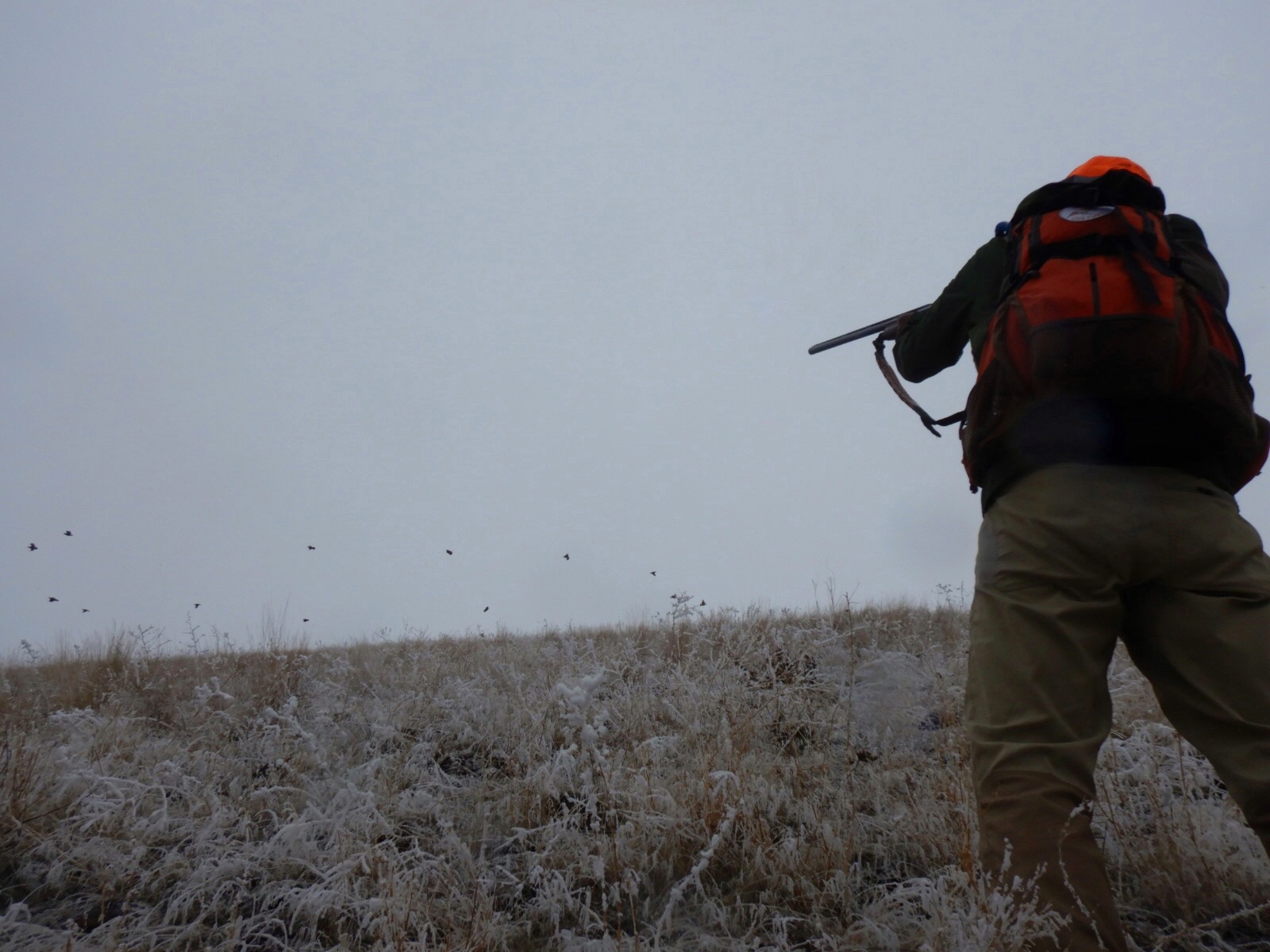
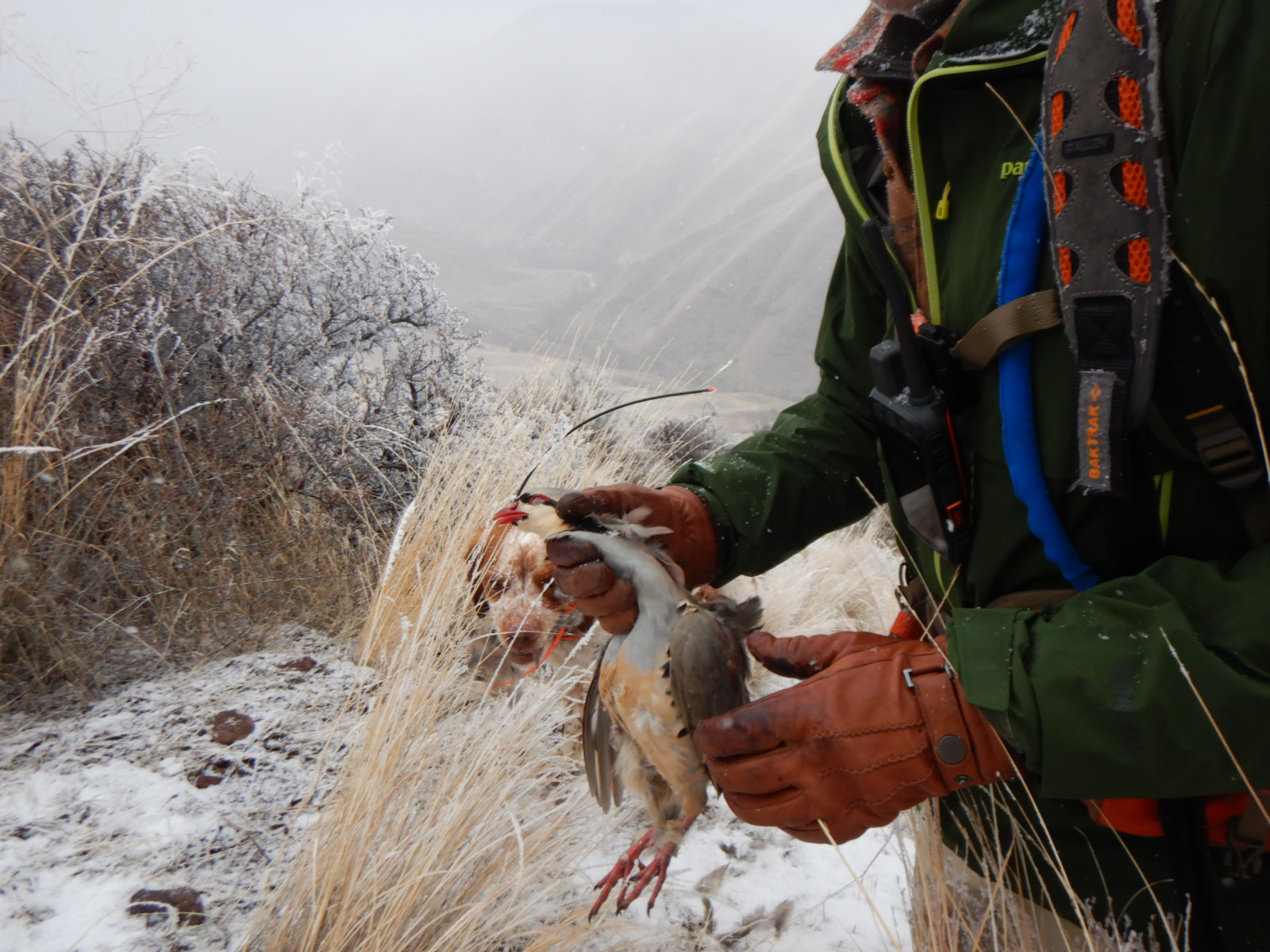
The covey busts, Bob shoots, Peat retrieves. Beautiful dog work. Magical. We continue this sequence a few more times finding new coveys and relocating old ones. The dense fog started to come up from below and the snow fell more heavily. We were dressed for the elements but the ground was getting slippery so we decided to head back to the pickup. Bob tells me, “Be careful on the downhill.” We headed down the same ridge we came up and our footprints, Peat’s, and the elk’s had vanished underneath a fresh dusting of snow.
The quickest door to open in the woods for a child is the one that leads to the smallest room, by knowing the name each thing is called. The door that leads to the cathedral is marked by a hesitancy to speak at all, rather to encourage by example a sharpness of the senses. If one speaks it should only be to say, as well as one can, how wonderfully all this fits together, to indicate what a long, fierce peace can derive from this knowledge.
“Children in the Woods,” from Crossing Open Ground
When you’re out there. Head. Thoughts. Observations. Hidden rocks the size of a golfball take you down, all stone of you. My experience is mine. Yours yours.
Here’s something of mine, what happens during and after, and also before the hunt. Not the hunt, but a hunt, and I’d be surprised if most chukar hunters don’t do this, too: things I’ve read that week or that stuck in my graycraw wash into the footsteps and missteps and breathing and hearing. When you’re climbing you’ve got the goal you can see — the ridge, the outcrop, the abutment, the hawthorn vein — but it’s never a straight line, especially with a pointing dog who, after all, is your partner. You repeat that, sometimes out loud and sometimes not, as if some or even you won’t really believe it. The fact of gravity resented. The failure to lose the weight you promised yourself you’d shed. Math. The sharp pain in the back of your throat. Is it Covid? It can’t be. I’ve been careful. Or have I? During a short rest a sound.
Howling. I hope it’s a wolf. We’ve seen prints nearby in the snow years ago. Suddenly I’m transported back 15 years to a solo elk hunting trip. The two nights I was camped featured nightlong wolfpack serenades. Ecstasy. Prescient or not I’d brought Barry Lopez’s Of Wolves and Men to read. On the second day of the hunt a tall wolf — one of the singers? — and I met at 15 feet on undulating ground. It vanished before my eyes while I marveled. Lopez’s book added to my admiration of these dogs, deepening the irony of living in a state seemingly committed to committing the sins Lopez documents in Of Wolves: extermination without cause. Worse: the science shows wolves improve elk numbers and genepool, but if only the politicians and ranchers would read and think they’d make a place for this predator. But that’s asking too much.
Reading while listening to wolf music
Caught up in this thoughtmemory, I’m a little further up the hill. Peat’s on point. I get over to him. Because they’re in the rocks they spot me miles away and bust wild. I reorient to the climb and return to the thought which now is more like a dream, triggered by another howl. I appreciate Lopez again and think of some of his other work, writing that — in part — led me to Idaho because I wanted to be like him, or at least write a little bit like he did, or at least about the kinds of things he wrote about. River Notes, Arctic Dreams, Crossing Open Ground. I had this romantic idea about the land and trying to fit into it and onto it and let it get through me and through to me. I still do. Without work like his, and others of his ilk (David Quammen, Aldo Leopold, Edward Abbey, Edward O. Wilson, Farley Mowat, John McPhee, Robin Kimmerer, Rachel Carson, Diane Ackerman, and Annie Dillard, just to name a few), what happens when I’m outside would be, I’m certain, much different. Worse, I think.
And then, nearing the ridgetop, I remember my favorite piece of Lopez’s, “Children in the Woods.” My mom, an art teacher, tricked my brother and me into competing to become the bird identifying champion of the Back Bay. I don’t know why. I also don’t know why my dad, a poet, built a cabin in the woods of Idaho but it set us free to explore and learn so many names of things in the forest that we didn’t even need to speak them anymore because we’d prefer to pay close attention to what we sensed and think about relationships between those things and us. When I think about it, as I did on this hunt, this, this is really the only peace I have. It’s as good an explanation as I have for why I keep wanting to hunt.
While recovering yesterday from this momentous Christmas Day hunt (momentous in so many ways, not least of which was the wolf howl and what it conjured), Leslie told me Barry Lopez had died. May he rest in fierce peace.
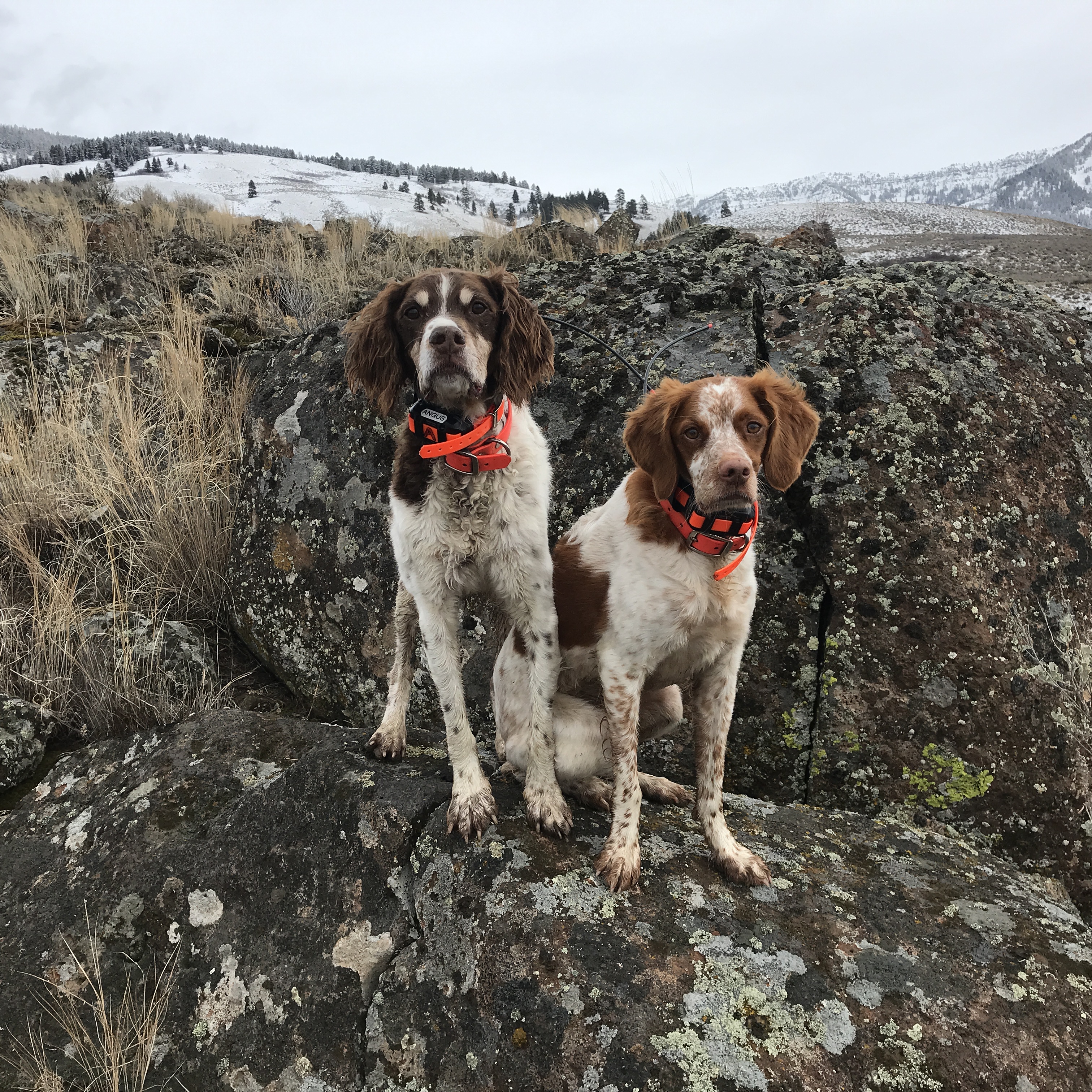
Not just one dog but two. Not much more work having two. They get fed at the same time, go to bed at the same time, and adapt to each other’s miscellaneous routines at home, like, for example, keying off of each other when it comes to hearing something outside, both of them to end up running full speed through the kitchen and out the dog door barking their heads off. We’d gotten use to having two dogs around all the time at home and on the mountain. The one thing that I loved most about having two dogs was watching them hunt together.
Last June when Angus passed away from cancer it was an adjustment, and a void for everyone, including Peat who now has to do all the work by himself finding the birds. It wasn’t that he was lazy, but he was smart. He was like one of those co-workers that we’ve all had at one point in our lives, the ones that sit back and watch everyone work and then when the donuts arrive from the boss on Friday rush to thank everyone for a good job, and he’d be first in the break room to get the only maple bar. Peat would be the first on the bird for the retrieve, a covey of birds that he didn’t find in the first place but he’d bring the chukar to hand and get all the immediate praise that followed while Angus continued to hunt.
Peat this season was definitely forced to step up his game by being the lone dog. His average mileage used to be three times ours, now it’s four times. He can find birds and he’s the relocation specialist but his nose is either super sensitive or not fully refined because he’s really cautious on pinpointing the covey’s location and getting close enough. The birds are either just very jumpy and busting wild for other reasons. I don’t know if it’s because he spent so much time as the co-pilot.
The main thing I’ve missed this season is watching him honor another dog. Peat in action is a beautiful, mesmerizing and sometimes funny sight to behold. It’s by far my favorite part of seeing a pointing dog work. Looking back, I think he purposely let Angus find all the birds just so he could honor him. They had a beautiful relationship.
Before the season started, we stopped by to visit Angus and Peat’s breeder, Katie and Gabe of Sunburst Brittany’s and I casually suggested that maybe they could loan us one of their dogs. I wasn’t entirely serious and thought that it was stupid to even suggest in the first place, but in November they lent us and entrusted us to keep Custer, their young liver and white American Brittany for a few days. I was excited to have another dog to hunt with again, and I was equally excited just to have the presence of another dog in the house.
One-and-a-half-year-old Custer arrived, and from the get-go it was evident that he hadn’t been around cats before. He went on point when he saw Seamus for the first time. Peat soon took notice of what was happening and acted like he’d never seen a cat before, either (despite getting his ass kicked by Seamus on his first day with us almost 6 years ago!), and both dogs chased Seamus and both got a full set of claws in their furry snouts. From that point when Custer wasn’t tethered to me, he was in his crate on the floor. My 15-year-old cat continued to taunt him by sauntering past his metal crate door within an inch. Cats are masters of intimidation. Trying to train Custer, a kennel dog, to be a house dog that lives with cats in one day so he could be loose in the house was very optimistic.
The following day, to give the cat a break from all of us, we took Custer out hunting with Peat to a place on some BLM land not far from where we live. We started out initially wanting to have Custer only hunt with me but realized that he hadn’t bonded with us yet and he wanted to hunt with Peat. About 20 minutes into the hunt, my Garmin beeped that Peat was on point. I headed his direction and could see Peat pointing and Custer honoring him through the tall bitterbrush. It almost brought tears to my eyes seeing two dogs working together again. Instead of getting into position to shoot, I pulled out my phone to photograph and capture the moment.
Custer honoring Peat for the first time.
The next covey of chukar we found, Custer was the first one to point. I slowly got into position and out of the left corner of my eye, I could see Peat running full speed right past him! Instead of honoring Custer, Peat ran right through the covey and busted them. Freaking Peat! I don’t know what he was thinking. I’m no dog psychologist, but on the next covey Custer found later in the hunt, Peat honored him. They took turns on a couple more coveys and we hunted with both dogs together at least six more times before returning Custer back to Sunburst. We would have preferred to have kept him longer if it wasn’t for the cat. I love my cat. That darn cat.
It was a beautiful thing to see Custer, Angus’s nephew, move with the same show-dog gait as Angus. He’s got the same sweet personality, and whisky colored eyes, and is a natural on the chukar hills. Custer is a miracle and a bright hope for the future where next spring a new puppy will be in our lives or maybe one of them will be in yours.
Merry Christmas and Peace on Earth. Enjoy the video!
Custer backing Peat again.Sunburst’s Custer and Peat, November 2020.Peat honoring Custer on some chukar. December 2020Custer post retrieveAngus and Custer, January 2020
I’d bet every chukar hunter has wished at some point that they were a hawk or an eagle or a falcon. Being able to survey the terrain from above, not to find chukar but for another angle from which to appreciate the landscape’s beauty, just seems fantastic. Yesterday, after busting a chukar into a rocky outcrop I noticed a larger bird emerge from the area. A peregrine falcon. It swooped and swirled a bit, came in for a closer look at Peat, and landed in a hawthorn bush. I wondered if it had noticed some tender alectoris revealing itself, or if it was just having fun flying around.
A few minutes later, in hot pursuit along a cliff bottom, marveling at the loads of fresh chukar guano at the base of the rocks, I nearly stepped on something that liminally seemed foreign. It was a drone, belly up and missing one set of rotors. The battery was gone. It clearly had gotten away from its owner, never to be found again. Until I came along.
I folded it up and put it in my bird pouch on top of the one chukar already there, and moved on. But I kept wondering from whence its owner had launched it. I couldn’t imagine.
When we got home, I looked to see if it had an SD card in it. Sure enough. Leslie was nervous. “What if there are weird movies on it?”
“I hope so!” I put the card in my computer and — voila! — it was readable. I looked through the files: about half images and half videos, some going back six years, and all but two were of non-chukar things and places.
The most recent, and final, two files — an image and a short video — were a bit over two years old. They were of an area I have hunted and know well. At first I didn’t recognize it because I’m not a soaring bird. It was fascinating to see the terrain’s familiarity reveal itself from altitude. It was a bluebird day. The two figures, clearly chukar hunters, were perched on a rocky knob admiring the view. No dogs were visible.
I keep a hunting log. I looked at the date of these two files and checked my log. Although I’ve hunted this area a lot over the past 10 years, the only time I hunted it in 2018 was on that same day. We were there, “just” across the ridge from these two men. We never saw or heard them. I might have passed within feet of the crashed drone.
I considered getting a drone at one point, for the reason that seeing this 37-second video is pleasurable. I’m a hawk. I’ve always wished that. I threw the drone question out to this blog a while ago, and got a lot of anti-drone comments that raised issues I hadn’t thought of, and which ultimately convinced me to delete the idea. Yesterday I posted on Instagram a rare tailgate photo of the drone next to the two chukar I got and got comments of the same sort: What size shot do I recommend for drones? I laughed. Sometimes we can’t have everything we want, and sometimes we shouldn’t want things we can have.
If this is your drone, I’m holding it for ransom. 🙂
Just above where I found the drone, in 30 mph wind. The bird numbers in this area, by the way, are SEVERELY down. For the work involved getting there (see the elevation profile below), I recommend it to super-masochistic 20-somethings who don’t have a UTV or a big appetite for bird protein.
Peat’s first season hunting, five years ago, began quite stressfully for me (and, consequently, Leslie and Angus). The first six chukar I killed that season Peat stole from the retrieving Angus and ran off into the brush and ate them. Any normal person would have been quite upset about this. I was literally livid and utterly distraught. There was, literally, no hope for the future. The only solution would be for me to kill the bastard and then myself. It was the end of the world.
Wait for it… I yell to Angus, “Don’t give it up!” Then you can hear the sound edited to eliminate my creative language…
Many people who love hunting talk about losing oneself in the activity as the real benefit from and attraction to the endeavor. I’ve written a lot about that in one way or another. The impulse to take with absolute seriousness a dog’s behavior in the field — when it doesn’t go right — as the beginning and ending, the totality, can be a drawback, a mitigation of the blissful removal of the world hunting sometimes offers. It goes with the territory. It’s also awful to be around someone (me) who surrenders himself or herself to these kinds of imagined tragedies. The price of intensity? Or is that just an excuse?
Well, I was dead wrong, and Peat told me so. The seventh chukar he watched fall to the ground (shot actually by my brother, on a different hunt than the one in the video, about a week later and not far from the same spot in Hells Canyon) he brought at a full sprint straight to my hand. Talk about bliss. Talk about the impossible.
Peat has not erred since. He’s made some impressive retrieves on birds that fell in places I physically could not get to. He’s tracked down wounded birds that ran a long way from where they fell. He’s found birds I didn’t realize I’d killed. He’s just been consistently great at finding and retrieving birds. Yes, ironic.
Yesterday, in the midst of one of the worst shooting slumps I’ve ever had, I managed to wing a chukar on a steep ridgetop. I watched it sail away a little wobbly, and headed in that general direction. Peat found and pointed it, and I missed my second shot at it, and watched it jet straight to the bottom of the canyon and land in a hawthorn patch. With no birds in the bag, and a lot of hope it would die down there, I descended the 1000 feet to its landing spot, which took about 15 minutes because of the rocky and icy steep slope. It wasn’t there. My heart sunk.
Not Peat’s. His tail modulated madly and he clearly had the scent of the bird that had run out of the hawthorn and farther down the canyon. Knowing I’d lost about 1000 feet more elevation than I’d planned and had to regain to return to the truck, I waited and hoped. I watched Peat on my Alpha screen, his GPS collar telling me how far he was every 2.5 seconds. With a normal range of about 150 yards, I watched him go out past 300, then back to 200, then pinball back to 300. A minute or so later, he returned to me, no bird in his mouth. He reconnected to the scent of that bird, and headed back out. He did the same thing, going past 300, bouncing around there, and returning sans oiseau. I gave him some water and gave up, starting back up the long climb.
I winged the chukar at the peak of the left side, and spent 30 minutes at the bottom while Peat searched for the bird even farther down.
Peat got on scent again, and retraced his steps as I watched on the Alpha. Again he ranged past 300, 310, 320, bounced around, and then came back to me, this time with a large adult chukar, dead and broken wing, in his soft mouth. I looked at my watch. It was 30 minutes past when we arrived at the hawthorn patch.
Angus blessed us with so much beauty and greatness and left huge shoes for Peat to fill. I’ve been rough on Peat, victim to the comparison game. But I’ve also sung his praises, while never fully eluding the shadow of Angus. It’s a complication most of you who’ve had more than one dog understand. But this irony — Peat-the-bird-eater > Peat-the-retrieving-phenom — now instructs me to let that shadow go and give Peat unequivocal acclaim.
Peat is every bit as good a hunting companion as Angus was.