I got a sick queasy feeling deep in my stomach as we detoured and drove into rural Council, Idaho. The curbside spot right out front of the local veterinary office was the exact spot where we’d parked the bright red Jeep two years before and it was empty and waiting for us. Just like the white crosses along the highways in Montana marking highway deaths, that spot reminded me of the death of Angus that occurred at that exact spot when we drove him there when his cancer could no longer be stopped.
Nothing bad happened to the dogs to prompt the detour and vet visit that day; we went there to get rattlesnake vaccinations since we had heard reports from other chukar hunters that they have been seeing a lot more rattlesnakes than normal. Despite the controversy whether or not they work or not, the vaccinations might buy us valuable time to get our dogs to the vet in an emergency. Peace of mind if you want to call it that.
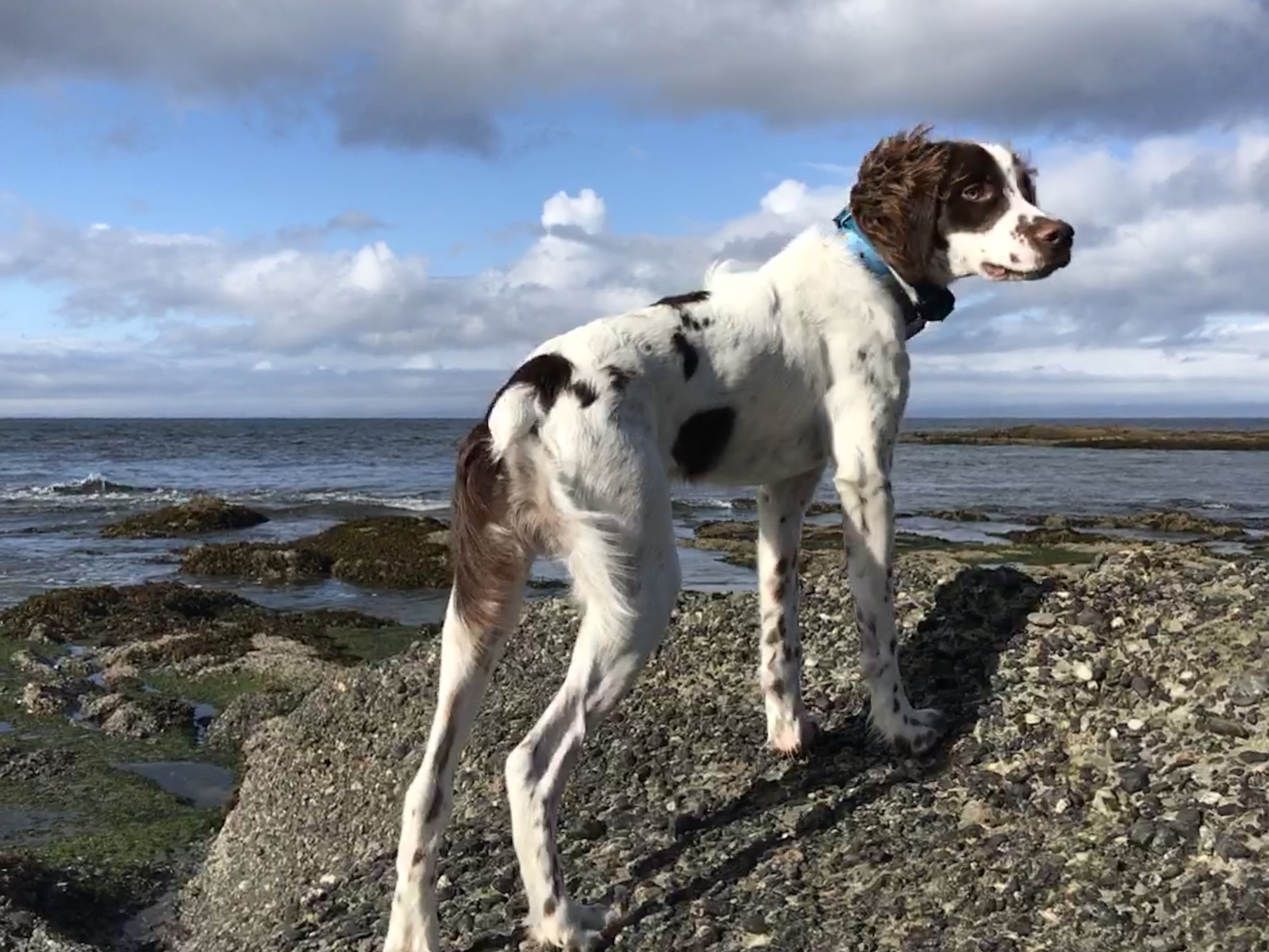
Bob and I each took turns taking one dog at a time into the vet exam room. I took Bloom first. A specimen of pure athleticism and muscles pulled me on his leash and dragged me into the tiny exam room. He’d only been inside this small room one other time, when he was 8 weeks old, so he wasn’t afraid of this place like dogs that make repeat visits.
I lifted Bloom onto the exam table. He shrieked loudly as Dr. Gardner suck the tiny needle into the area where he’d pulled up the skin on his neck and injected the rattlesnake vaccination. I was embarrassed by his behavior and apologized and blamed his genetics and reminded Dr. Gardner that Angus did the same thing whenever we took him there after several barbed wire injuries needed stitched up, his yearly vaccinations, and nail trimmings. Dr. Gardner remembered, and Bloom — just like Angus during nail trimmings — required all hands on deck including the receptionist to hold him down and try to keep him from clawing his way off the exam table. Bob was outside on the sidewalk waiting for it to be Peat’s turn and heard Bloom screeching at the top of his lungs. He told me later that he wondered if they’d decided to do open heart surgery on him without anesthesia. Peat’s turn wasn’t much better but we were both glad to get that out of the way.
The next day we decided to hunt in a place we’d gone several years ago. The pullout where we parked near the river to begin our hunt was scattered with old dried up goat heads. Nasty little things, and before we even started we were pulling several of their spiked seeds from the dogs pads as they stood on and hopped around on three legs. Cruel and imperfect plants. In the ecosystem where all flora and fauna have a purpose, I’m not sure what good they do?
We headed up the rocky slope while there was still shade on this part of the mountain and before the October sun peeked over the ridge. The soil was parched and cracked, and the grasses and end-of-season arrowleaf balsamroot crunched underneath my boots. We both thought it was ridiculous and pointless hunting so early in the season where there wasn’t any green-up and it hasn’t rained for months. About an hour into the climb both dogs seemed to sense birds but had trouble pinpointing them in such dry conditions. A covey of Hungarian Partridge that was probably walking uphill busted wild way above us and flew down the ridge out of sight. It was a good sign despite the dryness and not being close to the water that we managed to see some birds. It was a long way down to where the huns flew so we kept going up and hoped to find them on the way down.

Bloom with his long legs and spanning gait ranges bigger than Peat but he’s still inexperienced, young, and insecure and will check back constantly for my whereabouts, and when he doesn’t we have to second guess if he’s onto birds. He’s got his faults and is a strange dog still figuring out the world. It will sure be exciting when he does.
Beep!
I scanned the tall grass looking for Bloom who I’d just seen ahead of me but couldn’t see him. My Garmin handheld strapped to my hunting pack beeped again, I squinted at the screen which was hard to read with the glare of the sun: Bloom on point 35 feet. I looked around and still couldn’t see him. Bob who was just above me yelled “Can you see him?” I answered back ,”No.”
I spotted something white buried deep down in the golden grass, I couldn’t even tell what it was. Bob yelled again “He’s right there! Can’t you see him, get up there, get ready!”
I hesitated. My mind was playing tricks on me and I wasn’t even actually sure that he was pointing birds because Peat, who normally backs Bloom, was still running around. As I got closer, he was sprawled on his stomach in an awkward position flat on the ground. I didn’t know what to make of what I saw and I couldn’t tell if he was breathing and thought maybe he’d been bitten by a rattlesnake or caught in a trap, or something else bad happened.
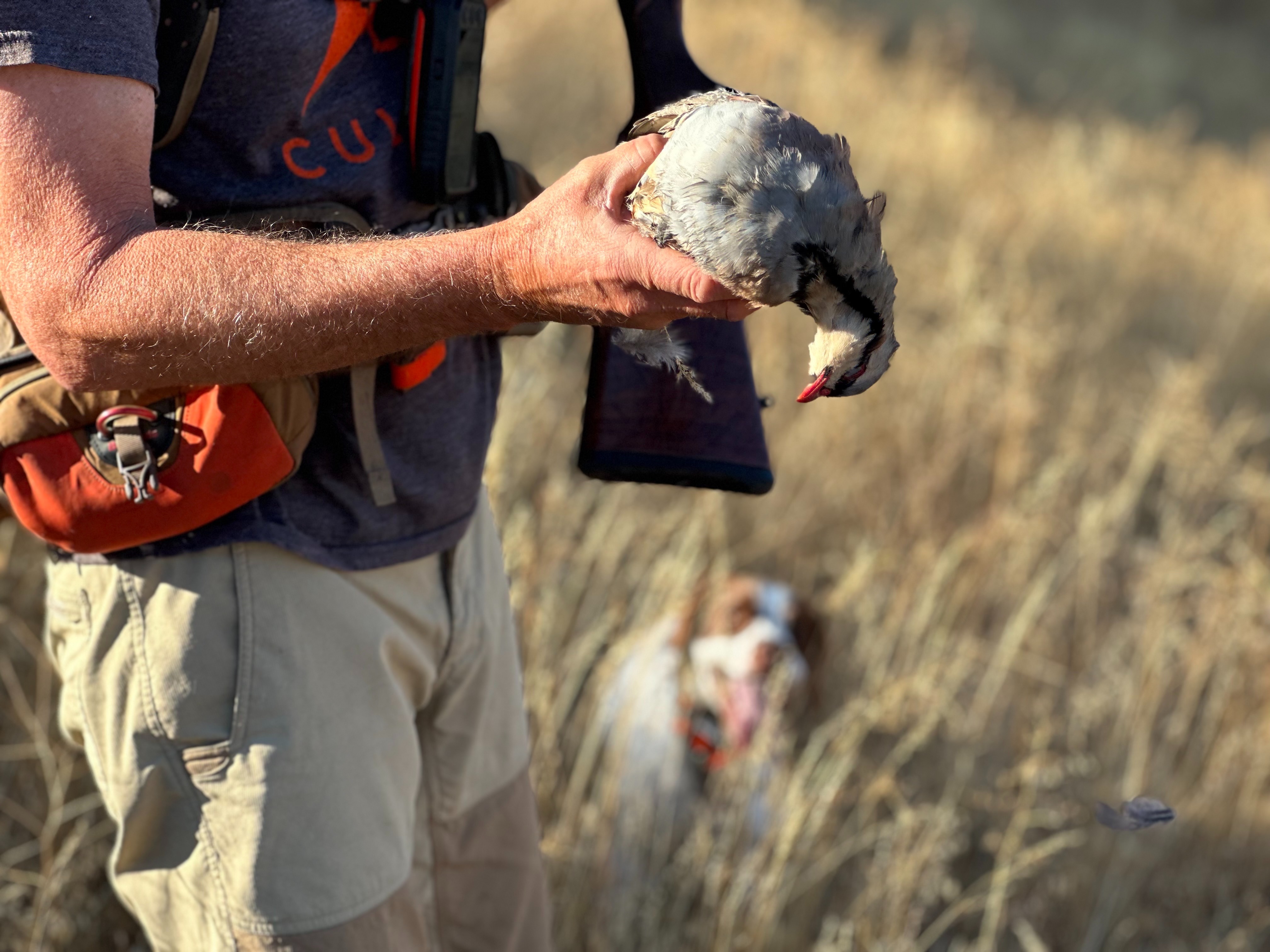
I moved even closer and could see that Bloom was shaking. I thought to myself, surely if he’d been bit or something we would know it. Suddenly, a covey of chukar exploded just in front of him. Instinctively, I mounted my shotgun and fired one shot but the birds were almost too close and I missed the one I’d picked out. Bob, who was above me and to my left, fired simultaneously and I saw a chukar fall to the earth. Bloom sprung up from the ground, found the downed bird and quickly put the chukar in his mouth while both of us were praising him. It wasn’t a perfect text book point and we’ve never seen him do that before, and even on the retrieve he dropped the chukar from his mouth while jumping over the grass to Bob like a mule deer.
We both agreed that in 10 years when we’ve forgotten the details of each point, bird, retrieve over the years, we’ll always remember this one. This imperfect crazy day that Bloom found, pointed, and retrieved his first chukar without any help. And on his belly, no less!
It was starting to get really hot outside and we slowly descended back down the mountain finding game trails to make the downhills easier to navigate. We got back to truck camper and I tied up the dogs up to the camper in the shade next to me and sat atop our school bus yellow wooden stepping box outside and removed my sweat-soaked leather boots and wool socks and then went inside and started making some sandwiches. From inside, I noticed a gray pickup slowly drive past us then stop and then back up and stop again. The two occupants got out. One of them approached Bob, who was sitting down outside in a camp chair, and introduced himself because he’s recognized Bob and the dogs from reading our blog. Tim and his brother both upland hunters chatted with us for a while while we exchanged stories. It was nice to connect in person with other chukar hunters.
Right after Tim and his brother left, we sat down to eat our sandwiches. Suddenly a small snake with diamond patterns on its back crawled swiftly out from underneath the yellow box I’d just been sitting on. We both jumped up from our chairs and I grabbed the dogs’ collars and pulled them away from the serpent. It was a baby rattlesnake, and we both couldn’t bring ourselves to kill it and watched slither away and disappear. Why would we end its life when it wanted nothing to do with us?
All imperfect things have a place in this world.