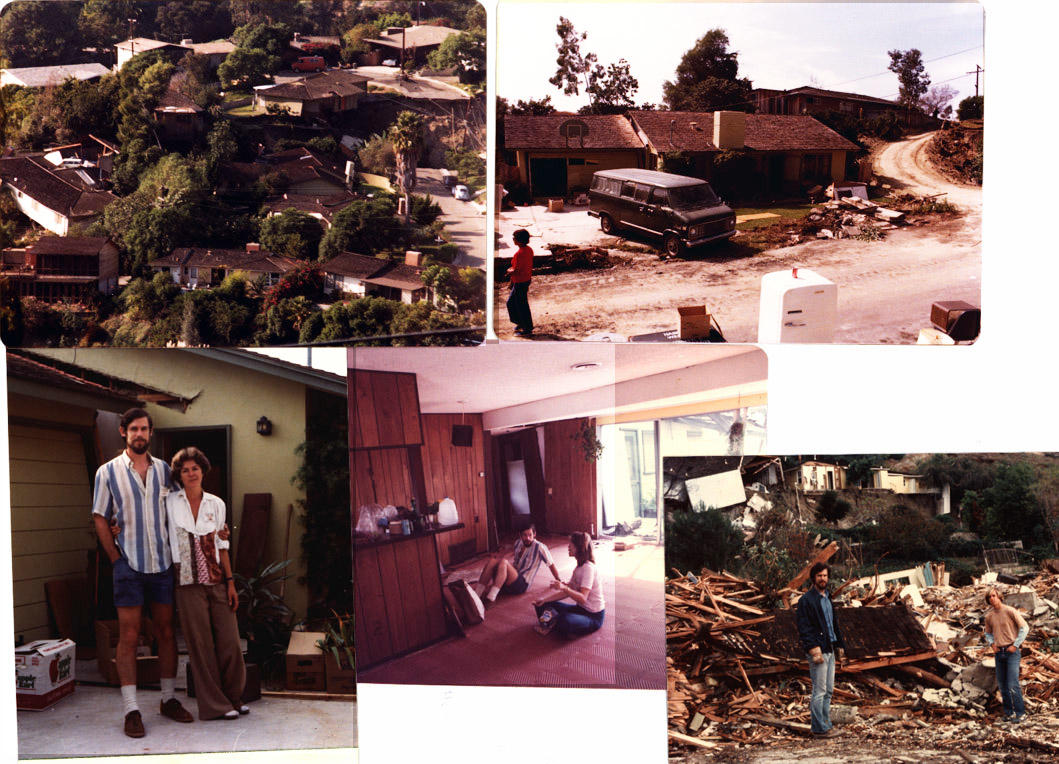
45 years ago today my 16-year-old mind and body awoke in the dark at the usual time to find things amiss. The wood shingle roof was making popping sounds. My mind needed some explanation. It’d been hot. Perhaps rain was falling on the tinder-dry shingles, causing them to expand dramatically, thus the popping. Feeling confident of this explanation, I continued getting dressed to head out the door for my morning cross country workout with the other devotees on the team.
I was wrong. What unfolded from that point on irrevocably impacted my life and the lives of those living in the other 28 or so houses destroyed by the landslide in Laguna Beach’s Bluebird Canyon. My mother, for example, a 39-year-old schoolteacher, was raising two teenaged boys. My soon-to-be stepfather living with us wasn’t quite yet 30. Several single elderly women owned houses in the neighborhood in the town now known for astronomical property values but which at the time was the epitome of modest. I don’t recall anyone being wealthy. Regardless, everyone faced a new challenge in a real estate landscape about to blast off: homelessness.
Life, as they say, as if they thought nobody would understand this if they didn’t say it, is full of surprises. I couldn’t have known then what a chukar was, for example. I wouldn’t have dreamed I’d end up living on a golf course, or that I’d be a school teacher, or a professor, or a bagpiper, or a brewer, or someone who failed to appreciate avocados until after he left the home whose landslide swallowed the two big avocado trees (and my brother’s surfboard) that supplied my mother with gallons of guacamole she did not try very hard to convince me was delicious.
And today on my way back to the truck after a hunt I found a very weathered $800 at the base of a bush . That was a surprise.
Another surprise is coming. Stay tuned.
Oh, birds seem to be surprisingly plentiful so far this season.
Thanks to my mom, I love birds. A barn swallow pair made a beautiful and precarious mud nest this spring on a beam just below the ceiling of our front porch. Their second batch of chicks is about to fledge.
I Am Here
I began this fourteen years ago as an attempt to share my attempt to understand what I liked so much about chukar hunting. My focus here has changed over time, more toward an attempt to share my attempt to understand what for me was the most vivid paradox I’ve had direct contact with: why I wanted to kill something I loved. Eight years ago, about, I began writing a story I thought would try getting at that in some other way. Like this, I’m still working on it.
A little more than two years ago Leslie and I experienced what I hope will turn out to be our purest direct contact with evil. It led to leaving bird country which led to many other unpleasant things. Now we’re back here. And we’re both hopeful and grateful.
Again
Grouse season opened two days ago. We didn’t go out and still haven’t. Lots of reasons. Chukar season starts soon. Yesterday, Leslie asked me if I was excited to get out there with the dogs. We’d yearned for a long time to be living in this place this time of year, and now it was here. Finally. I wasn’t sure how to answer. I’m muddled. But the best I could come up with was, “I’m identifying too much with the birds.”
Will
Anyone who hunts must sometime recognize the fact that taking an animal’s life means denying its will to live. Whether it goes beyond that depends on the hunter. Many will question from where or why they adopted or assumed that kind of power, and possibly wonder or even question if they’re okay with that.
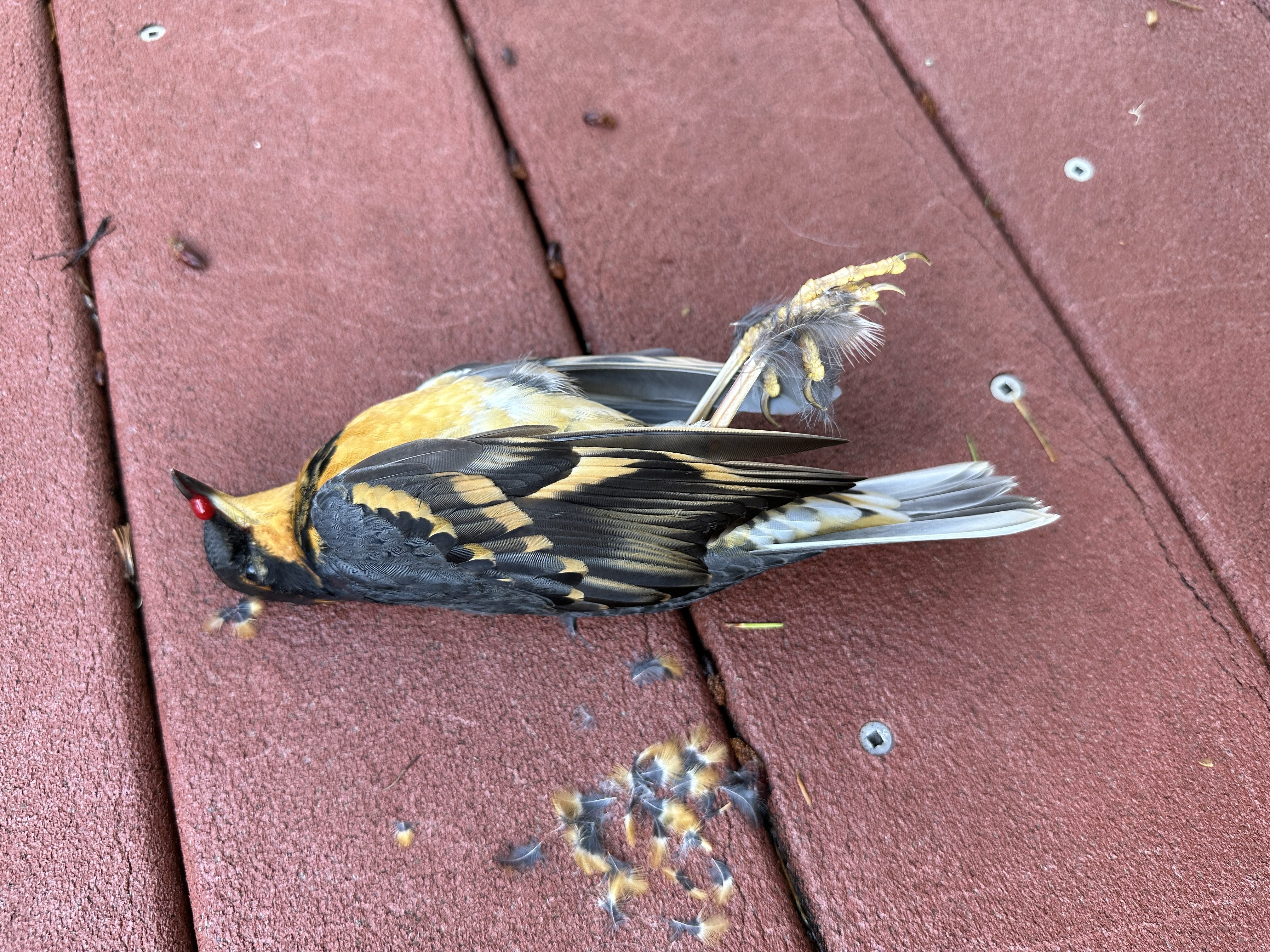
Late fall in northwest Washington meant lots of varied thrushes, the cover bird on Sibley’s field guide. Until we lived there, I’d never seen one. We had lots of them in our yard. I felt very lucky. One day one flew into one of our windows. It lay dead on the porch. I went outside and picked it up, still warm. A drop of blood, globular and viscous and contained, had escaped through and sat on its nare. Its eye was open and I watched it change from reflective to opaque. I thought, “I hope it didn’t know what it hit,” and took it to the dense foliage on the other side of the fence, where I left it, safe from the dogs.
There are accidents and there are intentional things. Hunting is no accident. Duh. Unlike our ancient predecessors, we don’t hunt to live. Some of us live to hunt. But that’s a different story. My hunting story is a now downward-trending sine wave of desire that’s more or less loosely affiliated with my will to live and somehow affiliated with the will of whatever I’m seeking to kill. It’s that affiliation that continues to baffle me. But one thing’s clearer now than before: the more I try to understand it the less sense it makes. There’s a string that runs through everything, and no matter what you do to that string or what happens to it, it’s still there. You can fray it, burn it up, throw it away, lose it, but that doesn’t get rid of it. It’s Hart Crane’s memory all “things nurse.”
Grateful
Cree hunting tradition poses prey as grateful. With certain conditions. Animals will gratefully give their lives to hunters as long as there’s some kind of mindful reciprocity given back and acknowledged by the hunter. Usually this means, at the very least, making the most of the animal: food, clothing, tools. They are glad to know we understand and appreciate what they’ve given to us. Most of us have learned this, and try to remember and abide by it as much as possible, but inevitably we fall short. At least I do, more often than not. Even Cree today debate the practicality of this and some even disavow it.
This, falling short, requires reflection, which is a form of grace in constantly changing form. I know that soon we’ll go out with the dogs and when I have a shot at the first covey that busts I’ll try to kill as many of them as I can.
Went on a short walk with the dogs today. Following them across a freshly snowed baseball field, I noticed their prints paralleling each other, in sets of four paws, like words on a page. Morse code. Tab (if you’re a guitarist). Braille in the negative.
Then I noticed the two dogs’ sets were mirror images of one another. Peat’s tracks are right-handed, Bloom’s are left-handed. The first and last paw of each dog is on the same side; Peat’s on the right, Bloom’s on the left. Bloom is Leslie’s dog. Peat’s mine. Leslie’s left-handed. I’m not.
In some coincidence, by one, I’ve found myself reading a lot about the Arctic lately. I’d always known it was up there, waiting. Well, not really. It never needed me. But I’d always felt a little guilty somehow. Ignorance. Maybe that accounts for why.
Anyway, first was Barry Lopez’s Arctic Dreams, which took a while because it’s a big book. I could go on about it, but I’ll just suggest you read it. It’s really good. Better, for me, is the next one: Hugh Brody’s The Other Side of Eden: Hunter-Gatherers, Farmers, and the Shaping of the World.
Both books deal with Eskimos. Among many of the things that have stuck with me, language comes up highest. You need to read it; I can’t explain it justly. But the crux of it is that what we try to say about our experiences in and with the wild — those of us who don’t come from a hunter-gatherer background — is defined almost totally by an absolute inability to convey that experience. Okay, so let’s move on. We try. We fail. We want to share. Some seem to get it. Some let you know. It feels shared somehow. But there’s still a lack, something’s missing. And that’s the piece, the lack. The land itself isn’t coverable by what we want to say about our moment in it. It, the land, is almost inconsequential while being essential. The arrogance. The assumption. It’s the farmer in us, and it’s what will end it all, in the end, for everyone.
Brody has a chapter on Creation that focuses on the first book of The Bible. This chapter, ironically, while limning the distinction between hunter-gatherers and farmers, and thus the basic tension in the shape of the world as anyone knows it, did more for this atheist in suggesting God as a reality than anything I know yet. This is how: farmers live in the easiest places, while the only remaining hunter-gatherers live where they’ve been pushed, areas not amenable to farming (either too cold or too hot). If anyone should relate to the land as another being, it should be the farmer. But it’s the other way around. God, then, makes this almost like a joke: in the places it’s basically impossible to live precisely because the land is so vicious and inhuman, those who live there (hunter-gatherers) relate to it as though it’s another person. It’s too perfect an irony not to come from God. (And, believe me, I get the irony of this idea.)
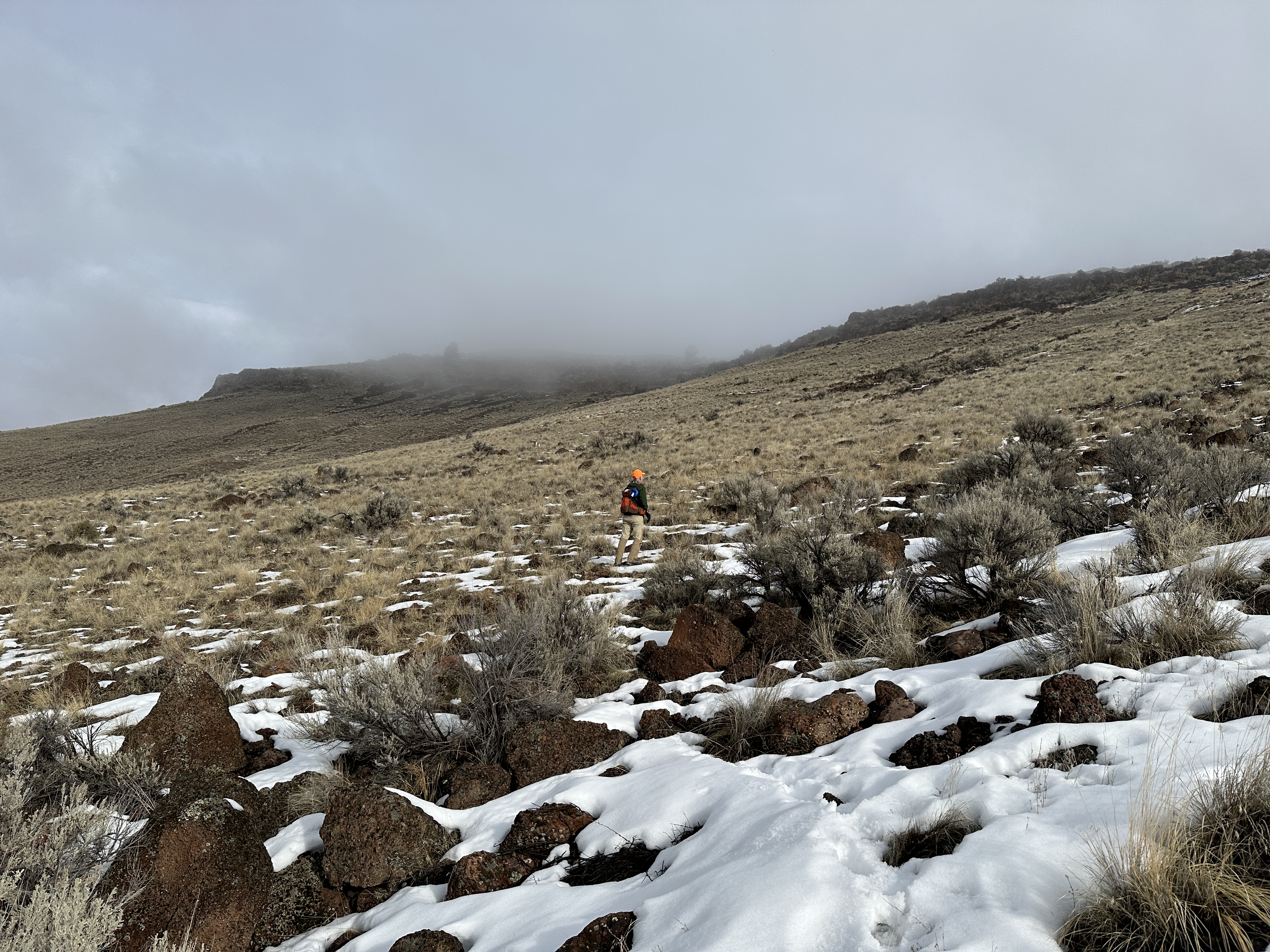
So all this comes to me as an accident right around the time we got the last chukar hunt of the season. The cap on the second of what I hope are the two mainly missed seasons. The hunt was epic. I’ve never seen more chukar on any single hunt. The spread of bird guano was uniform across the entire ground we covered: everywhere, and I’ve never seen anything like it anywhere. It was a place that had been hunted a lot, and it was easy to see why: lots of chukar. But, as often happens in January, they busted pretty wild. They could hear us coming a mile away, with the crunchy snow. Still, lots of points, lots of long chances, and one stealthy, solid, long hold from Peat that got me a good enough shot for my rusty brain to connect. And Bloom, who honored Peat, found it and brought it right to my hand. The whole thing was a blessing, and it was hard not to see it as a kind of thank-you from the place and those in it.
Somehow — I really don’t know how — I’ve ended up with a sense of the places I walk looking for chukar as other people. And not just those places: all land. I feel lucky to have come to this, and it’s an assumption I think I came to naturally from watching dogs and trying to find birds, paying attention; the similarity to the shape of the world in the eyes of hunter-gatherers strikes me as a rich coincidence, one I came to but one they’re born into. Land: there’s a rich relationship, richer in reciprocity: we want to pay attention to one another. I remember, as a teenager, looking at the boardwalk in my hometown destroyed by massive waves one winter and thinking joyous thoughts not because of the destruction but because nature still had a fighting chance, some kind of power. Without anthropomorphizing too much (a naughty word for those of us from the farmer culture while a central feature of the language systems for hunter-gatherers), it seemed like the waves were sending us a message about abuse. I think this is why it bothers me so much to see medusahead and cattle damage of many other kinds all across the range; it seems felonious and matricidal, especially coming from agriculturalists.
Oh well. We carry on. Next year there will be more medusahead, more star thistle, more over-grazed, abused public land. But we’ll be out walking on it with dogs looking for birds, never giving up hope, learning from dogs in this, and paying attention, listening to things the land might want to tell us. And none of it can be captured in our words. But that doesn’t mean we won’t try.
“The short man followed, limping, terrific, crablike.”
Nearly through reading 900 pages of Faulkner short stories, and can’t get rid of the sentence above. For some reason. Yesterday, while doing research for a story I’m writing, I came across a Cree word that any bird hunter would appreciate: “Papêtikwâskopaniow.”
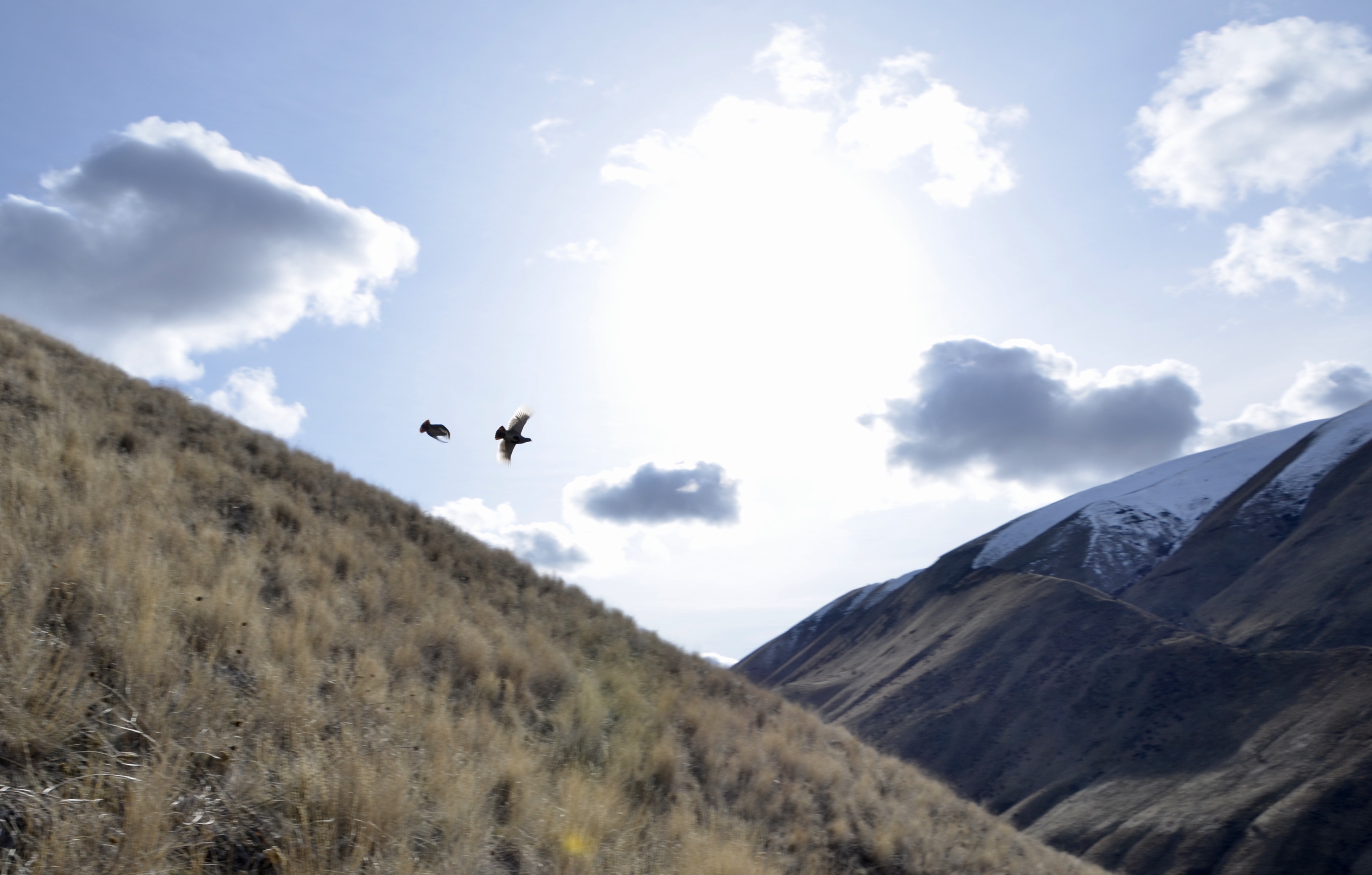
I wish I could pretend I knew how to pronounce it. But it means the thundering sound a partridge makes with its wings when it takes off.
We’re always, all of us, until we die, in between things. Words and sentences stick with us, for some reason or reasons (often inexplicable), that mark a point in time and place that’s there as a kind of anchor. I’m sure I’m driving Leslie crazy by randomly repeating (usually as she’s about to fall asleep at night) that sentence from Faulkner’s story “Death Drag.” I can’t explain why I like it so much, but I know I do and am fine with leaving it at that. Then there’s the Cree word, which I might say a lot about. Each of these linguistic landmarks will bookend a moment in my life later on that will remind me I was in the middle of something intense here, in this case not really the kind of intensity I would choose, but just one of those life things that we’re always in the middle of. My stepmom likes to say, after an emotional response to something, that she was “in the middle of being moved.” It’s like that. But it seems, probably for everyone, that we’re always in the middle of something, whether it’s being moved or not. For me, this marked moment has to do with moving. And it’s moving, too. But see, that’s another story.
The Cree word, for obvious reasons, struck me. When I came across it I was simply looking for the Swampy Cree (“N Dialect”) word for “hello” on an online Cree dictionary. Hello? Maybe you can think of the thunderous surprise of a grouse busting right at your feet as a kind of greeting. More likely, the word came up because of a coding glitch. But I’ll take the connection; it makes some sense. The bird flipping you the bird? There are all kinds of ways to say, and all kinds of ways to interpret, “hello.” Lookout, idiot! Nice to see you again. Is anyone there? The word itself is liminal, and the context and how we see it gives it its meaning. One of my favorite lines from Hamlet nails it: “There is nothing either good or bad, but thinking makes it so.”
Papêtikwâskopaniow. Good: it’s beautiful to me, enviable even, that the Cree have a single word that captures such an incredible, shocking, powerful, complex experience, especially if you’re a bird hunter. Bad: English doesn’t. But then, these judgments are of course culturally contingent and biased. Liminal. Can we say it matters who we are and where we come from? Who gets to say that? And who gets to say how we feel about killing a bird?
We do. We must. So what do you say?
One thing I love about the Cree word is the agency it gives to the partridge. Some of us talk about “fair chase,” so this matters. For Cree, and most First Nation people, “prey” are so much more than that. This word makes it clear it’s the bird who makes the sound with its wings, and it’s a specific kind of sound. One word. You’ve experienced the sound. When you replay that moment reflected by that word I would bet your brain slows it down so you can see it, so you can get in the middle of it. Liminal. The bird is leaving one place and going to another, and anyone who’s watched a big dusky grouse do this in dense woods or even in grassland knows that even that bird doesn’t know for a while exactly where it’s going. And when it’s a covey of chukar, or waves of a super-covey, what then? The sensations. And where does this leave you? Do you shoot? Can you?