Author: Leslie McMichael

  • Remote

    Remote

    “As for me, I am tormented with an everlasting itch for things remote.” – Herman Melville, Moby Dick.

    So far this season, Bob and I have been only hunting at higher elevations where the earthy golden grasses and light green sage colored hills meet up with the forested mountains. These are places to take advantage of now. Soon these places will be almost impossible to reach when the winter snows start falling, which will be any day now. Intrepid hunters that don’t mind post-holing for miles can get to these spots when the snow is really deep in December and January. We’ve done it before but it’s really hard on the dogs. It’s hard on us. And you wouldn’t see birds anyway.

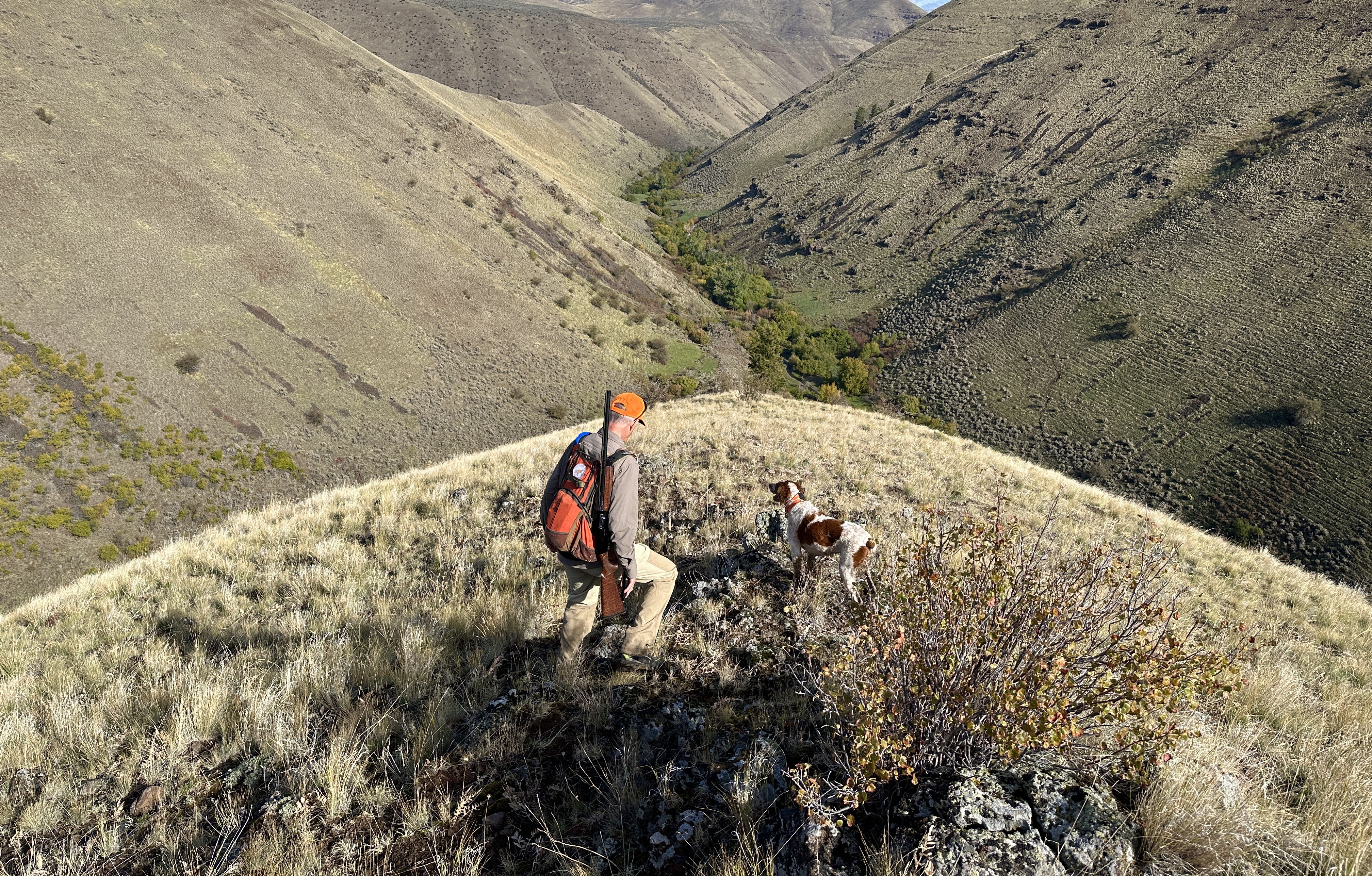
    Five years ago in Mid-November, Bob and I hunted on top of a higher elevation plateau covered with big basin sagebrush and antelope bitterbrush. It was remote and far from any roads or two-tracks and undulated like a rollercoaster and required a steep downhill hike first, then a climb up to the top of the plateau, then back down again before climbing back out. It had all the things you would want for good habitat for chukar: steep slopes, rocky outcrops, water, plenty of things for the birds to eat, and cover from predators.

    A couple of weeks ago, waking up to almost perfect health for my age and the sweetness of early morning darkness, I suggested we make the drive back out there. I’m not particularly fond of hunts that start with the downhill first, unless we’re doing a shuttle, but I’d thought of that place often and really wanted to go back. The motivating force was, besides being incredibly scenic, especially in October, was that historically chukar were there before, so they should still be there, right? I do know that every year things change, every month and even day changes your odds of finding them, but it’s the eternal hope that really drives us.

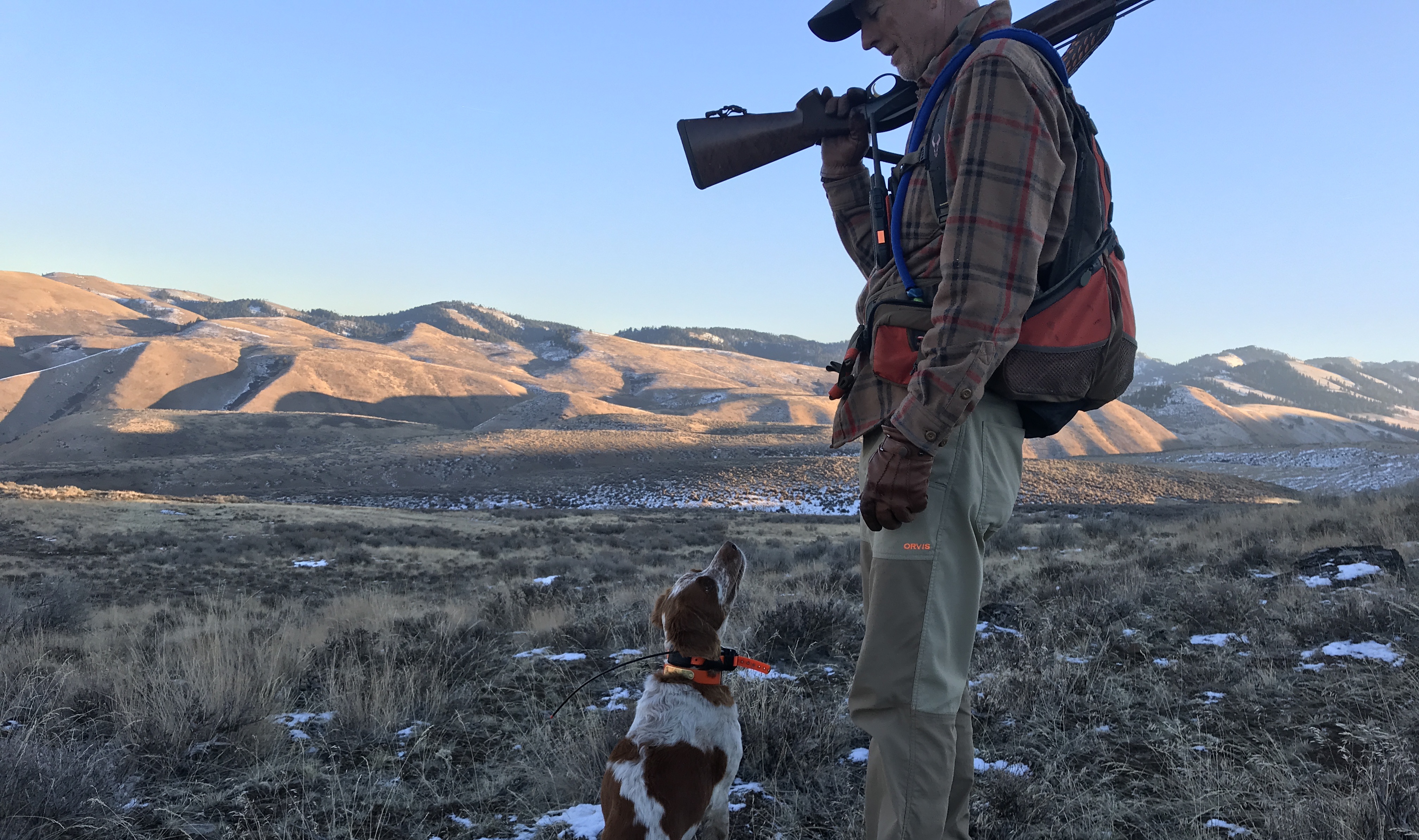
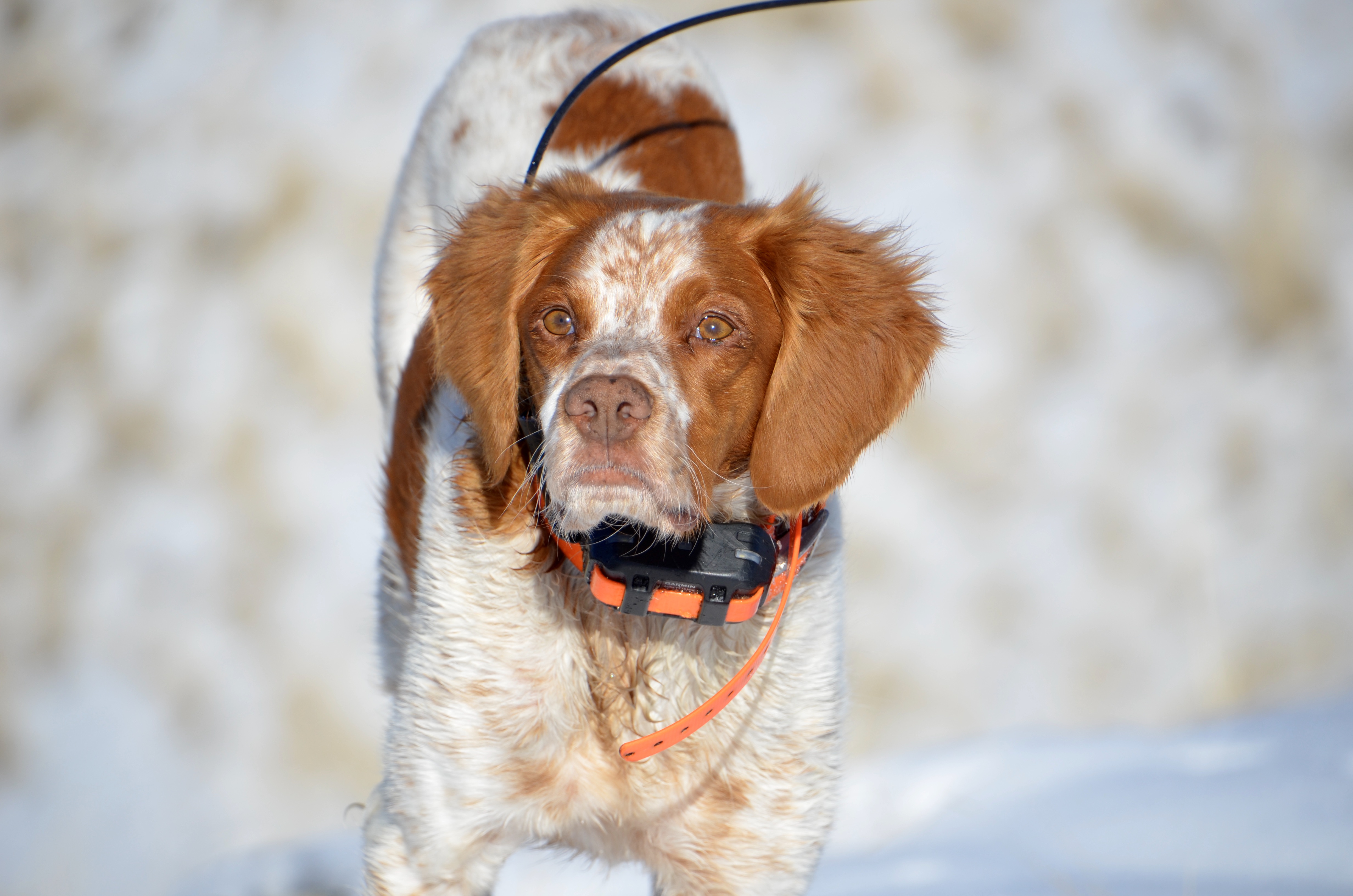
    We left home and after about an hour drive on a gravel road, we arrived to the place where we wanted to start our hunt. We put on our heavy packs, mine weighed down by what felt like gallons of water, and took our shotguns out of the cases. Before letting the dogs out, we put their orange Garmin hunting collars on, which is never an easy process when they are excited and know what’s about to happen and behave like wiggle worms or house cats not wanting to be held.

    The early morning sun was still behind the horizon as we started our descent and the air was cool and frost coated the short green up. In the distance, a rosy alpenglow lit up the hills to the west. At the start of the 1,000-foot descent on a game trail meandering through a dark and shadowy ponderosa pine-lined draw with a tiny dribble of a creek running down it, Bob insisted that I go in front, so I took the lead, which was unusual. I prefer to follow because I’m usually slower and don’t read the terrain as well. I try to make a mental map of the landscape but I’m prone to daydreaming and I once got us temporarily lost in a snow storm, a few seasons ago, in a maze of game trails and rocks and ridges that all looked the same.

    I felt excited to be back and descending on this trail again after five years. A trail that’s been used by wild animals for time immemorial that leads to a place that hasn’t been destroyed by humans. It had rained the day before and prints of deer and dents by bigger and heavier hoofs of ungulates still wandering the area were on the trail. Some tracks were going uphill and some downhill. Peat’s petite little prints and Bloom’s bigger ones were freshly impressed into the earth heading away from us. I looked back up the trail and saw my own tracks. The sound of a grouse busting got our attention and we both removed our shotguns from our shoulders and looked into the direction of the sound. Peat tracked it down across the creek and found it up on a limb of a tall pine tree and starting barking. This is what he does whenever grouse are in trees. He usually barks his head off until we can’t stand it but I don’t like shooting grouse out of trees and Bob really doesn’t either so we buzzed Peat back and decided to continue walking and leave it be.

    I stopped and examined scat of a black bear which was berry- and seed-filled. I pressed it with my boot, and thankfully it was dry. We kept going, more scat, maybe a coyote or fox, turds full of fur. The front of my thighs and ankles started to feel the terrain and I was cursing at myself for suggesting such a strong and steep place this early in the season in when not really knowing my fitness.

    We got closer to the bottom of the damp draw and near the creek the banks were all muddy and eroded and the gooey mud stuck to the bottom of our boots. The creek was a welcome relief for the dogs as they paused to drink water before crossing. Bob took the lead in front of me and stopped and swished the soles of his boots in the water as he crossed, to get the mud off. He said, “I don’t want the extra weight for the long climb.” I did the same but stepped into a slightly deeper section of the creek and water splashed inside one of my boots and got my wool socks wet.

    I followed Bob up the other side of the draw as we zigzagged our way out of the bottom of the creek bed. Five years ago, we flushed chukar out of this spot. This year, nothing. I finally caught up to Bob taking a quick break to catch his breath. He said, “I’m taking 61 steps before stopping to rest.” We continued. I tried 61 steps for a while, hoping to find my rhythm but couldn’t. Mind games to get you to the top where sometimes your mind is your worst enemy and the relationship between walking and thinking and the movement of memory when you don’t have what I call “chukar legs” yet in this early part in the season.

    Almost to the top of the plateau after two hours of hiking, we heard chukar calling in the distance but couldn’t pinpoint exactly where it was coming from, but it sounded like they were on the opposite side of the ridge, the one we just came from.

    I truly believe that some of the chukar up there have never seen a human or hunting dog before. This could be a good thing or bad? Some chukar hunters say birds bust wild and the dogs can’t hold them in the early season because they’re not used to being hunted, or just that they’re young birds. Others say towards the end of the season in January when they’ve had tons of pressure from dogs and people, that’s when they really bust wild. From years of experience doing this, I believe it’s a total crapshoot and there is no rhyme or reason for their jumpiness.

    Once up on top, we split up to cover more ground and to increase our odds of finding old deer or elk sheds. Bob and Peat went one direction, and Bloom with me. Peat stopped ahead and pointed solidly, then three or four dusky grouse busted from the ground one by one near some ponderosa pines just ahead of us. The grouse were too far for me to get a shot. Bob tried to hit one but missed. Bloom, with his strong prey drive and inexperience, saw one flying in the sky and took off like a high speed freight train to pursue it. I buzzed him to come back, which he did. We continued hunting, keeping each other in sight as we headed down a ridge, Bob in front of me.

    The dogs methodically covered the terrain doing circuits and periodically returning to get some water. We noticed Peat was favoring his front right leg and wouldn’t put any weight on it. We examined it and didn’t find any cuts on his pads, and after palpating still didn’t find anything. We kept going down the ridge. A few minutes later, we watched Peat, who we’ve dubbed “The relocation specialist,” find one of the grouse from earlier hunkered down in a sagebrush as it suddenly busted wild before he had a chance to point it.

    The descent down the open ridge felt like it went on forever, and it was covered with loose rocks. I didn’t remember it being that way before. It’s funny how you don’t remember certain things about past hunts. They always seemed easier. Once back down, we crossed over a different section of the creek before heading back up. The climb from the bottom was hard and it was hot. We used as many game trails as we could find and I pulled myself upward using bunchgrass to hold onto, but I felt wimpy for getting sick of it and stupid for complaining about side-hilling and being afraid of traversing one particular loose scree vein on my hands and feet. I had to remind myself that this is part of the game and that every hunt after this will be easier.

    Bloom, our workhorse, continued to cover tons of ground all the way up which took about an hour. Peat kept stopping and laying down in the shade of sagebrush. I worried about him and the possibility of having to carry a lame dog up the rest of the 1,000 foot climb. In the 16 years of hiking these chukar hills with Bob, this was the first time I thought about getting a dog sling for emergencies.

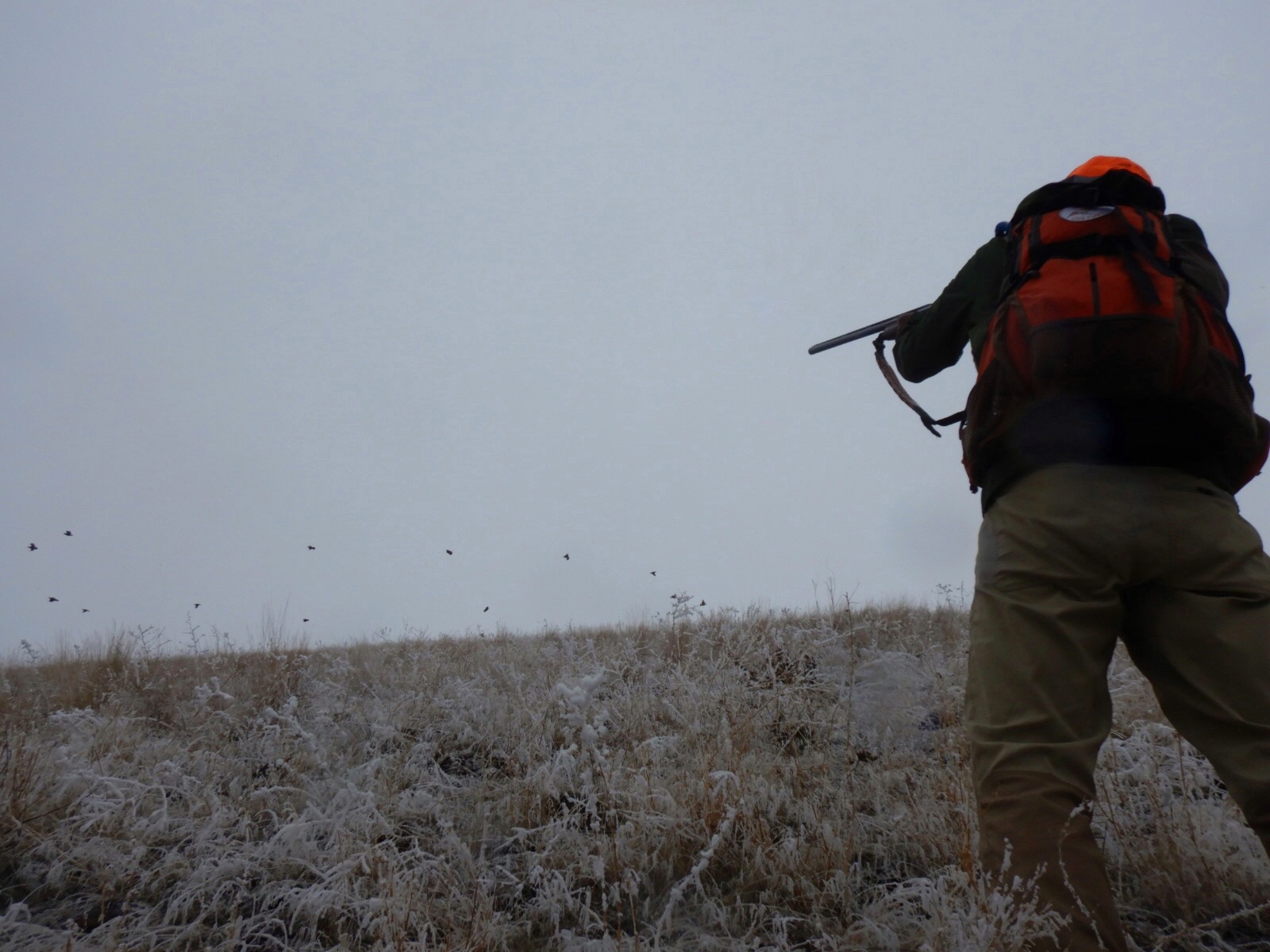
    Almost towards the top of the climb we entered another small forested area. My Garmin handheld beeped that Bloom was on point above me. Bob said, “He’s your dog; you better go.” I picked up the pace, climbing uphill and looking for him and busting through the thick hawthorn and bitterbrush. Then suddenly a grouse busted above me, flew past, I shot, and missed. I felt defeated. It was an easy shot on a big bird.

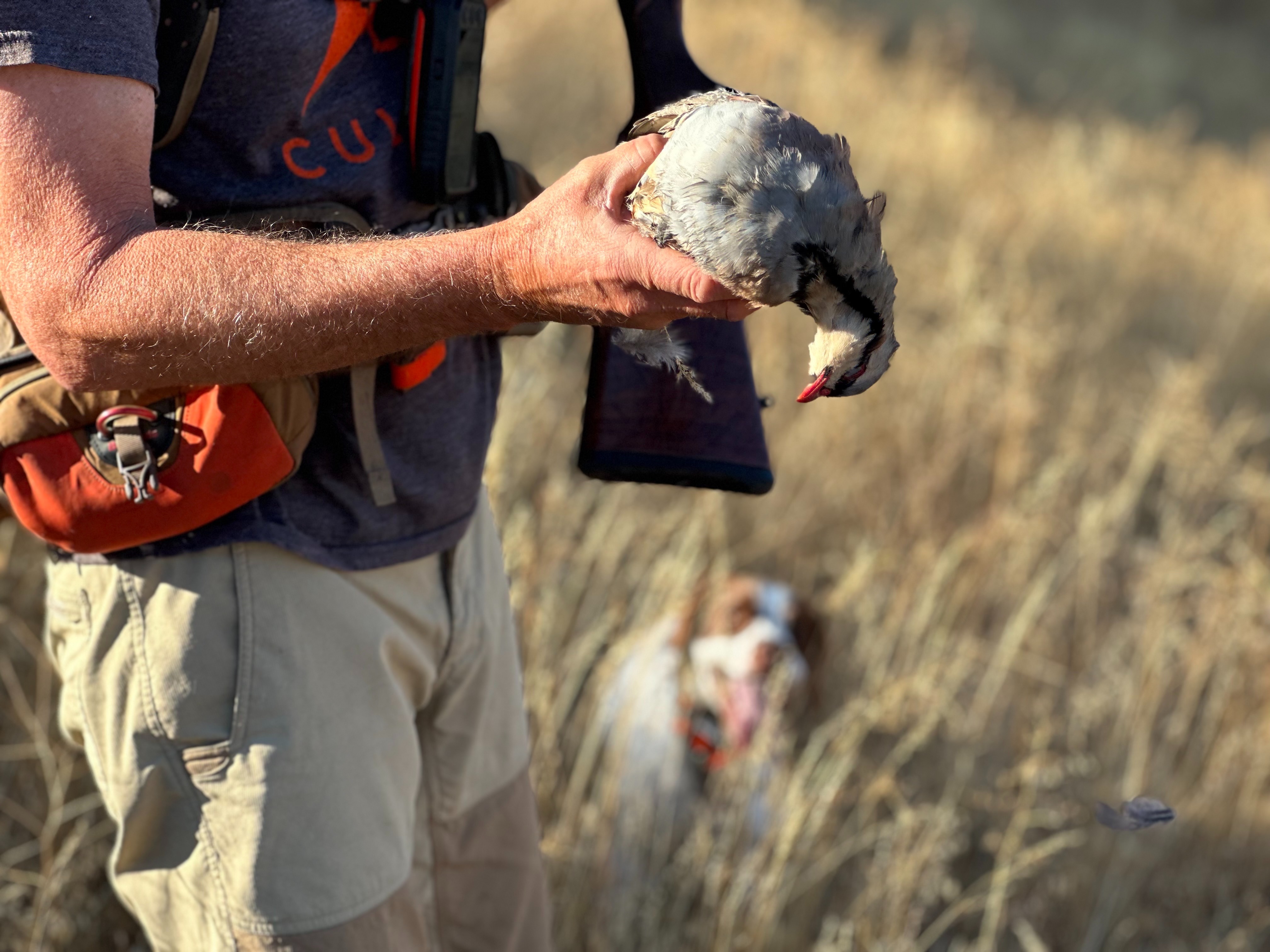
    On top of the last ridge, the final point of the day was Peat finding a covey of chukar just below the rocky ridge with Bloom backing him. Just as we were carefully navigating downhill getting into position in front of Peat, they busted. We both shot and Bob hit one. The chukar landed on the ground and started running. Peat chased it down and did the most remarkable retrieve despite his handicap. The only bird bagged in our five hour hunt was pointed and retrieved by a three-legged dog.

    When I get nostalgic about the past, which seems more often these days, there are things I’ll remember on this beautiful autumn day engrossed in the intimacy of this remote landscape, and I will love them all.

    Peat is now fine if anyone is wondering.

    On the descent.
    The wall in the distance for the final climb.
  • All Imperfect Things

    All Imperfect Things

    I got a sick queasy feeling deep in my stomach as we detoured and drove into rural Council, Idaho. The curbside spot right out front of the local veterinary office was the exact spot where we’d parked the bright red Jeep two years before and it was empty and waiting for us. Just like the white crosses along the highways in Montana marking highway deaths, that spot reminded me of the death of Angus that occurred at that exact spot when we drove him there when his cancer could no longer be stopped.

    Nothing bad happened to the dogs to prompt the detour and vet visit that day; we went there to get rattlesnake vaccinations since we had heard reports from other chukar hunters that they have been seeing a lot more rattlesnakes than normal. Despite the controversy whether or not they work or not, the vaccinations might buy us valuable time to get our dogs to the vet in an emergency. Peace of mind if you want to call it that.

    Bob and I each took turns taking one dog at a time into the vet exam room. I took Bloom first. A specimen of pure athleticism and muscles pulled me on his leash and dragged me into the tiny exam room. He’d only been inside this small room one other time, when he was 8 weeks old, so he wasn’t afraid of this place like dogs that make repeat visits.

    I lifted Bloom onto the exam table. He shrieked loudly as Dr. Gardner suck the tiny needle into the area where he’d pulled up the skin on his neck and injected the rattlesnake vaccination. I was embarrassed by his behavior and apologized and blamed his genetics and reminded Dr. Gardner that Angus did the same thing whenever we took him there after several barbed wire injuries needed stitched up, his yearly vaccinations, and nail trimmings. Dr. Gardner remembered, and Bloom — just like Angus during nail trimmings — required all hands on deck including the receptionist to hold him down and try to keep him from clawing his way off the exam table. Bob was outside on the sidewalk waiting for it to be Peat’s turn and heard Bloom screeching at the top of his lungs. He told me later that he wondered if they’d decided to do open heart surgery on him without anesthesia. Peat’s turn wasn’t much better but we were both glad to get that out of the way.

    The next day we decided to hunt in a place we’d gone several years ago. The pullout where we parked near the river to begin our hunt was scattered with old dried up goat heads. Nasty little things, and before we even started we were pulling several of their spiked seeds from the dogs pads as they stood on and hopped around on three legs. Cruel and imperfect plants. In the ecosystem where all flora and fauna have a purpose, I’m not sure what good they do?

    We headed up the rocky slope while there was still shade on this part of the mountain and before the October sun peeked over the ridge. The soil was parched and cracked, and the grasses and end-of-season arrowleaf balsamroot crunched underneath my boots. We both thought it was ridiculous and pointless hunting so early in the season where there wasn’t any green-up and it hasn’t rained for months. About an hour into the climb both dogs seemed to sense birds but had trouble pinpointing them in such dry conditions. A covey of Hungarian Partridge that was probably walking uphill busted wild way above us and flew down the ridge out of sight. It was a good sign despite the dryness and not being close to the water that we managed to see some birds. It was a long way down to where the huns flew so we kept going up and hoped to find them on the way down.

    Half way up

    Bloom with his long legs and spanning gait ranges bigger than Peat but he’s still inexperienced, young, and insecure and will check back constantly for my whereabouts, and when he doesn’t we have to second guess if he’s onto birds. He’s got his faults and is a strange dog still figuring out the world. It will sure be exciting when he does.

    Beep!

    I scanned the tall grass looking for Bloom who I’d just seen ahead of me but couldn’t see him. My Garmin handheld strapped to my hunting pack beeped again, I squinted at the screen which was hard to read with the glare of the sun: Bloom on point 35 feet. I looked around and still couldn’t see him. Bob who was just above me yelled “Can you see him?” I answered back ,”No.”

    I spotted something white buried deep down in the golden grass, I couldn’t even tell what it was. Bob yelled again “He’s right there! Can’t you see him, get up there, get ready!”

    I hesitated. My mind was playing tricks on me and I wasn’t even actually sure that he was pointing birds because Peat, who normally backs Bloom, was still running around. As I got closer, he was sprawled on his stomach in an awkward position flat on the ground. I didn’t know what to make of what I saw and I couldn’t tell if he was breathing and thought maybe he’d been bitten by a rattlesnake or caught in a trap, or something else bad happened.

    I moved even closer and could see that Bloom was shaking. I thought to myself, surely if he’d been bit or something we would know it. Suddenly, a covey of chukar exploded just in front of him. Instinctively, I mounted my shotgun and fired one shot but the birds were almost too close and I missed the one I’d picked out. Bob, who was above me and to my left, fired simultaneously and I saw a chukar fall to the earth. Bloom sprung up from the ground, found the downed bird and quickly put the chukar in his mouth while both of us were praising him. It wasn’t a perfect text book point and we’ve never seen him do that before, and even on the retrieve he dropped the chukar from his mouth while jumping over the grass to Bob like a mule deer.

    We both agreed that in 10 years when we’ve forgotten the details of each point, bird, retrieve over the years, we’ll always remember this one. This imperfect crazy day that Bloom found, pointed, and retrieved his first chukar without any help. And on his belly, no less!

    It was starting to get really hot outside and we slowly descended back down the mountain finding game trails to make the downhills easier to navigate. We got back to truck camper and I tied up the dogs up to the camper in the shade next to me and sat atop our school bus yellow wooden stepping box outside and removed my sweat-soaked leather boots and wool socks and then went inside and started making some sandwiches. From inside, I noticed a gray pickup slowly drive past us then stop and then back up and stop again. The two occupants got out. One of them approached Bob, who was sitting down outside in a camp chair, and introduced himself because he’s recognized Bob and the dogs from reading our blog. Tim and his brother both upland hunters chatted with us for a while while we exchanged stories. It was nice to connect in person with other chukar hunters.

    Right after Tim and his brother left, we sat down to eat our sandwiches. Suddenly a small snake with diamond patterns on its back crawled swiftly out from underneath the yellow box I’d just been sitting on. We both jumped up from our chairs and I grabbed the dogs’ collars and pulled them away from the serpent. It was a baby rattlesnake, and we both couldn’t bring ourselves to kill it and watched slither away and disappear. Why would we end its life when it wanted nothing to do with us?

    All imperfect things have a place in this world.

    The retrieve after the imperfect point
    Bloom’s Day
    Dogs doing their Dorothea Lange look
  • Ebbing and Flowing

    Ebbing and Flowing

    “The road to Neah Bay is serpentine, a thin twist of wet double-yellow-lined gray. It flirts for twenty miles with the edge of cliffs that seem to stand at the mercy of the Strait of Juan de Fuca and its wide swath of soon-to-be Pacific Ocean. Mapmakers mark it as scenic when it would be better marked IMAX: waterfalls and cliffs and mud slides on the left; white-capped blue water on the right.” — Robert Sullivan, A Whale Hunt

    There is only one way in and out of Neah Bay and I know the road like the back of my hand now and take every opportunity in between hairpin turns to look out to the water for gray whales, big waves, and cargo ships carrying colorful stacks of containers. Back home in Idaho when I’d drive the winding road into the canyon to go chukar hunting I knew every hairpin turn, too.

    Our first major purchase besides our house just outside Neah Bay was a big portable generator because the locals told us that in the winter the power goes off a lot and sometimes for three days. We were also told to have supplies like food and water in your car in case you get stuck behind a landslide, and even to carry a chainsaw in case a big tree falls over the road. It rains 144 inches a year here, and life on the Peninsula is dictated by the tide charts and storms which come often. One second it’s pouring rain and then it’ll be sunny. We were also told it doesn’t start raining a lot until November but it rained 20 inches in October and an inch a day so far in November. After 40 years of living in Idaho where it rained 12 inches a year it’s been hard to get used to the wet climate.

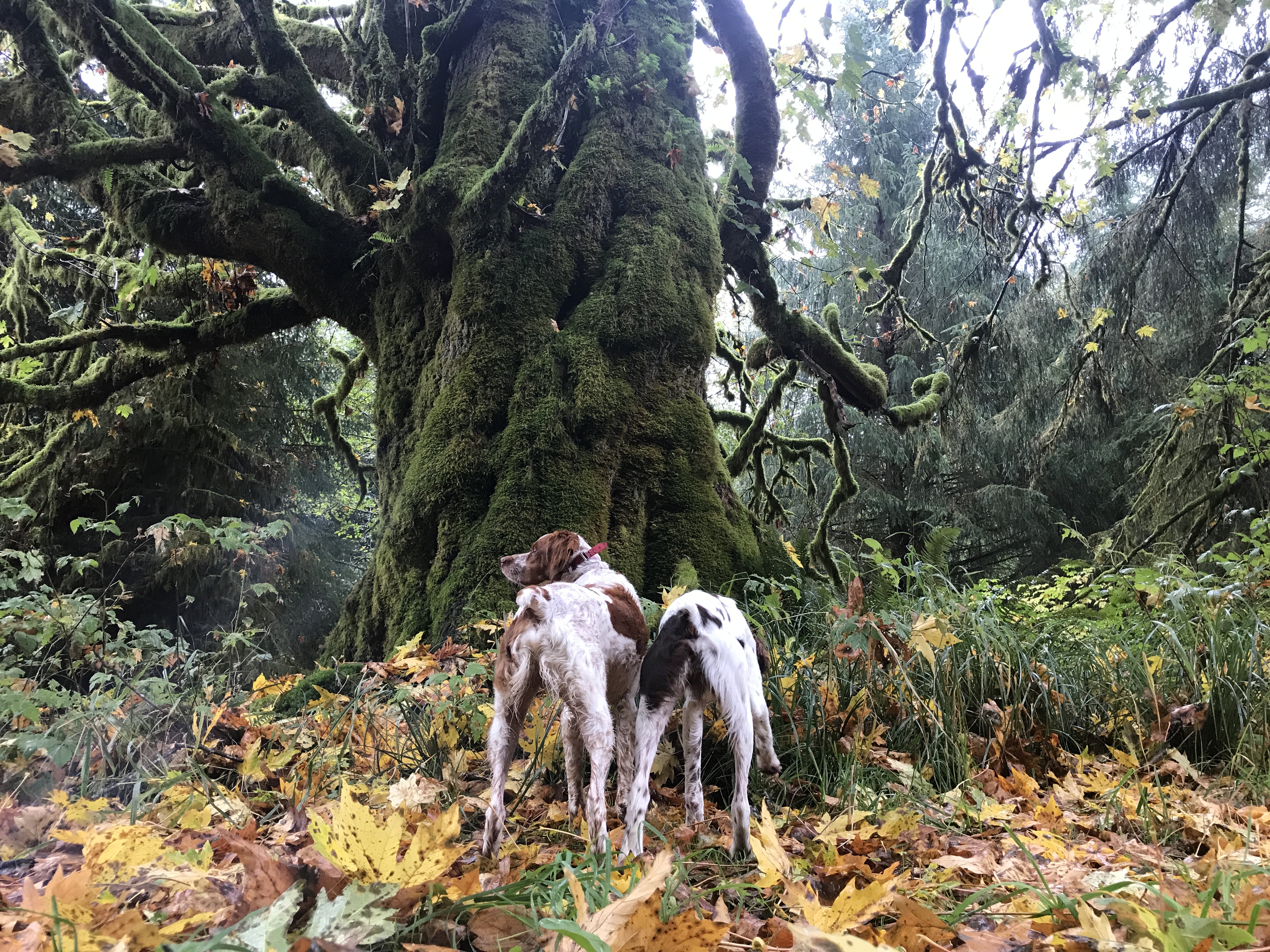
    This past summer in-between home improvement projects and the many trips to Home Depot and shopping two hours away we took the dogs out exploring and we’ve found some logging roads so the dogs can run off-leash. These roads start at sea level and head up into the coastal mountains forking, intertwining, with dead ends and roads you can see on maps but they don’t exist anymore or have gotten so overgrown you can’t find them. In this part of the Olympic Peninsula where tall Sitka spruce, red alders, and Douglas Firs grow thick, they have provided a nice canopy to get out of the rain; but sometimes the precip smothers me, so I’ll seek out the huge clearcuts in the forest where I find solace and familiarity like the wide open spaces back home in Idaho.

    Bloom is almost 7 months old now. He’s turned into a beautiful dog with long legs and a show dog gait that when he runs reminds us of his great uncle Angus. He moved here with us when he was 8-weeks old and has only known the rain forest and the smell of ruffed grouse and the chukar wing that he chased around the backyard before pointing.

    Bloom and the Salish Sea

    We’ve been out looking for birds but grouse hunting in the rain forest can be a tricky proposition we have found out. Besides being steep and wet, it’s so thick of sword ferns, brambles, and tangled deadfall that when the dogs do occasionally find a grouse, trying to get close enough and into shooting range before they fly is next to impossible. I thought many times about just shooting my shotgun into the air to see what kind of reaction Bloom would show.

    Grouse hunting in the Olympic Peninsula
    Solace in the wide open clearcuts

    We all carry a relationship to land and to the place that we call home, or in my case the place that I used to call home and that is or was part of my identity. It was what molded me. The pull back to the place where I felt connection through nature and place was too strong to resist, and like a salmon heading upstream from the Pacific and back to the place it was born, I felt like I had no choice but to go. I said goodbye to Bob as he headed off to school one day and loaded up the dogs in the pickup and headed East and to a place where I knew Peat would find birds for Bloom.

    After eight hours of driving the landscape around The Dalles, Oregon changed from emerald green to brown, dry, and parched. A few hours after that when I finally got down into the canyon and to familiar places that had green shoots of bunchgrass growing back, cattle were now covering the hills and grazing it and eating all the grasses down to the nub that would — if they’d live — provide cover for the birds. I was sick to my stomach because of the overgrazing.

    My excitement and happiness being back to familiar surroundings was taken over by my anxiety and fear of going hunting alone with no cell service and I worried about everything that could go possibly wrong in taking a puppy hunting chukar for the first time. Things that went through my mind were, what if Bloom gets lost, gets torn up by barbed wire, bitten by a rattlesnake or falls off a cliff or his pads get ripped up from the rough rocks. My worst fear was what is he’d be gun shy or he he’d be a jerk and blow through every one of Peat’s points.

    Bloom and Peat on the chukar hills

    It was mid-afternoon when we finally arrived to the place where we parked and I put the collars on the dogs and took my shotgun out of its case and headed out. It felt great to be out of the pickup after the long drive. Within ten minutes Peat found some birds and when I got up to him he was in his classic Peat point which is almost comical but beautiful at the same time. Bloom caught up to us and seemed oblivious of what Peat was doing. I wanted to yell at him, “Look at Peat, back him!” Bloom instead was intensely smelling the ground and running around, and then he ran right through the covey of Huns that were hunkered down near some sagebrush. I lost my cool and in my frustration didn’t get a shot off and instead watched the birds fly away. I watched Bloom watching the birds and it was almost like he realized that we weren’t out for just a hike but we were actually hunting. It dawned on me that Bloom only knows rain forest scents and had never smelled Huns before, in addition to all the other smells of the High Desert. On the next couple of coveys of chukar and that initial group of Huns that Peat would eventually relocate, Bloom honored him. I was so relieved. Bob assured me before I left that Bloom is going to be good. He was, and nothing bad happened.

    After the hunt, I found a dispersed camping spot and I watched the sunset over the Wallowas. I could see in the distance the mountains and ridges that I’ve covered on foot, hundreds of miles over the past ten years with Bob, Angus, and Peat and know like the back of my hand just like the serpentine road back home in Neah Bay.

    Home

  • Dreams

    Dreams

    I can’t imagine being an insomniac; sleep has never been a problem for me. Almost every night like clockwork Bob wakes up around 2:30 or 3 and turns on the bedside lamp and starts reading a book and will read for at least a couple of hours. Most nights, I’ll wake up, glance at him and roll over and go back to sleep, but last night I woke up and stared at him in the glow of the light. I squinted to see what he was reading because it’s usually something different each night. He was reading a book of poems by Wallace Stevens. He turned off the light and said, “I remember the poem.” I said “What are you talking about?” He then started reciting the poem out loud and it ended with the words:

    Of the January sun; and not to think
    Of any misery in the sound of the wind,
    In the sound of a few leaves,

    Which is the sound of the land
    Full of the same wind
    That is blowing in the same bare place

    For the listener, who listens in the snow,
    And, nothing himself, beholds
    Nothing that is not there and the nothing that is.

    I whispered to him so that I wouldn’t wake up Peat who was nestled in between us still sleeping. “That’s a really lovely poem, thanks for sharing.” I tell him goodnight for the second time and I toss and turn and try to get back to sleep and start thinking of frost, the boughs of pine-trees crusted with snow and junipers shagged with ice and spruces rough in the distant glitter. I start thinking about how much I miss being on the mountain, so I start retracing my footsteps, my path up and down, one slow step at a time, the upland version of counting sheep I suppose, and think about a season that went by so fast that it almost seems like it never happened. I turn over one last time and reach over to stroke Peat on his back. I can hear him sigh, and then I fall asleep and start dreaming.

    I dream of zigzagging through miles of golden bunchgrass, lichen covered rocks, and dense Antelope bitterbrush and sagebrush forests so thick where sometimes I’d lose track of Bob and Peat. I dream of traversing huge wide open landscapes and the unknowable vastness of it all, and creeping across steep scree slopes while trying not to slip, and how it always seemed that Peat would point on just the other side of a barbed wire fence that I’d have to cross over or crawl under. I dream of those hot and smoky and super dry early season conditions where I ran out of water a couple of times and that covey of chukar that busted wild over my head and we didn’t even know it until we got home and saw the photo. I dream of borrowing beautiful young Custer and how much fun and exciting it was to hunt with two dogs again and also to hunt with Peat’s dad, Sioux, the Mouritsen family, and other Sunburst Brittanys.

    I dream of trudging through knee-deep snow covered with hoarfrost just to get to the top of the ridge and not finding any birds after all the hard and painful work just to get there. I dream of those staunch points and retrieves, and missed shots because my fingers were so bitterly cold to the bone that I couldn’t take the safety off when the birds busted. There is also in my dreams that somber exhilaration when everything finally does come together. I dream of Bob finding a matching set of deer antlers that are such an amazing part of nature, and on another hunt seeing a Peregrine Falcon cruising overhead just before it swooped down and carried off that chukar Peat was pointing. I dream of hunting in late November when the sun sets so early and seeing the pink alpenglow on the distant mountains and how I was so happy and relieved, still over a mile from the pickup, that Bob was the one who’d packed a headlamp in his hunting pack .

    I dream about busting through the thick brush in a deep draw and being tripped, tangled and caught by brambles and branches, and on so many hunts in December and January sliding on my butt on the icy, slick, and muddy slopes and watching Bob do the same thing.

    I dream about the old rattlesnake skins on the mountain left behind like ghosts. I dream about those yellow shotgun shells Bob so lovingly made for me with just a wee teaspoon of Angus’s ashes carefully put inside each one so I could spread his ashes in all of my favorite hunting spots. And the favorite thing I dream is how, just before going to sleep after a day on the mountain, the sweet but spicy and bitter smell of sagebrush lingers on Peat’s fur and which I inhale when I kiss and bury my face in his head and neck.

  • Weathering the Storm

    Weathering the Storm

    Moving forward. Going backwards, uphill, and slowly descending.

    Last hunt of 2020 for us was yesterday, I followed Bob around the chukar hills just like the old days. Camera in hand. No shotgun. Winter is my favorite time to be out there. It’s quiet.

    Following tracks of ghosts of deer, elk, and birds. Detective work. Bob whispers to me, “I think they were just here.” I look down to examine the prints in the snow. Tiny dog tracks are heading upwards, the lone elk is going downhill. We keep going up.

    We continue to follow Peat. He’s pointing 185 yards away. We look up to see if we can see him, snowflakes are gently falling to earth and into our face. We climb the steep ladder to get to him. He’s focused, patient, and won’t even look towards our direction but knows we’re finally there. His job is almost done.

    The covey busts, Bob shoots, Peat retrieves. Beautiful dog work. Magical. We continue this sequence a few more times finding new coveys and relocating old ones. The dense fog started to come up from below and the snow fell more heavily. We were dressed for the elements but the ground was getting slippery so we decided to head back to the pickup. Bob tells me, “Be careful on the downhill.” We headed down the same ridge we came up and our footprints, Peat’s, and the elk’s had vanished underneath a fresh dusting of snow.