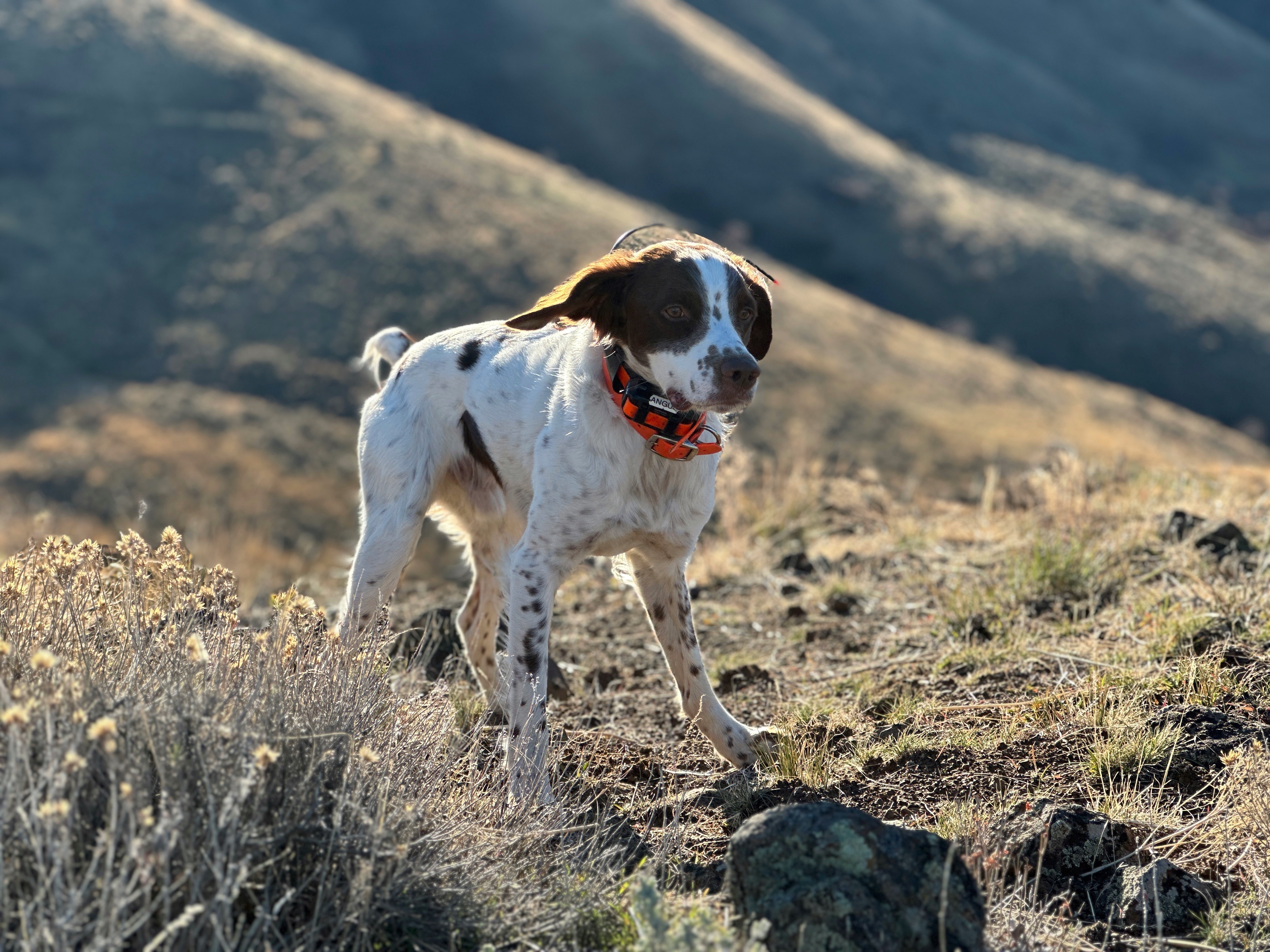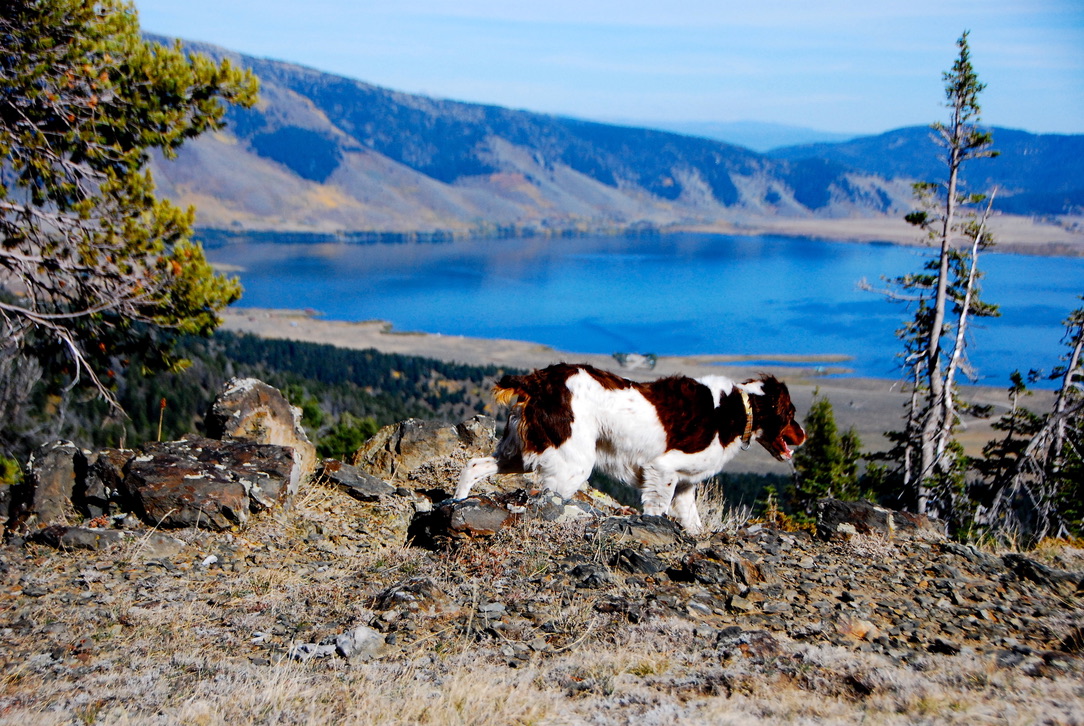
Grouse in Idaho opened two days ago, so we decided on our initial attack today. Today’s high is supposed to be 96. It’s been hot, and smoke from a new fire near Cascade has choked our valley thickly after a brief teaser of a few clear days. The hills are parched and the trails talcum. Visibility is solely conceptual. But we left early, undeterred and — speaking only for myself — brain dead.
This is the time of year I never seem to remember much. My excitement to get out with the dogs and the gun always seems to occlude the simple memory of years of early September disappointment of getting out with the dogs and the gun.
We walked for a while on an old road that was supposed to be closed, but which vehicles had simply gone around the locked gate; onX and the USFS map show these places as non-motorized but in reality it’s a crap shoot if people comply. ‘Merica.
After a bit, the dogs reached Pole Creek and we heard the first grouse bust of the day. My heart quickened. When we reached the tiny creek, we saw the typical nuclear winter of cattle. See the video. Or don’t. You’ve seen it before, I’m sure.
The dogs busted a few more grouse but my heart had left the station.
Remind me next year to read this post before I go grouse hunting again.
Thirty years ago I spent a month in Turkey. Erika had invited me to join her, and initially I thought it was a bad idea. I’d been chronically depressed and my therapist worried something bad might happen and trigger a personal catastrophe way over there. But I decided to go, and the thought of being in a different place began feeling more and more exciting.
Erika and I shared the same birthday, hers being a year after mine. My oldest friend introduced us, thinking we might like one another. We dated for a while, but by the time she invited me to join her in Turkey things had cooled into a state I thought was undefined. Plus, she’d been gone a while.
Hardly a day has passed since then that I haven’t thought of that trip. Talk about formative. Talk about memorable. I’ve been blessed with more than my share of stellar travels, and I think about many of those a lot still, too. But the trip in Turkey with Erika has stuck with me more than any other, and I’m not sure why.
I’ve been thinking about it lately in terms of chukar, probably because the season’s almost here. Erika and I traveled to the eastern part of Turkey, at one point taking a fairly large risk traveling in an unmarked Turkish Army van into Kurdish territory near Armenia. Traveling through landscapes that — later — Hells Canyon would remind me of, I had never heard of chukar but am sure — now — that I had to have been looking at their native habitat.
That van ride sticks with me. Over-filled with soldiers, who chatted nervously the entire several-hour trip, I understood nothing of what they said and was almost glad about that. Kurds had bombed a number of Turkish military vehicles on that road in the previous couple of weeks. Erika, the only female on board, was nearly fluent in Turkish and talked with some of the men. Straight-faced. I sat on someone’s lap and watched.
But we got to our destination safely and spent a couple of nights with a group of Kurds near Mt. Nemrut. Music and dancing at sunrise on a mountain top built by a vainglorious king in 62 BC.
Erika with Kurdish friend on Mt. NemrutSunrise on Mt. Nemrut
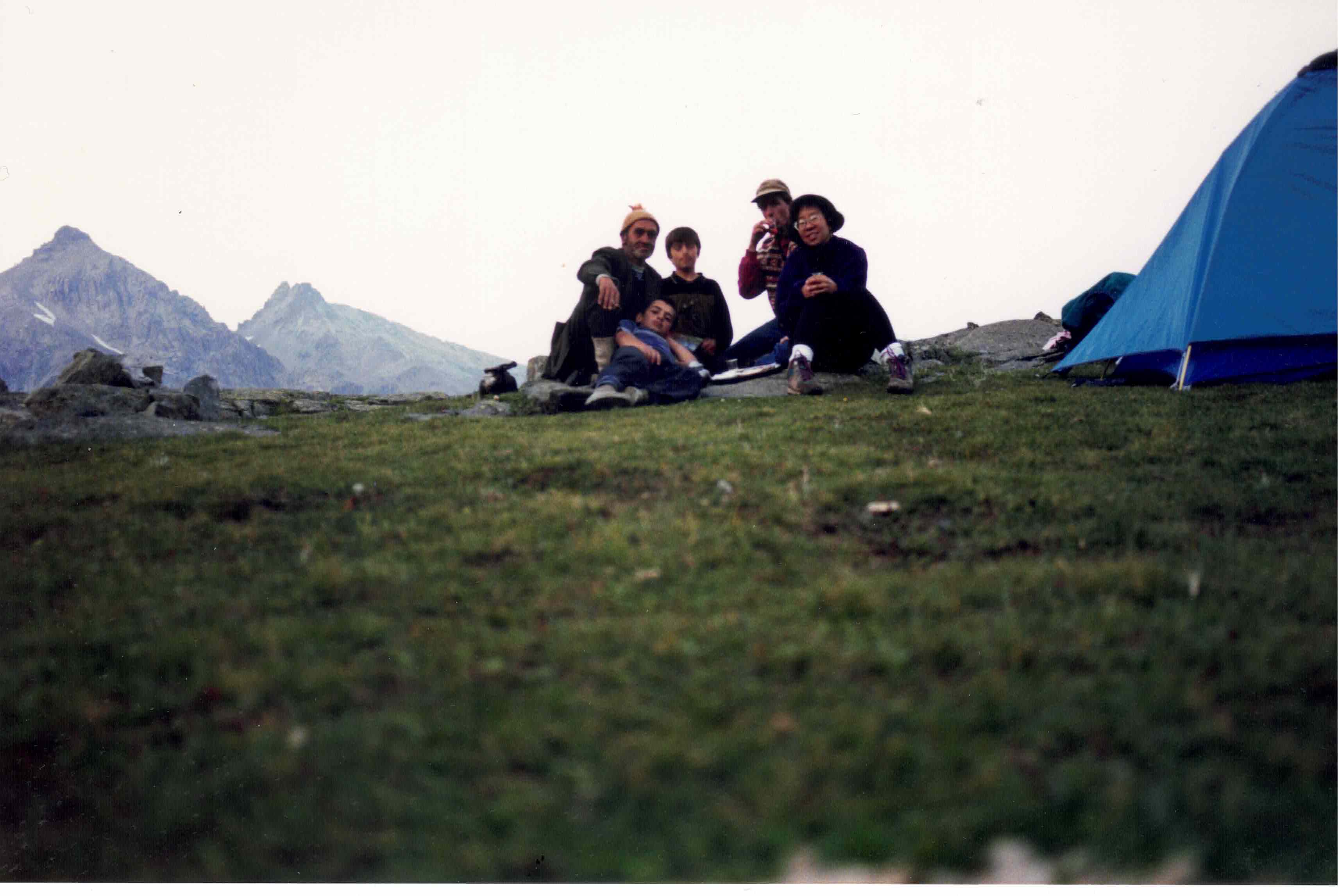
Nearly everything we experienced on that trip was suffused with intensity for me. A hair-raising “cab” ride to a medieval ghost town on roller-coaster roads littered with sheep, one of which our frustrated Indy driver plowed into at high speed. A complicated, multi-person negotiation by Erika in a little town over what we needed to do to get to our hostel a few miles away. Having tea brought in a samovar to us on a silver tray by shepherds at a high mountain lake after they set up our tent for us, realizing we were beyond exhaustion. Getting lost in dense fog on a mountain peak the next day, afraid we’d perish there until we ran into a French mountaineer on a mission. Listening to Arif Sağ for hours and hours over the PA on a cross-country bus trip, not believing my ears. Somehow I got Erika to find out whose music that was. Some of my chukar videos on YouTube use Sağ’s music. Erzurum.
The chukar hills of ErzurumMountain shepherds with Erika and me in the Little Caucuses (before we got lost in the fog)
Language has a lot to do with this intensity, with the adhesive quality of this trip’s memory. Communication. Until that trip I’d never been — and haven’t since — in a situation where I couldn’t communicate easily most of the time. English wasn’t common in Turkey, especially in the east, and Erika spoke five languages. I relied on her for everything. Movement. Nutrition. Lodging. Fun. Analysis.
Which suggests something that looks like a trend, a fortunate one, in my life: trust in women more capable in important ways than me. I was raised from age five by a single mother who’d become a schoolteacher after her first marriage so that she could provide for her two boys. She wasn’t affectionate or textbook nurturing, but she was solid and I relied on that (she’s grown to be more affectionate with age, which I feel lucky to witness). In graduate school, I chose the one woman among my four advisers to direct my dissertation because I trusted her the most in terms of communication. The best boss I’ve ever had — my principal for the first three years I taught high school in Cambridge — was a woman, by far the most competent, fair, and reliable professional I’ve ever had the luck to work with.
And so Erika. Soon after we met she revealed to me that a few years earlier she’d been hit by a car during a century ride on her bike, and that the majority of major bones in her body had been shattered. She’d spent a long time in the hospital. She said this matter-of-factly as she showed me some scars and her gnarled collar bones. After our trip to Turkey, we became better friends than lovers, and she continued developing her career as an agricultural economist, traveling all over the globe but also coming home frequently, often from the other side of the world, to do her share of care-taking for her cancer-stricken mother. I visited her in Mexico City, where she’d moved for a while and had a comfortable apartment. She spent a week or two with me and another friend at our cabin in eastern Idaho, fly fishing, hiking, and mountain biking.
For years afterward, every August 26th she’d call me to wish us both a happy birthday. She did most of that kind of friendship tending, I’m ashamed to say. Once, for my birthday, she sent me a “Fly Fish Mongolia” hat from Ulaanbaatar where she was studying wheat farming. And she’d call me on that day no matter where she was, her voice joyous and always winningly sly, a soft laugh ready to pounce. Then, a year or two went by and I realized I hadn’t heard from her in a while. I did an Internet search sometime around 2010 and learned she’d passed away in 2008 from a long battle with ovarian and breast cancer. In all those phone calls she’d never once mentioned she was sick. Aside from the shock, reading her obituary was strange for a lot of reasons but one was how little I’d known about her. She was much more accomplished than I’d ever realized, which is saying a lot because — despite her definitive modesty — I always felt lazy and unremarkable around her, not from anything she did or said but simply from comparing our calendars. She was always heading somewhere far away to do something important. I was just hanging out, trying to pull my head out of my ass and finish my Ph.D.
44 is too young. I can’t help but feel Erika was cheated. I’m still alive and have the tremendous luck to feel grateful our paths crossed. We all take too much for granted, but it seems that at least one measure of greatness in someone might come from an ability not to take much for granted. It exhausts me to imagine how that’s possible, how such people not only exist but prosper.
I ran into a friend the other day who gave me crap for not posting anything for a while. I appreciated it.
This used to be my favorite time of the bird season. Not as many people to contend with. Peace and beauty of a remarkably different quality. The “certain slant of light.” Snow concentrated the birds into predictable places, and they seemed to hold better.
Now I just feel sorry for the birds and don’t have the heart to bother them. Big snow Januarys, along with very cold air and lots of wind make it hard to find bare ground and food. Their will to live far eclipses mine. I’m not sure if chukar do this, but I know ruffed grouse spend a lot of the winter in snow caves they make, which shield them from wind and much colder temps than if they were out walking around or roosting somewhere. My dogs smell them through the snow, and they’d point them and bust them, giving me another chance to miss (if it was before the end of the year; they still point and bother grouse in January). To me, that’s not fair chase.
Being back in galliforme country this year has been wonderful. Our two-year remote yearn, idiotic as it was, helped me appreciate the good days we can get in the field here. And we got plenty — not as many as we’d hoped, but they were almost all good days. And we’re older, which should equate to more patience somehow, although — for me — it’s debatable (especially if you ask Leslie; some things do never change). The worst thing about feeling our season is done is seeing how pent-up the dogs are. But they’ll get over it. I have more things to do than they, so it’s not as hard for me.
We aim to enter next season in better shape than we did this year. For some reason, we failed to get chukar fit by mid-September. Too much golf? Just lazy? Still, we hunted into chukar shape and were able to do some tough hikes. We haven’t practiced getting old, so feeling we are old is odd. Something else to figure out. Or just accept. I’ve been keeping busy trying to get my first real estate client (hasn’t happened yet), writing a bunch of stuff, including a short novel set in chukar country which I haven’t been able to get anyone interested in yet (not surprising, but I like it and think it’s good).
I’ll end with this because it’s been on my mind all season: I’ve noticed more boot-prints in places I never used to see them, on ridges far from anywhere a UTV can go, which means people are spreading over more chukar terrain. I think that’s great. Get out there.
“Maybe we fear that the work we depend on images to do for us — the work of immobilizing, and therefore making tolerable — will be undone if we throw the image back into the flow of time.” — T.J. Clark, The Sight of Death (8)
“I think we hide, necessarily, from an understanding of what is most to be avoided in the sight of death.” — T.J. Clark, The Sight of Death (227)
What is the “face of death”? We’re in a sport that makes us face death whenever we’re successful. And instead of shying away from it, discomforting as it might be, we photograph it, and most of us post the photos for others — friends and strangers alike — to see.
Why do we do this? Where does our current publicization of this taking of life fit on the continuum of monumentalized, frozen-in-time death? If T.J. Clark is right (and I’m inclined to agree with him, except maybe for the “necessarily” part), we take and share these photos of our kills both to acknowledge and avoid understanding what we’ve done. I have to think there’s something in our DNA that compels us not only to record the fact of our death-causing (and even death-gazing) but also to share it so we don’t have to think about it too much; McLuhan’s “the medium is the message” rings in my head. This compulsion might be limited to those of us outside the hunter-gatherer lines; even though we’re hunting, we don’t need to and neither have our ancestors for thousands of years. In fact, the compulsion might be because hunting isn’t necessary for our survival. It might be compensatory somehow.
I’ve written about Brightman’s Grateful Prey before, specifically how traditional Cree animal-human (prey-predator) relationships differ from those of Invader/Agricultural traditions (i.e., most of us who are not Native Americans or First Nations people). I’ve tried to fit the imagistic depiction of prey into the Cree system but can’t, nor does it fit in Hugh Brody’s account of Inuit hunting culture, which I’ve also recently mentioned. For hunter-gatherers, at best, static portrayals of a formerly alive thing are disrespectful. At worst, they’re like putting a curse on yourself. But that’s a different tradition, different culture than this. So let’s see.
Even without doing a thorough historical analysis, it’s fair to say that there are a couple major (let’s call them “Western,” as in Western European) traditions in how dead prey get represented. One, for lack of a better term, might be called the “Still Life Tradition,” and the other the “Hero Shot.” In super simple terms, “still life” images foreground the prey as objets d’art (removing, mostly, the hunter), and the “hero shot” foregrounds the hunter and/or his “achievement” (dead prey). I’m going to talk mostly about the Hero Shot, but I’ve included some fantastic “still life” paintings, too, mainly because they’re amazing (you’ll know why).
Classic Hero Shot: hunters posing with their alectoris prey, Spain, 2014An older version of the above shot, also in Spain, 1959Solo Hero Shot: 1937 photo of a young Australian bird hunter with his day’s take.A more creative Hero Shot, 1940s, Australia, by the same photographer as the above photo (looks like some sort of snipe)1912 Hero Shot, including dogs (no location indicated)1903 group Hero Shot, Nome, Alaska (ptarmigan)Still Life: Jan Fyt, “Dead Partridges with Hound,” 1647 Paul de Vos, “Hunter and Dogs by a Table with Dead Game and Fruit,” Flanders, 1640s or 1650s.Hendrik de Fromantiou, “A Still Life with Dead Partridge, Pheasant, and Hunting Gear,” Holland, 1670. View this full size for impressive feather detail on this perdix perdix specimen.Carstian Luyckx, “Gentleman hunter with his pack of dogs and hunting trophies,” ca. 1650-58, Belgium.John Constable, “Study of a Dead French Partridge,” circa 1830-1838. Constable was my favorite artist when I was young, mostly because of his romantic, highly detailed landscapes such as “The Hay Wain.” I was surprised to find this relative of alectoris chukar among his works.My favorite kind of Hero Shot, for the true hero of the affair, although he (the bird dog) has relied on me to do the killing, the middle part: he found it, I shot it, and he retrieved it.The Solo Bird and Hunter Hero Shot, on locationMy last “tailgate shot” (2017): to me, it’s appropriate that the drone I found sits alongside the chukar because I think it accentuates the undesirable “out-of-place-ness” of this type of image. I see a huge, distasteful imbalance between technology and nature here. Classic “tailgate” Hero Shot with dogs, hunters, and prey arranged with heads hanging off the edge of the tailgate. 2016. One of my favorite all-time dead-prey photos. Angus, who never stopped hunting is still hunting while Peat poses with a bird that came out of the conifers on an after-school hunt in a place I thought I’d only find grouse. Adding to the image’s dearness to me is the history of Peat’s initial reluctance to retrieve and radical, sudden change of course, becoming a flawless retriever to this day. It’s one of the purest gestures of reconciliation I’ve known, even though he’s “just” a dog and probably doesn’t think of it like that.4 years in the making: The Kid with his first chukar, after trying hard for most of 4 seasons with me, he finally got one (he actually got three that day). Doesn’t speak much for my guiding abilities, but a worthwhile Hero Shot.
Chukar hunting is hard, and bagged birds come at a price, whether it’s the calories you burned in the pursuit, the abrasions on your dogs’ pads, the pride you had to swallow when you couldn’t get up the hill to your dog’s stealthy point in time, or the axle you broke trying to get just a little farther up that nasty road. Lining birds up on a tailgate for a photo, with your amazing dog whose praises you’ve made a habit to sing and your best human buddy you’ve shared the challenge with, makes a certain amount of sense. This photo is not intended to say, “Screw these stupid birds, I’m glad they’re dead and I’m gladder I killed them.” It’s not meant to say, as the truly stupid saying about chukar hunting goes, “The first one’s for fun, and the rest are for revenge.” Rather, it’s meant to say, I think, “I respect these birds, love where they live, admire beyond description my dog’s singular flotation of the whole proposition, and am grateful for the opportunity to hunt them.” It says, “Chukar are beautiful, and a worthy pursuit, and I’ve hunted them fairly, ethically, and shot well enough to harvest some of them, who — I admit — gave their lives in exchange for all of the above.”
So, going back to T.J. Clark’s thoughts about these images of death, the faces we see probably daily (at least during bird season) of these multitudes of expired prey, I still can’t help wondering what we’re avoiding, “what is most to be avoided in the sight of death.” I do think something’s not being said here, whether it’s in the image or outside it, behind it, surrounding it. What, for example, really, is remorse? Pity? Sorrow? Projection? Reciprocity? Do those register? And, if so, since they’re all necessarily (aha!) irreconcilable (unless you commit suicide every time you kill a bird), where do they go, what do they do to us, what can we do with them? And how can we participate in a tradition (whether it’s a Hero Shot or a still life) saturated with adulation but based entirely on death that’s not our own, without avoiding something important? Is that possible? Does it matter?
On a very crass and basic level, what we’re doing is trying to connect (with others?) and using the death of birds to do so. Somehow, posting pictures of bird dogs pointing or of the sun rising beautifully over a ridge just doesn’t garner the same kind of response (or we think it won’t) from whomever we’re trying to connect with. The result rather than the experience. The bottom line. It used to bug me when I’d go back to work on Monday and the dudes who didn’t chukar hunt would ask, sincerely, “How many birds did you kill this weekend?” Once I answered, “None, but you should have heard the wind carry a slow sound in the hawthorn.” Connection aborted.
One of the loveliest poems I know is Robert Burns’ “Song Composed in August,” which situates bird hunting naturally in the middle of courtship:
Avaunt, away! the cruel sway, Tyrannic man’s dominion; The sportsman’s joy, the murd’ring cry, The flutt’ring, gory pinion!
Part of what I like about this is that it just puts it out there, this is what we do, they’re birds, they’re beautiful, and some of them, when we’re not trying to get laid, we kill. Chalk it up to “tyrannic man’s dominion” and the “joy” of sportsmen. We hear and see and might even be the cause of the murderous gore, and then get on with things. This, it seems, is exactly in the right cultural milieu. Harvest. Death isn’t really faced because it doesn’t have to be (as long as it’s not your own, and even then…). So, killing birds — and posting photos of them — isn’t the end of the world. Unless you’re the bird. I just think, aesthetically, that photos of dead birds look way better in natural settings (rocks, grass, dogs’ mouths) as opposed to tailgates or (the absolute worst) impaled on barbed wire. But that’s just me.
This will probably be the final post for a while about Hercules.
The town hall meeting called by Hercules Silver Corp last night in Cambridge was, unexpectedly, packed (I took the photo above before everyone had arrived). Hundreds of people showed up for what was, expectedly, a PR presentation by Chris Paul, CEO, and Chris Longton, VP of Exploration. I recognized many ranchers, teachers, and other community members in the crowd, as well as journalists, representatives from Idaho Wildlife Federation, Idaho Fish & Game, and Backcountry Hunters and Anglers. Judy Boyle, the 7-term District 9 Idaho House Representative from Midvale, began the meeting by introducing Paul and Longton, as well as the Washington County Commissioner for District 3, Gordon Wilkerson. Boyle, as seems to be her trademark in public comments, wasted no time criticizing the federal government, saying that the mining project was the first positive hope for the community since when “we used to manage our own forests, remember that!?” Then she handed the mic to Paul.
Paul began by calmly saying that he was glad to see so many people come out to learn about the project, and that he decided to call the town hall meeting to respond to lots of rumors he’s heard about what’s going on, one of which is that next year there’ll be 200 miners coming to town. “That’s not going to happen,” he said.
After Paul gave a long-ish review of the history of mining on this site, and some explanation of their scientific and exploration activities, Longton illustrated the mining process as a whole. He emphasized, repeatedly, that the project is in the exploration stage, the first stage of any mining project, and that it could take up to 13 years before it progressed to the design stage, which could take another 13 years before reaching the construction stage (Stage 3). He elaborated that the design stage (Stage 2) required detailed planning for the reclamation stage (Stage 6), which would remove much of the physical evidence of the mine’s existence. Paul added that present-day mining operations are required to bond for the reclamation stage, which prevents a lack of recourse for communities savaged by mining operations that abandon the mine, which is common historically. It was interesting to see Longton’s demeanor change during his part of the presentation from relatively calm to stressed and labored; I had the distinct sense that he was angry to have to explain all this. Then, during the Q&A afterward, he overdid the friendliness when answering questions. He came across to me as more volatile than I’d expect a geologist to be, which was in direct contrast to Paul, who — dressed to match the local code, in flannel plaid shirt, jeans, and a vest — stayed calm and understated the whole time. Sophisticated.
All of this talk about mining, of course, has nothing to do with what Hercules is doing, which is trying to find copper and silver so they can sell their rights to an actual mining company. Much of what they shared in their presentation was obviously to allay fears of the negative impacts a future mine would have on the Andrus WMA. During the Q&A that followed their presentation, many questions focused on the impact of a mining operation in the area. Since Hercules isn’t going to be doing any mining, they, understandably, prefaced their answers as purely hypothetical and speculative, but tended to downplay the potential impact. Where would the workers live? (A. They’d hope to hire as many as possible locally, but typically mining operations want miners to live on-site or close by.) What would happen to an already “messed up” Highway 71? (A. No idea at all; that bridge’ll be crossed if and when it’s gotten to.) What would happen to the Snake River? (A. No idea since we don’t know what kind of mine it would be.) Would it be an open pit or an underground mine? (A. We don’t know yet, but that based on how deep the copper is, it would probably be subsurface and therefore have minimal surface disturbance; Paul, who answered this one, of course didn’t say anything about the plethora of environmental and occupational hazards of underground mines.) How would public access to the site be affected? (A. For what Hercules is doing there won’t be any impact or limit on access for recreation, grazing, etc.) I know you can’t say, but what’s your best guess how long the exploration phase you’re doing will take? (A. You’re right, I can’t say, but if you’re gonna press me I’d guess 5 years.) Someone else asked how many drill rigs they’ve had up there, and Paul said they had three this year, and might add a fourth next year.
In my opinion, based on my extensive hiking up there this fall, Both Paul and Longton significantly minimized the impact on the site that their exploration has already had; Longton, for example, showed a slide of a huge drill rig whose footprint was bigger than Cambridge, and then contrasted it with a photo of their drill rigs, saying they could “probably fit 10 of them in this room.” Maybe not. The drill pads they’ve already made up there are sizeable for the area — at least 50 yards by 50 yards — but they didn’t say anything about the numerous roads they’ve bulldozed between drill rigs and storage areas. The two gated access roads into the site — Camp Creek and Grade Creek — have been noticeably eroded by the machinery traffic in the area, and the runoff and silt will no doubt end up in Brownlee Creek, Brownlee Reservoir, and the Snake River. No discussion of mitigation of this whatsoever.
And, of course, not a word about the principle on which public land is founded: multi-use. Mining rights trump all other rights in Idaho. But part of the site is on Forest Service land, so they were blurry on permitting, as well as the breakdown of state-federal land and the respective regulations. I’d prepared a list of questions, as did Leslie, but it was clear from the outset that Hercules Silver Corp’s objective was to sell their part of the project to the community mainly by emphasizing that they’re not doing much to change anything up there right now; they’re “just looking.” They knew a major hope in the community was jobs the mine might bring (which Boyle alluded to in her introduction), but they immediately downplayed that as an imminent possibility, and as something they wouldn’t be involved in anyway since that would happen only after a mine had been designed and when it was entering Stage 3 (Construction), which could be 20 years off if I understood Longton’s presentation. It struck me as ironic that Judy Boyle introduced the meeting by suggesting how promising this would be economically for “the community” (as if everybody wants the same thing she, and the mining industry, wants: to pull as much money from the ground as possible, regardless of the impact on the land). Of course, she’s just doing her part to smooth the way, which is why Chris Paul has expressed great admiration for Boyle. If I were him, I’d want to be on her good side (full disclosure: I’ve long been bothered by Boyle’s efforts to eliminate federal land in Idaho, the passage of her trespass law in Idaho, and especially her in-person support of Ammon Bundy’s violent takeover of the Malheur Wildlife Refuge in 2016. I’ve witnessed many times her uncivil responses to positions that don’t agree with hers; see, for example, the factually vague, gaslighting rhetoric she uses in a Boise Metro Chamber video dialog titled (ironically) “In Search of Civility” from 2021, especially in contrast with the other guest, Idaho legislator Ilana Rubel).
I talked with some folks afterward, and most had the same feeling I had: that it’s going to be a while before we know much, or before much changes. Hercules has the rights, and will explore — drilling and other research, including the geophysical stuff that all those high-voltage wires were for, about which at one point either Paul or Longton said, “You didn’t see piles of corpses anywhere near those wires” (I wondered if this was in response to my complaining about it in my previous posts) — for at least another year. One person I talked with, who runs a natural resource business in the area, said that if a mine goes in and they hire locally it will be tough if not impossible for him to hire any employees, as it will for other businesses in the area that can’t pay as much as the mine would. Several people I talked with afterward had the same concern about the non-economic impact on the public land: its importance for big game, upland game, and outdoor recreation. But one thing’s clear: if Hercules finds what mining companies feel is worth digging for, it’s going to happen, and they’ll do whatever necessary to make it happen. Whether the community will benefit in any way is anyone’s guess, but — unless Hercules pulls the plug because there’s not enough there to sell — it’s not an if but a when. Maybe I’ll be gone by then.
It’s obvious I’m against this project 100%. I know that’s hypocritical in an absolute sense because we all depend on the metals they hope to find here, and they’re apparently in short supply (I’m not sure this is true, but they said so). My defense against my hypocrisy is that not all mining areas are in places that were originally private lands which were purchased and donated to a public entity specifically for wildlife conservation. Elk hunting, for example, is big business in Idaho but also an important part of life and local tradition in the area. The vast majority of elk killed every year nearby spend winters on the Hercules site. Some local hunters (many of whom are ranchers) have expressed concern about the negative impact wolves have had on elk numbers and harvest rates (the science on this is ambivalent at best); but if the Hercules site becomes a mine (even a subsurface one), that winter ground will be unavailable to elk and they will disappear from the area (as will all other access, recreational and cattle-related). No science needed to know that fact.
Another layer of irony here is that Hercules and its major investor (Barrick Gold) are Canadian companies; Paul said he was from BC and it’s over-explored, and (in the podcast I linked to in Hercules 2) the Canadian government was a pain to deal with, especially compared to Idaho. Idaho prides itself on its natural beauty, but when it comes down to it its legislators will sell it if they can.