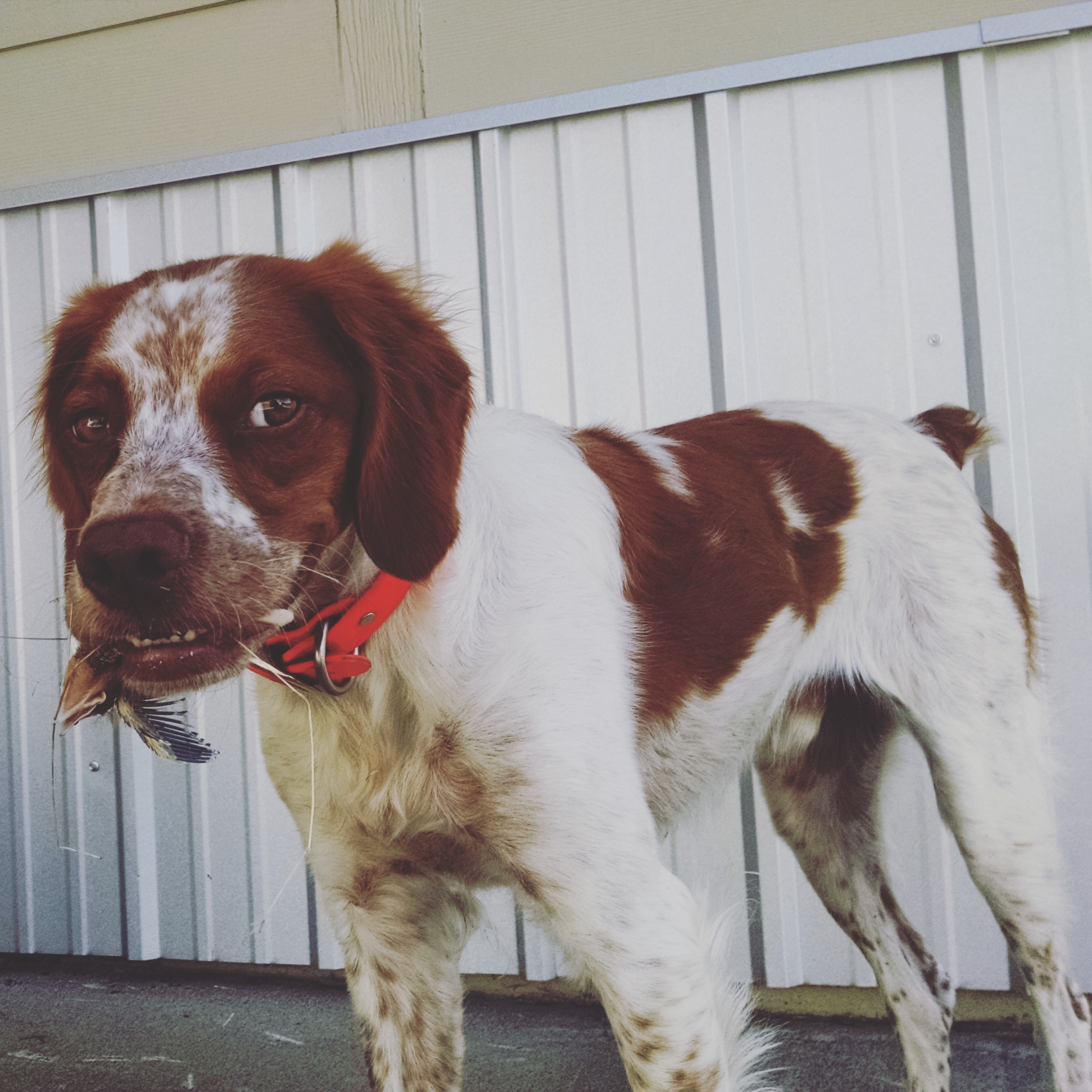
Peat was ten years old yesterday. Aside from upping his counter-surfing game, he hasn’t changed much from Day One. Instead, we have. It might explain why we have no friends, but I’ll take that trade any day (now). As some of you probably remember, it wasn’t like this at first. I still think of the four-inch hole I put in the bedroom door in Cambridge from throwing a bone at him in madness and hitting the door instead. I came very close to re-homing him. It goes without saying, but I’ll say it anyway because I love him so much: I’m glad I didn’t.
Happy birthday Crazy Eyes, Peat, my baby.
Here are a few photos and a video I made of him a while back.
Anyone who hunts birds knows heartbreak, if only because most of us have been through dogs. The best of them last a quarter of our lives at the most. So we watch them come and go. And then there are the birds. And the land. Innocence. You know what that’s like.
I’ve been trying to learn a new instrument, the Irish pipes. They’re called “uilleann” pipes (pronounced “ILL-in”), which is Irish for “elbow.” You use your elbow to pump a bellows which fills a bag under your other elbow with the air you need to resonate up to 7 reeds. Then there are 13 keys you play harmonies with using your wrist and thumb while your fingers play the melody on a 14-inch tube with a finicky reed. It’s far more complex and insane than the Scottish pipes, which I’ve played since 2007 and had previously thought was the most ridiculous instrument ever invented. This instrument puts Ireland’s association with drink in a new light.
Irish music, like the people coming from that small island, is known for its ferocity, its speed. It’s lesser known for what, in my humble opinion, are its much better but heartbreaking slow airs, tunes we Westered mortals might call ballads. Most of those come from old poems or stories, and nearly all of them have Irish titles: Táimse mo Chodladh (I Am Asleep), Port na bPúcaí (Song of the Faeries), Éamonn a’ Chnuic (Ned of the Hills), An Raibh Tú ar an gCarraig? (Were you at the Rock?)…
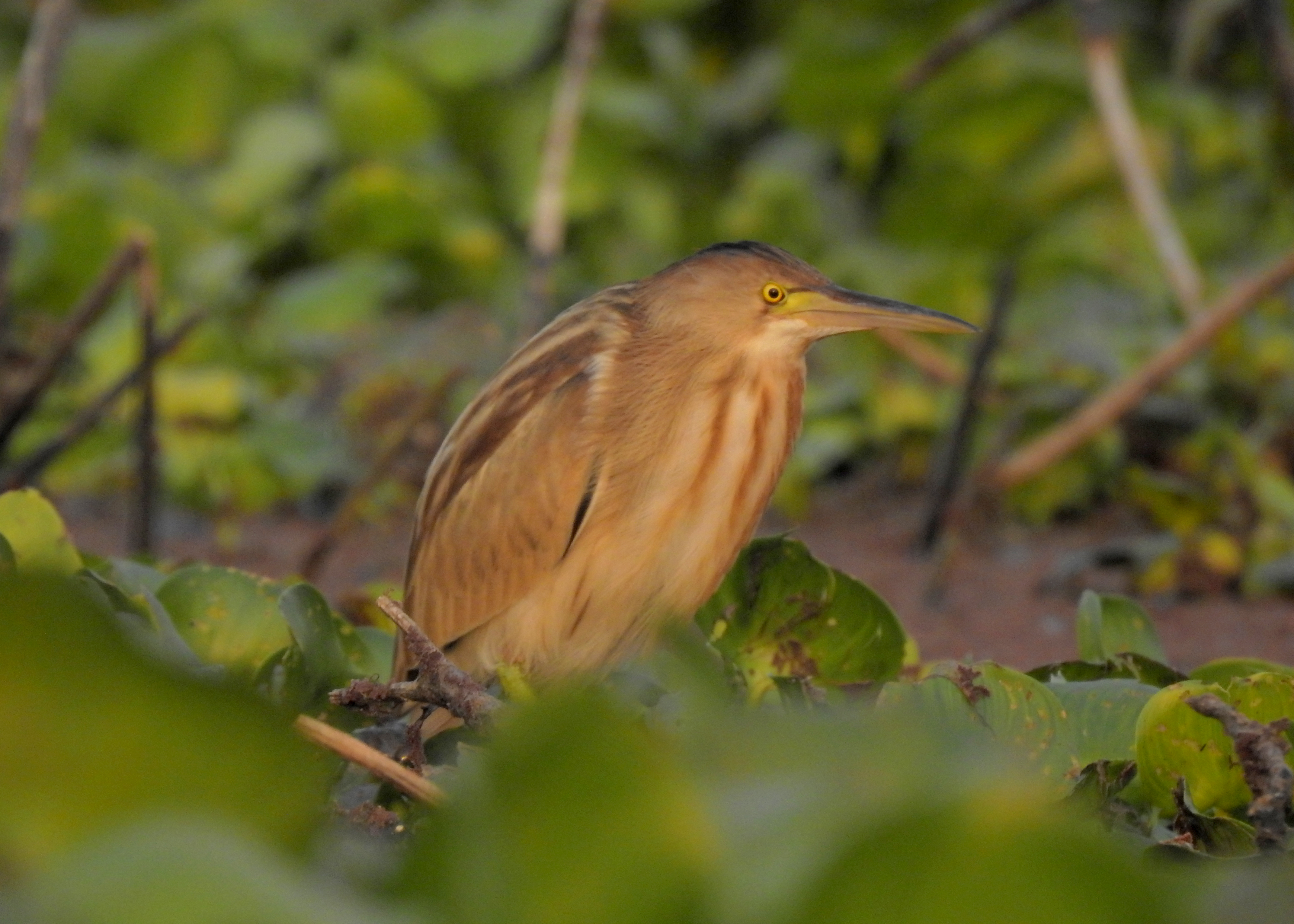
An Bonnán Buí (The Yellow Bittern) asserted itself for some reason today. Maybe it was the weather, or the news, how can you know? It’s been a common song over there for a long time, and without getting all musicological on you, I’ll just say it oozed its way into me somehow today. I’d heard a bunch of versions by my favorite players (thanks, YouTube). Everyone does it quite differently, and I’d decided I needed to learn it. I have the printed sheet music, but it didn’t even closely match any of the far better versions by Chris McMullen or Cillian Vallely or Liam O’Flynn. So I picked one (McMullen’s), and started memorizing it. There are two phrases, and it took about an hour to get the first under my fingers. And then I realized there was something more I didn’t know.
I looked up the tune, and learned it’s after a poem from the early 18th century by an Irish poet called Cathal Buí Mac Giolla Ghunna. He was an admitted drunk, and this — his reputed greatest work — was about his struggle with alcoholism. He’d happened, in winter, upon a yellow bittern that had died of thirst at the edge of a frozen lake. Like most good poems, this says a lot with very few words. Seamus Heaney’s translation of one of the later stanzas:
I am saddened, bittern, and brokenhearted To find you in scrags in the rushy tufts, And the big rats scampering down the rat paths To wake your carcass and have their fun. If you could have got word to me in time, bird, That you were in trouble and craved a sup, I’d have struck the fetters of those lough waters And wet your thrapple with the blow I struck.
In the end, the poet decides that — even though his wife desperately wishes he’d quit drinking — he can’t give up drink because he knows that when he dies he’ll get no more.
I was a music major in college, at first, anyway. One of the first things I learned and have never forgotten is that “programmatic” music is a hoax: any music purporting to paint a specific picture is not only bad but should be avoided and, if you’ve got the time, you should talk shit about it. The professor’s point, I recall, was that music was better than that. It was ineffable. It said more than a simple picture could. That’s why it was important to pick it apart, dissect it, musicologize it.
When Chris McMullen or Cillian Vallely start playing this tune I see the dead bittern and my heart breaks.
Today is my brother’s 60th birthday. He emailed me some of his thoughts about why he’s probably going to stop fishing for steelhead, something he’s loved and done for a long time. Much of what he said reminded me, in very different ways, of why I think more frequently these days about not chukar hunting anymore.
We’ve been hooked on the web cam showing Shadow and Jackie, the 11- and 13-year-old bald eagles trying to raise chicks in a nest high above a lake in the San Bernardino mountains. Two chicks hatched a few days before the third egg, and that littler chick survived long enough to develop a large fan club before it died. No fault of the parents. The weather there has been brutal. We could see them live anytime, and often marveled at one of the parents — only its white head and huge yellow beak visible in a snow-mounded nest — softly covering the babies during a howling snowstorm. We watched Shadow and Jackie bring dozens of dead fish and coots and ducks to the nest, tear them up, and gently feed them to the little fuzzballs. Leslie said today, “Look at all the animals that died to feed those chicks.”
It’s hard to stay away from the news, even though it’s obvious to anyone with a heart that there’s nothing good there. Very much the opposite.
I needed to learn about the yellow bittern, its story, today. For some reason. I didn’t expect it to, but it made me cry. That made me feel more human than I have in at least 50 days. So I guess that’s a good thing about heartbreak.
More news this morning from Hercules, about a new lease they signed with the State of Idaho, encompassing for the first time the area on the other side of Highway 71.
Most of this land is on the Andrus WMA, and offered hunters and other recreationalists nearly countless opportunities to use the public land. Ranchers also have run cattle extensively in this area for generations; it’s unclear how their leases will be affected by Hercules’ expansion. Expect to see the same degree of closure to access there as on the other side of Highway 71 between Camp Creek and Grade Creek. Now the entire area from Middle Fork of Brownlee Creek Road all the way down to below West Fork Road will be open to mineral exploration by Hercules.
To anyone who’s read this blog, it’s no secret that this was our main hunting area. Now, with the charred remains of last season’s fires on the other areas we hunted nearby there’s nothing left within a day’s drive. What did we expect?
Hercules’ news release on the new leases highlights the benefits to Idaho:
“Under the terms of the lease, the Lessee will pay an annual rental fee of US$24,927, which will increase by 3% each year over the 20-year lease term. The Lessee will remit a 5% Net Smelter Return (NSR) royalty on any minerals produced from the leased area. To incentivize production, minimum annual royalty amounts are due each year, regardless of if the lease has reached production, starting at US$20,000 per year for the first five years of the agreement…”
I guess Idaho should feel lucky that Hercules will be contributing almost the equivalent of one full-time beginning teacher’s salary.
Over the years, I or Leslie would joke, one of us, usually me, “What is life?” The question, for me, which I shared at the time, years ago, with my wife, came from a recalcitrant student of mine. “Recalcitrant student” is basically the same, in my short career as a teacher, as saying that black was dark.
Anyway, Tony would sigh that while everyone was working on something, and I was “monitoring.” It took everything I had to ignore his question.
But it’s a good question. Even though it would recur as a joke, it quickly, to both Leslie and me (we’d admit later), would evolve into a sort of private needs analysis. What about ______? Did he really mean _________? They couldn’t have thought that ________? And, we all know, there’s no answer.
For game birds, the question is more basic, if asked at all, which most would say doesn’t happen. Ever. For those creatures.
Today was Christmas. There was the usual several-day lead up. Now I’m walking the dogs on the golf course, snow here and there, crispy, then some quiet wet grass, what will spring be like? Will the greens show snow mold? Probably. They didn’t spray them this fall, the morons. Blah blah blah. What a waste some thoughts are.
I used to love Christmas. Like most kids (I don’t actually know if this is true; it could just as easily not be), I’d get up earlier than my parents, sometimes conspiring with my sibling, and plot and hedge and wonder. I’d listen, too. That was private. Something never to be checked with the other. Shameful to admit that, maybe. Or maybe just claiming something like a moment for myself. Something before the deluge of waking up parents, of tinsel getting caught in bows and ribbons. Of scoldings, forgivenesses (because of Christ’s birthday) calculated agonizingly by the scolder, pecking orders chipped away at, families going at it.
Lucky to have had that, to have had all that. All that it was. Lucky not to have known it wouldn’t last. Unlucky to have realized, probably simultaneously, that it was over. When you don’t have your own children, there’s no surrogacy period, and we’re in about the 5th decade of disillusionment. Of course, if you do have children, there’s always the chance they’ll hate you; that’s the consolation prize we give each other when we’re scared shitless we’ll be too daft to know what to do when it’s too late. Or even that it’s too late.
So what is life? For me, for the past long while, it’s been two-thirds waiting and one-third chukar hunting and trying to make sure nothing falls through the cracks during that one-third. I think I’ve done a decent job at scribbling all that down. At managing it. At monitoring it. Maybe I leveraged that in my classroom when Tony was just, maybe, breathing an expression of boredom out loud. Or maybe he wanted someone to answer. Or maybe he was just playing the fool. As a brown-skinned kid, one of exactly two at our school, who suffered through (or at least sailed through) years of ignorance and bullying (“The Wall”), Tony became a flag-flying MAGA-phile. I see his truck and his flag sometimes there in town. And I’d bet he hasn’t a clue he impacted me in any way.
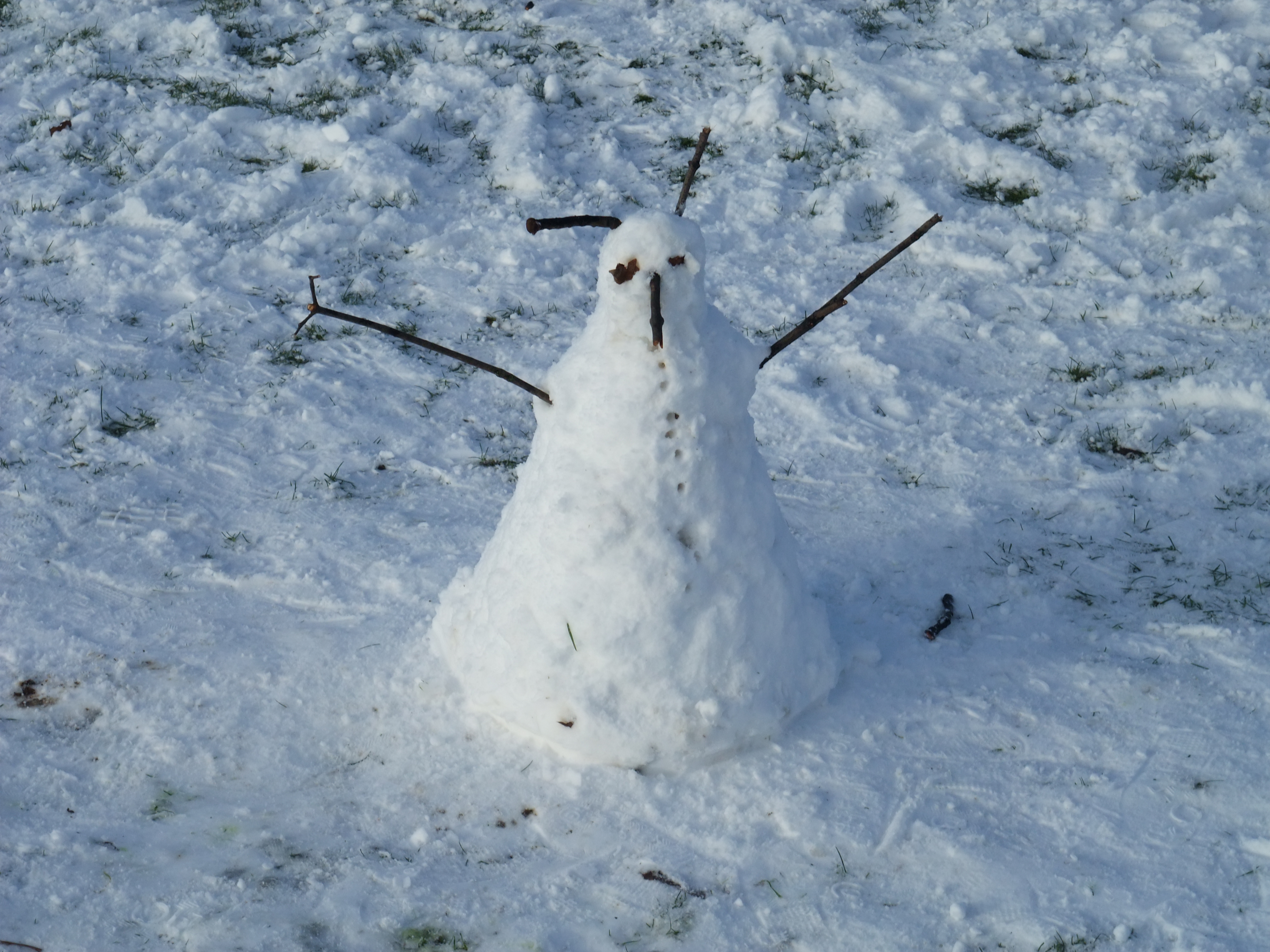
One of my proudest achievements as a teacher, mainly because of what the students taught me from the experience, was having Tony’s class read Robert Pinsky’s translation of Dante’s Inferno. I expected them to hate it or at least be bored by it. The opposite. That’s for keeps. Which makes me wish I’d had Tony and his class, all pretty recalcitrant boys who I’d genuinely come to love, read Wallace Stevens’ “The Snow Man.” I know Tony would have taught me a lot about the last few lines:
“…the listener, who listens in the snow, And, nothing himself, beholds Nothing that is not there, and the nothing that is.”
Ventured over for a hunt on what used to be one of my favorite spots in Hells Canyon.
We waited until the Hercules-Barrick “exploration” mining operation shut down for “winter weather.” The last two years, the one time each season we’d hunted over there was interrupted by run-ins with mining operations. All this on public land, land we pay taxes every year to maintain. Land that was given to Idaho specifically for wintering ground for deer and elk. Land that many people I know feed their families from the big and small game harvested from that public land. Land that ranchers I know used to run their cattle on in the summer. Land that is now torn up by new roads and heavy equipment.
Up high, where no motorized vehicles can go (or haven’t gone yet), we saw lots of birds and big game prints. Down low, where it’s pretty easy to get to, not so much.
Down lower, the signs. Of things to come, no doubt.
The gate at the junction of Camp Creek and Grade Creek roads, all on public land funded by taxpayers who are being told they can’t access their land.
It’s worse than sad to see something you love destroyed, and then to be charged for it, and then to be told to stay off of it. Idaho needs to re-work its ancient mining laws: if mining operations close or inhibit access to public lands, taxes should be reduced accordingly, even if it’s only a few cents. Remember the Boston Tea Party? Judy Boyle is not my representative. And Chris Paul, CEO of Hercules, is a Canadian whose business Canada has banned from doing things in his own country for numerous environmental and human rights violations. If they get their way, Barrick, an even more vile non-U.S. offender, will buy the operation and staff it with Peruvians. The local community won’t see a penny. And all this waiting for the deportation shoe to drop with the incoming “administration.”
We hiked out on Camp Creek, a road that used to be an old two-track terminating at a locked gate on Highway 71, one of the few non-motorized access points to the north end of the Andrus WMA. Now it’s a freeway for heavy equipment, with numerous drill pads excavated along the road. I used to finish great hunts reflecting on life and hunting and connections while walking down this road, and occasionally get interrupted by pointing dogs or busting coveys, bonuses reserved for epic days in the field. Now, it’s just anger, sadness, and maybe a few less savory thoughts.
This is a bad sign. Mining operations are required to have a “Storm Water Pollution Prevention Plan,” and Hercules-Barrick put this box and a contact phone number (with a Saskatchewan area code) at a place that nobody is supposed to go. The box was empty. I called the number, and got a “Call cannot be completed” message.