Author: Bob McMichael

  • Wife Dies on Chukar Hunt

    Wife Dies on Chukar Hunt

    I’m nervous about this, but there is a point. Let me get to it. First, neither my wife nor anyone else’s wife — as far as I know — has died on a chukar hunt.

    This whole thing started because some of my students learned I was a “YouTube” star (I disagree); for them, stardom meant having more than 100 subscribers to my channel (I have 3,000+), and a video with over 1,000 views (my video with the most views has over 1 million). They told me I should be getting paid for my videos, which I didn’t believe. But one of them showed me how to “monetize” them, and I’ve received a couple checks now from Google; I gave the kid $20.

    “You have to make click-bait videos! ‘Wife Dies on Chukar Hunt’!” We had a good laugh about their idea, and moved on to the riveting world of participial phrases. But they kept bugging me about it, so I started thinking it might be fun, just about the time I decided I’d had it with Instagram (I deleted my account last summer). So I never did anything about it. The season came, and I sort of forgot about it.

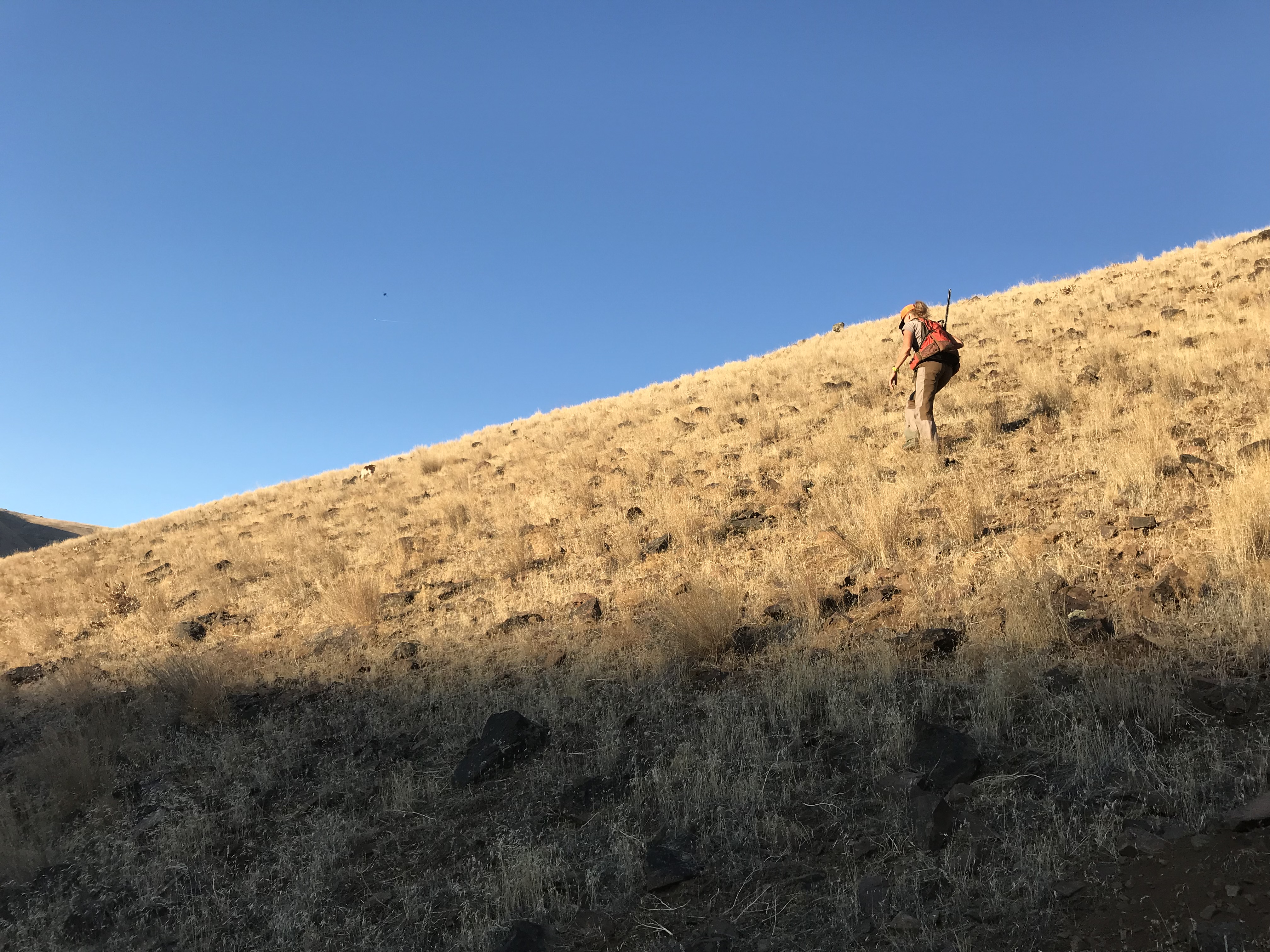
    Until today: looking through some of the photos of our hunts so far this season, feeling kind of ho-hum about the lack of moisture and the dry conditions and difficulty finding birds, I came across a 12-second video we staged with Leslie saying something about “dying” from hiking up a steep slope. So I took a few minutes and made a quick video, titled “Wife Dies on Chukar Hunt,” posted it on YouTube, and am now waiting to see what happens.

    I wouldn’t even have tried this if I weren’t concerned about the impact of social media on our world. My students’ lives seem to revolve nearly entirely around it. They all have smartphones, even the poorest of them, and — before we decided to ban smartphones at school — would be on them all day long. As cross country coach, I had to make very specific and precise rules about when and where my runners were allowed to use their phones.

    Social media has also invaded my little insulated chukartopia: before being persuaded to join Instagram (a cooperative effort by my students and wife, each with a different yet equally futile objective: students so they could stalk me, and wife to help promote this blog and its hat and shirt sales), I operated under the contented delusion that there weren’t many chukar hunters out there. But not long after joining Instagram, and a couple chukar hunting groups on Facebook, I quickly realized that, even during the off-season, the “pile of chukar on my pickup’s tailgate” photo was as common (to others; not me) as fake is to news these days. I felt naïve, and a little disturbed, both by my naïveté and by the existence of a genre of unselfconscious slaughter photos. This blog has featured its share of dead bird photos and videos, so I have no right to criticize anyone for sharing their accomplishment; chukar hunting is badass, and getting a limit is definitely an accomplishment.

    But it does bother me, I’ll admit. Part of it might be envy: I’ve only limited one time in the 18 years I’ve been doing this, and I did post a photo of it on the blog (it was a long time ago); I’m not a good enough shot, and not fit enough to hike long enough to find enough birds to shoot limits more than I have. But the other part of it, the part I think social media encourages (especially Instagram, with its ridiculous algorithms of self-aggrandizement), is definitely not something that even remotely represents what I find amazing about this pursuit. If anything, it highlights the thing I like least about it: killing. If there’s a trend in social media representations of chukar hunting, it’s that it’s more about that awful, disingenuous euphemism “harvesting” and not so much about the hunting, or the dogs. And I’m not here to say my way’s the right way — to each his or her own (although, this is my blog). I’m just saying that I find much more intriguing things in any given chukar hunt than the carcasses I can pose for a tailgate hero shot.

    The other thing I found extremely disingenuous about Instagram in particular, which led me to delete my account, was that it was a forum for false praise and very limited tolerance for honest exchange of ideas. Granted, it’s a photo app, but the comments on photos — unless the topic or caption was “edgy” — were unreflectively encouraging of slaughter as the primary objective of bird hunting. As long as the photos had some dead birds in them, they got lots of “Great job” and “Go get ’em, dude!” comments. I posted a photo of a private stream (the kind with water and trout in it) in England and linked it to the GOP assault on public lands in the U.S., and got no end of shit for it, which surprised me because — hello? — chukar hunting is a public land game. I mistakenly assumed my chukar hunting followers were down with protecting public land access. Apparently not. Partisan politics is alive and well, even in chukardom. Useful to get that learned.

    Which brings me back to “Wife Dies on Chukar Hunt.” In one sense, it’s a “If you can’t beat ’em, join ’em” thing. In another, it’s a (probably ineffective) parody of social media and the fact that even as noble and rarified an activity as chukar hunting is not immune to the depravity of our social-media-obsessed world. Enjoy, or don’t. I really don’t care. Really. And if you feel the urge to comment solely with an emoji (as someone did on a recent post), do yourself a favor and unsubscribe.

  • Poetry and Chukar Hunting

    Poetry and Chukar Hunting

    Sunlight lavishing brilliance

    Sunday, September Sunday … Outdoors,
    Like an early page from The Appalachian Book of the Dead,
    Sunlight lavishes brilliance on every surface,
    Doves settle, surreptitious angels, on tree limb and box branch,
    A crow calls, deep in its own darkness,
    Something like water ticks on
    Just there, beyond the horizon, just there, steady clock …

    Reading through some stuff for a school project, I came across a poem by Charles Wright called “The Appalachian Book of the Dead,” and some lines in it — because this is what happens sometimes when you allow yourself to read — arrested me and my chukar-on-the-brain-ness. The beginning of the poem, above, intersects with catalogs of my Hells Canyon chukar hunting memory. But it’s the end of the poem that really does it for me, brings it home in all the activity’s weirdness, struggling with the meaning of hunting and competing mortalities, the effort put into it, the miracle of motion, the season changes, and — mostly — the terrain…

    It always amazes me
    How landscape recalibrates the stations of the dead,
    How what we see jacks up
                                                      the odd quotient of what we don’t see,
    How God’s breath reconstitutes our walking up and walking down.
    First glimpse of autumn, stretched tight and snicked, a bad face lift,
    Flicks in and flicks out,
                                                a virtual reality.
    Time to begin the long division.
     
    Landscape recalibrating stations of the dead

    I feel like I’m constantly trying to answer the question for myself, “Why this?” Finding things like this poem, which I don’t “understand” really, helps articulate possible answers, and that’s satisfying. What are you searching for, not just when you’re out there, but — even more — afterward?

     
    I remember Charles Wright from the 1970s. He lived on a street in Laguna Beach next to one of my school friends, and he was a colleague of my dad’s at UC Irvine until he moved east to another university. I remember liking his voice and Southern accent, but it wasn’t until I started teaching English that I’d read any of his poems. I like how things come around in strange, boomerangy ways, paths crossing and getting reasserted unexpectedly, intersections which, if you have the time, notice themselves in you and amplify things you didn’t realize could be amplified.
  • Report

    Report

    Lucky to spend the weekend in Hells Canyon, and lucky to be able to hike in great weather in that awe-inspiring place. We didn’t find as many birds as I thought we might, but we found some. The lack of moisture has so parched the earth and all its vegetable accoutrements that it feels like walking on talcum powder. Springs, the ones I went to anyway, didn’t yield any good numbers (or any at all) of birds. They’re out there somewhere. We just didn’t find many, except very high, and scattered in ones and twos in rockpiles. It was, actually, good chukar hunting. The tarnish on all this, which gets worse each passing year, is the uncontrolled, rapid spread of medusahead rye. I wouldn’t be surprised if it’s completely taken over every surface in Hells Canyon within the next ten years. At that point, it will be truly unhuntable. So get out there and enjoy it while you can. We are.

    The light patches of grass in the background are medusahead, which wasn’t in this area just last year.

    All medusahead, crowding out even the cheatgrass

    Light-colored medusahead patches on the Oregon side are spreading, too.

    Peat retrieves one unlucky chukar

    IMG_0560
    I’m down there somewhere

    IMG_0554.jpg
    Just add water, then we’ll have something.

  • Chukar Fugue

    Chukar Fugue

    It’s this. I spent most of today’s hike weaving together phrases of future, present, and past memory fragments: stressing to keep up with the dogs through backlit bunchgrass on 45-degree slopes toward the water punctuated by dried cattle hoove divots; no concept of my identity but just a pursuit; no concept of the fact that I’m in an environment that’s not “usual”; the occasional, hysterical interruption of the sudden realization I don’t know where my wife is, or where I am, or where the dogs are, or — oh, yeah — eruptions of birds, unannounced, interwoven with the sky, lenticular wisps of clouds, glint of the barrel swinging, sun stinging my eyes on the miss, the diminishing blur of reddish tailfeathers, shadow patterns careening off puckering water, basalt outcrops, redlined heart-rate, heaving chest, butt on dirt and parched cheatgrass, a smiling dog with a matted feather stuck to his gluey gum wondering, “what now?”

    Ten minutes in on this second day of the season, after a gorgeous mistake yesterday, Peat bee-lined from the shore up a wee crotch of a draw and froze. Angus soon joined him and validated the point. Both held solid until I hoisted myself the hundred or so yards, and then they burst. It’s on the video, in slo-mo, even. I hit the first three, not even sure how many birds took off, then watched more waves of ones and twos going every direction, in the air, on the ground, in my memory. Fantasy start. We worked hard chasing them, finding new coveys, dogs going nuts, and Leslie made the shot of the day, a crosser across a ravine. She saw it land but couldn’t find it. Then Peat pointed it (it’s on the video, too). What a day.

  • The Source

    The Source

    There’s a gorgeous but reviled magpie out the window scarfing up birdseed. A Eurasian dove just landed 5 yards away. Peat and Angus are snoozing after today’s opener, dreaming of getting skunked because their idiotic “master” took them to a parched desert landscape to look, duh, in vain, for the first chukar of the season. Crucified arrowleaf balsamroot made me wish I’d installed earplugs before heading out. It doesn’t matter. Robins, blackbirds, more doves, some house finches, a Say’s Phoebe. Leslie has the tummy flu, my Camelback bladder leaked all over the back of the rig, I threw a tantrum, spoiling the excitement and the anticipation. Everything’s relative. Maybe not as bad as a few years ago when we thought we’d “show ’em” by camping in the boat and getting a jump on everyone, only to discover they drop the reservoir level at night, causing us to unload the whole vessel at 3 a.m. so we could get it back on water (this after relocating to a spot that wasn’t occupied by a sow black bear and her two cubs); we woke to the realization I’d forgotten to pack the stove so we could make coffee. Cold water coffee doesn’t begin to approach the “cowboy” style. We love sleeping with our dogs. I wouldn’t have it any other way. It takes a toll on them and us, but it’s worth it, I think.

    IMG_8395.jpg
    It started out nice
    IMG_9767 2.jpg
    The source taking a break
    IMG_9773 3.jpg
    Dry as a bone

    Peat met his dad the other day. Angus met his birth facilitators. We’d finally found time to visit Gabe and Katie Mouritsen of Sunburst Brittanys with our two dogs they produced.

    It’s weird to think about the process. You can’t conceive of it in human terms without thinking of kidnapping, or the slave trade, or child trafficking, or maybe prostitution. Thank goodness we’re talking about dogs, though, and the process of purchasing a dog from a breeder is older than dirt so I’d guess it’s not something those involved question much. It works. It’s worked for us rather well. Some things might be better left unthunk.

    Despite the process and its required interactions with Sunburst in obtaining our two treasures, we’d never taken the time to get to know Gabe and Katie. We swung by their new setup in New Plymouth, and they introduced us to their stock. Peat’s mom (Candy) passed in January, but his father, Sioux, was there, and so were lots of new Brittanys they’ve acquired from several places around the country. Despite working full-time, Gabe and Katie have built their program into an impressive operation with new options on pairs coming down the pike. We’re in for another some time but that brings up a painful thought of life without Angus. After all, all this is because of him. He’s the source. He’s why I’m here, we’re here. What can you do with that?

    IMG_9469
    Peat meet your pops
    IMG_9475.jpg
    Next generation