
…a thrush sings…
Its fresh-peeled voice
Astonishing the brickwork…
— Philip Larkin
Gestation
Thanks to my mom, I love birds. A barn swallow pair made a beautiful and precarious mud nest this spring on a beam just below the ceiling of our front porch. Their second batch of chicks is about to fledge.
I Am Here
I began this fourteen years ago as an attempt to share my attempt to understand what I liked so much about chukar hunting. My focus here has changed over time, more toward an attempt to share my attempt to understand what for me was the most vivid paradox I’ve had direct contact with: why I wanted to kill something I loved. Eight years ago, about, I began writing a story I thought would try getting at that in some other way. Like this, I’m still working on it.
A little more than two years ago Leslie and I experienced what I hope will turn out to be our purest direct contact with evil. It led to leaving bird country which led to many other unpleasant things. Now we’re back here. And we’re both hopeful and grateful.
Again
Grouse season opened two days ago. We didn’t go out and still haven’t. Lots of reasons. Chukar season starts soon. Yesterday, Leslie asked me if I was excited to get out there with the dogs. We’d yearned for a long time to be living in this place this time of year, and now it was here. Finally. I wasn’t sure how to answer. I’m muddled. But the best I could come up with was, “I’m identifying too much with the birds.”
Will
Anyone who hunts must sometime recognize the fact that taking an animal’s life means denying its will to live. Whether it goes beyond that depends on the hunter. Many will question from where or why they adopted or assumed that kind of power, and possibly wonder or even question if they’re okay with that.
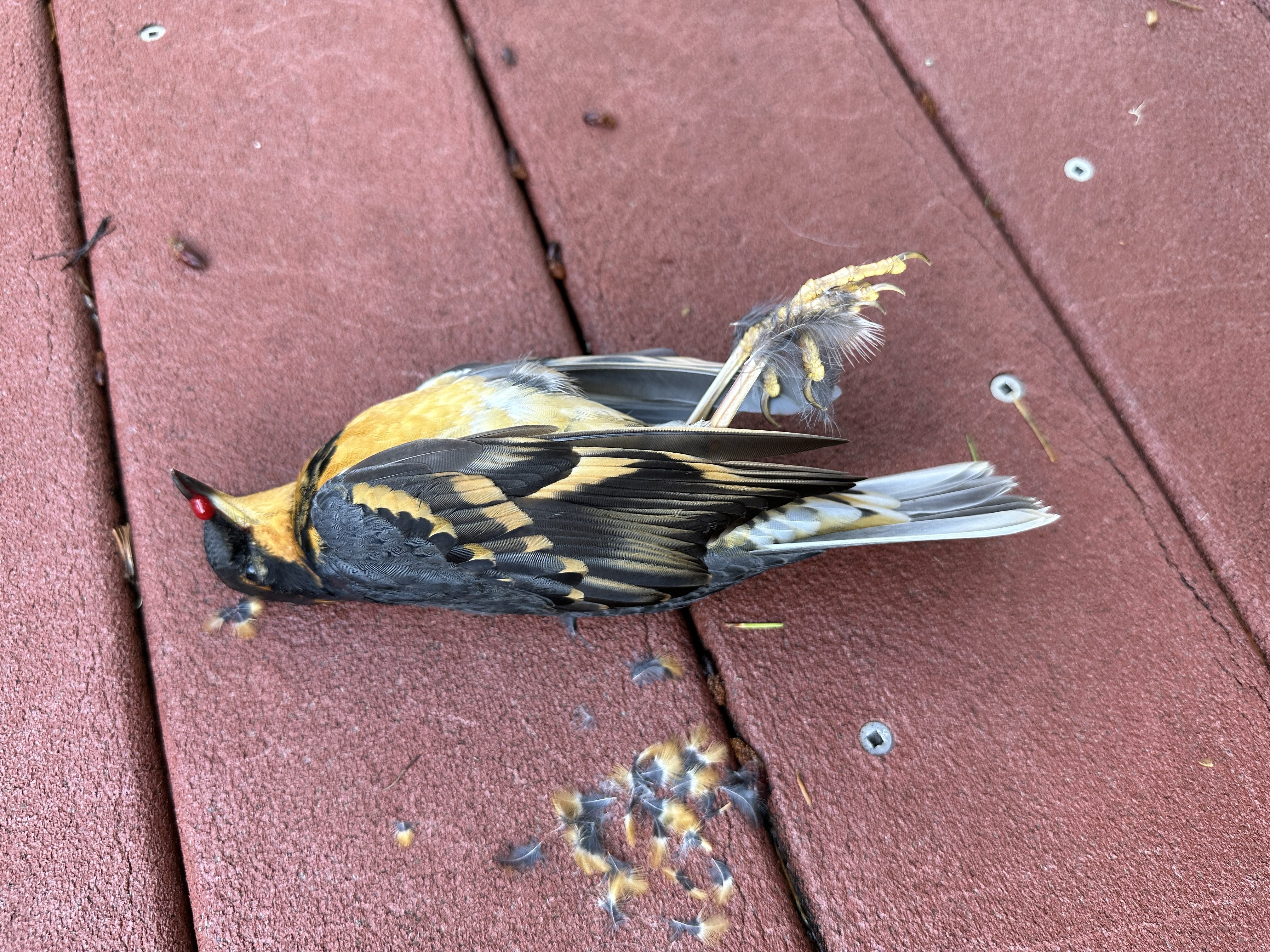
Late fall in northwest Washington meant lots of varied thrushes, the cover bird on Sibley’s field guide. Until we lived there, I’d never seen one. We had lots of them in our yard. I felt very lucky. One day one flew into one of our windows. It lay dead on the porch. I went outside and picked it up, still warm. A drop of blood, globular and viscous and contained, had escaped through and sat on its nare. Its eye was open and I watched it change from reflective to opaque. I thought, “I hope it didn’t know what it hit,” and took it to the dense foliage on the other side of the fence, where I left it, safe from the dogs.
There are accidents and there are intentional things. Hunting is no accident. Duh. Unlike our ancient predecessors, we don’t hunt to live. Some of us live to hunt. But that’s a different story. My hunting story is a now downward-trending sine wave of desire that’s more or less loosely affiliated with my will to live and somehow affiliated with the will of whatever I’m seeking to kill. It’s that affiliation that continues to baffle me. But one thing’s clearer now than before: the more I try to understand it the less sense it makes. There’s a string that runs through everything, and no matter what you do to that string or what happens to it, it’s still there. You can fray it, burn it up, throw it away, lose it, but that doesn’t get rid of it. It’s Hart Crane’s memory all “things nurse.”
Grateful
Cree hunting tradition poses prey as grateful. With certain conditions. Animals will gratefully give their lives to hunters as long as there’s some kind of mindful reciprocity given back and acknowledged by the hunter. Usually this means, at the very least, making the most of the animal: food, clothing, tools. They are glad to know we understand and appreciate what they’ve given to us. Most of us have learned this, and try to remember and abide by it as much as possible, but inevitably we fall short. At least I do, more often than not. Even Cree today debate the practicality of this and some even disavow it.
This, falling short, requires reflection, which is a form of grace in constantly changing form. I know that soon we’ll go out with the dogs and when I have a shot at the first covey that busts I’ll try to kill as many of them as I can.


Chirp away