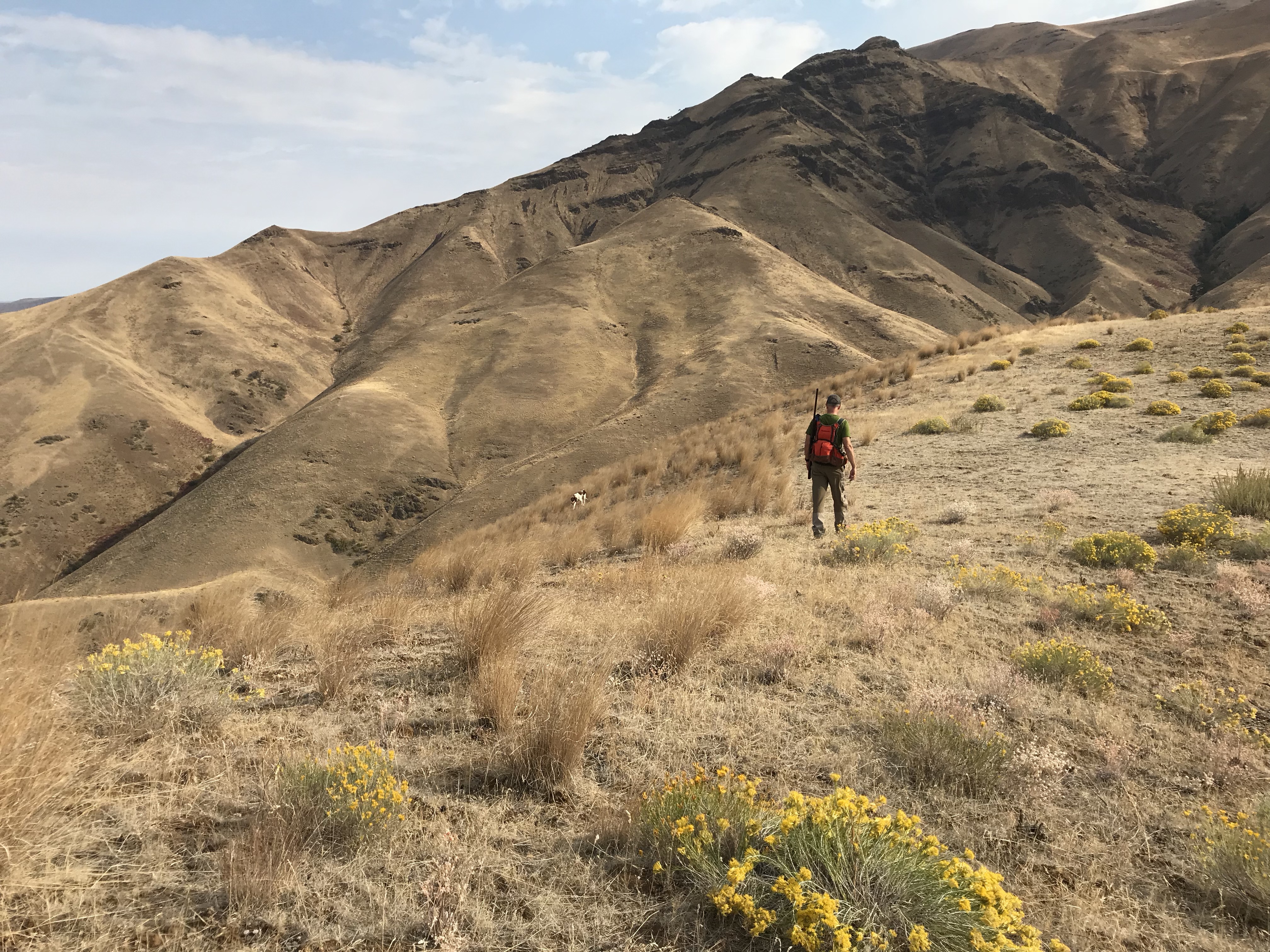
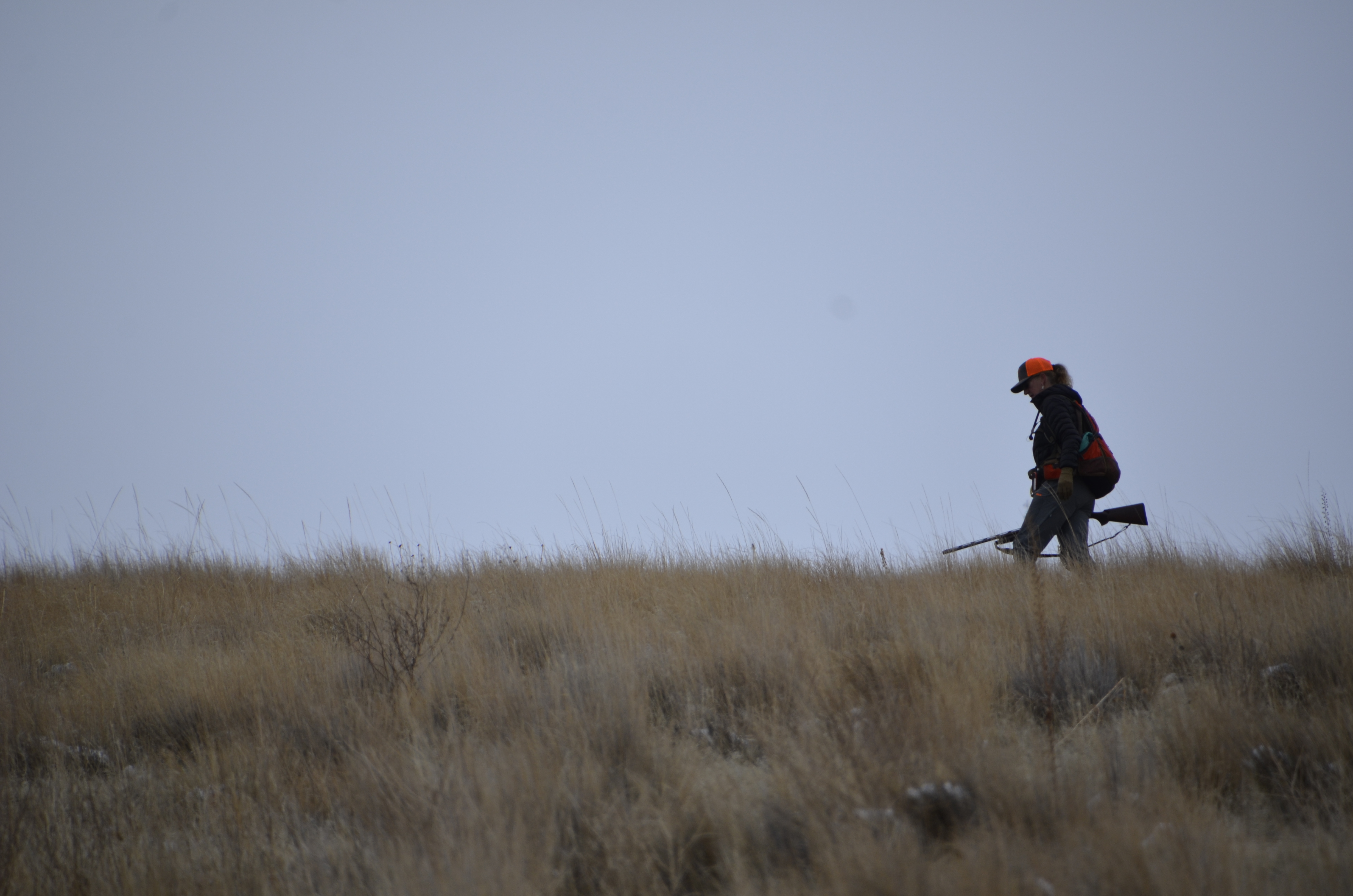
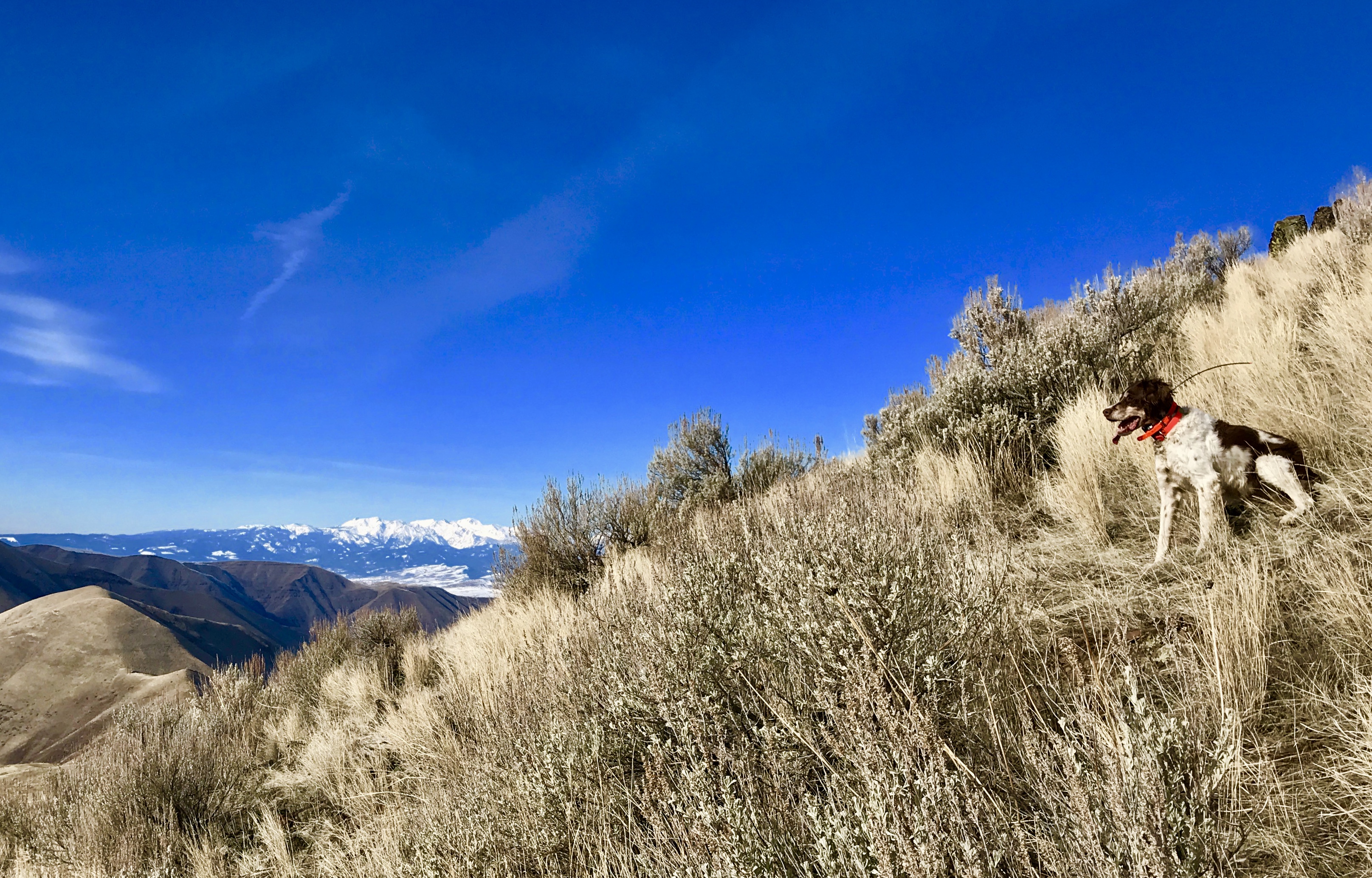
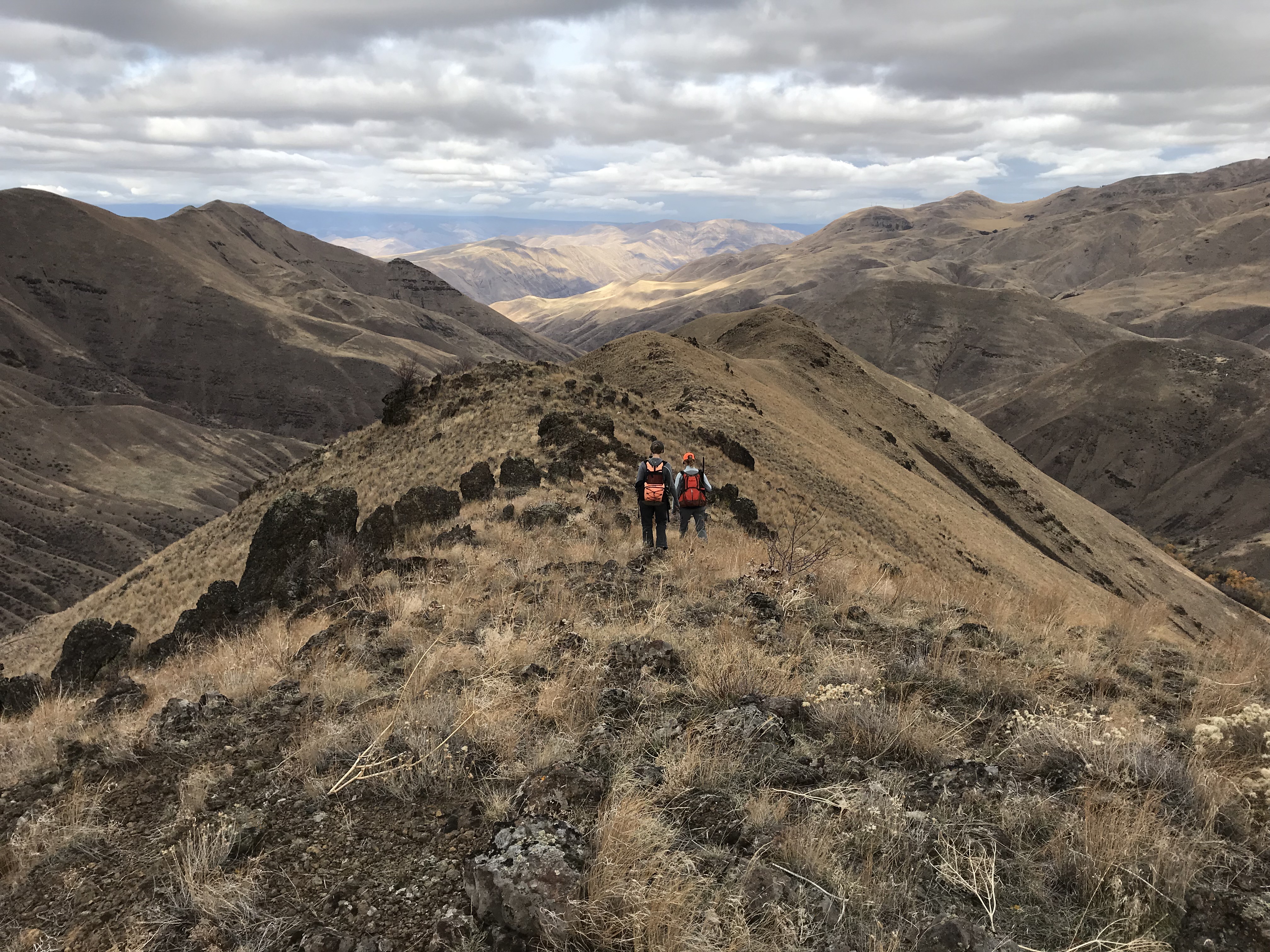
The landscapes where the birds live dictate where you’ll hunt chukar in the West. Terrain covered in sagebrush, bunch grass, scree veins, and rocky talus outcroppings high up in the clouds is typical in this part of Idaho. You’ll encounter steep traverses and sidehilling that make you wish you had tightened your boot laces tighter. Later in the season, in December and January, it gets snowy, icy, and slick which slows you down especially if you have to posthole it. These hard-to-get places on public lands that can only be reached on foot are what the allure and fuss is all about. It is man and his dog against nature and its elements, or in my case, woman against nature.
We reminisce and think about these beautiful, wild, and remote places and will plan our hunts next season to purposely seek them out. The reality of it is, you’ll walk a lot, sometimes for hours to find them and only see one covey on good days, but it’s these special places and your attempt to put yourself into position to shoot over a pointing dog that makes you go back another day, and another day, to try again and then dream about the coming season and doing it all over again.
The video below is my form of ode to walking the chukar hills.
“Range after range of mountains. Year after year after year. I am still in love.”
– Gary Snyder
Spring break this year, we drove across the West and past many, many mountain ranges in Idaho, Nevada, Utah, Arizona, and Montana. I didn’t dare sleep in the car or stare at my phone while being a passenger moving past them because I’d miss them. Instead, I gazed across the landscapes or would read my tattered paper road maps splayed across my lap and try to find out the elevation of the highest peak that I could see in the distance or the next little town coming up. On one particular mountain in Nevada, I tried to imagine the route I’d take to the top. Looking out the back window as we drove past it, Bob asked what I was doing and I told him I was trying to figure out a good route to the top. He asked if I was planning on doing that anytime soon. I told him no, but anything is possible.
The western United States is blessed with vast areas of public lands in the middle of nowhere that rarely get stepped on by a human foot, but it doesn’t make them any less special or less valuable. If anything, it’s the opposite.
It wasn’t until spending time the past few years hiking around the chukar hills that I realized how important they were to me. On our road trip across the West, I started reflecting back on all the many hundreds of miles hiking up and down these mountains and back to the beginning. I felt like talking about it in the video (below).
I almost didn’t go hunting on the last day of the season. I woke up tired.
The day before, I’d gone out with the dogs for my fifth hunt in seven days. Overwhelmed by the dread of the looming last day and already missing it, I wanted to take advantage of the unusually pleasant weather we’d been having in this part of Idaho, plus a schedule — or shall I say a lack of schedule — that allows me to hunt in the middle of the week. When I took early retirement from my employer last year, someone told me “The worst thing about being retired is that you never have a day off.” It’s true.
My second to the last hunt of the season was also my 52nd hunt. I know this, because back in September on opening day, as I’d done the previous season, I started keeping track with data off my GPS watch, if I could remember to turn it on. I like to know where I hunted, my distance hiked, how long the hunt was, and elevation gained. When I got back home I’d write it all down with a ball point pen in my hunting journal which is hand lined with a ruler on a paper notebook. Nothing fancy, just the old fashioned way. Bob, who I’ve dubbed the king of gadgets and who one of the UPS guys a couple of years ago called the king of Amazon Prime because of an almost daily delivery of books or some type of high tech gadget, keeps meticulous detailed records of all his hunts on an Excel spread sheet. Besides all the stuff that I like to keep track of he, likes to record how many shots fired, how many killed and bagged, lost birds, shooting percentage, how far each dog ran, averages and totals for each category, and a barrage of other miscellaneous notes.
After losing all the elevation in the truck driving deep down into the canyon and finding the place I wanted to hunt the second to the last day of the season, a place unoccupied and not near anyone else, I parked and left on foot with the dogs heading back up uphill for about an hour to the middle of a ridge. Angus and then Peat bolted in a direction that I didn’t want to go but I followed anyway. A couple of minutes later, my Garmin beeped that Angus was on point 127 yards away. Whenever Angus points, it’s almost always legit. Peat, on the other hand, has a collar that’s so ultra sensitive to him stopping for just a second to pee or to smell something that I’ve found myself often ignoring it when it signals me that he’s on point. I picked up the pace through the deep snow drifts that were tucked between forests of sagebrush, and zigzagged my way down to Angus. Once I found him, Peat soon arrived to back him up. I slowly and quietly inched my way in front of Angus, and the birds busted. One shot, and one chukar went down as we also watched the rest of the covey fly downhill changing direction and then disappearing behind a ridge near us instead of flying across valley and to the opposite ridge.
Not much snow for the end of January.
It took a few minutes for Peat to find the downed bird and we had no plans to give up on it because the day before I’d winged one that flew down hill into a some bunch grass and rocks and the dogs couldn’t find after 30 minutes of searching. While Peat was retrieving the bird, Angus continued to hunt. It was almost like they had an agreement between them that one would stay looking for the one that I shot and retrieve it while the other continued on searching for the scattered covey.
On a bed of the terrible noxious weed, medusahead.
We continued in the direction of where the covey flew, traversing the rocky and muddy sagebrush and medusahead-covered slope. Angus below me with Peat working above me, my Alpha beeped that both dogs were pointing at the same time, on a different covey and not the ones that had just busted. Stopping to stare down at the screen to figure out which dog was closer, Peat flew past me heading towards Angus with a fairly fresh 3-foot-long mule deer leg in his mouth. This was no surprise because one of his many affectionate nicknames I’ve given him over his life time besides “Little F*#ker,” “Little Dummy,” “Crazy Eyes,” “Precious,” or “Sweet Pea,” is the “Garbage Man.” He has this uncanny knack of finding the stinkiest, nastiest, usually dead thing, and either rolling in it or running around with it in his mouth, unwilling to give it up for anything. Our current UPS delivery person last spring, a guy named Sail, was walking up to our house doing a delivery to support bibliophile Bob’s habit that I yelled at the top of my lungs to “STAY CLEAR” while I was hosing off and scrubbing Peat with a skunk concoction remedy for the fourth time after he rolled on a dead skunk near our house.
The big question of the day was whether Peat would drop the deer leg when he got up to Angus. As I fought my way through the sagebrush, I pulled out my phone and was actually hoping to capture what might possibly be the first photograph of a dog pointing with a deer leg in his mouth. To my disappointment, when I got up to both dogs, Peat backing up Angus again, Peat didn’t have the leg in his mouth anymore. He had actually dropped it.
The spooky birds busted below Angus flying downhill before I could get into position in front or to the side of Angus to shoot. This has been the theme for most of January where it’s hard to get near chukar before they bust wild. The dogs and I continued into the direction of both scattered coveys before my Garmin again beeped both dogs on point. Again, both dogs were located in different directions. Peat was closer but I could see him above me pointing downhill below a rocky outcropping so I headed uphill. One single busted from the rocks, and I shot once as the quick flying bird disappeared behind the rocks so fast that I didn’t know if I’d hit it or not. My Garmin beeped again, Angus was still pointing 180 yards below. “You have to always honor the point” was something Bob stressed to me last year, so I headed downhill towards Angus. Wondering where Peat was, I stopped and looked behind me uphill just as I saw him running downhill with a chukar in his mouth. I was so thrilled and surprised at the same time that I’d actually hit that one. Angus who held the bird or birds as long as he could before they probably eventually busted returned to check up on me wondering why I didn’t go down to his point.
Not a tailgate shot but a rock shot.Double day: my first ever.
The following day, the 31st, closing day, we went one final time. My goal was to head uphill and find a place with views of the surrounding valley. I wasn’t worried whether we’d find more chukar, I just wanted to take it all in. The plants, trees, rocks, and other kinds of birds and animals define my place in this ecosystem.
A treasure and a treasure.
We headed up a narrow and snowy two-track in a deep valley lined with trees and bushes. Peat in his usual fashion found an animal bone and wouldn’t give it up. I forced it out of his mouth and flung it as far away as possible. I continued on looking at the ground at elk and deer tracks plus Peat and Angus’s tracks in the patches of snow. A paw print that I didn’t recognize at first caught my eye. It was a big cougar track, fairly fresh probably from that morning and heading the same direction. Peat’s body language and routine changed. Instead of running up the trail out of sight a ways and coming back like he normally does he was sticking close to me, running a few feet ahead, stopping and smelling the ground, and continuing on another few feet before repeating smelling the ground again. I watched Angus down by the creek; he wasn’t acting differently, but he’s older and wiser and not the big chicken of the two dogs.
Still, the cat track and Peat’s behavior was a bit unnerving. We continued up the road and I kept Angus closer to me and instead of carrying my gun on my shoulder, I kept my gun in the ready position and carefully listened and looked behind frequently. I could never willfully or ethically kill an animal like a wolf, coyote, or this cougar that I wasn’t planning on using for food but I actually thought about having to kill something to protect myself or the dogs, and this was the first time I felt the dogs or myself might be the prey.
Roles reversed. I now know how the chukar must feel.
On the final climb. 63,755 feet in elevation gain for the season. Peat and Angus way more.Upland Peat.Angus on the decent.Chukar hills.One last point.Taking it all in.Last photo of the 2018/2019 season.
Yesterday, we carefully sneaked out of the house to head down to the canyon with just Peat, leaving Angus behind. The old warrior Angus has been running lots of miles hunting the past couple of weeks and against his will we forced him to take the day off. We knew getting ready to go wouldn’t be easy without him catching on so we put both Peat and Angus inside the car in the garage while we dressed and loaded up our hunting gear into pickup outside. Once ready, we let them back into the house and corralled Peat outside into the pickup and drove off and looked back as Angus was watching in disappointment from the fenced yard.
The higher mountain elevations were blanketed with a fresh layer of snow overnight so we decided to hunt in a spot down in Hells Canyon, a place we hadn’t walked around this season and where there wasn’t as much snow. Our starting point was an easy spot to access right off the highway. Bob decided not to hunt so Peat could have a chance to hunt for me for a change. In the past so far, and we’re not sure why, but whenever Bob hunts, Peat prefers to only stay with him. As with all hunts down in the canyon, the terrain dictates that the only way is up so we headed up a small game trail in a thick draw lined with brush and trees hoping to find some grouse on the way up. Within five minutes, Peat busted through the brush and stopped above us, barking his head off. His bark was different this time, not his usual high pitched barking he makes when he flushes a grouse up into a tree. His bark was deeper and had the sound of fear in it. We quickly made our way up to him and found the source of his agitation. A big beautiful bobcat with haunting golden eyes was caught in a trapper’s snare underneath some bushes. I was angry. How could a trapper get away with putting a trap in an area close to a popular bird hunting area where hunting dogs could also get accidentally caught? Trapping bobcat in Idaho is totally legal from Dec 14-Feb 16 in this area so there was nothing we could do but walk away. We normally carry heavy duty wire cutters in case the dogs ever got into a snare but they were at home in Bob’s hunting pack. I would never mess with any trappers traps unless one of the dogs got caught in one and I would never tamper with or free wildlife from traps because it’s actually illegal to do so.
Trapped cat
Trying to put the whole affair behind us and forget about it, we continued our climb up about 1,500 feet with Oregon at our back and up into the snow that we were trying to get away from in the first place before finally getting into some birds.
Fence line ascentThe wall
Once at the top of the steep climb, Peat found and pointed a covey of Huns and I managed to knock down one as they busted and flew downhill over the ridge. Peat, not used to hunting with just me, was confused on whether to bring the bird to me or to Bob.
First point of the dayThe retrieveThank you Peat!Pointing chukarPointing a covey of chukarWhat next?Heading down and away from the draw
The bluebird sky, amazing views, and Peat brilliantly hunting just for me made up for our terrible start. Yesterday’s hunt will be forever remembered as “Bobcat Gulch.” Now knowing that traps are in the area we will probably never hunt there again and especially not during trapping season.
Our home in the country, Salubrious Basecamp as we affectionately call it, has seen a flurry of adventurous friends and family, hunters and non-hunters, visiting us the past couple of months, each of them wanting a chance to see what all the chukar hunting fuss is all about. We love that our visitors will take time out of their busy lives to make the drive. Our gracious guests, all of them, before arriving will always ask if we need any last minute food items from the city. They will come bearing new craft beers, pastries, breads, snacks, and even single malt whiskey from Taiwan (of all places), things we can’t buy in town at our local general store. We ask them to only bring themselves, but are very grateful of the gifts. In return, we’ll make some game bird-inspired dishes like prosciutto-wrapped grouse marsala or chukar nachos, and take them to some of our favorite public land hunting grounds and allow the ones that hunt the opportunity to shoot over our dogs. It’s not just anyone we’d trust with doing this.
On this day of thanks-giving, I’m most grateful for our family, friends, and the good dogs that enrich our lives and the fond memories of hiking the chukar hills with them.
Cyclists and mountaineers Jon and Sarah
Jon on the descent
Avid fly-fishing nephew, Finn on the right
Runner, teacher, and new hunter Gretchen
Gretchen’s puppy Cody smelling wild chukar for the first time
Ultra-marathoners and triathletes, Bill and Kim
Cody hot on my heels learning about chukar terrain