Tag: dusky grouse

  • Black Friday

    Black Friday

    Yesterday, Thanksgiving, we hunted a beloved area that got burned in a big fire that started on Labor Day. We weren’t sure what to expect, but have been anxious to see it up close for a while now. From the road, you can only see so much.

    Inside it, the devastation was both unsurprising and heartbreaking. Along the creek, you could see temperature changes in the fire’s path, and the flames’ duration from spot to spot. I found myself weeping at times, and terrified when imagining what it might have been like to be there as the inferno navigated its way up the canyon. I felt grateful that the birds and mammals who called that place home are stronger and swifter and smarter than we are. I’m assuming they moved and hope they’ve found suitable habitation.

    One of the reasons we chose this place was that I hadn’t bagged a grouse this year. Up high, fir stands in tight draws usually housed good numbers of dusky grouse, the biggest bird we hunt (although next year I intend to hunt sage grouse for the first time). Within five minutes I killed probably the only pair of ruffed grouse left down there. Gorgeous creatures, but the remorse I used to struggle with blind-sided me while looking at their feathers and blood dripping from their beaks before putting them in my bird bag. Clearly, and gratefully, only a temporary resolution.

    No sign of chukar in the usual places on the way up. At the top, in the forest, the fire had been greedy thinning the undergrowth, and the large population of dusky grouse had obviously flown the coop. We angled up higher to more open areas whose robust blankets of bunchgrasses were toast, singed into a blackened crewcut. These rolling slopes covered in bunches of grass had made oases for chukar, provided protection from raptors, and now were desolate, bereft of blades.

    At closer look, though, a happy sight: almost undetectable sprouts of green emerging from the scorched tufts. I wished I was a botanist so I could predict how long it would take these beautiful plants to reach maturity again and stand firm against the noxious invasion of medusahead, spotted knapweed, rush skeletonweed, and star thistle (among others) that seriously threaten this unique but delicate habitat. I’m eager for spring so I can see how these grasses have fared. I love them. I named one of my favorite beers after them (Bunchgrass Rye IPA).

    On one knob that pre-fire was dense with sagebrush, large charred polka-dots showed only the charcoal base of these important and gorgeous plants. Another happy sight, though: in several of them, healthy deposits of chukar poo. Chukar have been there, but we didn’t see any and Peat didn’t find any on our 6-mile (and his 20-mile) hike.

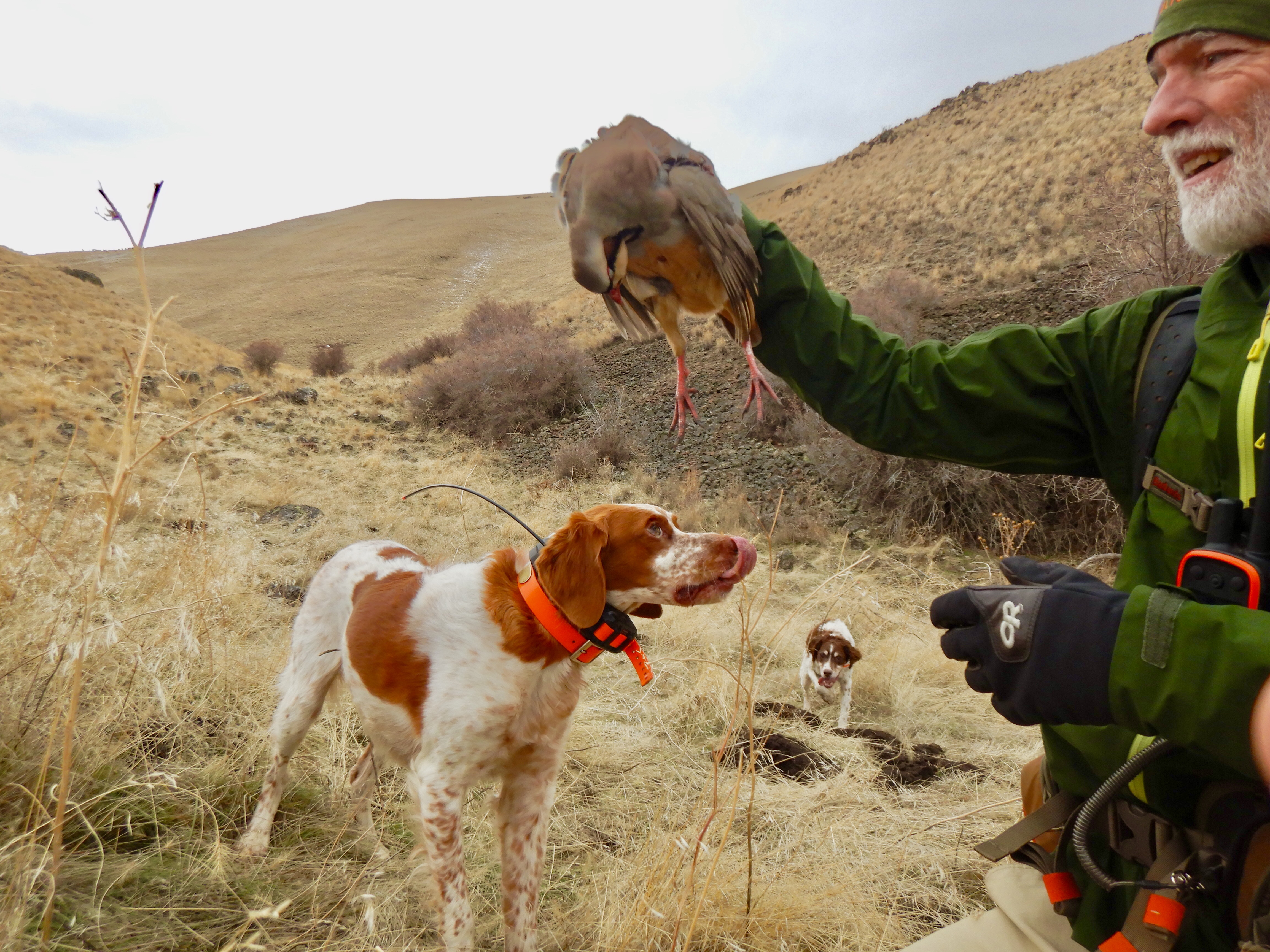
    The terrain lured us farther and higher than we’d intended, and on a snowy north-facing slope we found fresh dusky grouse tracks. Seconds later, Peat pointed into a stand of conifers. Two of the pterodactylic galliformes launched simultaneously. Leslie and I each shot at the only one without trees in its way, and we each killed it with shotgun shells I’d loaded containing some of Angus’s ashes. He loved grouse hunting.

    On the way down, it was fascinating to see springs in places whose pre-fire plantlife concealed. There was much more water on this terrain, coming out of it, than I ever dreamed in the decade I’ve hunted there. It shouldn’t be surprising: this high desert landscape is stingy with water, so pockets of large plants on the otherwise arid land should signify a spring. Plant-bare, though, you can see it now. But the lack of cover at these springs meant we wouldn’t see any birds that used to chillax there.

    Bagging three birds on this hike, despite the remorse, helped make it feel successful. I suppose I should assign more success to the fact that some of the vegetation is rebounding already. But the completely toasted creek bottom dampens the hope for recovery, there at least, because — unlike Hart Crane’s river — the fire did not quickly flee that particular watery spot. Fire and water, hope and sadness. Life.

    An early ruffed grouse gift
    Pick up your &%$@!# shells!
    Bunchgrass comeback
    Phoenix
    Other resurrections
    Signs of life and death
    First dusky of the year (actually, only 1/2: Leslie & I both killed it)
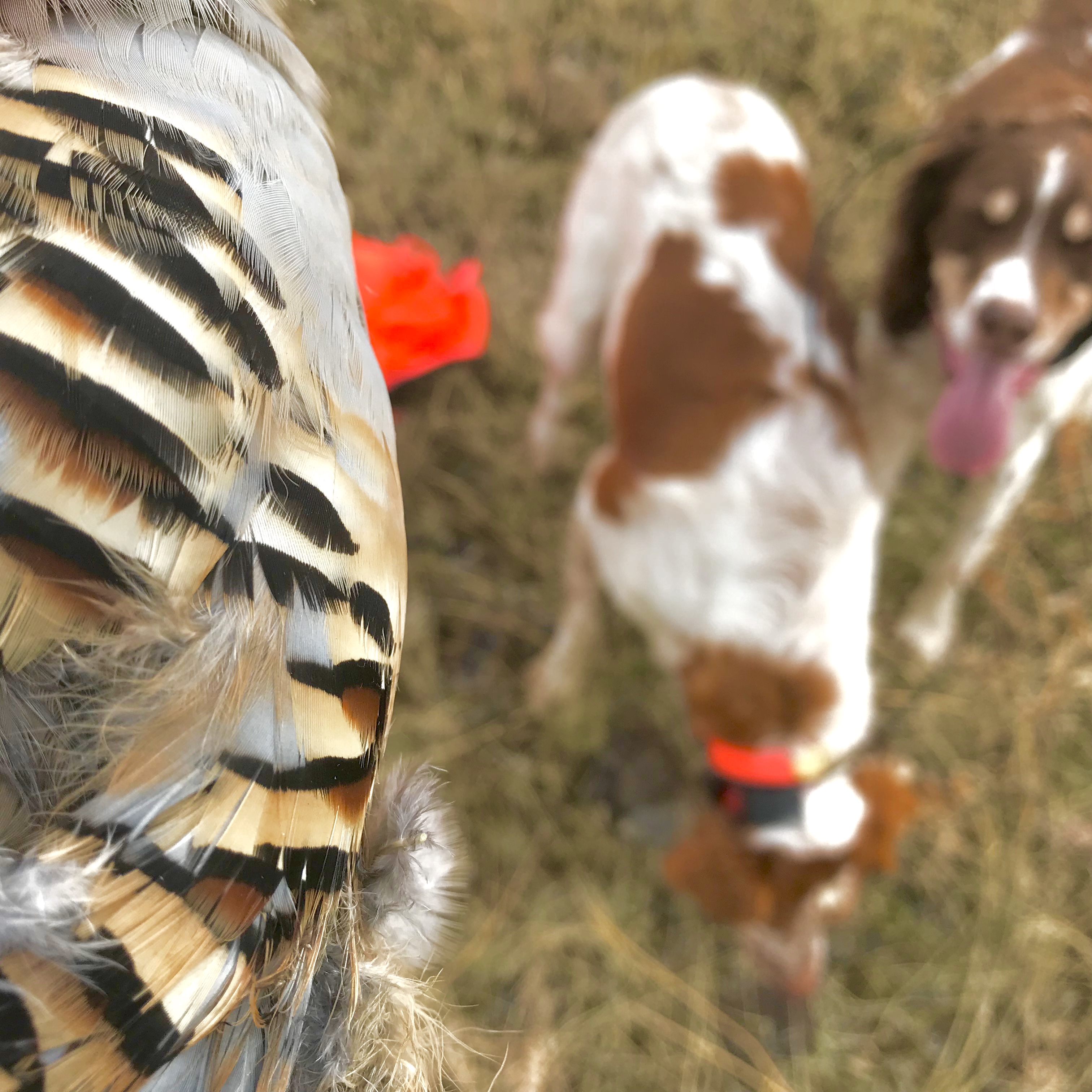
    Big birds with excellent, appreciated protein
    Angus’s legacy
  • Blessed

    Blessed

    As usual, chukar hunting, like some of the best things in life, continues not to make much sense to me. What does make sense to me is that the fact that it doesn’t make sense is probably the reason I keep doing it, not necessarily so I can find some sense in it, but because it’s not subject to the rules of things that should make sense. Things that should make sense are problematic because when they don’t make sense, which always eventually happens, then you get all warped up and try to force something that can’t be forced. Something breaks, or needs to. There are things about chukar hunting that make sense, such as — duh — you need to remember to bring your gun, and your dogs, and all that other crap to make it happen. But that’s not the hunting. I’m talking about hunting. It makes no sense. I love it. That I’m able to do it and not feel obliged to understand it makes it my favorite blessing. I guess that’s why I’m writing about it on Christmas instead of doing it; I’d rather be out there, but there are things that need to make sense today that got in the way. Writing about it is a way of trying to have it make sense, but I’m not afraid I’ll turn it into an understood thing because it’s hunting. Hunting can’t make any sense. When it does, I’ll stop.

    So I’m glad I’m not yet sleeping in an alabaster chamber, partly because I’m not really sure about my level of meekness, but I’m happy to report that I’ve been touched by morning and by noon, several times, in the past week of hiking the chukar hills with our family. It’s been a particularly blessed week.

    Partly because we’ve made a more devout effort this season to hunt areas we’ve never hunted before. Surprise: it’s paid off. Everyone has his or her go-to spots, and ours seemed to have dried up this season, which is good and bad but overall a blessing I think. If the familiar spots had contained the numbers of birds we’d been accustomed to, we wouldn’t have expanded the repertoire and would have missed what’s been there all along but untouched by our feet. I hope there’s a lesson in this we can remember.

    Another blessed thing is that, as the season winds down, I’m amazed that each season we seem to lap more miles, elevation gain, and bagged game. This sounds like bragging (maybe it is), but it’s notable to me because it speaks of a growing desire for something: maybe it’s time with the dogs, especially one whose season itself is a miracle but also the other one who’s getting better each hunt (miraculous in itself when considering our beginning together). Maybe it’s a proof thing: can we do more even though our bodies don’t look or feel as fit and young as only a few seasons ago? Maybe we’re just dumber. Who knows? It makes no sense.

    I’ll take it. I feel blessed. I wish you all the same.

    It seemed miraculous that the antler-rubbed shavings still sat in a pile months after being scraped
    Peat’s ruffed grouse
    Peat’s dusky grouse
    Double chukar
    Peat’s haul Christmas eve: dusky grouse, chukar, and Hungarian partridge
    Peat and a Hungarian partridge
  • Leslie Bags Her First Chukar

    Leslie Bags Her First Chukar

    She did it

    They said it couldn’t be done. They said it was impossible. They said, well, they said lots of things I can’t repeat. But the one thing they didn’t say was, “She’ll never give up because she’s as stubborn as an Appalachian mule.” So today, Leslie proved them all right and wrong and bagged her first chukar. Two months into her first season, at age 55 and never having shot a gun until August, any chukar hunter will tell you this is an accomplishment-and-a-half.

    Both dogs were birdy, and Leslie was above me. Peat flushed four chukar just in front of Leslie, who – because she has learned to decipher the degrees of birdiness in our dogs – was expectant. I saw the birds go at the same time I heard the shot, but didn’t see it fall. It took Leslie a few moments to say to me, “I think I got one.” It was almost as if she couldn’t believe it. Then Angus made a beeline down the slope and lifted his head with a mouthful of feathers. Initially he headed to me, but Leslie called him and he changed course and brought it right to her hand. What made me feel even better than the pride I felt for Leslie was seeing her smile, like a curse had been lifted. She looked at the bird, which she’d killed instantly with her 20-gauge, 1 oz., 7-1/2 shot load, and thanked it for its life, something I’ve gotten away from doing, regrettably.

    Chukar Country Trifecta

    We continued on for another 2 hours or so, and she got off a couple more shots but didn’t connect. I managed a Hun and a Dusky grouse, so a three-species day in mid-November on a year that was supposed to be meager from last winter’s massive snowfall ain’t bad. Yesterday was a good day, too, in another spot where we saw lots and lots of chukar and bagged a couple. So there you have it!

  • 2011-2012 Chukar Highlights

    Angus pointing chukar
    Angus strikes a familiar pose

    Been meaning to put together a highlight reel of our season last year. Took me a while. There’s something about the turn in the weather that makes me begin to feel like it won’t be too long before we can start another cycle. The one major distraction from thinking about next bird season is the current, horrendous tick season (see my post from last year about ticks); after a run last weekend I pulled 32 ticks off of poor Angus.

    But I digress. We got out a lot last season and, thanks to my wife whose video skills have gotten quite good and who has no interest in shooting birds with a gun (lucky me!), we got some good pictures. Although I have a favorite spot I go to whenever I have the time, we made it to a bunch of different places and saw some incredible country. Angus, with very little training, is more than I could ask for in a hunting partner. I’m lazy on the work and don’t have the patience to make him steady to wing. We see plenty of birds and my shooting – which I hope to improve this summer – yields us more than we like to eat (although with the risotto recipe I came up with might make me want to increase the take).

    Anyway, enjoy the highlight reel.