Tag: chukar

  • Love and Danger

    Love and Danger

    On the steep ascent the winds were blowing hard and the dogs were having a hard time pinpointing the birds and singles were busting wild from the grasses and the minute you blinked one would take off like a missile.

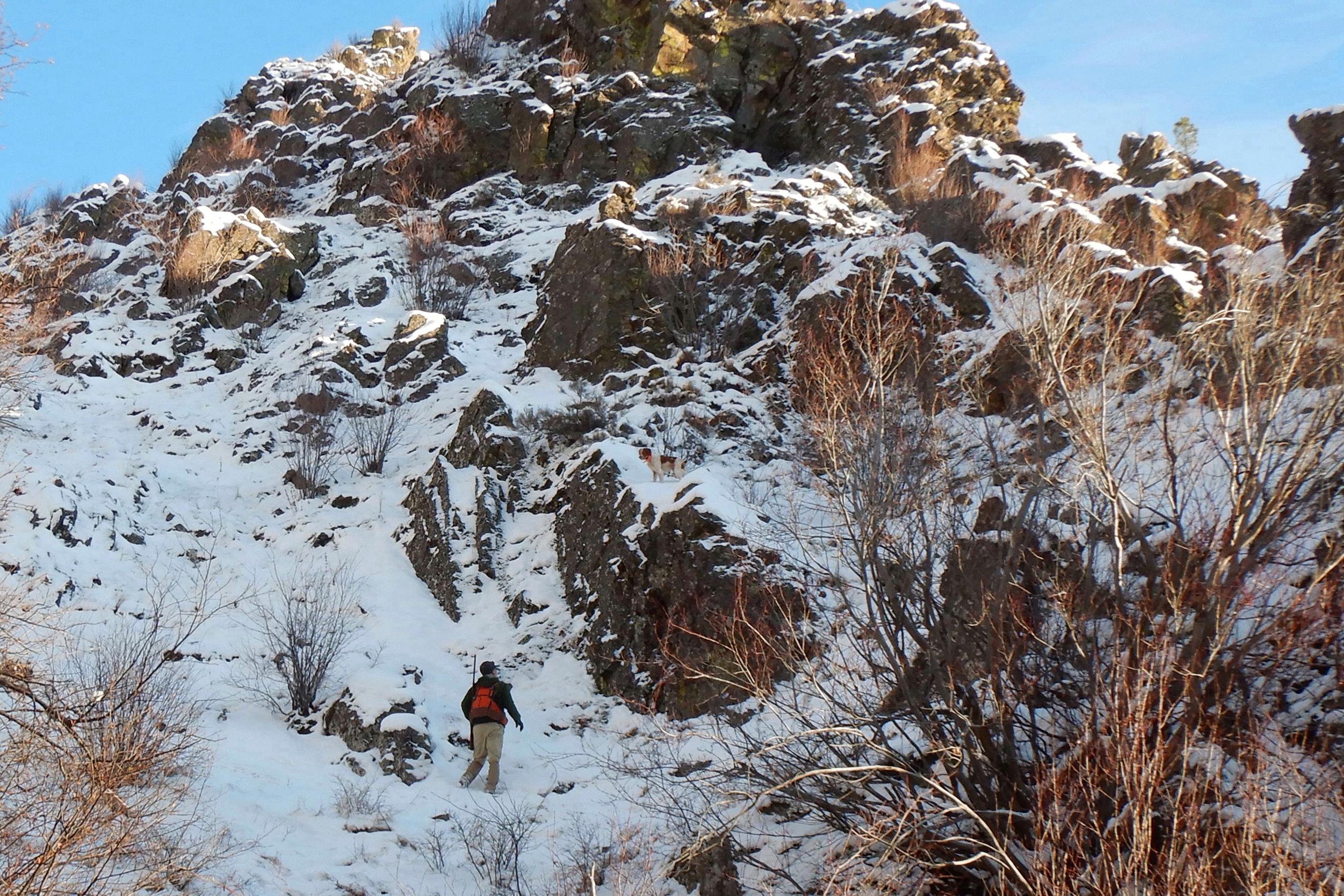
    Halfway up the ridge, I stopped on top of a rocky outcropping to wait for Bob who was below me. That day my legs felt great and for once I was pushing the pace up the mountain and getting to the dogs on point before him. He made it up to me and we stood there a huge gust of wind almost blew me off my feet. He said, “I’m not standing next to you anymore,” as he looked over the edge of the rocks and down a steep drop off.

    Looking down waiting for Bob.

    We continued climbing higher up the ridge. Peat located a covey of chukar above me, and he held the point religiously but just before I could get close enough, the birds –impatient — busted and flew downhill. All that elevation gain for nothing. I grumbled to myself about it. We continued up for a little longer before bailing out completely because of the very high winds at this point on the ridge. I’d remembered my very experienced bird hunting friend Sam telling me once that “The birds are at ground level and out of the wind; they’ll be there.” They were there but I wasn’t ready for them or couldn’t get to them. On the way down, Angus went on point in a rocky draw just above me. I waved my arm and got Bob’s attention and pointed in the direction of Angus because he couldn’t see him. A covey of chukar busted and flew downhill overhead in between us and we both shot at the exact same time and a single chukar fell to the earth. I thought it was my shot that hit it, and Bob thought he hit it. This was the first time this had happened to us. It didn’t really matter to me whose bird it was, it was a shared experience and I don’t keep track of my shooting average anyway.

    Just over half way up
    Shared bird, shared moment

    We stopped on the downhill to take a break after a long steep descent from the ridge top. I was tired and needed to eat something. I sat down on the ground with my shotgun planted firmly between my knees pointing up at the sky and pulled out a piece of cheese and some crackers, sharing some of it with Peat. It had been a hard hunt, an exhausting one, and a frustrating one. I sat there and watched a herd of elk in the distance grazing.

    Herd of elk

    After resting for a few minutes, Bob and I continued traversing across a steep slope where I found a narrow game trail and started following it. Stepping off the trail to walk around a rock on the trail my boot slipped on a patch of slick mud and before I knew what was happening I was tumbling down the mountain with my shotgun flying out of my hand and into the air. Everything happened so fast. Bob below me witnessed the whole thing and while I sat there on the ground stunned he yelled, “Are you okay?” Feeling my limbs, nothing was hurt. I felt lucky. I looked around for my shotgun and found it uphill laying on the ground with the barrel pointed right at me. The safety was still on, but this was the first time chukar hunting that I felt like something really bad might have happened.

    A few minutes before I fell

    Over the course of the season, our rule is not to hunt the same place twice, and increasingly as we’ve gotten older we find ourselves hiking more miles and gaining more elevation, and finding very remote places each time out but I’ve also managed to end up in some very questionable nooks and crannies with loose rocks and boulders. I have done my share of crawling on my hands and knees or on my butt to negotiate them. I wonder how long I can keep this up.

    Why do we love doing a sport that could be potentially dangerous? Jack Kerouac wrote, “Pain or love or danger makes you real again.” I don’t know about this.

    Lately, my mind keeps wandering back to the chukar hills and sitting on the hillside with Peat by my side on that cold and very windy December day watching those elk. It was a moment when my only complaint or worry about anything was that my ears were cold, the birds were busting wild, and I wasn’t sure what I’d make for dinner that night. These were innocent times.

    It wasn’t until this past chukar season or lately that I’ve worried about my health or my mortality, but these last few days have been surreal around here. Our school has closed for who knows how long, sports canceled, jobs lost, life interrupted. As of today, we don’t have any cases of COVID-19 in our county but if things go as they have it’ll be inevitable. I’m anxious not knowing what the future might bring for the world, our country, our town, our school, our neighbors, or for us.

    I appreciate you reading this post. You’re probably sick of reading about the virus and might be hoping this post would be an escape from it, but it has affected each and every one of us in different ways. I do know one thing for sure: the birds will still be there in the chukar hills this fall when things hopefully get back to some sense of normality.

    Until then, I hope you and your family stay safe out there.

  • Rituals

    Rituals

    Some things are rituals. It was never discussed on Saturday but over the course of the last four months it was customary or tradition that we’d bird hunt on every Sunday.

    Last Sunday morning while sitting in front of the wood stove drinking coffee and looking out the living room window toward the mountains, Bob said, “Let’s go for a hike after I get done grading papers. Just because the season is over doesn’t mean we can’t go for a hike. Besides, we all need some exercise.” I agreed wholeheartedly.

    I grabbed my upland bird pack from the garage and transferred things from it to my day hiking backpack. It was always a practice during hunting season that I’d have a mental check list of things to add to my pack so not to forget something important. It was routine to fill my hydration pack with water, look to make sure my gloves were still in there, to add some dog treats and snacks. Of course this time I didn’t need to worry about packing enough shotgun shells or to remember to put my shotgun in the back of the pickup. One ritual we didn’t break this time was to bring GPS collars for the dogs. Bob accidentally forgot the collars once so as we would drive away from our house, I would always ask him if we have the dog collars. We don’t really need GPS collars if we’re not hunting but Angus is deaf and senile sometimes and it’s comforting knowing we could track him if he wanders off, which he did a couple of times this season.

    We drove through town and past a couple of churches with parking lots packed full of big pickups and cars. We’d always joke on our way down to the canyon on a late Sunday morning that we were going to the 24-Hour Church of HELLS Canyon.

    It was a beautiful February afternoon. We started up a steep ridge, and the ascent felt easy. We continued our climb for another hour through the sage and bitterbrush, and the dogs went on point down below me near Bob. The sound of a covey busting filled the air. Out of habit, I was expecting to hear the sound of Bob shooting, but it was strangely quiet and I wondered if the dogs were confused why we didn’t shoot. Did they know we weren’t carrying a gun and it’s the off season? Traversing up the ridge we found a few more coveys of Huns but no chukar. We’d hunted here once before earlier in the season but the dogs had found only chukar and no Huns. Weird.

    We hadn’t spent a lot of time in the canyon this season, but spiritually I feel like the hills are sacred. The hills are my church. We eventually turned around and headed back down, and I stopped to admire the view of the distant snow-covered mountains and to watch Peat and Angus running through the golden bunchgrass and I knew at that exact moment that this spot I was standing on was where I want to scatter some of Angus’s ashes.

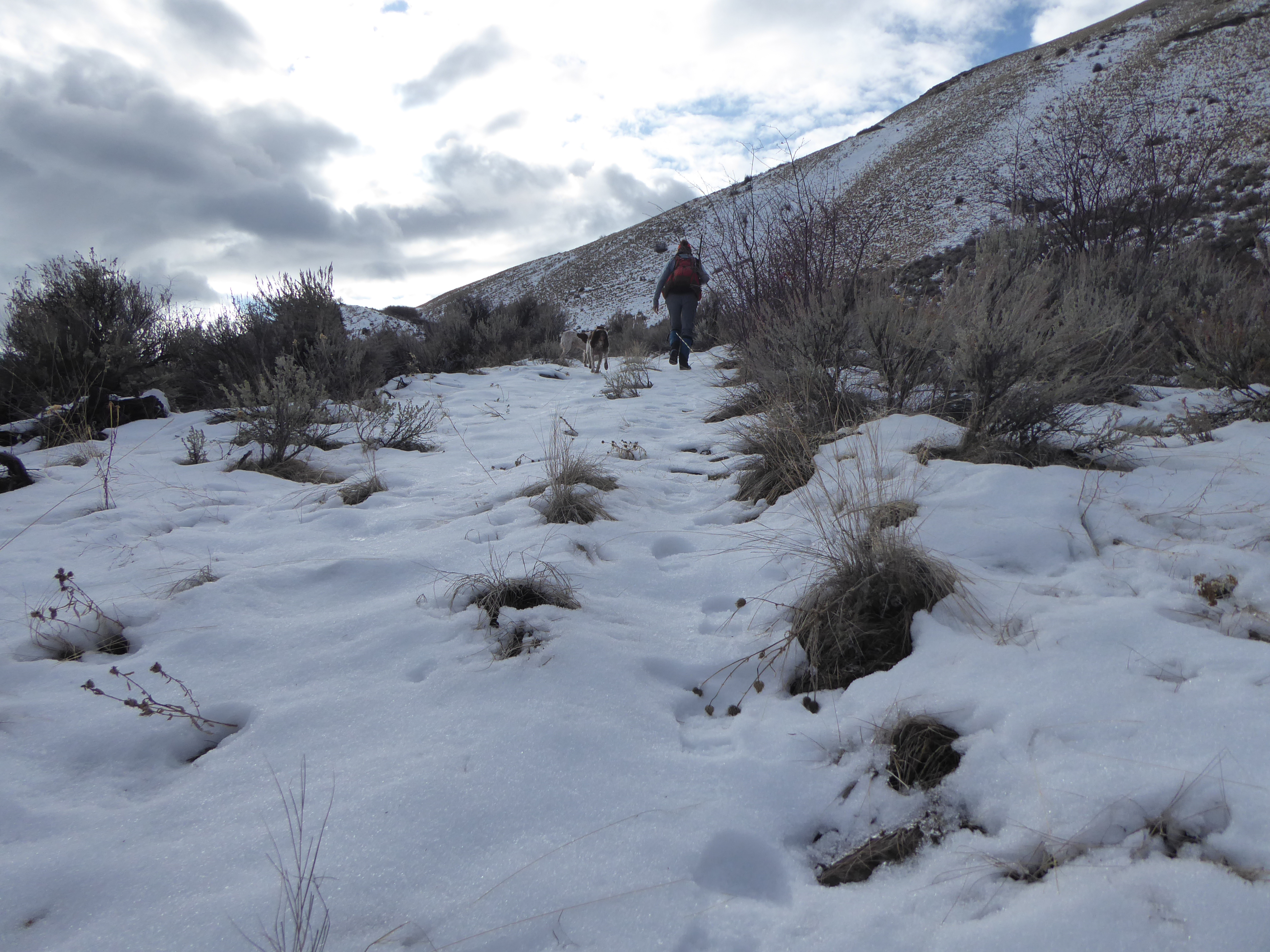
    Heading up.
    Angus with his subtle point. It’s the way he’s always done it.
    Peat backing Angus who’s way below him.
    Catching the wind.
    Strange not carrying a shotgun in my hand or on my shoulder.
    A couple of Huns
    Peat watching them fly.
    A single that busted after the main covey
    Funny Peat laying down while honoring
    Peat honoring Angus again.
    Sacred hills.
    Angus of the chukar hills.
    So long, farewell, and just like a habit we’ll be back next season.
  • Old Paths

    Old Paths

    Bob and I stood there at the bottom of the mountain for a couple of minutes looking up the steep ridge and up to a rocky outcropping high up on the ridgetop. We scanned the terrain for obvious paths made by animals. These paths usually prove to be the easier route up to the place in the rocks where we hope to find some chukar. Bob hollered at Peat and Angus to go find some birds, and our dogs, just like wild animals, naturally followed these old paths. We followed the dogs.

    I headed up the rocky game path with my head down, lifting one foot front in front of the other, and I’d count twenty steps before allowing myself to catch my breath for a second, and then I’d dizzily look around to see if the dogs were onto birds.

    Game paths are habits of the landscape. Some are straight, some are meandering, some cross through creek beds lined with hawthorns and aspen trees, and a few have dead ends. We have been beckoned by and followed many hundreds of miles of these ancient paths chukar hunting the past few years and have followed ghostly footprints left in the snow, mud, and dew. We have stopped to examine tracks of elk, deer, rabbits, mice, snakes, turkeys, coyotes, chukar, cougar, wolves, and our own dogs’ paw prints.

    chukar path

    Humans are animals too and we make tracks in the icy snow and slippery mud. Our footprints and scent are now obvious to the next traveler. Walking on these paths veining the earth makes us feel human, they make us feel more connected with nature. There are beautiful things we will never see unless we walk on these paths.

    Hole in the rock.
  • The Sequence

    The Sequence

    I live for this moment. This sequence.

    My dogs look like they’re onto birds. I sense it from subtle nuances and have learned from training and experience how to read their body language. If I’m hunting with just one dog all my focus is on that one dog. If both of my dogs are in the picture, I have to decide which one to trust more and which one to follow more closely.

    I remove my shotgun from my shoulder and hold it in ready position and carefully pick my way through the loose rocks without trying to look down. I see Angus through the thick sagebrush. He has stopped and is motionless. He’s on point. Out of the corner of my left eye, I see Peat rushing up and stopping just behind Angus.

    Angus with his beautiful show dog gait starts creeping forward. Peat stays put. Scanning the tops of the sagebrush, I’ve consciously made myself focus softly, not knowing which direction the birds might bust. I slowly start moving into position in front of Angus.

    Like a flash of lightning, more to my left than I’d anticipated, a small covey of chukar busts flying at top speed away from me. I quickly mount my gun while taking the safety off, then point the end of the barrel with the fleeing partridge’s arc, my index finger goes onto the trigger, and I squeeze. Everything happens so fast I don’t have time to think, relying on muscle memory from past experiences.

    The dogs hear the noise of wing-whirr made by the covey of chukar taking off, and the sound of the single shot, and they get excited and run in the direction of where the birds flew hoping to pick up some scent on the ground of a downed chukar. They run back to me and give me that look: why did you miss? The sequence of usual events gets messed up this time and we don’t have a retrieve to make it complete.

    I berate myself, making up all kinds of excuses and asking questions. Was it my stance and posture, my gun mount, or that I didn’t focus on the bird and follow through? Some or all are true. It messes with my head.

    The three of us move on and we’ll try this spot again next year.

    The initial point and honor, with Angus about to creep
    The approach
    Peat’s backing the invisible Angus
    Bust and shot: birds just above the sage
    Why’d you miss? Do you know what I went through to find those birds? Can you not hold up your end of this bargain? Would it kill you to practice once in a while? Do you think I’m doing this for my health? Do you think I’m getting fat? Why do you give me so many treats?
  • Recovery

    Recovery

    Most of the snow lay clean and unmarked. We could tell nobody had hunted this spot since this first big snowstorm of the season, three days before. We were jacked. It was cold outside and early in the day, the pine trees, bushes, and grasses were frilled with snow, it was magical and beautiful. Hunting chukar in the snow does have its advantages; seeing fresh chukar tracks in the snow, you know they’re there.

    Somewhere?

    Chukar were here

    The snow was also unwelcome.

    The first mile uphill, I lead the rhythmic march following the legible impressions left in the snow by the dogs whenever they were running in a straight line. Angus stopped to pee ahead of me. I got up to him and stopped to examine the hole in the snow. It was a cruel reminder that his urine was tinged with blood, something we’re seeing more often recently.

    Following Angus

    Bob followed behind in my footsteps and as I slowed he’d take over. I felt like I was walking on a beach in deep thick sand. We rounded a corner and the strong wind once at our backs was now in our faces. I pulled up the hood on my jacket and Bob stopped to take off his hunting pack and as he was pulling out his wind shell he said, “I can’t believe I’m actually cold.” He’s never cold when we’re hunting. I stood there for a minute waiting for him until he said to go ahead, and once I reached the saddle I should turn left. Angus turned left before the saddle so I followed. We got to the top of a ridge but the windswept snow drifts were up to my knees. I saw Bob from a distance across the other side of the ridge and could see him signaling me over to him. I slowly made it over to him, threading my way through the sage and wobbily walking across the baby-head rocks and larger boulders underneath the snow, trying not to slip. From the top of the ridge we could see an area in the distance on another ridge where the snow was burned off. Bob said, “I think we should go over there, and get out of this wind. I bet the birds are all out of the snow right now.” I agreed.

    Don’t let the sun fool you, it was bitter cold

    We headed down the ridge and came across a perennial deer path worn by hooves heading up and down the mountain. We followed it for a while until we could see Peat and Angus looking birdy down in a tight draw. Angus immediately went on point while Peat was above him honoring him like a statue. Bob, below me, was slowly heading down towards Angus. The covey of a dozen chukar busted and flew like missiles straight downhill and around a corner. A single busted later and Bob got one shot off and I could clearly see it getting hit but it kept flying downhill until disappearing into the bushes about 400 yards below us. “We have to go get it!” I yelled over to Bob, “I saw where it landed!” We headed down and recovered it after Peat found it, only a wing sticking out of the snow.

    There are definitely times when you don’t shoot chukar no matter what for fear of not recovering the bird. During every point you analyze the situation and imagine where the birds might bust and fly, and, if you do manage to hit one, where they might land. Some dogs will go to the end of the earth to find a downed bird; Peat and Angus are that way and it’s not worth risking losing them by having them go down a super steep rocky cliff wall and fall or get stuck.

    Some people also say they don’t hunt birds in the snow because it’s unethical. Yesterday, I think the birds had the advantage on us because of the icy and slippery conditions, and getting to a point before the birds busted wild was almost impossible.

    Waiting with Angus

    Towards the end of the hunt, Bob and the dogs yesterday searched for at least 45 minutes for another chukar that went down. Bob saw it fall from the sky after shooting it and saw it hit the ground on a snowy, rocky hillside across a different ravine. I didn’t see it go down but he said he marked it and then yelled at the dogs, “Dead bird.” At this point in their lives they know what to do. Peat seemed part mountain goat, part house cat as his lithe body scoured the wall of snowy rocks, zigzagging back and forth and up and down, nose to the ground. I cringed from below, fearing he’d slip. He’s careful and cautious but also a little half-possessed while looking for downed birds. Peat couldn’t locate it, so Bob crossed the ravine to the other side to look for it while I stayed and watched from below. Once he got over there, the bird was nowhere to be found. Angus stayed closer to me and further below by busting through the brush looking for it. Between Bob, Angus, and Peat they couldn’t find the bird. Maybe it was buried in the snow? Maybe it landed only winged and stunned and then flew off and we didn’t notice.

    Heading up to look for the bird

    When do you give up and walk away?

    The sun was starting to set behind the mountain and it was getting colder by the minute. We’d already trounced around in the snow for 8 miles and were getting tired and the dogs were wet, it was time to start heading to the pickup before it got dark.

    This wasn’t the first time this season that one of us has lost a bird we saw fall to the ground. I’m not sure what my odds are because I don’t keep records, but I’d say that of 20 birds this season, I’ve only lost one. Bob hits more birds so I’d say his odds are slightly higher.

    It’s never easy leaving a dead or wounded bird behind, but it’s just part of hunting. I can still hear Bob’s choice words ringing in my ears when not finding downed birds; I’m sure nobody hates losing birds more than he does.