Tag: chukar hunting books

  • Grace

    Grace

    Unmerited favor.

    I’ve gotten out quite a bit so far this season. The weather’s been good. We recently took a trip to what — in years past — had been the best place I’d ever hunted chukar, for many reasons. We’d looked forward to it for nearly a year. But for whatever reason the hunting was terrible. Or I should say that the bird count was terrible; the hunting was excellent as it usually is when compared to not hunting. But in more miles than normal we saw a small fraction of the number of chukar we’d routinely seen in the area.

    Still, six or seven weeks into the season, it’s been good in many ways. Stats. Because of the nerdy log I keep, I can see that — so far — it’s taking me less time, distance, and elevation to bag birds than it ever has (my duration, elevation gain, and distance hiked, however, are significantly down — which I attribute to age; you can’t win ’em all). My shooting started out much better than average but — with yesterday’s atrocious performance, perhaps attributable to our first outing in Hells Canyon this season, on jumpier (probably much more frequently hunted) birds — it’s back down to my “normal” (but still unacceptable) 35-ish percent. Most of the 23 hunts I’ve done this season have been in completely new places, closer to home, found on onX; I’ve looked for public lands that — on the computer — looked like they should have chukar, and every single one of them has, sometimes with very good numbers of birds, and usually these have been places that I doubt many — or any — people have looked for chukar (they tend to be places that a UTV can’t get near). The conclusion that I make from these interim data is that — finally — it seems I’m getting more efficient — dare I say better? — at finding and hunting chukar. I could go on about all this. But…

    A person wearing an orange hat and backpack walks through a grassy field with two dogs, amidst rolling hills under a clear blue sky.
    Pretty over-grazed and overly flat terrain, but we’d never been here and didn’t see sign of others, either. And there were lots of birds. Plausible conclusion: the lack of homo sapiens is a good indicator of game bird presence.

    One of the best things for me this season has been hunting with nearly-eleven-year-old Peat. Five times now he’s chased down chukar that I knocked down, disappearing for quite a while, and come back with them. Yesterday, for the first time this season, Peat disappeared after a bust in which I was able to whiff three times with no visible evidence of having even ruffled any feathers. It was one of those “I can’t believe I didn’t hit anything!” busts. But he came running back to us at least five minutes later with a chukar in his mouth. One of every seven birds I’ve bagged this season has been courtesy of Peat’s hard work after the shot.

    A dog carrying a chukar bird in its mouth, surrounded by rocky terrain and sparse vegetation.
    Peat with the chukar I didn’t know I’d hit

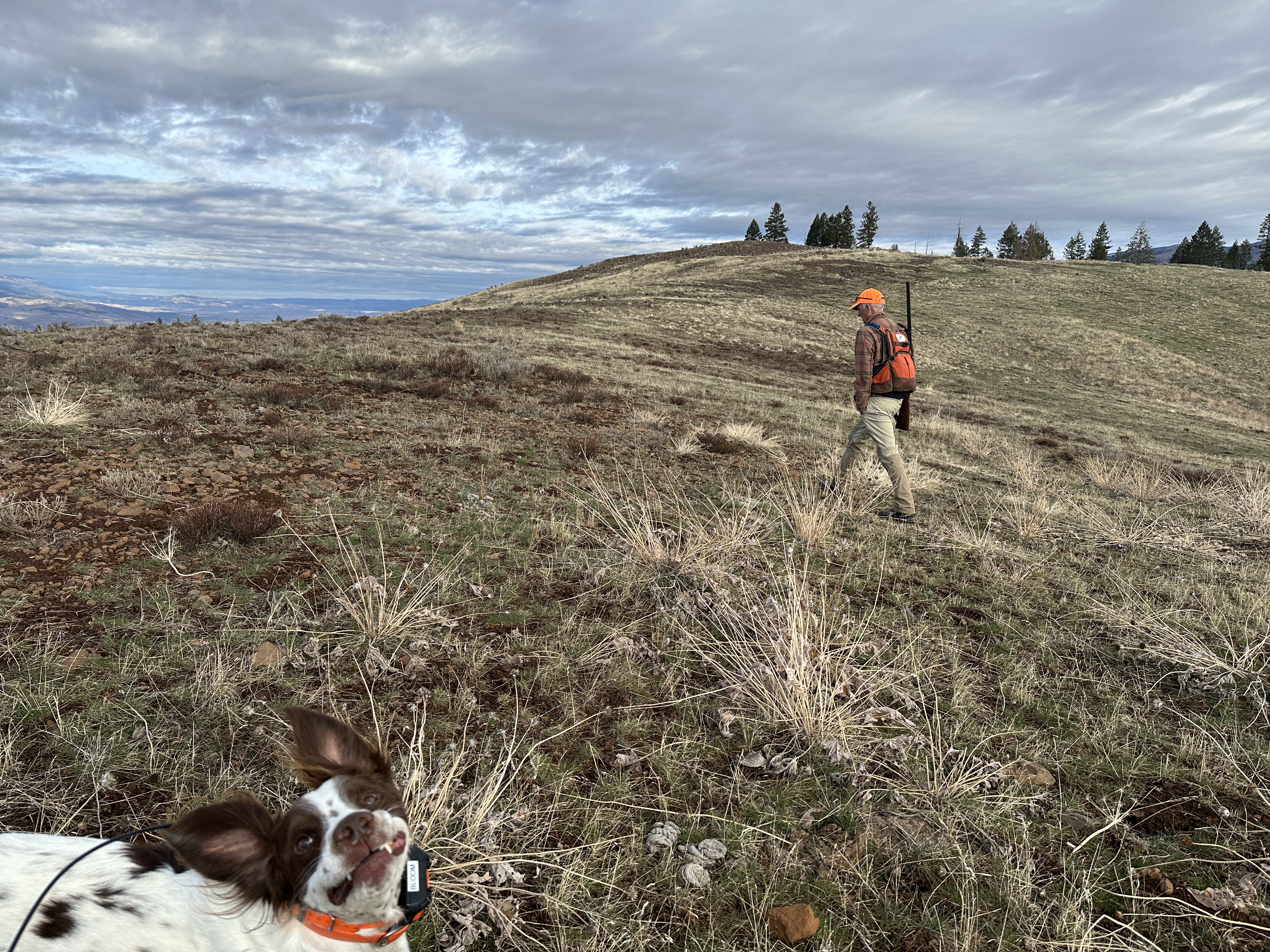
    The Hard Work Before the Shot award will without question go to Bloom. He covers much more ground than Peat does. Bloom averages more than four times what we cover, while Peat does almost three times our distance. Bloom in 18 hunts with me so far this season has run 272 miles, while Peat, in 22 hunts, has covered 237. We’ve noticed that when we all hunt together, Bloom tends to false point fairly often, especially at the beginning of a hunt. He definitely improves as the hunt goes on, but it’s almost like he’s trying to impress Peat, whose favorite thing in life is to honor another dog’s point (see my YouTube channel for many examples of this). Usually, Bloom’s first point of a hunt is several hundred yards uphill from where we’re just getting acclimatized, and we book it up to him, sometimes after he’s been stationary for up to 20 or 30 minutes, and as soon as we get up to him, he bolts. I’ve started calling it a “self-imposed whoa,” which is weird because Angus, who never once false pointed, always pointed with this very un-stylish posture (Angus is Bloom’s great-uncle). But as the hunt progresses, he seems to get more and more solid locating and pinpointing birds, which is really great. He tends to leave the retrieving and tracking duties to Peat, so it’s a good division of labor. I will say, though, in the couple of hunts I’ve done alone with Bloom that he has not false pointed even once, and has been an ideal hunting partner. It’s almost as if he’s trying to tell me that I can still do this when Peat is gone.

    A brown and white dog running through dry grass while carrying a bird in its mouth, with another dog in the background.
    Bloom doing his thing, whatever that is.
    A dog with a collar standing on rocky terrain, observing its surroundings in a grassy field.
    Bloom’s “self-imposed-whoa” posture
    A dog with a white and brown coat, wearing an orange collar, stands on rocky terrain in a grassy landscape, with hills in the background.
    Bloom in a “real” point (birds were there)

    Maybe the best thing that’s made this season, so far, really good is Leslie. I’m not sure about saying this because I realize it might make me look like much more of an ogre than I think I am, but she’s done two things differently this season than she’s done in the eight seasons since she started hunting. First is insisting I go alone with Peat every once in a while. As I’ve said, that’s been beautiful; I think it’s been beautiful for both of us because she’s gone by herself with Bloom several times and has really enjoyed that. Second is, when we all hunt together, she agrees to go where I want to go, and the discussions about the route we’ll try to take get vastly reduced. I’ll be honest here by saying that the main reason I have liked hunting for the 25 years I’ve been doing it is that when one is really hunting everything else disappears, including language and everything that stems from it. There’s nothing else like that for me (except, maybe, playing music). This, for me, makes it necessarily a solo endeavor. Any “foreign” intrusion on that — whether it’s your wife or best friend or boss or whatever — mitigates the escape from everything that is crucial to liking it, to wanting to hunt. So the thing I think I’m most grateful for this season, among many great things, is Leslie’s realization and appreciation of how and why I like hunting. It’s allowed me, for probably the first time since she began hunting (which was a huge step for her for many reasons), to sincerely enjoy hunting with my wife. I realize her sacrifice here, and that, as I said, I might look bad in the equation, but I’m just trying to be honest.

    A woman kneels in a grassy area, smiling while holding a chukar bird in her right hand. Two dogs are positioned nearby, one is a brown and white dog and the other is a tan and white dog. The background features a mountainous landscape.
    Leslie on a recent hunt

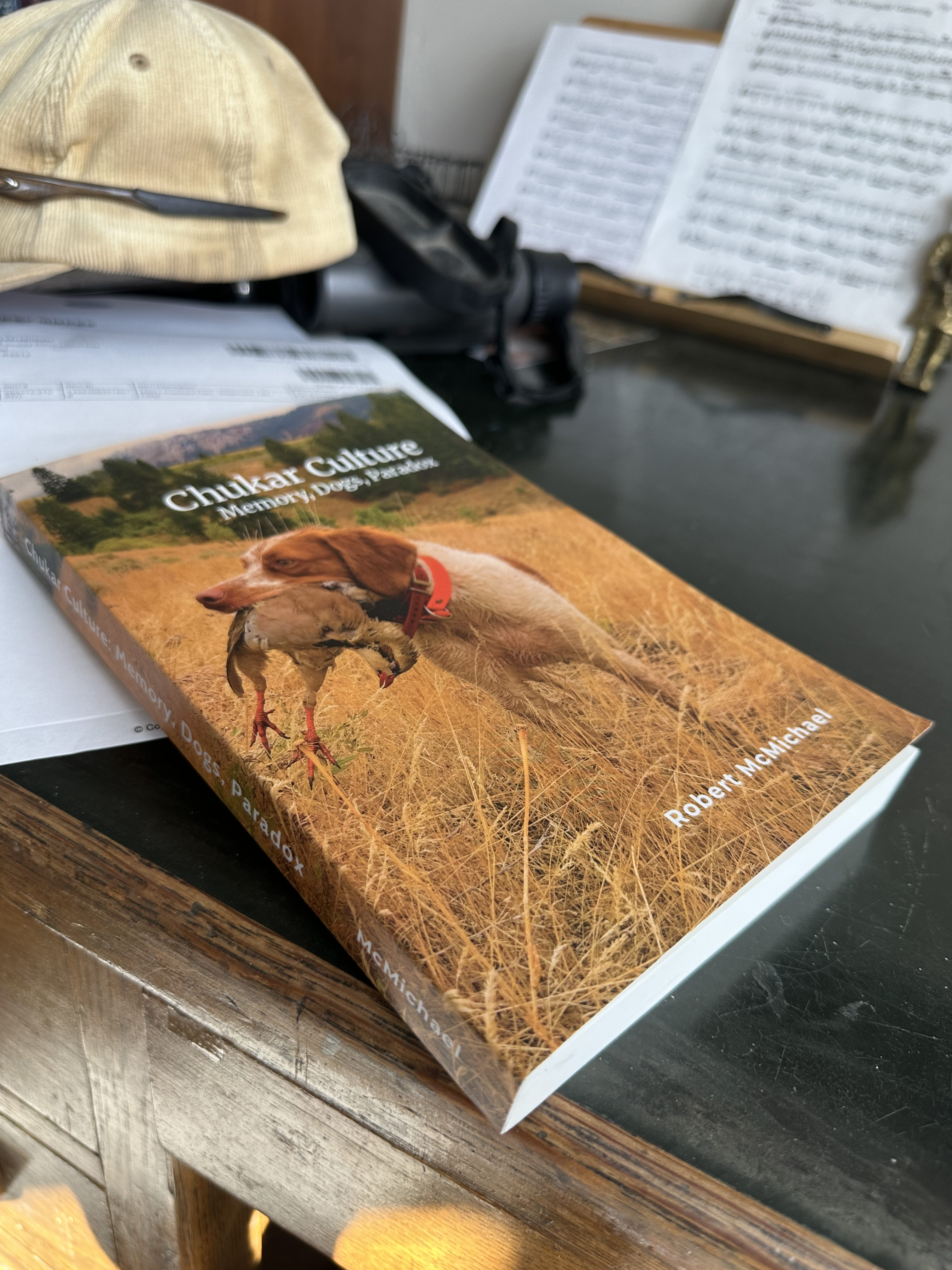
    Finally, the other thing that’s made the season so far very good for me has been the book. Many of you have bought a copy of Chukar Culture: Memory, Dogs, Paradox, and for that I’m very grateful. I’d love to hear what readers think about it, so if you’ve gotten a copy please don’t be shy sharing your thoughts with me. I’m trying to figure out how to market it better, but am kind of stymied there (i.e., I’m open to suggestions!).

    Book titled 'Chukar Culture: Memory, Dogs, Paradox' by Robert McMichael, featuring a dog holding a chukar in a grassy landscape.

    Speaking of merch: hats, shirts, and hoodies are coming soon. I will post here when they’re live.

    Thanks for reading, as always, and may your season be filled with as much world-cancelling experience as you’re looking for.
  • The Book

    The Book

    After all the pretty contrast of life and death
    Proves that these opposite things partake of one…

    –Wallace Stevens, from “Connoisseur of Chaos”

    Click the photo to go to the ordering page

    Well now I have a book about chukar hunting to offer. I published it myself (through my little press). It’s being handled, for now, by a print-on-demand business (Lulu.com), which prints and ships the book when someone orders it, although you still order it through Chukar Culture here (or you can just click the photo above and it’ll take you to the ordering page). It might take a week or so for orders to arrive. If it takes longer, or there are problems, then I’ll change things up.

    In the meantime, I’ll tell you I’m fairly happy with it. It’s largely composed of edited versions of many of the blog posts I’ve published here for the past fifteen years. There are some unpublished longer pieces, too, which I like as well as any of the already-seen things.

    The one thing missing, of course, is what I’ve liked best about keeping this blog going, which is the dialog from readers. The book would be twice as long (and twice as good) if I’d been smart enough to figure out how to include comments. Next time?

  • Book Review: Strategies & Tactics for Chukars and Huns

    There’s a new book out on chukar hunting, which I had a chance to read recently. Strategies and Tactics for Chukars and Huns, by retired wildlife biologist Mike Stamm, is currently available as an e-book on Amazon. It’s a welcome addition to the limited book-length information on chukar hunting, and — while looking at similar things as the books by Pat Wray and Richard O’Toole (whose book seems out of print) — focuses more on the title’s promise: how to hunt these birds successfully.

    Written in a straightforward, conversational way, Stamm’s book surveys what most experienced chukar hunters do to prepare for and execute a successful hunt, from equipment, clothing, footware (even more thorough than my several posts on chukar hunting boots), maps (real and virtual), and — most importantly — how to approach birds in different terrain and at different times of the season.

    We get a lot of questions from visitors to this blog about where to find birds. Stamm’s book is worth a read for people relatively new to this endeavor because it spends some time on what kind of habitat to look for (and how to look for it), and will give other more experienced hunters either new ideas about or validation of their own strategies and tactics.

    This is a self-published book, and is admittedly a work in progress. One of the things I like about it are the author’s own illustrations, which show a humorous side to the activity, which is in keeping with most serious chukar hunters’ self-conception: you have to be able to laugh at yourself to want to keep doing this ridiculousness; when the birds are laughing at you from the rimrock above, if you don’t laugh, too, you’re in for an even harder day. The illustrations also make me feel much better about my own shoddy artistic talent. So there’s that.

    My favorite illustration in Stamm’s book. I can think of other figures that visit (or live in) chukar habitat to describe as “outlaws.” I prefer to think of chukar more as naturalized overlords facing an invasion from bovine and ATV abuse.

    Two things missing from Stamm’s book, in my humble opinion, are (first) an informative diatribe about medusahead and the forces that have led to its status as the thing that will extinguish chukar in natural habitat, and (second) any mention of the best chukar dog breed ever, the Brittany. If you can look past those two things, I think it’s well worth a read.

  • Chukar Science

    Chukar Science

    A while back we took a shooting lesson from a certified shotgun instructor. We learned a lot, it increased the number of birds we bagged, and improved the ethical component of upland bird hunting: more clean kills and fewer cripples.

    The instructor, Joel Loftis, has written an impressively detailed guide aimed (pun intended) specifically at chukar hunters, and I’m pleased to offer it for sale in our Shop.

    The Chukar Hunter’s Wingshooting Guide, which Joel wrote as an extended syllabus for his shooting students, includes a ton of information about vision, balanced loads, patterning, setup, gun fit, strategy, and has the most extensive bibliography of any upland hunting book I’ve seen. The guide reflects the intensity of Joel’s instruction style, is remarkably well-written, and is based on an impressively wide range of research. Chukar hunters will know that there are a few books out there on hunting this stellar bird (name the books), but none of them go into the level of detail Joel provides in this guide. Below is a photo of the Table of Contents. Check it out.