Hunted an old favorite yesterday, and I’m not hiding the location because I’m afraid it’s not long for this world.
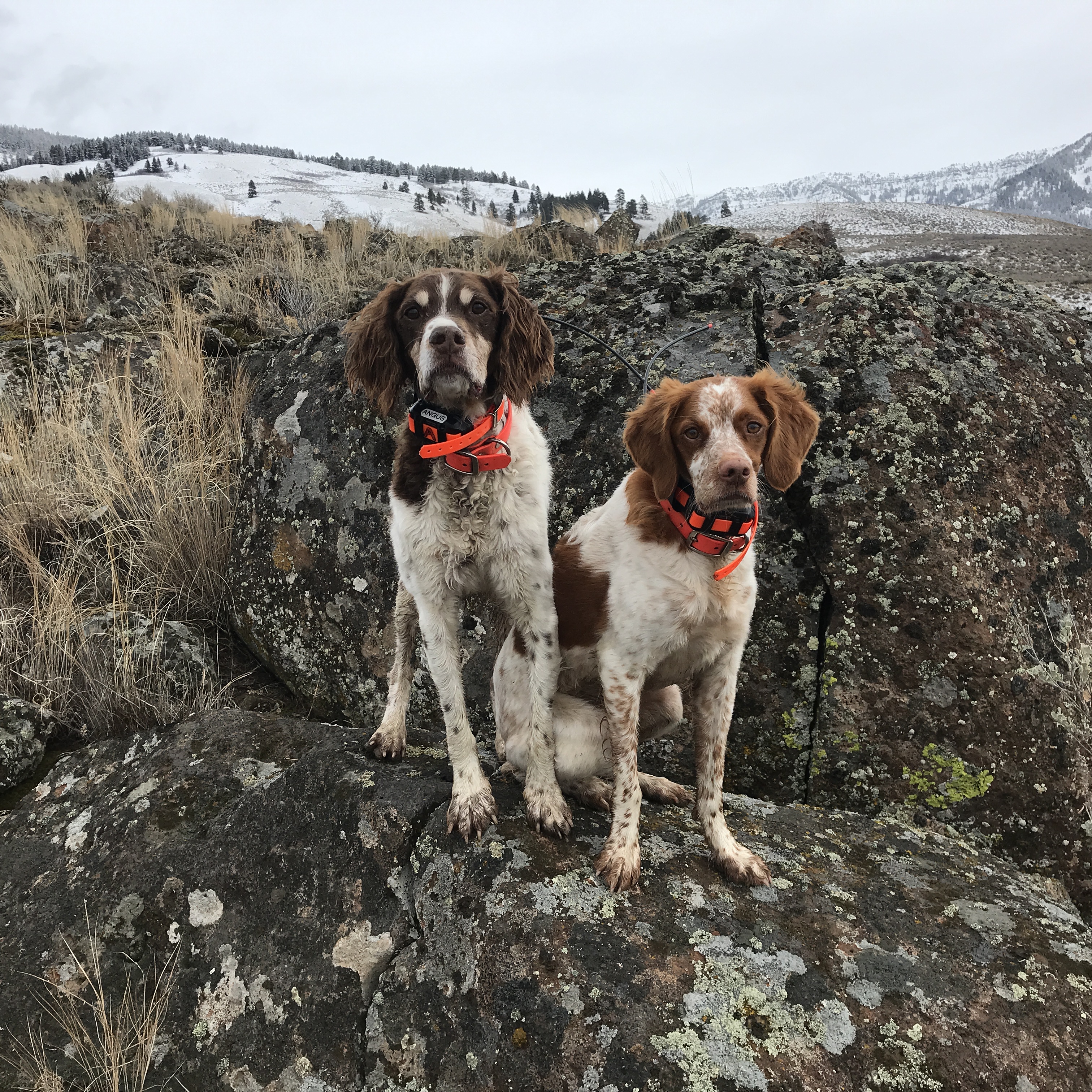
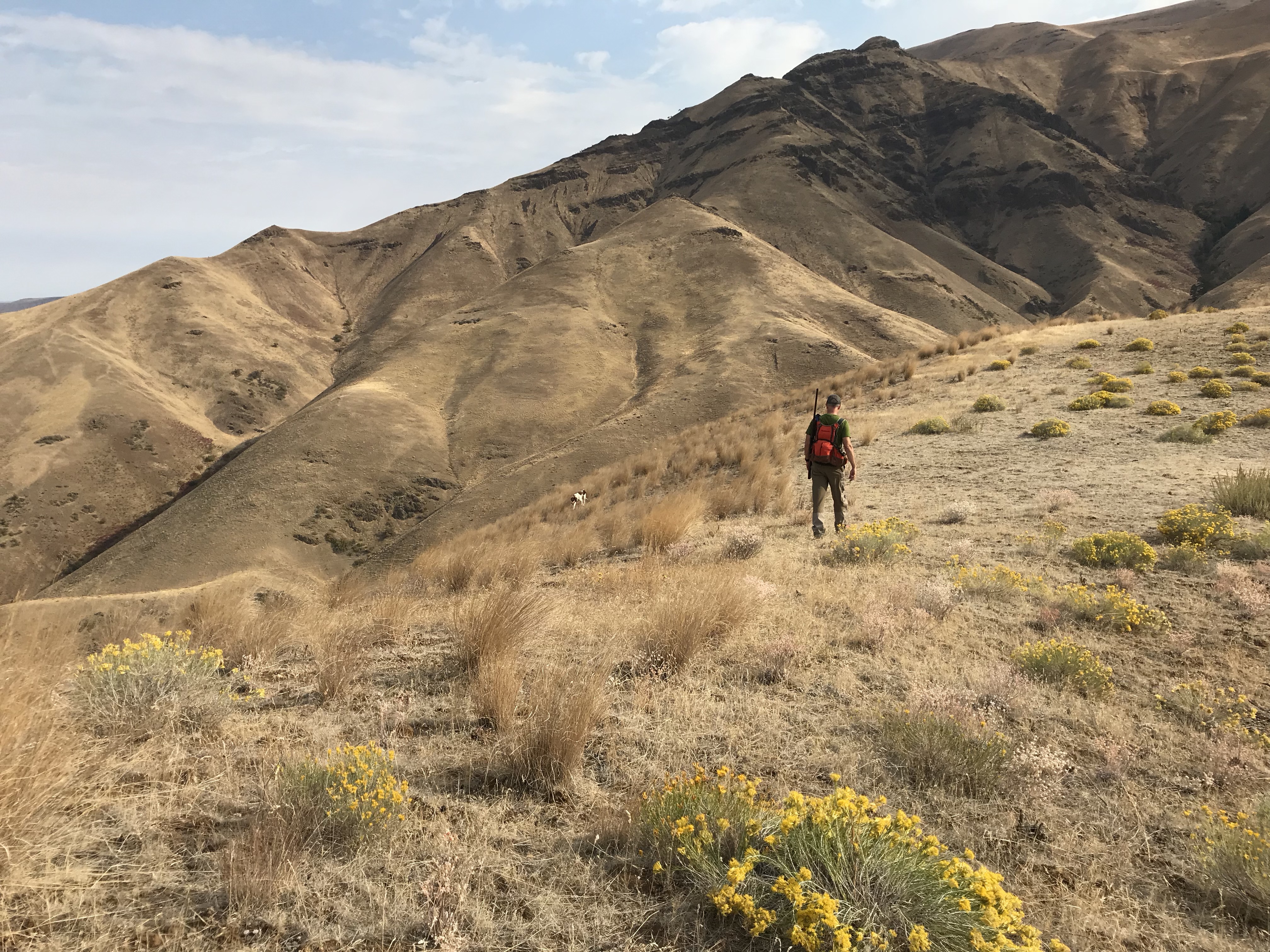
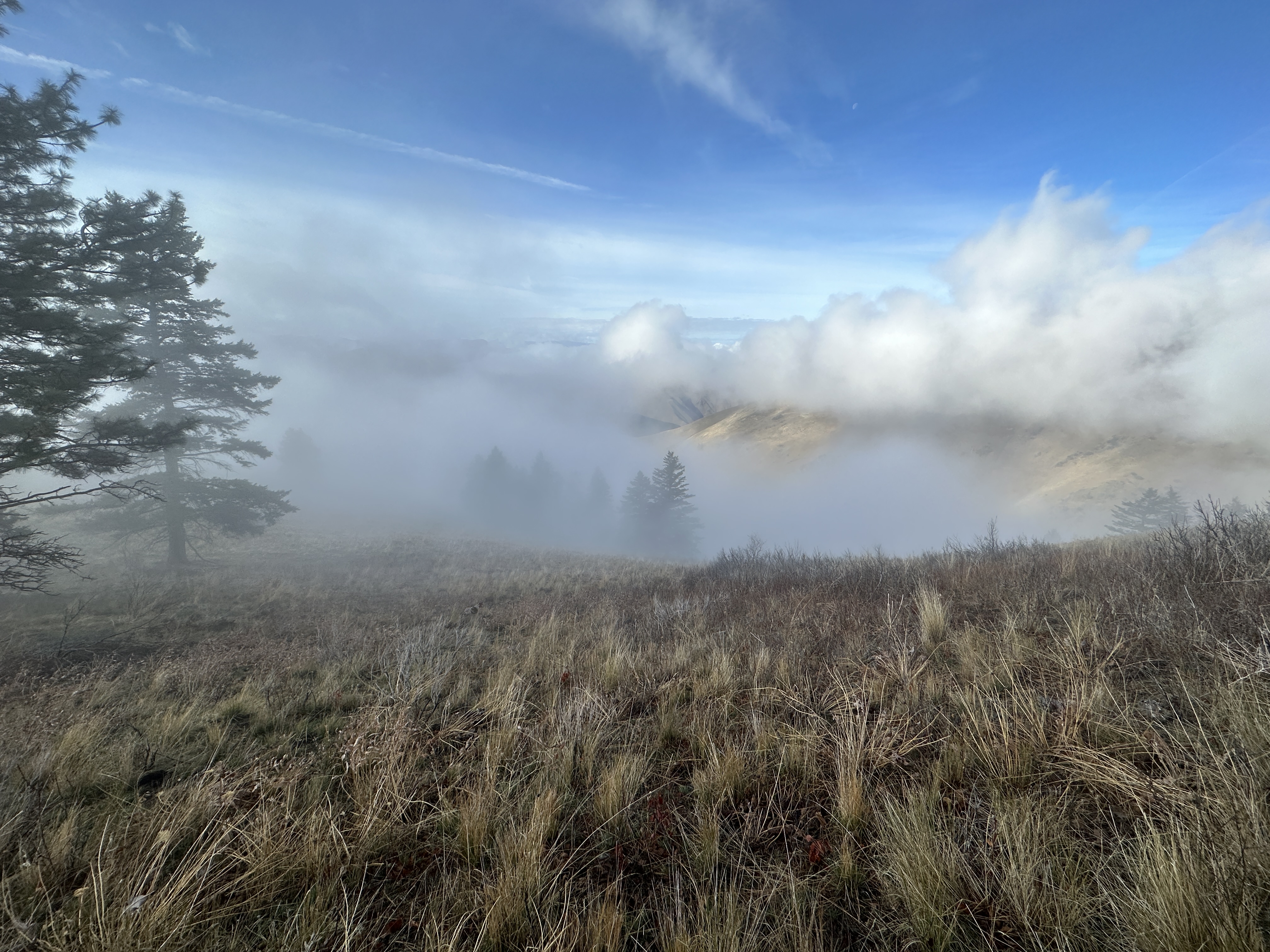
Peat and I went out for a rare solo hunt (Leslie and Bloom are nursing hurt wheels). The rationale was that the forecast was for nicer-than-normal weather with no precip, with an atmospheric river heading our way for the next week. We like to take advantage of windows. We headed out into torrential rain and wind, which I thought must be some kind of cosmic error that would soon be corrected. Instead, the rain continued for quite a while, then turned to fog so dense I couldn’t see Peat 20 yards in front of me. Finally, after a couple of hours, it got gorgeous, and stayed so.


We saw a lot of chukar, and Peat pointed almost all of them we saw. Unfortunately, despite the fact that he held the birds for up to 10 minutes (some of his points were a couple hundred yards up steep hills), they all busted before I got to within 50 yards. No shots on those. Overall, it was a great hunt — by far my longest of the season (8.6 miles) and the second longest of my entire chukar hunting history, with the second most elevation gain ever for me (2800 feet). Peat ran 25 miles and did about 7,500 feet of elevation gain. He’s a bit sore today (as am I). One chukar in the bag, though, after all that doesn’t pencil out on a caloric replacement scale.

Two things must be shared about this spot: first, it’s apparently being liked too much by hunters (I don’t know of an area in Hells Canyon that gets more pressure). Ben Jonson’s suggestion that what we love we might want not to like too much seems worth reflecting on.
Second, it looks as though it’s about to become a huge open-pit silver and copper mine. Most of the land sits on more than one-third of the Cecil Andrus Wildlife Management Area, on land owned by the state of Idaho (and thus, you and me, right?). A Canadian mining company called Hercules Silver Corp acquired the mineral rites in 2021 and has been conducting exploratory drilling and geophysical tests since then, with a massive expansion of the project in 2023. Their investor presentation hawks the project as “Located in the state of Idaho, with a pro-mining congressional delegation, governor and state legislature, and local political support for the project.” And, “Long established mining history with streamlined permitting…” I know nothing about mining, which allows me to be flabbergasted by the Hercules’ investor newsletters bragging about finding 2.6 grams of silver per ton (I do know that there are 454 grams in a pound). It seems like not a lot of silver in a ton of excavated earth. I’m probably missing something.

It does seems strange that all this is happening on public land, but apparently it’s all legal and relatively easy in the state of Idaho, which is apparently populated by dupes, if I take Hercules’ implication correctly. I’ve been unable to find any reporting on this project in the press, and it doesn’t show up in a search on the Idaho Conservation League’s or Idaho Wildlife Federation’s websites; I contacted both organizations about Hercules several weeks ago and haven’t gotten a reply. Unlike federally owned BLM and Forest Service land, Idaho state land apparently doesn’t require a public comment period for projects impacting the environment. But the fact that Hercules has brought a massive amount of heavy machinery and pallets of 5-gallon buckets of chemicals related to the drilling operation up these tiny gravel roads and been running high-voltage electrical cable and high-pressure 1″ air hoses across the entire area, which covers about 10,000 acres, makes me wonder. Yesterday, Peat pointed a covey of chukar about 30 yards from heavy equipment and excavation activity; if I’d shot I’d have peppered the workers. While we searched a thicket near a pond for a grouse, a truck drove up and the driver got out and powered up a nearby high-powered air compressor. The gates to get into these areas have small handmade signs announcing the high voltage wires with “DO NOT TOUCH WIRES.” The wires are everywhere, and hard to see, only about 1/16″ of an inch thick. Peat and I tripped on them numerous times. I’m assuming we were just lucky they weren’t energized. I wonder.
I’m trying to find out more about this situation, and will share what I discover. This was one of my all-time favorite places to hunt, so I’m part of the “liking-it-to-death” factor (although this was the first time I’d hunted there in three years; I won’t be back). I know others who love this spot, not just for birds but for big game. It’s important wintering ground for elk and deer which, unlike chukar, are endemic. But still, it makes me sad to see it getting ripped up. And it won’t get put back or made right again. Ironic that it’s happening on the Cecil Andrus Wildlife Management area, which is managed by Idaho Fish & Game. It makes me think of one of my favorite passages in literature, the last paragraph of Cormac McCarthy’s post-apocalyptic novel The Road.
“Once there were brook trout in the streams in the mountains. You could see them standing in the amber current where the white edges of their fins wimpled softly in the flow. They smelled of moss in your hand. Polished and muscular and torsional. On their backs were vermiculate patterns that were maps of the world in its becoming. Maps and mazes. Of a thing which could not be put back. Not be made right again. In the deep glens where they lived all things were older than man and they hummed of mystery.”