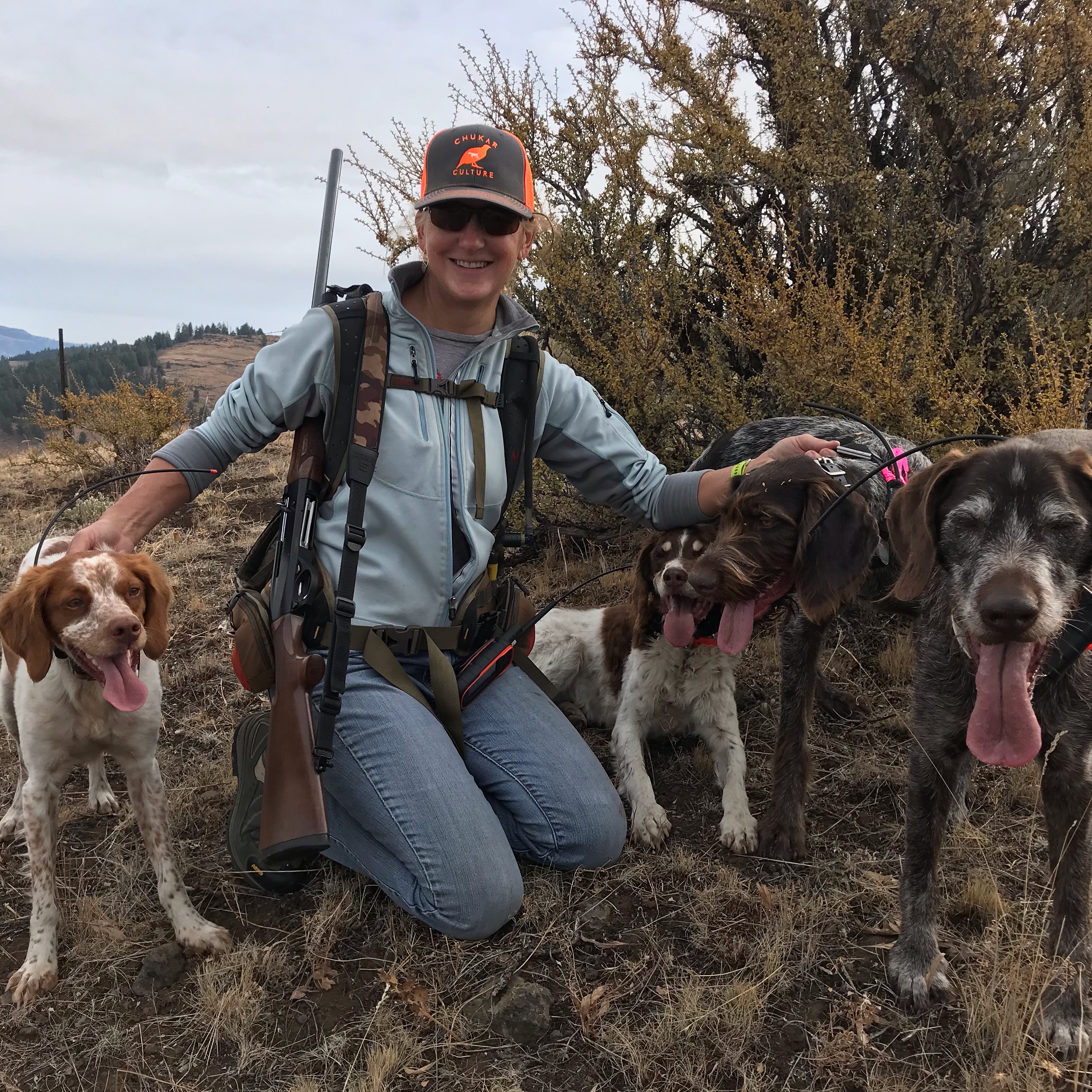
I admit it, I’m a sucker for trying to take a good shot or even a bad shot. A snapshot, that is. I always swear I’ll leave my camera or phone tucked away while I’m hunting but end up breaking my own rule. Bob even went out a couple of times without his gun and got some beautiful shots.
Tomorrow is season opener for chukar and grey partridge in Idaho. This will be our 10th year sharing stories and photographs of hunting wild birds in addition to sharing just a small taste of the culture of upland life in our neck of the woods.
A lot the hunts from last year were challenging, but we always have a fun and wonderful time when hunting alone or with family, friends, and good dogs. These are some of our favorite moments from the 2018/2019 season.
Thank you for following along on our journey each year. Maybe we’ll cross paths with some of you out there reading this right now. If we do, we look forward to meeting you.
Enjoy your season, happy hunting.
Leslie and Bob
Looking backSun and sagebrush
The low creep
In the bag
A walk for chukar with some Virginians
The wallDouble pointFinnFour pointing dog day
Pot of gold
New friends and old friends
The color of the season
Fence lineFavorite shade of blueHungryHoarfrostChargeAfternoon traverseThe long descentSamNose to the groundCovey riseInto the cloudsFocusedAged warrior
I’m seduced by landscapes. I’m enthralled by them.
Camping next to the Missouri River in Montana for most of the summer, Bob quietly tied fly-fishing flies while Angus slept near. A book sat on the table, a gift that arrived in our mailbox shortly before we left Idaho, given to him by a close friend. Not planning on looking at the book because I had brought along other things to read, I picked it up, thumbed through it, and immediately became obsessed with it. The beautifully written Landmarks by Robert Macfarlane is a gorgeous book on the language of landscapes and nature. It’s a collection of words drawn from dozens of languages and dialects of the British Isles to describe land, nature, and weather. It’s a passionate defense of nature as well as the importance of reflecting nature in language.
The book’s epigraph resonated with me and I’ve been unable to get it out of my head. “Scholars, I plead with you, Where are your dictionaries of the wind, the grasses? ” Norman MacCaig (1983)
There are too many definitions of words in the book to pick my favorites, but one that I like is zwer, “the whizzing noise made by a covey of partridges as they break suddenly from cover. “
Robert Macfarlane writes, “Without a name made in our mouths, an animal or a place struggles to find purchase in our minds or our hearts.”
The Oxford Junior Dictionary chopped words when reprinting its latest edition. Words like beaver, heron, minnow, dandelion and willow are now gone and they added chatroom, cut & paste, voicemail, and biodegradable instead. According to recent studies from The Nature of Americans, children are spending less time outdoors and in wild places.
We need to keep the words for the wild things. We need to make sure we never forget these words.
The swirls in the snow made by grasses blown by wind: anemographia.
While out upland bird hunting up and down the steep mountains, I get easily distracted. I’ll take my gloves off to touch with my bare hands the rough surface of the basalt rocks covered in patches of lichen shaded rusty orange and bright chartreuse green. I’ll gaze up into the sky to watch the bald eagles or red-tailed hawks catching the wind currents. I’ll push my way through the wild sunflowers with their brilliant yellow and delicate petals. I’ll slalom through the sea of sage with their three-lobed silvery green leaves, grabbing them in handfuls and pressing them up to my nose to inhale the bitter and earthly fragrance. I’ll stop to look at the knee-high dry grasses in the late autumn that show signs of new life as blades of green poke up through the dirt. In the winter, I’ll stop and look down at fresh snow and examine the swirls that the grasses made on the surface on a very windy day or admire the hoarfrost on a cold morning hunt.
During these moments of admiring the wild things, sometimes I forget I’m hunting and trying to keep up with the dogs to look for birds. Maybe I’m hunting for the wrong reasons or maybe I’m hunting for the right reasons? Maybe I’m hunting something other than birds.
Magical point. Hoarfrost: deposits of ice crystals on objects exposed to the free air, such as grass blades, trees, or leaves
The culture of chukar hunting in our neck of the woods is pretty evident all-year-around. Go to one of our fall 8-man home football games or a local cross country meet and you’ll see your share of Chukar Culture hats on the sidelines. We’re wearing them, parents are wearing them, the out-of town Virginians who come here every fall to hunt are wearing them, and the kids who think their English teacher Mr. McMichael is pretty cool and want a Chukar Culture hat just like he wears are wearing them.
We’ve given more hats away than we’ve sold; it’s okay, we’re not selling hats to make money anyway. The students are curious about chukar hunting and have gone through four years of high school living vicariously through the adventures of Peat and Angus.
One kid, a local 12-year-old, who completed the hunter education course a couple of years ago asked us to take him bird hunting this past weekend after hearing stories about Peat and Angus from his older brothers. We’d taken kids hunting before and the theme it seems when we pick them up at their home is that they’re usually not wearing terrain-appropriate footwear. We’ve had kids tag along with us wearing anything from colorful moon boots, rubber rain boots with no traction, or sneakers. The new kid yesterday, was wearing his Mom’s old running shoes.
We hauled the new kid up and down steep hills yesterday in the pouring rain looking for dusky grouse in the big stands of pine trees next to the sea of fragrant wet sagebrush. We all got drenched, and Peat and Angus were soaked to the bone and covered with stickers. We found lots of birds down in a deep draw but the uphill climb back to the pickup was challenging even for me in this early season. All of us were tired and wet but the kid never complained, despite the fact that his feet were soaked and he’d been slipping up and down the hills in them all morning. Like his older brother before him, he was a bonafide trooper. He asked lots of good questions about bird hunting, and hopefully he’ll want to tag along when the chukar season opens soon.
Grouse tree and the kidLooking for a way up through the thick brush
On the drive home, we asked him what size shoes he wears, but kids’ feet grow like weeds. This week they’re a size 6. We’ve got a crap-ton of old boots on our shelves in the garage, sizes men’s 9 and women’s size 10. We save our old boots as back-ups just in case, but usually they just gather dust until we eventually donate them to the thrift store. I wish some of our boots would fit the kid. We can take care of getting him a hunter orange hat to wear in the field but if any of you out there have any smaller sized, old boots also gathering dust could you send them our way?
When Peat was 7-months-old, we took him hunting with Angus to a place where his day of hunting lasted exactly 15 seconds. Upon arriving to our hunting destination, we let both dogs out of the pickup and before we knew what was happening we saw Peat streaking a 200-yard beeline to a covey of Huns that were hunkered down in the sage. Standing next to the pickup, we watched in horror as he flushed them before we could get there and then he proceeded to chase them for another 200 yards. Bob was furious and immediately banished him to the pickup and into his crate of shame for the remainder of the hunt. He sat there, staring out through the metal grates wondering what he’d done wrong.
Yesterday, I took our old Jeep out for a long drive with the dogs on dusty, washboard, gravel back roads near that place with them bouncing around in the back and thought of Peat and his rough start into the world of hunting his first season. If you’ve been following this blog since we got Peat, you’ll know what I’m talking about.
The following video is a tribute to the dogs. Most of us wouldn’t be doing this compelling sport if it wasn’t for them.
We all have our stories about how bringing a dog into our lives changed it, enriched it, or sometimes made it more complicated. We have our own tale going back to the beginning of Chukar Culture and where it all got started with this one particular Brittany named Angus who is now 12-years old. Looking back at it all, because of this one dog our lives ended up taking a route that might have gone in a different direction or maybe we wouldn’t even live in a part of rural Idaho where we purposely put ourselves to be closer to abundant public lands for chukar hunting.
The reality of getting my first puppy and converting from a cat person to a dog person didn’t come until later in life. Growing up in rural Eastern Oregon, we always had a menagerie of outside cats and kittens that I’d dress up in doll clothes whenever I could catch them. We did have a couple of dogs, my Mom had a small white poodle that only liked her and my Dad inherited a bird dog, a large Weimaraner from a neighbor that lived down the street. My dad wasn’t a bird hunter or any kind of hunter for that matter, but Greta, named after my Dad’s aunt, lived in a kennel in the backyard and was never let inside the house. Every once in a while, I remember my Dad letting her out of the kennel and into our fenced back yard to run. My brothers and sister and I would all run for cover in fear of her running over our bare feet as she did hot laps around the grassy yard. At the time, I didn’t know that this would be my first introduction to high energy bird dogs.
Back in 2007, Bob and I had only been married for about four years and were both 44 years old, over the hill, I thought at the time. We both met and married later in life and this was about the time when people stopped asking me if I’d ever have children. Bob was working in the aviation industry and was in Calgary, Canada while I was home alone with a few evenings to myself. On the first night, I decided to start looking for Brittany puppies for sale. Bob and I had talked about getting another Brittany, probably another female, orange and white, just like Glenna, our only other dog at the time. Glenna was one year old when Bob and I first met, but I wanted one just weaned to experience early bonding with my own dog and to see what it might feel like, and I hoped it might fulfill my lack of not having children and the maternal instinct that I thought was deep inside me.
Sitting down at the computer I searched “Brittany Puppies Idaho.” The website Gun Dog Breeders came up and I found a link to Sunburst Brittanys. Wow, that was easy! I clicked on the link, and photos of a litter of tri-colored American Brittanys popped up on my screen. I was smitten! I loved the coloring and especially their cute caramel colored eyebrows, and — best of all — they would be ready to come home with their new owners in a week. I forwarded the link to Bob to check them out and then immediately emailed Sunburst to inquire about availability of the females. The breeder, Gabe, replied back the following morning, and informed me that of the litter of 10 puppies, eight were male, 2 were females but the females were already spoken for. My heart sunk. Later that night, I called Bob on the phone and told him the bad news. He said, “We could get one of the males as long as we can name him Angus.” He’d fallen in love with the photos of them too and wanted to go look at them as soon as he got home.
Angus’s litter, born June 2nd, 2007. Sire and dam were Sumac and Sage. Angus is at the far left.
Bob returned from his business trip just before bedtime, a day earlier than expected. Excited to go see the puppies he rode his motorcycle 14 hours non-stop from Waterton Lakes, Canada to Boise with only a couple of quick stops. In the morning, we drove out to Emmett to meet Gabe at his kennel located on a hillside at the base of Squaw Butte. Interestingly, Squaw Butte, located North of Emmett, was one of the main places in Idaho where chukar flourished rapidly when they were first introduced as a game bird in Idaho back in the 1950s.
Gabe’s operation at Sunburst Kennels in the early years, as far as we could see, was just a small fenced-in area in the backyard for the puppies. We could tell right away that Gabe was very passionate about what he was doing and wanted to make sure we got the dog we wanted. It didn’t take us long; Angus was the only one that came running to us. We left Emmett that day with wee Angus, a week earlier than recommended by most authorities (42 instead of 49 days). For years, we wondered — whenever something wasn’t quite right with Angus — if we’d taken him from his litter too soon. If we did, then he and we have gotten over it. Some experienced hunters have told us he’s the best bird dog they’ve ever seen. I’m certainly not complaining (or taking credit for his ability and skill; I’d blame Gabe on that one).
Baby Angus
When we arrived to Sunburst Kennels and met Gabe for the first time, we weren’t really looking for a hunting dog, we just wanted another Brittany. At this point in our lives, Bob hadn’t been doing much hunting because of his very busy job and because Glenna was one of those bird dogs you’d let out of the truck and then would disappear for hours before finally returning when she felt like it. When she did get the whim to hunt it was for herself, and she’d move every bird for miles into the next county. These were the days before we owned or started using electronic dog collars to control the dogs.
Glenna died when Angus was only three, and Bob finally took Angus chukar hunting for the first time. Aside from going grouse hunting a couple of times, Angus naturally pointed chukar, having honed his skills on squirrels in our backyard. From one of his first points when tagging along with Bob during his chukar hunt, I captured a photograph of Angus pointing and we knew we had something special. Chukar Culture and our blog started at this exact moment.
Young Angus, natural chukar pointer and the photo of the moment that started it all.
When Angus was eight we decided to get another Brittany from Sunburst. Bob contacted Gabe to see if any more of Angus’s line was around. To our disappointment, Angus’s line was no more. Gabe said that he was expecting a litter from a set of new totally different dogs that he was certain would be great hunting dogs. So, four years ago, we got Peat, our second Sunburst Brittany and my second puppy, and this time I got to name him. He’s a combination of American and French Brittany with a beautiful orange and white roan coat and scattered ticking on his forehead. We like his funny and affectionate personality, his smaller size, and his off-the-charts natural hunting ability and prey drive. Gabe was right, this line is fantastic! (If you’ve read this blog for a while, you know the true story on Peat.)
Bob and I sat down with Gabe and his wife Katie recently at their beautiful home and kennel, now located next to the banks of the Payette River in New Plymouth, Idaho. We got a tour of their kennel and met a litter of adorable 5-week-old puppies almost ready to go home to their lucky new owners. Katie, with the help of Praire, their 10-year old daughter, cooked Indian chukar curry from an old family recipe, sharing some of their chukar breasts from the past season. Over this and some delicious local craft beers we had some intimate conversations about life, dogs, hunting, ethics, and how it seems as we’ve gotten older the number of birds harvested isn’t as important as much as the experience of being out there hiking around public lands in some incredible places around Idaho with our family and dogs.
Gabe told us how a Brittany changed his life. A fifth generation Idahoan, Gabe grew up upland bird hunting in the chukar hills near his home in Emmett with his family, and hunting pheasant in the the empty fields nearby before they were all turned into subdivisions. Gabe became interested and fond of the Brittany breed after reading a book about them when he was a kid. When he returned from his two-year church mission following high school, he said he was a changed person. With some soul searching he said he had to make some tough choices and re-examine the path his life should take, and it started with getting his first dog of his own back in 2002, a Brittany that he named Sumac. Another choice, even more portentous, was to leave the church. He said he hasn’t regretted that decision, but that he has suffered some strained personal relationships with family and some friends because of it. During this transition, he met and married Katie, started his own family, and decided to become a Brittany breeder, all in a short period of time.
Sunburst Brittanys, the early years. (This and the following photos are courtesy of Gabe and Katie Mouritsen.)
Sumac, Gabe’s first Brittany.
Gabe and Katie over that past 14-years have meticulously bred their dogs. Gabe has done extensive research on pedigrees and genetics, and has found what for him is the perfect combination of Brittanys not bred to be field trial dogs but bred specifically for hunting and for family pets. Their approach works, but it’s no accident and they’ve worked very hard to build their kennel to where it is today. Not everyone looking for an upland hunting dog wants a dog like the ones they breed, but most of their new litters are sold before they are even born, and their dogs are now all over the United States, as far as New York and Alaska. We’ve been lucky to have had two of them and hope to get our third in the next couple of years.
These days Katie has taken on more of a major role in managing the kennel now that their three children are in school. Besides just taking care of the dogs on a daily basis she’s learning more about gun dog training and handling and just this past season, Katie decided she wanted to upland hunt and did all the proper things to make it happen. The cool thing about Gabe and Katie is that besides breeding these amazing hunting dogs the whole family upland hunts together. This past season their oldest boy Nathan got his first chukar while out hunting with his younger brother Kurt, and Prairie can’t wait until the day her arms are strong enough to carry a heavy shotgun so she can start chukar hunting. A multi-generation Idaho upland family for the future! A very happy and wonderful family, I might add.
Idaho upland family
Nathan and Kurt admiring a grouse up close. Serious props for the hats they’re wearing.
10-year old Prairie relaxing with the dogs after a hard hike in chukar terrain.
Nathan and Kurt checking out a chukar hotel.
Nathan after the retrieve.
Prairie documenting chukar hunting, but not for long. She hopes to carry a .410 soon.
Kurt surrounded by the Sunburst clan. Sioux and Candy (L, R) are Peat’s sire and dam.
In the end, you look back at your choices and wonder if you made the right decisions. It was a dog that saved Gabe and it was Gabe and Katie’s dogs that saved me. In a sense, Angus and Peat are my children.