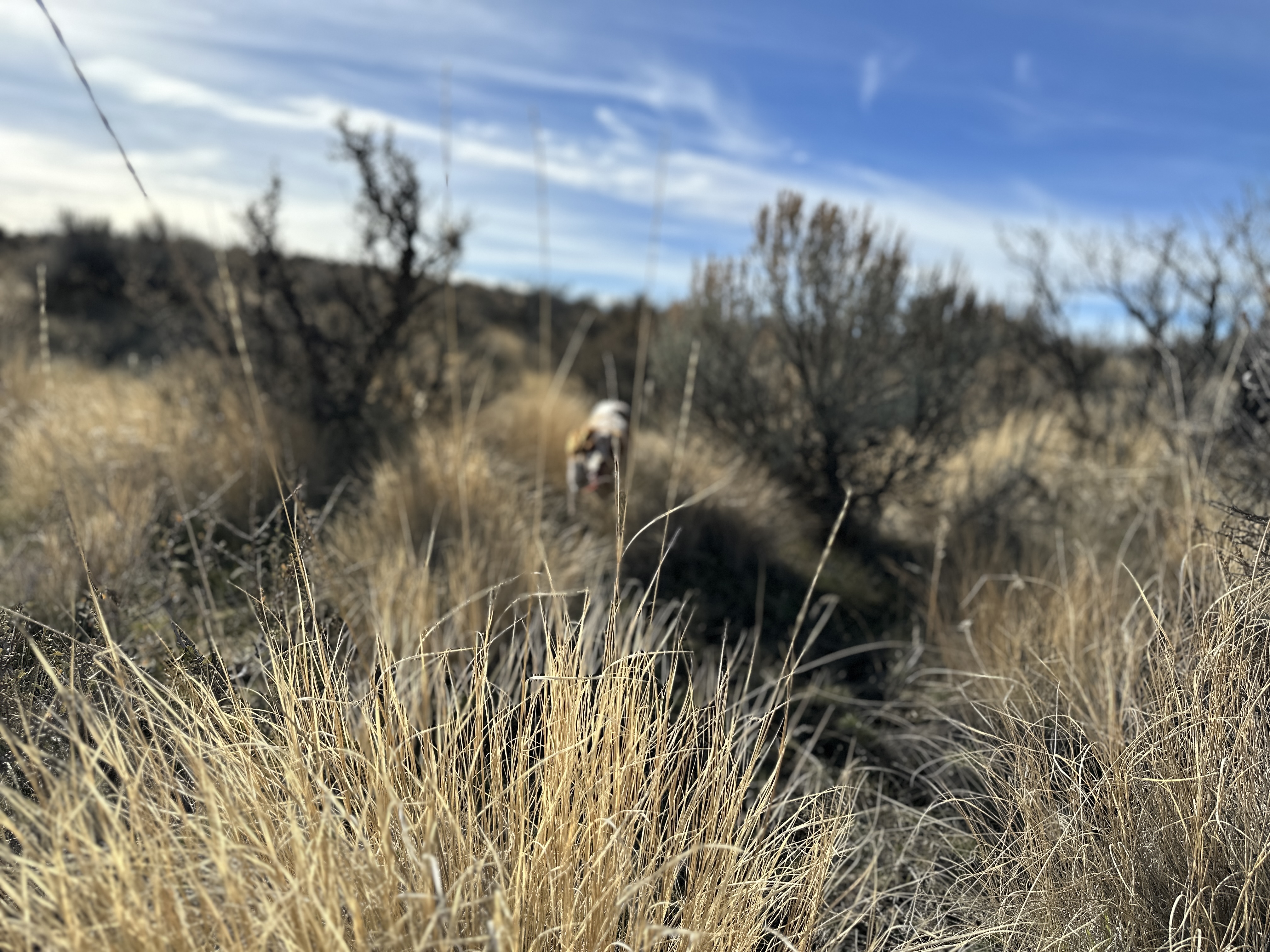
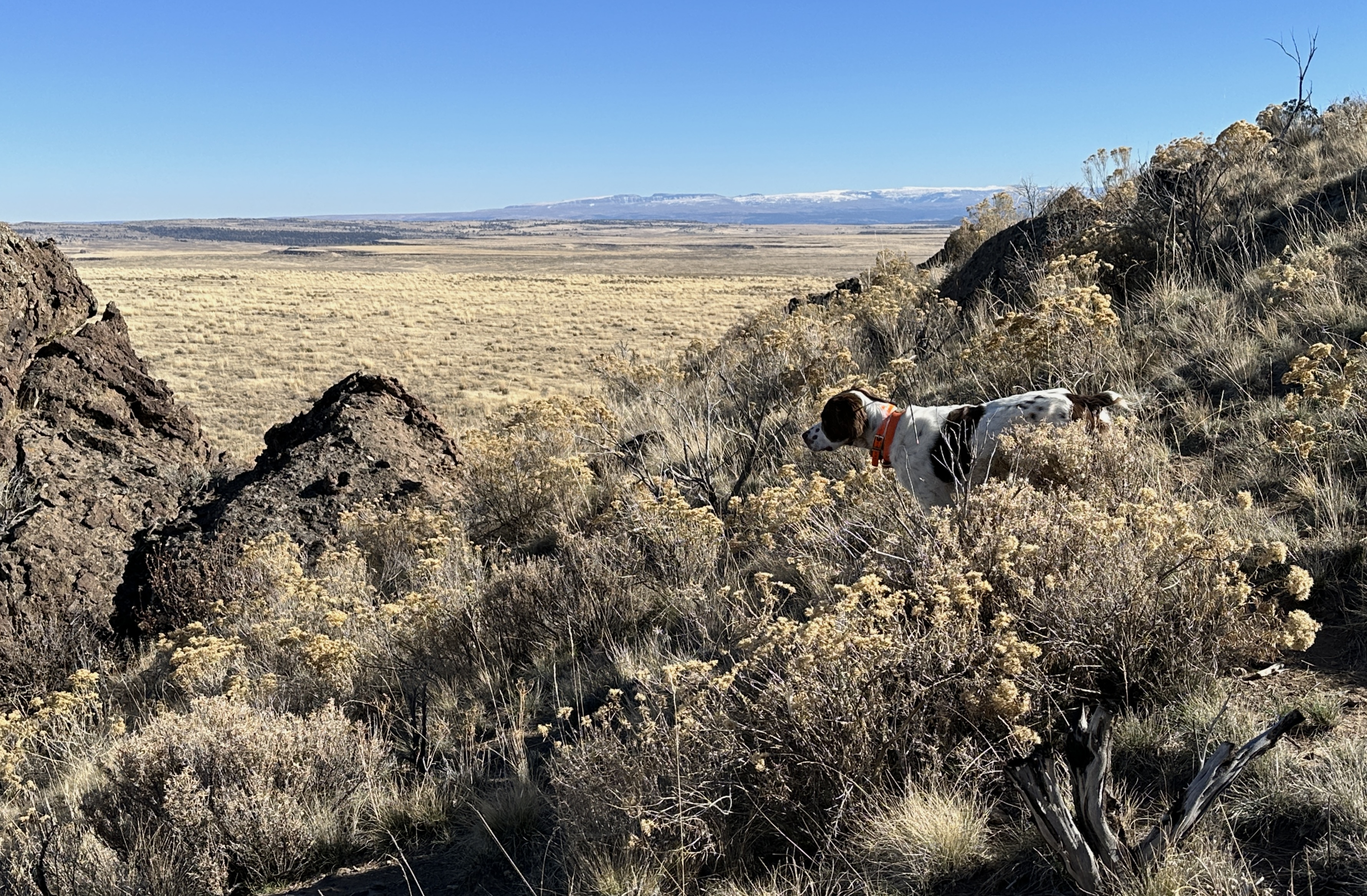
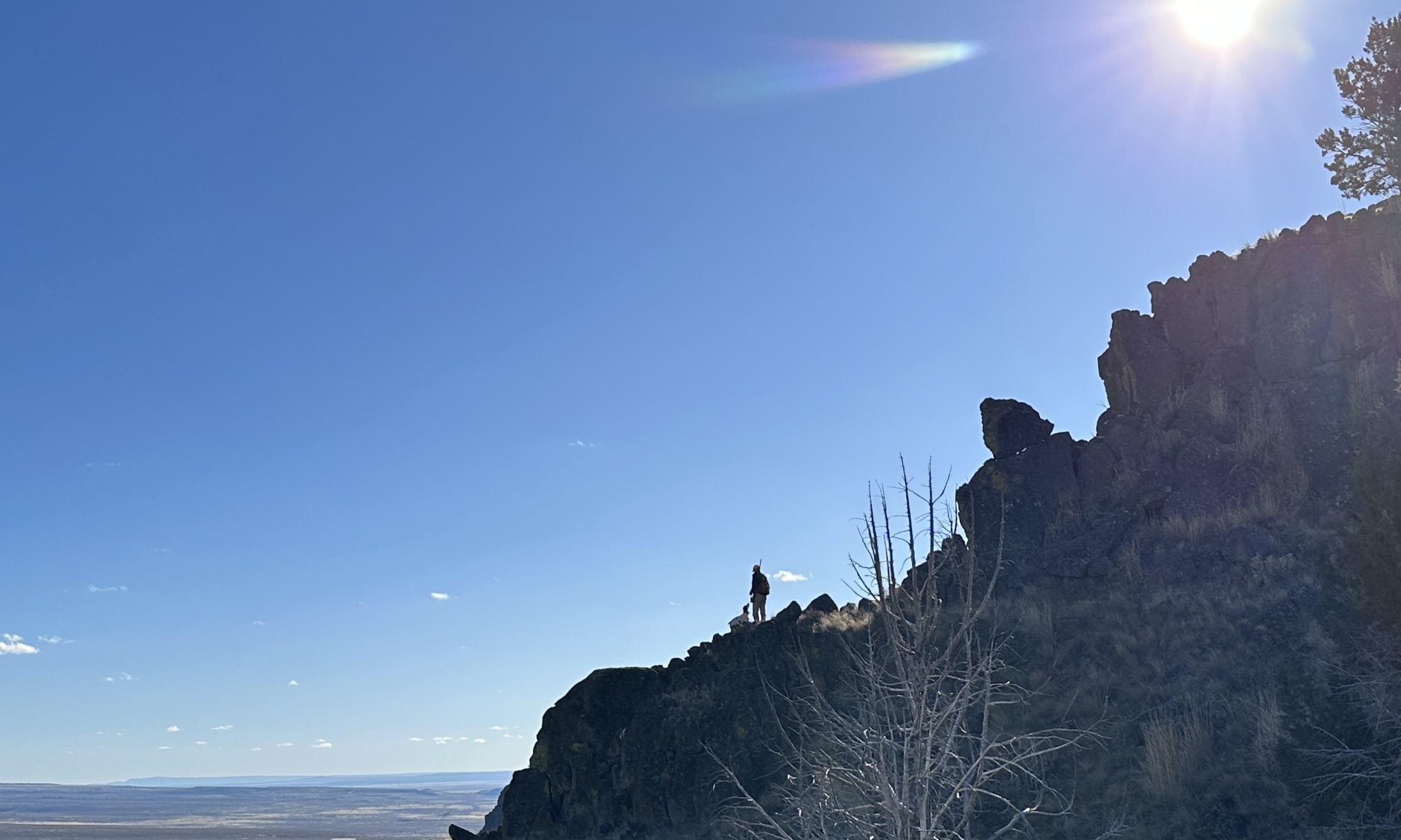
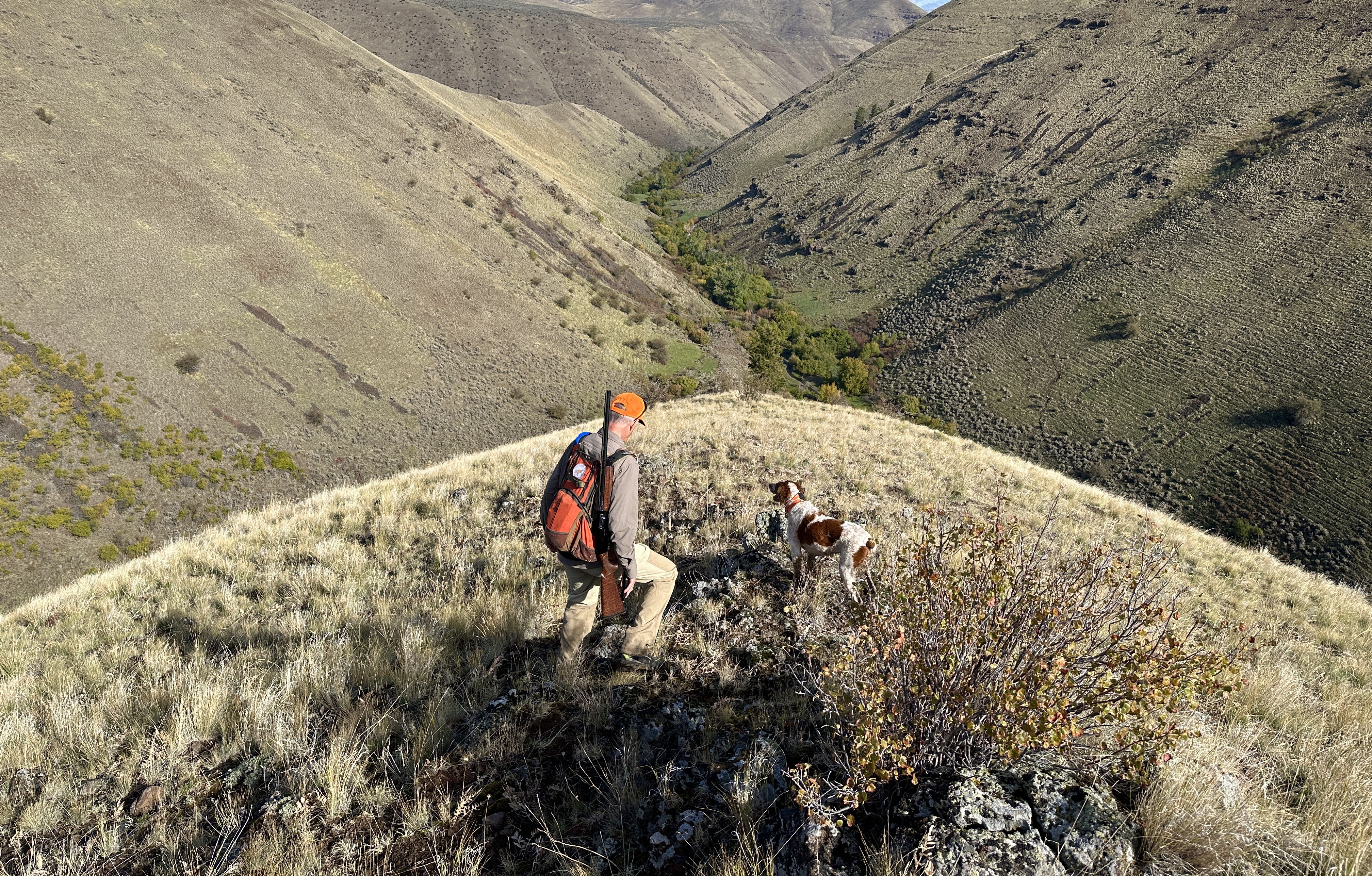
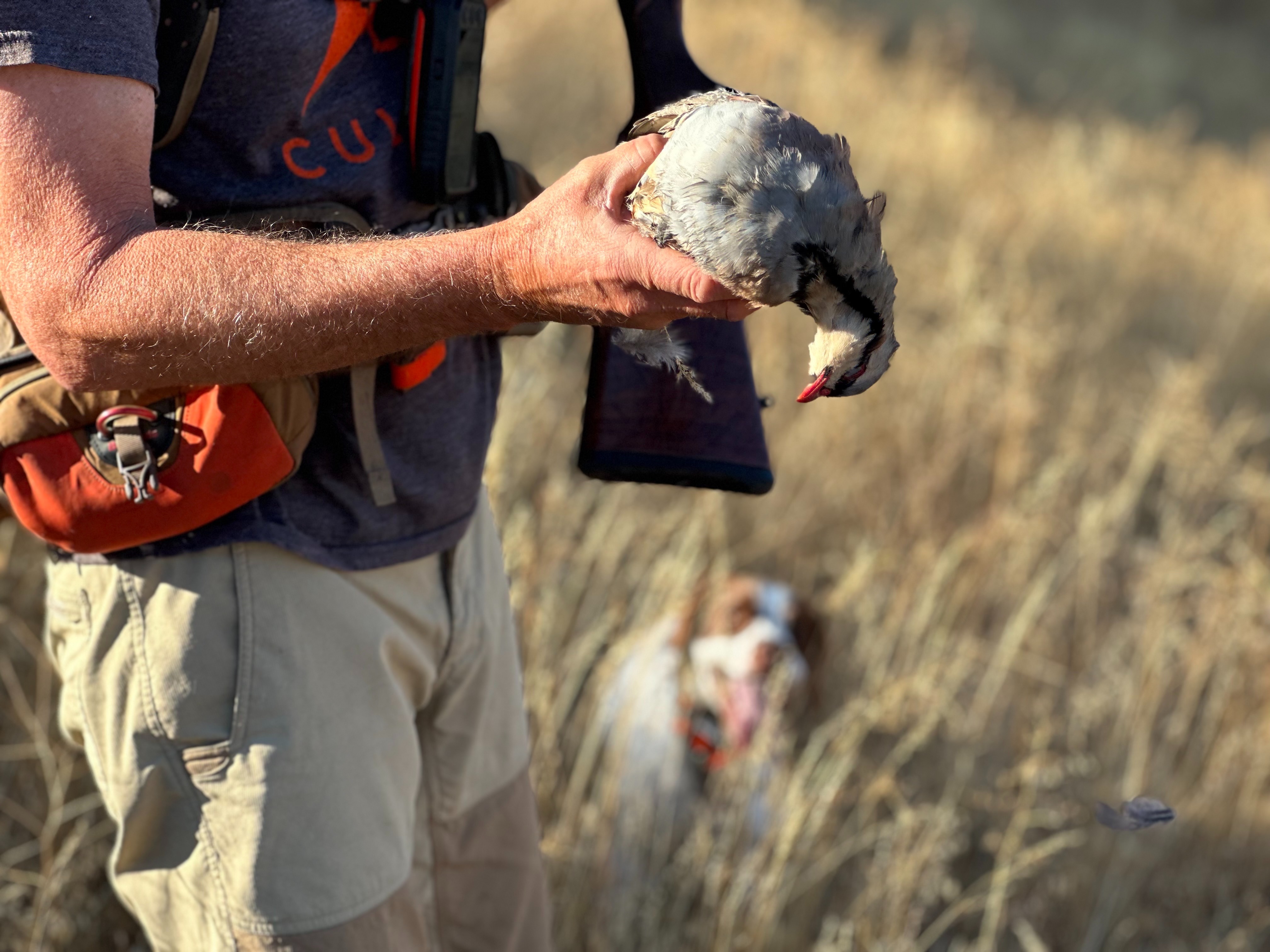
The two years we lived in Washington, as I’ve said here before, were not the easiest two years for us. We missed the chukar hills, empathized with our dogs’ longings for open hills of bunchgrass and sage, and just simply were unable to ignore the call to the hills. Local surrogates paled in comparison. When we returned to those hills last February, they were buried in snow. So we had to wait. Now that the snow’s here again, we’re recalling the patience required but it’s easier being here, no longer two days’ drive away. I’m busy trying to gainfully employ myself, and I’m liking the challenge and channeling some of that into the new blog/website. But the industry’s hurting, I’ve yet to land a client, and so am doing what I do (when I’m not hunting): reading and writing on topic. Here’s my latest:
I did get out with Peat into the chukar hills for a long hunt yesterday. December 5th. T-shirt weather in the midst of lots of precipitation. Gorgeous. Not as much action as we’ve typically seen in this above-average bird year, but enough. Bizarrely, even though I filled my 100-ounce Cambelbak bladder, I ran out of water (three miles from the truck). A first for December. Still, stellar day.
50 miles from home, I realized that I forgot to pack my extra shells for our hunting and camping trip. I sat there for a few minutes in the passenger seat in silence and mad at myself at my unthinkable mistake and embarrassed to say anything to Bob. I wanted to run off and hide.
It wasn’t totally unthinkable. It wasn’t like we forgot the shotguns or our boots this time. A couple of years ago, heading down the road for an out-of-town hunting trip we were about 45 minutes from home when I realized that both of our hunting boots were still on the boot warmers in the garage. We immediately turned around and went back to get the boots which made for a very uncomfortable and quiet detour back home. We swore from that moment on that we’d always have a check-off list for packing.
I fessed up about my stupid forgetfulness just before crossing the border into Oregon and the big to city to us, Ontario. We exited into the parking lot of the Walmart, parked and headed into the far back corner of the store to shop for shells and to also look for a cheap dog-proof cooler (or in our case Peat proof cooler without zippers like the soft sided ones have). The Walmart Superstore wasn’t so super when we discovered they didn’t sell ammo anymore and the cooler selection wasn’t very impressive. We left empty handed.
We then drove all the way across town to a couple of other stores that were open but their selection of 20 gauge shells for upland was pretty dismal or non-existent, focusing mostly on waterfowl shot. On the bright side, at least we found a small Igloo Playmate plastic cooler at Bi-Mart and were fairly confident Peat shouldn’t be able to figure out how to open it.
We forged ahead and originally wanted to stop for a quick hunt somewhere in the desert along the way but it started snowing sideways and then it rained. Not the best hunting weather for us or the dogs. Once we headed south the clouds opened up and we could see blue skies.
Arriving to the campground in the late afternoon we set up camp. I pulled out my pack from the pickup and opened up the shell pouch to see what exactly was in there and analyzed the situation in my head. Okay, I rarely shoot more than once on a covey and I’ve got 12 shells so that would last maybe four hunts if I only shot three times per hunt. Of those shells three of them were Angus shells that Bob hand-loaded four years ago and they’re filled with some ashes from our Brittany named Angus who died four years ago. I’ve been carrying them around for good luck ever since.
Good luck Angus shells.
It wasn’t going to be the end of the world to only have 12 shells but I’d definitely have to be discretionary in my shooting and not waste any shots unless it seemed like it was a sure thing which in the chukar hunting world is totally laughable.
Just before dinner, we met a fellow hunter in the campground who had been out the previous two days and according to him, the hunting was terrible and he hadn’t seen many birds. It was ridiculous but I was actually relieved to think that chances of shooting would be limited.
The opposite turned out on our first two days of hunting. It was really good, and the dogs found plenty of birds. We were pleased. Thrilled.
On our third day of hunting we found an area to hunt that looked good on the maps but in person it wasn’t very promising and no visible water sources were nearby for miles even though the map showed what looked like a small pond which was now drier than a bone.
Bob and I decided to stay together since I was down to my last three shells, all of which were Angus shells. Not very long after we started our hike from the pickup the dogs started finding birds but I couldn’t get a good shot and passed on ones that were borderline too far away. Towards the end of the day the dogs found and pointed one last covey of chukar up in the rocks above us. Bob got up to them first and they erupted and flew downhill towards me. I quickly mounted my gun, shot, and hit one on a crossing overhead shot. Bloom hauled down the hill past me to retrieve it and beat Peat to it. On the way up heading towards me with the chukar in his mouth, Peat snatched it away from him and continued to run past me taking my chukar to Bob as if I didn’t exist.
The only other times (yes, plural) Peat stole a bird from another dog was back in 2015 when he was eight months old. Instead of simply attempting to retrieve them, he watched Angus do all the work of finding, pointing, and holding the birds and then would take the bird Bob shot from Angus’s mouth on the retrieve and go off and eat it. He did this for the first 6 birds Bob shot that season. Angus, gentlemanly at the wrong time, didn’t put up much of a fight. Bloom, like his blood relative Angus, didn’t either.
Peat’s first season was frustrating, legendary, but epic in its own twisted way. Luckily after the sixth time stealing a bird from Angus, a switch turned off or maybe on in his brain and he started retrieving them directly to us and didn’t stop to eat them.
On the morning of what would have been our fourth hunt in Oregon, we woke up early and noticed a flat tire on the pickup. It was no surprise with all the rocky backroads we’d been driving on the day before. It was 10 degrees outside but at least it we were parked on a flat piece of ground and not pulled off on a shoulder of a busy highway. Bob changed it but now without a spare tire and with the nearest tire repair shop 60 miles away we decided pack up instead of hunting and head home rather than risk being stranded out on some remote rocky and gravel road without cell phone coverage.
A couple of days after arriving home and anxious to head out again, I went for a solo hunt with Bloom at a place where I’d been before. 20 minutes into the hunt Bloom went on point below me and held them until I arrived. The covey of maybe 15 birds busted and flew downhill. I shot one chukar, it tumbled to the earth, and Bloom retrieved it right to my hand. I was elated! I searched around and found my bright yellow shell on the ground and picked it up and looked at Angus’s name on it. It was an emotional moment. The place where this happened was almost the exact spot where I shot my first chukar back in 2016 that was pointed and retrieved by Angus.
Divine Intervention?
Bloom with his super sensitive nose is still figuring out this game but with each hunt he’s getting better. Yesterday, hunting solo with him in a new spot, I thought it would be too windy to find anything but I remembered my friend and longtime hunter Sam telling me years ago, “Birds are on the ground and their world is much calmer; it’s not as windy down there.” Bloom tracked down birds just below tops of ridges in the frigid and howling wind and went on point on at least 6 different coveys and a couple of solos. I didn’t think that I would be able to shoot with my fingers being bitter cold to the bone but it’s funny how you forget the coldness when your dog goes on point.
Bloom has a lot to live up to with his legendary genetics and with our high expectations but after the last few hunts and seeing him work, he’s going to be fine.
My first chukar (2017), compliments of Angus (and Peat)Bloom pointing a covey of chukar yesterday.
Hunting’s beauty lives wildly between control and chaos. What do you control? How do you deal with chaos?
We have expensive, complicated electronic devices that tell us where our dogs are and track a ridiculous amount of data. They give us a sense of control. We got them because we disliked the chaos of hunting without them. I might argue they allow us to focus more on the beauty of hunting. The liminal.
The dogs are licking their wounded paws. We failed to notice Bloom’s abrasions and Peat’s broken toenail at the quick until it was too bloody late. Both are on the DL now, in the best chukar country I’ve ever seen. It just seems endless. I don’t want to hunt without a dog, so we’re going home early. Spoiled stupid. Poor dogs. We should have done better by them. Running on a golf course every day, we now realize, has not toughened their pads the way the gravel trail we used to live near did. Good to get that learned.
Peat too is a control freak. Bloom’s still figuring out how he feels about retrieving. Rough and labyrinthine at best. I know Peat notices. I winged a bird that both dogs saw hit the ground running. They competed in catching it, which Bloom did, besting Peat in that rodeo, then beelined past me toward Leslie, then away from her, bird clamped hard in his mouth, and then dropped it minus a massive mouthful of feathers and some back skin. Peat watched. A few minutes later Leslie knocked one down and Bloom quickly found it. Heading back up the hill toward Leslie with it, he dropped it a couple times, took it behind a big rock. Soon Peat emerged with the bird, ran straight past Leslie, and brought it to me.
As a pitcher, I could appease my need for control of the game but always failed to realize and appreciate the supreme irony of struggling to throw strikes, which an external force (the freaking ump) controlled. This little nugget of life has, of course, stayed with me. All of it, especially the illusion. Rarely still am I able to see its beauty.
The place we’ve been this week, whose exact location naturally I will not specify, is magical. But most chukar terrain seems that way to me, especially when I’m in it, and it varies dramatically. There’s a lot of beauty in that. But even more, the beauty seems to lie in what all those places afford, with or without lots of birds: a setting for an activity that “mocks the steady running of the hour.” We choose the place but have no idea what will happen, where we’ll go, or how long it will take. It’s the wildest.
“As for me, I am tormented with an everlasting itch for things remote.” – Herman Melville, Moby Dick.
So far this season, Bob and I have been only hunting at higher elevations where the earthy golden grasses and light green sage colored hills meet up with the forested mountains. These are places to take advantage of now. Soon these places will be almost impossible to reach when the winter snows start falling, which will be any day now. Intrepid hunters that don’t mind post-holing for miles can get to these spots when the snow is really deep in December and January. We’ve done it before but it’s really hard on the dogs. It’s hard on us. And you wouldn’t see birds anyway.
Five years ago in Mid-November, Bob and I hunted on top of a higher elevation plateau covered with big basin sagebrush and antelope bitterbrush. It was remote and far from any roads or two-tracks and undulated like a rollercoaster and required a steep downhill hike first, then a climb up to the top of the plateau, then back down again before climbing back out. It had all the things you would want for good habitat for chukar: steep slopes, rocky outcrops, water, plenty of things for the birds to eat, and cover from predators.
A couple of weeks ago, waking up to almost perfect health for my age and the sweetness of early morning darkness, I suggested we make the drive back out there. I’m not particularly fond of hunts that start with the downhill first, unless we’re doing a shuttle, but I’d thought of that place often and really wanted to go back. The motivating force was, besides being incredibly scenic, especially in October, was that historically chukar were there before, so they should still be there, right? I do know that every year things change, every month and even day changes your odds of finding them, but it’s the eternal hope that really drives us.
We left home and after about an hour drive on a gravel road, we arrived to the place where we wanted to start our hunt. We put on our heavy packs, mine weighed down by what felt like gallons of water, and took our shotguns out of the cases. Before letting the dogs out, we put their orange Garmin hunting collars on, which is never an easy process when they are excited and know what’s about to happen and behave like wiggle worms or house cats not wanting to be held.
The early morning sun was still behind the horizon as we started our descent and the air was cool and frost coated the short green up. In the distance, a rosy alpenglow lit up the hills to the west. At the start of the 1,000-foot descent on a game trail meandering through a dark and shadowy ponderosa pine-lined draw with a tiny dribble of a creek running down it, Bob insisted that I go in front, so I took the lead, which was unusual. I prefer to follow because I’m usually slower and don’t read the terrain as well. I try to make a mental map of the landscape but I’m prone to daydreaming and I once got us temporarily lost in a snow storm, a few seasons ago, in a maze of game trails and rocks and ridges that all looked the same.
I felt excited to be back and descending on this trail again after five years. A trail that’s been used by wild animals for time immemorial that leads to a place that hasn’t been destroyed by humans. It had rained the day before and prints of deer and dents by bigger and heavier hoofs of ungulates still wandering the area were on the trail. Some tracks were going uphill and some downhill. Peat’s petite little prints and Bloom’s bigger ones were freshly impressed into the earth heading away from us. I looked back up the trail and saw my own tracks. The sound of a grouse busting got our attention and we both removed our shotguns from our shoulders and looked into the direction of the sound. Peat tracked it down across the creek and found it up on a limb of a tall pine tree and starting barking. This is what he does whenever grouse are in trees. He usually barks his head off until we can’t stand it but I don’t like shooting grouse out of trees and Bob really doesn’t either so we buzzed Peat back and decided to continue walking and leave it be.
I stopped and examined scat of a black bear which was berry- and seed-filled. I pressed it with my boot, and thankfully it was dry. We kept going, more scat, maybe a coyote or fox, turds full of fur. The front of my thighs and ankles started to feel the terrain and I was cursing at myself for suggesting such a strong and steep place this early in the season in when not really knowing my fitness.
We got closer to the bottom of the damp draw and near the creek the banks were all muddy and eroded and the gooey mud stuck to the bottom of our boots. The creek was a welcome relief for the dogs as they paused to drink water before crossing. Bob took the lead in front of me and stopped and swished the soles of his boots in the water as he crossed, to get the mud off. He said, “I don’t want the extra weight for the long climb.” I did the same but stepped into a slightly deeper section of the creek and water splashed inside one of my boots and got my wool socks wet.
I followed Bob up the other side of the draw as we zigzagged our way out of the bottom of the creek bed. Five years ago, we flushed chukar out of this spot. This year, nothing. I finally caught up to Bob taking a quick break to catch his breath. He said, “I’m taking 61 steps before stopping to rest.” We continued. I tried 61 steps for a while, hoping to find my rhythm but couldn’t. Mind games to get you to the top where sometimes your mind is your worst enemy and the relationship between walking and thinking and the movement of memory when you don’t have what I call “chukar legs” yet in this early part in the season.
Almost to the top of the plateau after two hours of hiking, we heard chukar calling in the distance but couldn’t pinpoint exactly where it was coming from, but it sounded like they were on the opposite side of the ridge, the one we just came from.
I truly believe that some of the chukar up there have never seen a human or hunting dog before. This could be a good thing or bad? Some chukar hunters say birds bust wild and the dogs can’t hold them in the early season because they’re not used to being hunted, or just that they’re young birds. Others say towards the end of the season in January when they’ve had tons of pressure from dogs and people, that’s when they really bust wild. From years of experience doing this, I believe it’s a total crapshoot and there is no rhyme or reason for their jumpiness.
Once up on top, we split up to cover more ground and to increase our odds of finding old deer or elk sheds. Bob and Peat went one direction, and Bloom with me. Peat stopped ahead and pointed solidly, then three or four dusky grouse busted from the ground one by one near some ponderosa pines just ahead of us. The grouse were too far for me to get a shot. Bob tried to hit one but missed. Bloom, with his strong prey drive and inexperience, saw one flying in the sky and took off like a high speed freight train to pursue it. I buzzed him to come back, which he did. We continued hunting, keeping each other in sight as we headed down a ridge, Bob in front of me.
The dogs methodically covered the terrain doing circuits and periodically returning to get some water. We noticed Peat was favoring his front right leg and wouldn’t put any weight on it. We examined it and didn’t find any cuts on his pads, and after palpating still didn’t find anything. We kept going down the ridge. A few minutes later, we watched Peat, who we’ve dubbed “The relocation specialist,” find one of the grouse from earlier hunkered down in a sagebrush as it suddenly busted wild before he had a chance to point it.
The descent down the open ridge felt like it went on forever, and it was covered with loose rocks. I didn’t remember it being that way before. It’s funny how you don’t remember certain things about past hunts. They always seemed easier. Once back down, we crossed over a different section of the creek before heading back up. The climb from the bottom was hard and it was hot. We used as many game trails as we could find and I pulled myself upward using bunchgrass to hold onto, but I felt wimpy for getting sick of it and stupid for complaining about side-hilling and being afraid of traversing one particular loose scree vein on my hands and feet. I had to remind myself that this is part of the game and that every hunt after this will be easier.
Bloom, our workhorse, continued to cover tons of ground all the way up which took about an hour. Peat kept stopping and laying down in the shade of sagebrush. I worried about him and the possibility of having to carry a lame dog up the rest of the 1,000 foot climb. In the 16 years of hiking these chukar hills with Bob, this was the first time I thought about getting a dog sling for emergencies.
Almost towards the top of the climb we entered another small forested area. My Garmin handheld beeped that Bloom was on point above me. Bob said, “He’s your dog; you better go.” I picked up the pace, climbing uphill and looking for him and busting through the thick hawthorn and bitterbrush. Then suddenly a grouse busted above me, flew past, I shot, and missed. I felt defeated. It was an easy shot on a big bird.
On top of the last ridge, the final point of the day was Peat finding a covey of chukar just below the rocky ridge with Bloom backing him. Just as we were carefully navigating downhill getting into position in front of Peat, they busted. We both shot and Bob hit one. The chukar landed on the ground and started running. Peat chased it down and did the most remarkable retrieve despite his handicap. The only bird bagged in our five hour hunt was pointed and retrieved by a three-legged dog.
When I get nostalgic about the past, which seems more often these days, there are things I’ll remember on this beautiful autumn day engrossed in the intimacy of this remote landscape, and I will love them all.
Peat is now fine if anyone is wondering.
On the descent.The wall in the distance for the final climb.
I got a sick queasy feeling deep in my stomach as we detoured and drove into rural Council, Idaho. The curbside spot right out front of the local veterinary office was the exact spot where we’d parked the bright red Jeep two years before and it was empty and waiting for us. Just like the white crosses along the highways in Montana marking highway deaths, that spot reminded me of the death of Angus that occurred at that exact spot when we drove him there when his cancer could no longer be stopped.
Nothing bad happened to the dogs to prompt the detour and vet visit that day; we went there to get rattlesnake vaccinations since we had heard reports from other chukar hunters that they have been seeing a lot more rattlesnakes than normal. Despite the controversy whether or not they work or not, the vaccinations might buy us valuable time to get our dogs to the vet in an emergency. Peace of mind if you want to call it that.
Bob and I each took turns taking one dog at a time into the vet exam room. I took Bloom first. A specimen of pure athleticism and muscles pulled me on his leash and dragged me into the tiny exam room. He’d only been inside this small room one other time, when he was 8 weeks old, so he wasn’t afraid of this place like dogs that make repeat visits.
I lifted Bloom onto the exam table. He shrieked loudly as Dr. Gardner suck the tiny needle into the area where he’d pulled up the skin on his neck and injected the rattlesnake vaccination. I was embarrassed by his behavior and apologized and blamed his genetics and reminded Dr. Gardner that Angus did the same thing whenever we took him there after several barbed wire injuries needed stitched up, his yearly vaccinations, and nail trimmings. Dr. Gardner remembered, and Bloom — just like Angus during nail trimmings — required all hands on deck including the receptionist to hold him down and try to keep him from clawing his way off the exam table. Bob was outside on the sidewalk waiting for it to be Peat’s turn and heard Bloom screeching at the top of his lungs. He told me later that he wondered if they’d decided to do open heart surgery on him without anesthesia. Peat’s turn wasn’t much better but we were both glad to get that out of the way.
The next day we decided to hunt in a place we’d gone several years ago. The pullout where we parked near the river to begin our hunt was scattered with old dried up goat heads. Nasty little things, and before we even started we were pulling several of their spiked seeds from the dogs pads as they stood on and hopped around on three legs. Cruel and imperfect plants. In the ecosystem where all flora and fauna have a purpose, I’m not sure what good they do?
We headed up the rocky slope while there was still shade on this part of the mountain and before the October sun peeked over the ridge. The soil was parched and cracked, and the grasses and end-of-season arrowleaf balsamroot crunched underneath my boots. We both thought it was ridiculous and pointless hunting so early in the season where there wasn’t any green-up and it hasn’t rained for months. About an hour into the climb both dogs seemed to sense birds but had trouble pinpointing them in such dry conditions. A covey of Hungarian Partridge that was probably walking uphill busted wild way above us and flew down the ridge out of sight. It was a good sign despite the dryness and not being close to the water that we managed to see some birds. It was a long way down to where the huns flew so we kept going up and hoped to find them on the way down.
Half way up
Bloom with his long legs and spanning gait ranges bigger than Peat but he’s still inexperienced, young, and insecure and will check back constantly for my whereabouts, and when he doesn’t we have to second guess if he’s onto birds. He’s got his faults and is a strange dog still figuring out the world. It will sure be exciting when he does.
Beep!
I scanned the tall grass looking for Bloom who I’d just seen ahead of me but couldn’t see him. My Garmin handheld strapped to my hunting pack beeped again, I squinted at the screen which was hard to read with the glare of the sun: Bloom on point 35 feet. I looked around and still couldn’t see him. Bob who was just above me yelled “Can you see him?” I answered back ,”No.”
I spotted something white buried deep down in the golden grass, I couldn’t even tell what it was. Bob yelled again “He’s right there! Can’t you see him, get up there, get ready!”
I hesitated. My mind was playing tricks on me and I wasn’t even actually sure that he was pointing birds because Peat, who normally backs Bloom, was still running around. As I got closer, he was sprawled on his stomach in an awkward position flat on the ground. I didn’t know what to make of what I saw and I couldn’t tell if he was breathing and thought maybe he’d been bitten by a rattlesnake or caught in a trap, or something else bad happened.
I moved even closer and could see that Bloom was shaking. I thought to myself, surely if he’d been bit or something we would know it. Suddenly, a covey of chukar exploded just in front of him. Instinctively, I mounted my shotgun and fired one shot but the birds were almost too close and I missed the one I’d picked out. Bob, who was above me and to my left, fired simultaneously and I saw a chukar fall to the earth. Bloom sprung up from the ground, found the downed bird and quickly put the chukar in his mouth while both of us were praising him. It wasn’t a perfect text book point and we’ve never seen him do that before, and even on the retrieve he dropped the chukar from his mouth while jumping over the grass to Bob like a mule deer.
We both agreed that in 10 years when we’ve forgotten the details of each point, bird, retrieve over the years, we’ll always remember this one. This imperfect crazy day that Bloom found, pointed, and retrieved his first chukar without any help. And on his belly, no less!
It was starting to get really hot outside and we slowly descended back down the mountain finding game trails to make the downhills easier to navigate. We got back to truck camper and I tied up the dogs up to the camper in the shade next to me and sat atop our school bus yellow wooden stepping box outside and removed my sweat-soaked leather boots and wool socks and then went inside and started making some sandwiches. From inside, I noticed a gray pickup slowly drive past us then stop and then back up and stop again. The two occupants got out. One of them approached Bob, who was sitting down outside in a camp chair, and introduced himself because he’s recognized Bob and the dogs from reading our blog. Tim and his brother both upland hunters chatted with us for a while while we exchanged stories. It was nice to connect in person with other chukar hunters.
Right after Tim and his brother left, we sat down to eat our sandwiches. Suddenly a small snake with diamond patterns on its back crawled swiftly out from underneath the yellow box I’d just been sitting on. We both jumped up from our chairs and I grabbed the dogs’ collars and pulled them away from the serpent. It was a baby rattlesnake, and we both couldn’t bring ourselves to kill it and watched slither away and disappear. Why would we end its life when it wanted nothing to do with us?
All imperfect things have a place in this world.
The retrieve after the imperfect pointBloom’s DayDogs doing their Dorothea Lange look