Category: Pets

  • Saved by a Dog

    Saved by a Dog

    We all have our stories about how bringing a dog into our lives changed it, enriched it, or sometimes made it more complicated. We have our own tale going back to the beginning of Chukar Culture and where it all got started with this one particular Brittany named Angus who is now 12-years old. Looking back at it all, because of this one dog our lives ended up taking a route that might have gone in a different direction or maybe we wouldn’t even live in a part of rural Idaho where we purposely put ourselves to be closer to abundant public lands for chukar hunting.

    The reality of getting my first puppy and converting from a cat person to a dog person didn’t come until later in life. Growing up in rural Eastern Oregon, we always had a menagerie of outside cats and kittens that I’d dress up in doll clothes whenever I could catch them. We did have a couple of dogs, my Mom had a small white poodle that only liked her and my Dad inherited a bird dog, a large Weimaraner from a neighbor that lived down the street. My dad wasn’t a bird hunter or any kind of hunter for that matter, but Greta, named after my Dad’s aunt, lived in a kennel in the backyard and was never let inside the house. Every once in a while, I remember my Dad letting her out of the kennel and into our fenced back yard to run. My brothers and sister and I would all run for cover in fear of her running over our bare feet as she did hot laps around the grassy yard. At the time, I didn’t know that this would be my first introduction to high energy bird dogs.

    Back in 2007, Bob and I had only been married for about four years and were both 44 years old, over the hill, I thought at the time. We both met and married later in life and this was about the time when people stopped asking me if I’d ever have children. Bob was working in the aviation industry and was in Calgary, Canada while I was home alone with a few evenings to myself. On the first night, I decided to start looking for Brittany puppies for sale. Bob and I had talked about getting another Brittany, probably another female, orange and white, just like Glenna, our only other dog at the time. Glenna was one year old when Bob and I first met, but I wanted one just weaned to experience early bonding with my own dog and to see what it might feel like, and I hoped it might fulfill my lack of not having children and the maternal instinct that I thought was deep inside me.

    Sitting down at the computer I searched “Brittany Puppies Idaho.” The website Gun Dog Breeders came up and I found a link to Sunburst Brittanys. Wow, that was easy! I clicked on the link, and photos of a litter of tri-colored American Brittanys popped up on my screen. I was smitten! I loved the coloring and especially their cute caramel colored eyebrows, and — best of all — they would be ready to come home with their new owners in a week. I forwarded the link to Bob to check them out and then immediately emailed Sunburst to inquire about availability of the females. The breeder, Gabe, replied back the following morning, and informed me that of the litter of 10 puppies, eight were male, 2 were females but the females were already spoken for. My heart sunk. Later that night, I called Bob on the phone and told him the bad news. He said, “We could get one of the males as long as we can name him Angus.” He’d fallen in love with the photos of them too and wanted to go look at them as soon as he got home.

    Angus’s litter, born June 2nd, 2007. Sire and dam were Sumac and Sage. Angus is at the far left.

    Bob returned from his business trip just before bedtime, a day earlier than expected. Excited to go see the puppies he rode his motorcycle 14 hours non-stop from Waterton Lakes, Canada to Boise with only a couple of quick stops. In the morning, we drove out to Emmett to meet Gabe at his kennel located on a hillside at the base of Squaw Butte. Interestingly, Squaw Butte, located North of Emmett, was one of the main places in Idaho where chukar flourished rapidly when they were first introduced as a game bird in Idaho back in the 1950s.

    Gabe’s operation at Sunburst Kennels in the early years, as far as we could see, was just a small fenced-in area in the backyard for the puppies. We could tell right away that Gabe was very passionate about what he was doing and wanted to make sure we got the dog we wanted. It didn’t take us long; Angus was the only one that came running to us. We left Emmett that day with wee Angus, a week earlier than recommended by most authorities (42 instead of 49 days). For years, we wondered — whenever something wasn’t quite right with Angus — if we’d taken him from his litter too soon. If we did, then he and we have gotten over it. Some experienced hunters have told us he’s the best bird dog they’ve ever seen. I’m certainly not complaining (or taking credit for his ability and skill; I’d blame Gabe on that one).

    Baby Angus

    When we arrived to Sunburst Kennels and met Gabe for the first time, we weren’t really looking for a hunting dog, we just wanted another Brittany. At this point in our lives, Bob hadn’t been doing much hunting because of his very busy job and because Glenna was one of those bird dogs you’d let out of the truck and then would disappear for hours before finally returning when she felt like it. When she did get the whim to hunt it was for herself, and she’d move every bird for miles into the next county. These were the days before we owned or started using electronic dog collars to control the dogs.

    Glenna died when Angus was only three, and Bob finally took Angus chukar hunting for the first time. Aside from going grouse hunting a couple of times, Angus naturally pointed chukar, having honed his skills on squirrels in our backyard. From one of his first points when tagging along with Bob during his chukar hunt, I captured a photograph of Angus pointing and we knew we had something special. Chukar Culture and our blog started at this exact moment.

    Young Angus, natural chukar pointer and the photo of the moment that started it all.

    When Angus was eight we decided to get another Brittany from Sunburst. Bob contacted Gabe to see if any more of Angus’s line was around. To our disappointment, Angus’s line was no more. Gabe said that he was expecting a litter from a set of new totally different dogs that he was certain would be great hunting dogs. So, four years ago, we got Peat, our second Sunburst Brittany and my second puppy, and this time I got to name him. He’s a combination of American and French Brittany with a beautiful orange and white roan coat and scattered ticking on his forehead. We like his funny and affectionate personality, his smaller size, and his off-the-charts natural hunting ability and prey drive. Gabe was right, this line is fantastic! (If you’ve read this blog for a while, you know the true story on Peat.)

    Bob and I sat down with Gabe and his wife Katie recently at their beautiful home and kennel, now located next to the banks of the Payette River in New Plymouth, Idaho. We got a tour of their kennel and met a litter of adorable 5-week-old puppies almost ready to go home to their lucky new owners. Katie, with the help of Praire, their 10-year old daughter, cooked Indian chukar curry from an old family recipe, sharing some of their chukar breasts from the past season. Over this and some delicious local craft beers we had some intimate conversations about life, dogs, hunting, ethics, and how it seems as we’ve gotten older the number of birds harvested isn’t as important as much as the experience of being out there hiking around public lands in some incredible places around Idaho with our family and dogs.

    Gabe told us how a Brittany changed his life. A fifth generation Idahoan, Gabe grew up upland bird hunting in the chukar hills near his home in Emmett with his family, and hunting pheasant in the the empty fields nearby before they were all turned into subdivisions. Gabe became interested and fond of the Brittany breed after reading a book about them when he was a kid. When he returned from his two-year church mission following high school, he said he was a changed person. With some soul searching he said he had to make some tough choices and re-examine the path his life should take, and it started with getting his first dog of his own back in 2002, a Brittany that he named Sumac. Another choice, even more portentous, was to leave the church. He said he hasn’t regretted that decision, but that he has suffered some strained personal relationships with family and some friends because of it. During this transition, he met and married Katie, started his own family, and decided to become a Brittany breeder, all in a short period of time.

    Sunburst Brittanys, the early years. (This and the following photos are courtesy of Gabe and Katie Mouritsen.)
    Sumac, Gabe’s first Brittany.

    Gabe and Katie over that past 14-years have meticulously bred their dogs. Gabe has done extensive research on pedigrees and genetics, and has found what for him is the perfect combination of Brittanys not bred to be field trial dogs but bred specifically for hunting and for family pets. Their approach works, but it’s no accident and they’ve worked very hard to build their kennel to where it is today. Not everyone looking for an upland hunting dog wants a dog like the ones they breed, but most of their new litters are sold before they are even born, and their dogs are now all over the United States, as far as New York and Alaska. We’ve been lucky to have had two of them and hope to get our third in the next couple of years.

    These days Katie has taken on more of a major role in managing the kennel now that their three children are in school. Besides just taking care of the dogs on a daily basis she’s learning more about gun dog training and handling and just this past season, Katie decided she wanted to upland hunt and did all the proper things to make it happen. The cool thing about Gabe and Katie is that besides breeding these amazing hunting dogs the whole family upland hunts together. This past season their oldest boy Nathan got his first chukar while out hunting with his younger brother Kurt, and Prairie can’t wait until the day her arms are strong enough to carry a heavy shotgun so she can start chukar hunting. A multi-generation Idaho upland family for the future! A very happy and wonderful family, I might add.

    Idaho upland family
    Nathan and Kurt admiring a grouse up close. Serious props for the hats they’re wearing.
    10-year old Prairie relaxing with the dogs after a hard hike in chukar terrain.
    Nathan and Kurt checking out a chukar hotel.
    Nathan after the retrieve.
    Prairie documenting chukar hunting, but not for long. She hopes to carry a .410 soon.
    Kurt surrounded by the Sunburst clan. Sioux and Candy (L, R) are Peat’s sire and dam.

    In the end, you look back at your choices and wonder if you made the right decisions. It was a dog that saved Gabe and it was Gabe and Katie’s dogs that saved me. In a sense, Angus and Peat are my children.

    A link to their kennel can be found here. https://www.sunburstbrittanys.com/
  • Off Season Shenanigans

    Off Season Shenanigans

    The man must learn to know his dog as a personality, not a formula.” -George Bird Evans 

    “Peat No!” I yelled at the top of my lungs as he booked full speed through the dog door and outside to the backyard with a big piece of cauliflower firmly gripped in his mouth. The piece had rolled off the kitchen counter and onto the floor. I followed him outside to the backyard out of pure curiosity to see if he’d actually eat his sudden treasure. He did eat it. It surprised me because our dogs have always disliked raw vegetables in any shape or form. Peat has an uncanny knack for appearing to be sleeping but the second somethings falls on the kitchen floor or when a bird hits our big living room window outside, he’s all over it. Angus with his deafness hasn’t been part of this game lately. A sad reality.

    Two-month old Peat

    The week before, while getting the toaster from the pantry, out of the corner of my eye, I saw a lightening streak zip past me. Peat was just starting to bolt through the dog door with a plastic package in his mouth that he pulled off the shelf behind me. I managed to grab his fast, furry hind end just as he was halfway to a corn tortilla bliss.

    I started making handwritten lists of things Peat has snatched and taken through the dog door. I’m not sure why I started it, but maybe because deep down in my perverted mind I thought it was funny. How can you get mad at a bird dog that is so obsessed with putting things in his mouth and carrying them around?

    Prescription glasses, two pairs — one of Bob’s, one of mine — were the bigger ticket items Peat carried outside and destroyed. The rest were smaller items, like a $10 coffee gift certificate, boxer shorts belonging to a guest, throw rug, entire pan of brownies that were in a plastic container, silicone computer keyboard protector x 2, kitchen sponges, 3-, dime store reading glasses (several pairs of which he’d sometimes bring back inside to chew on some more in front of us like it was no big deal), kitchen spatula, custom osage wooden spoon, entire loaf of nice artisan bread, insulated cooler bag, Tupperware container + lid, fleece blanket, towel from bathroom, lunch bag with apple inside which he pulled out and ate in front of us while we were in the hot tub staring at him with disgust, pot holder, brewing equipment foil insulation, Zippo metal hand warmer, Kitchen-Aid mixer lid, stack of old Christmas and birthday greeting cards, expensive fly-tying rooster hackle, Tupperware bowl full of huckleberry muffins of which he ate the entire batch. I’m sure I’m missed things, but you get the picture and not everything was destroyed. He’s very selective. He ate some of them and has earned more than one trip to the vet. Remorse was nowhere to be seen in Peat’s visage.

    Boxer shorts, not our guests but another pair found by an alpine lake.

    Bob on the other hand isn’t so amused by Peat’s shenanigans because during Peat’s first season of hunting he grabbed from Angus’s mouth at least the first 6 chukar Bob shot that season and refused to return them. I don’t think Peat really cared. Bob did.

    Yes, it’s okay that you blame us or me. We put things where there is a good chance he might grab them. The one second you let your guard down he takes advantage of it because he’s no dummy, plus he’s one fast mofo. I’m sure some of you can relate and have similar stories of your own high energy bird dog and their attempt to get your attention. We didn’t have a dog door until Angus was about three years old but do remember him managing to squeeze one of the large couch cushion pillows through the medium-sized dog door to take outside to chew on. Angus had his share of destroyed objects but not as many. You forget these things and end up with another puppy sometime in your lifetime again, and then you remember. Some of us, like a bad habit, keep doing it over and over.

    I’m the first to admit that Peat isn’t perfect. He’s not spectacular, and he’s a total piece of work. Bob blames it on not enough exercise in the off season. I blame it on Peat being Peat. I could also blame it on some bad advice we got from a dog trainer friend that told us when Peat was a puppy, “Don’t yell at him when he puts something in his mouth and try to make him give it up; he might get confused and think it’s a bad thing and then not want to retrieve anything.” Some of us aren’t the best dog trainers and handlers, and we are included in that group. Peat, our badly behaved dog at home turned into a fantastic upland hunting dog. The only downfall from Peat is now Angus has to be coaxed into releasing a retrieved bird to hand because of his fear that Peat might intercept it.

    We almost gave up on Peat. I’m glad we didn’t. Don’t ever give up on your puppy or dog. He or she might come around and surprise you, and allow you to buy that new pair of glasses you really wanted.

    Fond of finding things to carry around. Peat pointing with a bone in his mouth.

  • Advice Needed

    Advice Needed

    Once again, I’m seeking advice from my more erudite and experienced readers…

    Peat, and sometimes Angus, but always at least one of them wakes us about 4 a.m. wanting to be fed. This has been going on for more than two years. Peat’s the ring-leader, and most aggressive. He’ll start by pacing and softly whining, which ultimately crescendoes to a series of Bo Jackson-esque runs at the foot of the bed, and a spin-bounce off it back onto the floor. Brittany body-slam. He’ll do this until we feed him.

    We’ve tried lots of things: totally ignoring it until the alarm rings (our latest, failed strategy); shutting them out once they get off of the bed (which leads to them scratching at the door at odd intervals like some horror film scenario); making them get back on the bed and ordering a stay (never works for long). Until very recently, we’d been doing what I’m sure is the absolute wrong and worst thing: giving in and feeding them so we can at least get another hour of sleep before the alarm rings at 6 a.m. Last night I wondered if the e-collar might be worth a try, but didn’t get up because I thought it would be another victory for far smarter Peat.

    So, if anyone has advice that might nip this well-developed habit in the bud, we’d love to hear it. The dogs will continue to sleep with us, so that’s not negotiable, which I realize might seal our fate on this as losers (of sleep, of dignity, of probably years of life caused by bad sleep).

    On an up note: Leslie had a great day yesterday, the penultimate day of the season. Maybe she’ll tell you about it. She’s planning to go out again today for the win while I slave away with dangling modifiers.

  • Haris

    Haris

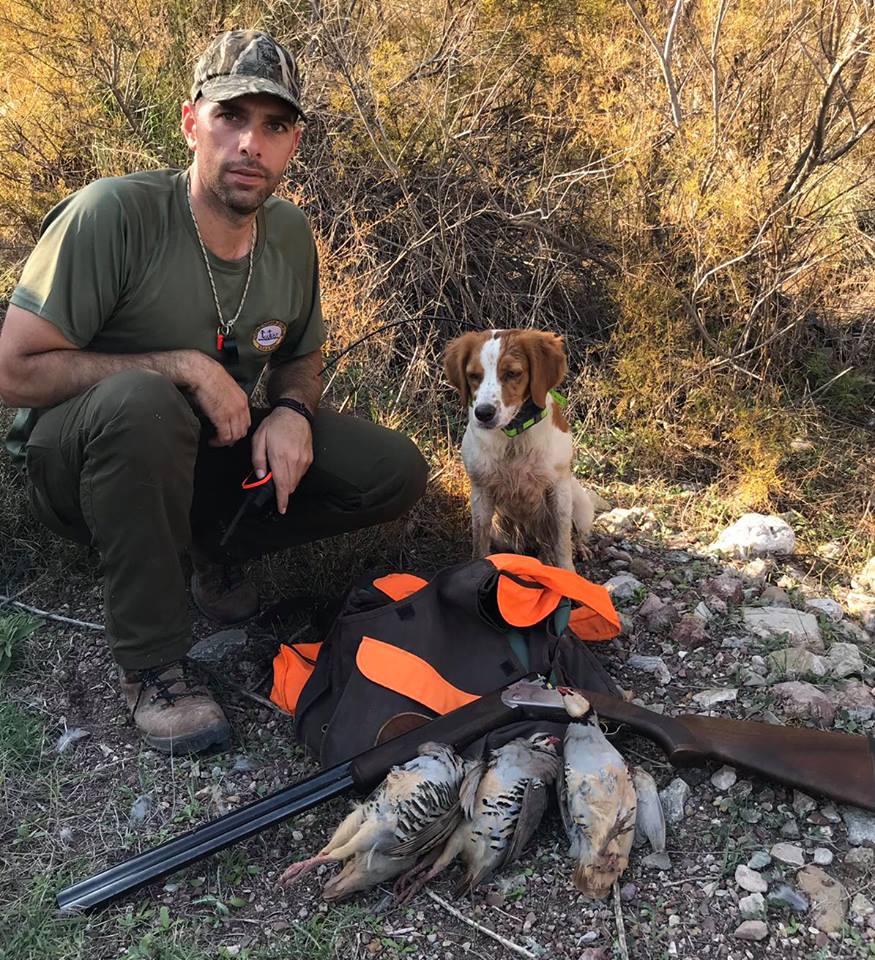
    Haris Papadopoulos, Molly, and some evidence of a good day’s chukar hunting on Cyprus

    Haris Papadopoulos contacted me through another blog of mine about two years ago with some questions about our dogs and the Brittany breed in general. He lives in Cyprus. We’ve been in touch since then, and just a few days ago he sent a report on his chukar hunting season with some photos of his young Brittany, Molly, himself, and the terrain where he hunts. He agreed to let me share his information on this blog, and even agreed to let me interview him via email. I am very grateful to him for the time he took to write responses to my questions, especially since English isn’t his first language. I can’t say enough about how wonderful it is to connect with strangers like Haris through a shared passion for bird dogs, pursuing challenging game, and the indescribable effects it all has on us. Here are my questions and Haris’s responses, which I’ve only lightly edited. Enjoy.

    Please tell us about yourself: where you live, what you do for a living, where you grew up, and how you became interested in bird hunting.

    I live in Cyprus, an island in the Mediterranean Sea. My hometown is Famagusta but most of my life I have lived in Limassol. I used to travel a lot because I was a professional athlete (sailor), and for 9 years I was living in Athens so I could do my preparation and have easier access to central Europe for regattas. I studied sports management but due to the fact that we own a family transportation business, I decided to help my father keep the company. Our clients travel from all over the world to visit Cyprus for summer. So, as you might understand during holiday season, I am really busy.

    My family, grandpa, father, uncles, and cousins from the day I can remember, we were hunting together during chukar season. I even remember my first bird. Oh, that sound, when chukar leave the ground… All the magic is to see the chukar going up…  Every time, after so many years, it feels the same!

    So, as a kid I could spend time with my father only when we were hunting, and actually now, as a grown-up, I feel blessed that I took these first steps with him. He taught me not only how to hunt but also the ethics behind hunting. Even though I still go hunting with my family, when we leave the car and take the dogs out, everybody hunts alone. This way the odds are in favor of the birds.

    Molly surveys the chukar terrain on Cyprus

    Please talk about chukar hunting in Cyprus, what licensing and regulations are like there, if chukar hunting is popular, and what the terrain is like. 

    First of all, in Cyprus there is no such thing as a private guide to offer hunting experiences or trips. Licenses are under public control. Every year they publish a map and you can check the areas you can go for hunting. To be allowed to get a license you have to be at least 18 years old and pass a written exam. You are allowed to hunt only with over-under or side-by-side shotguns which means only two shots. The quota for chukar is 4 birds per hunting day. You are allowed to start hunting as soon as the sun goes up and stop as soon as the sun goes down… Approximately (during chukar season) this means between 6:15 am until 4:50 pm. Before and after these hours your gun has to be packed and inside the car.

    Chukar season opens the first Sunday of November and ends last Sunday of December. We are only allowed on Wednesdays and Sundays, so approximately we get 17 hunting days with our dogs. I know it is not a lot but Cyprus is so small that if they allow more hunting days, the population of chukar, which is already decreasing, will completely disappear. But at least we can exercise our dogs from 15 July until end February, but I personally stop before chukar start to mate.

    Chukar hunting is very popular in Cyprus. Our population is 1.2 million, and last year we issued 44 thousand licenses.  But hunting chukars needs strong legs, big lungs and good working dogs. Usually you can see hunters around the first 4-5 hunting days when it is easier to locate the birds. After that, especially on Wednesdays, I don’t see a single hunter up the mountain.

    The landscape is very similar to the one you are hunting. Rocky and low vegetation. Some Cypriot hunters prefer the woods, but I believe that is not chukar’s favorite. Through your videos I would say that the Hells Canyon landscape is very similar to the one I hunt.

    Mixed bag!

    Do you hunt other types of birds in addition to chukar (I noticed a woodcock in one of your photos)?

    My heart beats only for chukar. BUT… There is a very big but here. Unfortunately, as I mentioned before, the chukar population on Cyprus is decreasing. Also, I believe the quota per hunting day of 4 birds is too high. So, even though I could spend all hunting season chasing chukars, I don’t. Some of my hunting days I spend on woodcocks. I do like woodcock hunting, different landscape, different conditions but if I had to choose, I could hunt chukars for the rest of my life.

    Molly as a puppy

    Please describe your relationship with bird dogs; did you grow up having bird dogs? 

    It’s not just a relationship. I can’t really find the words to say it. Dogs were always part of my family. At the beginning of this interview I mentioned that from the first day I remember, I was hunting. Same for bird dogs. My father always hunted with English pointers. He really loved them. I found some books, when the Internet was not even a thought, that showed he was ordering his dogs from British breeders. Our first pointer came to Cyprus 1978, before I was even born. So, as a kid we always had a dog around.

    Molly in her second season

    Please describe your interest in the Brittany breed.

    Two years ago, after I came back from Greece, I really wanted to get my first bird dog. The one I will grow and train. At that time I really felt like a teenager. My father insisted I get an English pointer because they are the best, and bluh bluh bluh… You understand what I am saying. I really wanted to prove him wrong!  One day at work, during my lunch break, I was watching some YouTube videos and noticed “Thanksgiving Partridge Hunt 2016.” As soon as I clicked on the video, the first thing I saw was Peat on point. After 21 seconds, I pushed the chair back and thought, Wow!  All these years and I didn’t even know that Brits exist?  I started watching one video after the other and I got really addicted. That was it, I contacted Bob to get some advice and I remember his words: “Get a Brit and just show it Love.”

    Please describe how you trained Molly, what was challenging about training her, and how often you and she hunt together.

    First thing, we learned the basics: sit and stay, ok, and give hand because I liked it. She was a bit nervous on wait, but I thought, she is still a pup, she will learn.

    Molly is almost 2, so I had my first full season with her this year. Last year, when she was a pup, I was taking her with me for hunting or exercise to become familiar with the field, get the smells, and overcome any fears she might have.

    Oh, god! The first year I thought I’d made a terrible mistake. She was so nervous, so anxious and I thought that I got a flushing dog instead of a pointing dog. I read so many books and thought I tried everything. I remember one day I planted a quail and I had her on leash. As soon as she got the smell she was trying so hard to flush it that she was crying… That day I said, Ok, I have to email Bob again for some advice. Indeed, he was right: she was just young and passionate. We finished the first season without a single point. We went back to the training field all January until mid-February… We were sleeping together, eating together, watching movies together, and sharing the same passion together. But we were missing that point.

    I will never forget 12 February 2018. 6:53 am. First point on chukar! I got on my knees, took her in my arms and started crying. Before my eyes, my baby girl was growing up.

    From that day everything changed. We started our training sessions mid-July for this season. Was very hot, but we didn’t stay out for long. Maximum 1 hour because with more than 30 degrees Celsius [86 Fahrenheit], she was not able to stay for more. A hunting day can last 8 hours if we don’t hit the quota early in the morning, so she has to be well prepared for this. One hour during summer could easily be 4 hours during winter.

     This season, Molly still hunted with so much passion, but through experience she is learning how to turn passion into smart hunting. Point after point, she understood that in order to shoot a bird she needs to point. She needs to show me the way. Without her I cannot track, and without me she can’t get.

    Please describe the best hunting day you have had with Molly, and what made it special.

    You know sometimes it is not the numbers that can make the best memory. That day was different. Every time I cover approximately 12 to 14 kilometres [7.5 to 9 miles] and Molly three times that with a lunch break… Since we’d been getting so many points during training I was seeking something more…

    Hot and light wind day. Half way you can find 5 pine trees on one side of the cliff (not very steep), where there is good shade to get some rest. We started walking around 6:30 am and we didn’t see a single chukar, and by then it was already 11:00. So, as I was resting, Molly went on the back side of the cliff to get some water from a stream coming down. After 2-3 minutes I heard the beeper on my Alpha, and I could see her on point. I said, No way! I jumped up, put on all my gear again and started to run. Indeed, not only Molly was on point but she blocked her first chukar! Pointing and blocking are different. In Cyprus, it is very rare for a chukar to be blocked so that the hunter will be able to get within a distance of 2-3 meters and then flush the birds himself. Her nose was so close, her eyes were so big. All her body was shaking. We were so happy to get that one and I was so proud of her. My Molly, my gun dog, my princess!

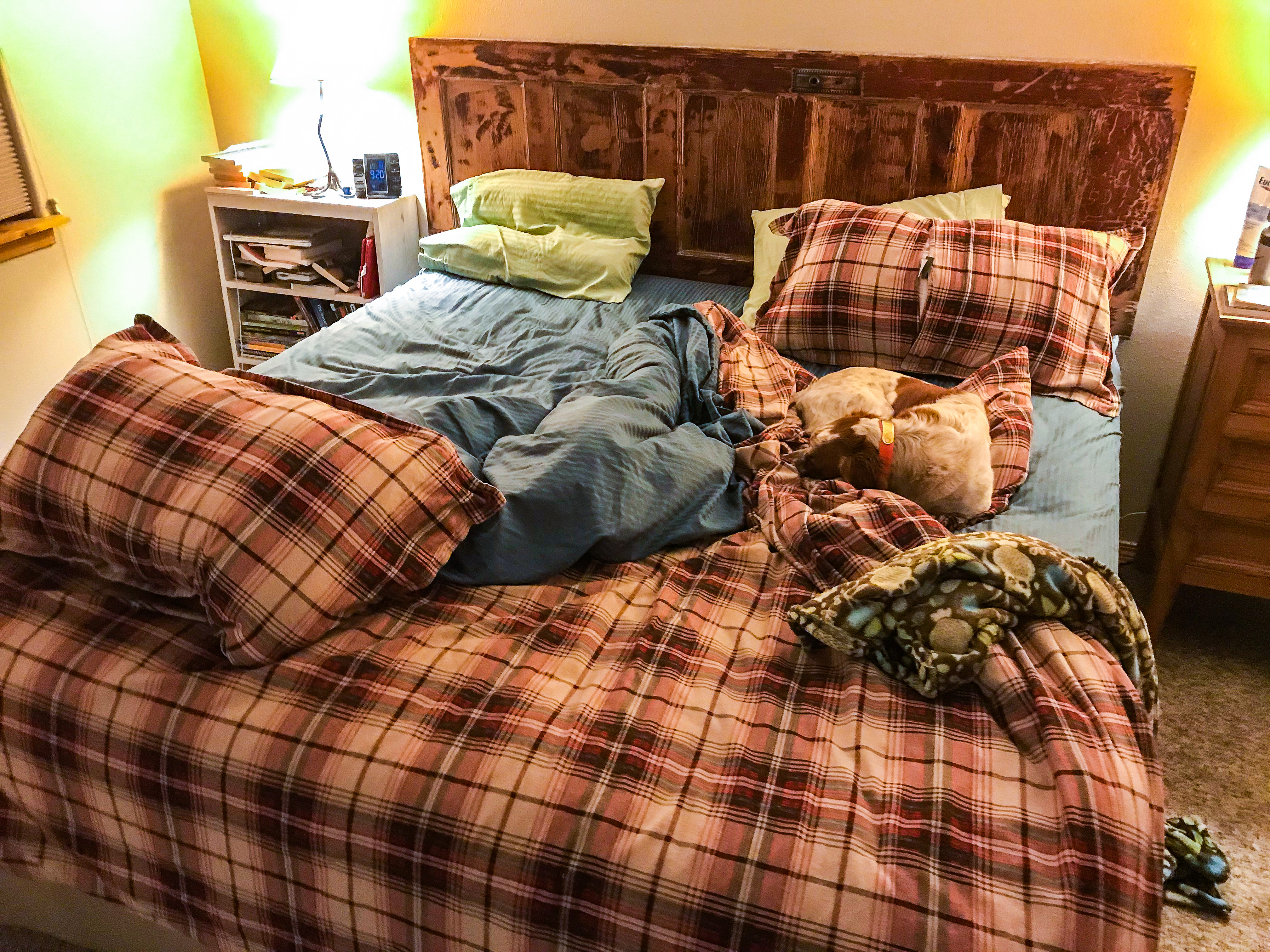
    This photo reminds me of the one of Angus, below
  • Sleeping (With) Bird Dogs

    Sleeping (With) Bird Dogs

    Not everyone sleeps with dogs. We do.

    One of the purest pleasures I know is, upon getting into bed, having Peat collapse himself onto my left side, pressing his back against my ribs and torpedoing his head across my armpit, his nose inches from my face, and his relaxed amber eyes peering into mine as he sighs his little wheezy “tired old man” sigh.

    Angus, the gentleman, consented to forego the bedtime “hole shot” to Peat once the younger dog proved trustworthy enough to join us on the bed, which was at about three months. Whether Angus was happy about this self-relegation I’ll never know; he doesn’t seem to have held it against me, and I miss having him in my armpit (I wrote about cradling Angus at bedtime in Gray’s Sporting Journal in 2015), a kind of sacrifice of intensity in our relationship that I worried would happen while we considered adding another dog to our household. True enough — it did. So the pleasure of Peat snuggling up against me isn’t quite so pure as it sometime seems.

    Both our dogs spend most of the night with us in bed. They occupy different places, moving around, changing positions from fully stretched out (it’s amazing how long they can make themselves and how much king-size bed real estate they can commandeer) to curled like a furry donut, recalling the small circles of dirt I’ve seen while elk hunting which coyotes have carved out of snow for their beds in the woods. Often, they’ll each head to bed before we do, as if to let us know they’d prefer we join them, even though it’ll be 7:30 or 8; usually, this is a day they hunted or got a lot of exercise.

    Bedtime, on a hunting day…

    Angus prefers my side of the bed, at the end where my feet would be, with his head near the edge, and he’s always there while I’m getting ready for bed. Often I’ll sit next to him on the bed while I floss, and put my nose to his while I’m doing my cat-cow stretches on the floor before getting into bed. He expects me to move him toward the middle of the bed, which I do as carefully as I can — we both have arthritis in our lumbar area — and then I give him a neck, back, shoulder, and hip massage, which he seems to enjoy and I like to think has helped allow him to hunt hard without noticeable reduction in effectiveness well into his 12th year of life. I’ll finish by rubbing the inside of his ears, which always elicits a sigh of satisfaction, and giving him a kiss on his forehead.

    Peat the retired sheet wrestler

    Peat’s bedtime routine also begins before we get into bed, but is far more dramatic than Angus’s. Peat is the first “sheet wrestler” we’ve ever had. For the first couple years of his life, whenever he jumped on the bed — whether it was bedtime or not, and this could be several times a day — he’d violently pull the covers and pillows of the fully-made bed nearly clean off so only the fitted sheet remained intact. He still does this, but not quite as frequently. He also sheet-wrestles the couch, although we don’t keep sheets on it; instead, he removes the seat-back cushions and pillows, violently and haphazardly ejecting them from the sofa, clearing a space for himself about the size of the interior of a VW bug. We believe he’s trying to make a nest for himself, but his approach is like Genghis Khan on crack. Once finished, and it’s anyone’s guess what precisely might create the signal of completion in his brain, he collapses into a ball with a huge sigh, gives us a look that says, “Why must you make me do this every night?” and goes to sleep.

    A Modest Proposal: Peat must barricade himself from all potential interlopers
    A half-baked effort for a fully-baked dog

    One of the good things, and there are a few, of being an insomniac, is that I get to witness my dogs sleeping on our bed more than someone who is a sound sleeper (such as my wife). I love seeing them dream, sometimes with their tails quivering happily as though they’re slaloming through sage on a fresh partridge scent. Angus, much more than Peat, occasionally whimpers while dreaming, sometimes desperately, which worries me and makes me reach over and gently pet him to interrupt what might be a canine nightmare. But who knows? Still, I consider it one of the great gifts of bonding with a dog to be able to imagine what they might dream about. This will always matter to me.

    Peat dreaming of alectoris plethoris

    Leslie also loves sleeping with our dogs, but she doesn’t get to witness the experience as much as I do because she’s, well, asleep. But she knows it happens, and often falls asleep serving as another one of Peat’s particular sleep-foils. He’s got his particular positions with her as he does with me; with Leslie, Peat takes advantage of the fact that she sleeps on her side, which gives him more surface area to collect body heat (at least that’s my guess).

    Peat in his usual place with Leslie, often after I’ve gotten up to go to school.

    I realize not everyone sleeps with, or approves of sleeping with, their bird dogs. The reasons for not doing so might be moderately persuasive to an open-minded person: their restlessness can interrupt your sleep cycle; it makes them soft; you can get meningitis and giardiasis from them (I often wonder about this since both our dogs are both saprophagic and coprophagic); it’ll ruin their ability to tolerate temperature extremes; it will damage their olfactory receptors; and they’ll ruin your sex life. I’m sure there are other reasons, but I really didn’t do much research on the question because I’m not actually interested in changing my behavior because I am pretty close-minded about this. First, my sleep cycle can’t be any more interrupted than it already is, and it has nothing to do with dogs on the bed; I’ve had insomnia as long as I can remember, at least 25 years before ever getting my first dog. Second, if my dogs are “soft” from sharing my bed, I shudder to imagine what a hardened version of themselves would do to the local chukar population; I fear chukar would go extinct from “point-fright.” Next, given the frequency, for more than a decade, of wet, bacteria-laden, often feces-infused canine saliva from Angus’s (and now Peat’s) licks and kisses, and the fact that I’ve never gotten sick from them, I’m not too worried. Maybe I’ve developed an immunity or something, or it could just be luck and I’ll actually end up dying from a kiss, like Jesus did. I can think of worse ends. Fourth, it does seem my lazy dogs are overly sensitive to heat, especially in the early season. But I can honestly say that I’ve never considered their endurance to be a limiting factor on my hunts. If anything, it’s always and only the reverse. And as far as cold goes, I’ve seen them shiver a few times, but — again — they can endure much more than I can, and it’s not like I’d ever ask them to go hunting by themselves when it’s 20-below. Fifth, similar to the “softness” question, if my dogs’ noses functioned better than they already do, I’d feel so sorry for the birds that I’d probably have to stop hunting as it would no longer be “fair chase.” Finally, well, I’d better not talk about the last thing.

    My ancestors, I’m pretty sure, slept with dogs, and some of them probably still are sleeping with them. I’m talking about those medieval knights (I realize I’m assuming I’m descended from at least one knight like this) whose graves are adorned with brass rubbings showing them in their armor, with the two most important things a knight could own: his sword, and his faithful dog. The dogs are always at the feet of the knight, which makes sense aesthetically and otherwise. The best sense it makes to me is that it’s a bridge from then ’til now: the two most important things I own, when it comes to chukar hunting at least, are my gun and my dog.

    A brass rubbing I did in England in 1978, now hanging in my classroom.

    The question always arises: were these loyal dogs buried with the knights? I’ve heard that they were but then that brings up the terrible question, what if the dog was still alive when the knight died? I couldn’t find any answers to this on the Internet, so I’m betting the dogs’ bones aren’t actually in the graves with the knights, but rather that they’re symbolic. Of what I’m not sure, but probably they symbolize what dogs would symbolize on anyone’s memorial today: loyalty, unconditional love, one could go on. Maybe even the poet Billy Collins’ ideas about what dogs think of their owners might pertain.

    Curious what your dog might think of you? You might be surprised.

    I doubt I’ll be buried with one of my dogs. I think I’ve asked to be cremated, and unless an awful coincidence occurs and my dog and I shuffle off this mortal coil at the same time I’d be horrified if someone even thought of dispatching my dog so he (or she) could go with me. But I wouldn’t mind if what was left behind of my brief stint on earth was some kind of evidence of my love for these creatures (which might seem over-the-top to those lucky bastards who’ve had dogs their whole lives; I didn’t get my first dog until I was 38), and — if I am lucky — their love for me.

    I love sleeping with bird dogs. These bird dogs.