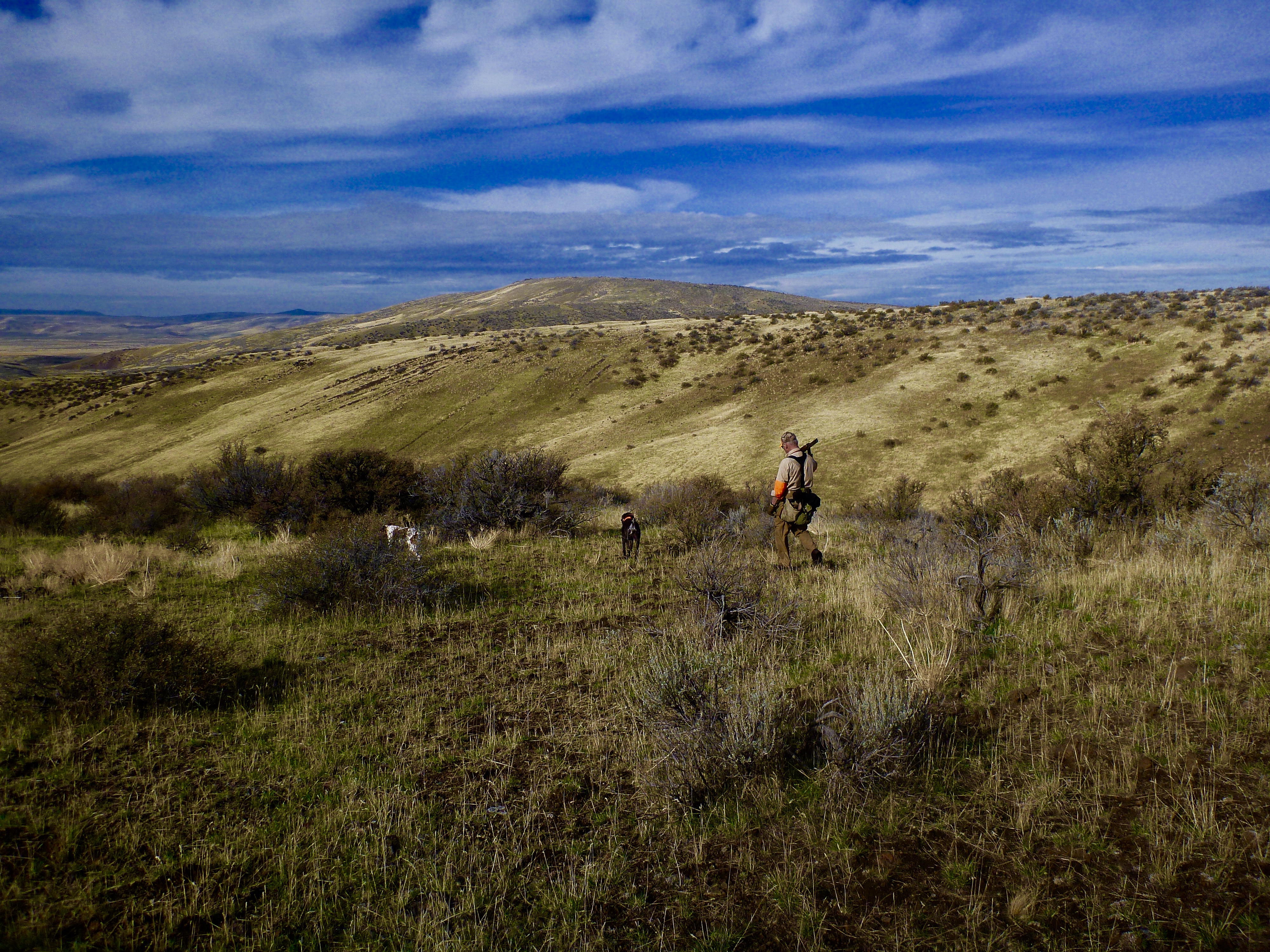
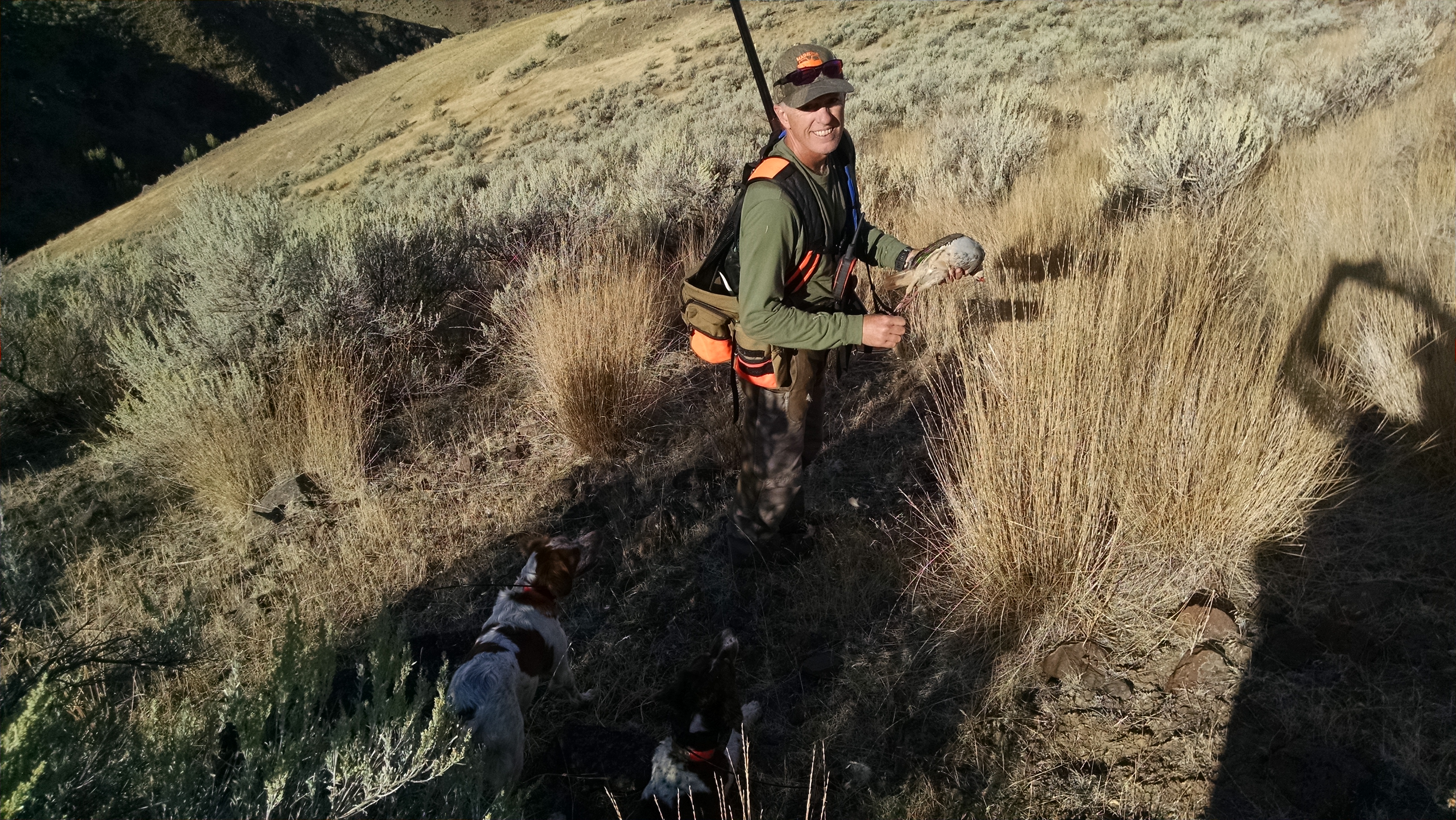
Here’s a video of some action on Hungarian partridge (a.k.a., Huns, or Gray – or Grey – partridge, a.k.a. perdix perdix) in Hells Canyon the last couple of weeks. For a good read on these beautiful birds, check out Guy de la Valdene’s The Fragrance of Grass.
Hmm. The past two days have been pretty neat, just hunting with Peat. Today, near the end of our hunt, my friend Sam punched me in the arm and said, “And you were wanting to get rid of him less than a year ago!” Yesterday Peat pointed 7 coveys, and today he pointed at least 10 times. In each case, he held the birds. And of the 8 birds I killed, he retrieved them all, including a double in which he had to descend 150 feet for the first one, and more than 300 feet for the next one. I’m pretty thrilled with this dog!
The recent rains have generated a proliferation of green-up, which – I think – has allowed the hard-to-find supercoveys to split up, which means that it’s easier for the dogs to find birds. Today, it seemed they were everywhere.
Early in the game
Peat literally had a field day. Within the first 30 minutes, he’d pointed three coveys and Sam and I each had at least two birds in the bag. Sam, with 65 years of bird hunting experience and a (only slightly) slower pace than mine, suggested something about how I hunted with Peat that was like a revelation: “Peat will hunt as fast as you can,” he said. “Since he holds the birds, let him hunt and go at your own pace so you don’t have to kill yourself to keep up with him.” Sam also remembered me telling him that this season – before Angus got injured – Peat was kind of lagging back and watching Angus, letting the older dog do the work. Peat had been working more like a flushing dog until today; after Sam told me to let him hunt, Peat was working out near 200 yards, covering way more ground than when he was with Angus, who’s never run very big. But Peat would always check back and return on a circular route so he wasn’t just running out-and-backs. In the process, we found birds all day long.
I realize we hit a spot today with a lot of birds, which might be barren in a couple weeks, since that’s how chukar hunting seems to go. They do move, depending on whether Bette Midler’s niece is driving a BMW or Mercedes that week. So you never know. But I’m thinking I’ll keep Peat. For now, anyway.
Here are more photos from the past couple of days.
Been a while. I’ve been out there, with mixed results. Birds somehow await cleaning in my fridge, but it seems the burgeoning populations promised by early outings have eluded me of late. Last weekend, for example, I hiked for six hours without seeing one bird in areas I’ve often previously found chukar. Of the eight or nine birds aging in the fridge, one is a chukar. The rest are grouse, quail, and Huns. Not complaining, just confused. But, as I tell my students, if you’re not confused you’re dead. So it’s okay. I’d much rather be confused.
Cousins
A favorite cousin and his partner visited us from California recently, and they wanted to see what chukar hunting was like, although just as hikers (they don’t hunt). So we went to an inviting area in Hells Canyon and set out on a game trail. Within minutes, in a brushy draw, the dogs were moving ruffed grouse. Unfortunately, on the way from the trail to the bottom of the draw, Melanie slipped on a mossy rock and fell and broke her wrist. She thought it was a bad sprain, so kept hiking (what a trooper!), keeping the wrist elevated the whole five miles or so, as well as for the next couple days of their visit. I felt responsible, and terrible, for not realizing that I take a lot of things for granted about chukar hunting, probably the most basic of which is that the footing is often precarious. Melanie has twice summited Mt. Whitney so I knew her strength and endurance wouldn’t be a problem, but failed to remember and take into account the difference between trail hiking and mossy scree scrambling. It’s a lesson I will remember .
Danged dawg done did a dandy
Speaking of injuries, Angus is down and out for a couple of weeks with one. We run with the dogs on the Weiser River Trail several times a week. The 84-mile gravel trail between Weiser and New Meadows runs along the old P&IN Railroad line, and is a fantastic place to get away from traffic with your dogs. Quail, grouse, Huns, chukar, and turkeys, along with deer, elk, bear, foxes, coyotes, and many other species of wildlife abound on this corridor. So does barbed wire. Angus, like all chukar dogs, has passed under and through countless strands of barbed wire in his career with nothing but a few nicks on his back. But last weekend (these things always happen on weekends, when the vet doesn’t hold regular hours), Angus met his match and somehow tore through skin and muscle on his right shoulder, requiring some reconstructive surgery and 20 stitches. Bad luck for the poor boy.
Before the stitches
Angus’s injury has given me a chance to spend some time in the field alone with Peat, which has been good, both for me and for Peat. The last hunt we had with both dogs began kind of hilariously (I said “kind of” for a reason): walking down a ridge in a pretty stiff wind, both dogs quartering about 50 yards in front of us, a small covey of Huns went up between Peat and Angus, startling the dogs. Then another covey of about 15 birds went up behind the dogs, and then another couple smaller coveys to either side of the confused Brits. All told, probably 50 or 75 birds went up before I could get within range. Those were the only birds we saw in nearly 6 miles of hiking. On the way back through that same area, mixed among cows, some of the same Huns went up and I managed to get one, on a nice point by Peat.
The next hunt with just Peat was less comical, with no birds of any kind sighted for the first 2.5 hours. But then, on a low slope in a heavy wind, Peat pointed about 150 yards below me. Because of the scree it took me a while to get down to him, and he was rock solid the whole time. I flushed the birds – a covey of about 15 chukar – but missed. A half-hour later, Peat pointed hard in a thick sea of sage brush, and an enormous covey went up, and I managed to kill one, although Peat could not find it despite running past it on the ground several times. I was grateful I found it (took a while). That’s another thing I’m sort of confused about: when I manage a clean kill both dogs seem to have a really tough time locating the dead bird. Any thoughts out there? A biology teacher friend of mine said it’s because the bird is no longer respirating, which makes sense. I wonder if others can back this up.
I’ll have a short video soon. Meanwhile, here are some random galliformity photos. Enjoy.
Resting – I’m enjoying the Q5 Centerfire packFall colors are worth seeingDreamyMy family (minus that damned cat)The drive home, over western larch (“tamarack”) needles
I’m lucky enough to be able to teach in a small school nestled here at Galliformes Ground Zero. One of my classes, a group of six 11th- and 12th-grade young men, each with a passion for hunting, has been reading A Hunter’s Heart: Honest Essays on Blood Sport(1997; a fantastic collection if you haven’t read it). It’s been wonderful talking with them about well-crafted essays and different perspectives on hunting, especially since I came to it late in life and these boys grew up with it. We’ve had some intense conversations and debates. I’ve learned a lot from listening to them. I wonder if it’s reciprocal.
The culminating project for this unit is for them to make a digital story describing what they’ve learned from hunting. I told them I’d make one, too, and so here’s my crack at it. (Select 1080p if you can, and turn up the volume.)
Forecasts for lots of birds this season are, in my experience so far, true. Covey sizes have also been relatively (or extremely) large, and locations have been all over the place: high, low, sage, open, rocks. Last weekend we hunted what was for us a new area, one I’d bet doesn’t get much pressure as it’s rather a pain in the ass to get to. I eclipsed my single day elevation gain and saw chukar everywhere. One area contained, conservatively, more than 150 birds.
Spring in the Fall
We found it tough, though, to get close to any of them. For the most part, all bigger coveys busted quite wildly. Boots crunching bone-dry arrowleaf telegraphed our presence on the open slopes, and satellite chukar moving along the ground made it tough for the dogs to point anything. Once the huge groups busted, Angus and Peat made some good points, some of which I got to, but – after shooting pretty well the first couple of weeks – I shot crapulously. Lucky chukar.
Dogs have been hot so far this season.
The wild-busting chukar got me thinking about my dogs, worrying actually. Why weren’t they more cautious? Were the birds moving more than normal? Were the dry conditions making it harder for them to pinpoint scent? Were the myriad partridges exciting the dogs too much for them to be more cautious? Was it just an example of early-season pointing rustiness? I admit to feeling exasperated as I watched dogs busting coveys from 100 or 200 yards away, but then they’d “redeem” themselves a few minutes later with a solid, classic point. Ah, the mysteries of chukar hunting; I think if I ever completely understand everything that goes on whenever we go out there I’ll be bored and quit.