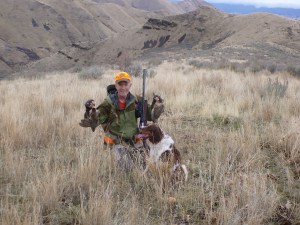
I usually hunt alone or with my wife (and of course Angus). It’s rare to be able to coordinate schedules with friends and deal with the travel time involved. Last weekend was a rare pleasure for me because I had a couple of friends, another great dog, and my usual companions to hunt with for two days. Most of the birds we saw both days were Hungarian partridges, but we also saw a few chukar.
The first was a bust (bad weather, few birds located), but that’s how hunting goes sometimes. The second was much better: better weather, more birds, and some new (for me) scenery. Enjoy those days in the field with your friends. More to come on these days…
The fruits, with a nice composition framed by a friend
About a year ago I posted a review of the Benelli Ultra Light 12-gauge shotgun. I just wanted to give a bit of an update on this thing. The short story is that I still love it, probably more now than last season, for a couple of reasons.
A year ago today, about 30 minutes into my morning hunt I jumped off of a big rock to get down a steep slope to Angus, who’d been locked in point for a while. I landed wrong, and shredded my ankle badly. My post, “Bad Day” details this experience, but doesn’t mention that in order to get back to my truck, about a mile away down horrendous basalt scree and over severely undulating terrain, I had to use my Benelli, fairly new at the time, as a crutch. Not being able to put any weight on my left leg, I held the Ultra Light by the barrel (after remembering to unload it) and used the gel pad on the stock end to stabilize me. Three hours later, I was back at the truck, sick to my stomach for many reasons, one of which was the damage to the gun I was sure I’d done.
But when I looked at the gel pad, it was only slightly scraped. I was also worried about the stress I’d put on it that, surely, Benelli’s engineers couldn’t have intended the gun to absorb. With my down time I checked the tolerances and fittings for any play and couldn’t detect any. I was also sure I’d scraped the walnut pretty badly, but – despite getting separated from my gun during the fall, when it slid about thirty feet below me and came to rest with the barrel pointing right at me – the stock sustained only minor scratches. Conclusion: although she’s a looker, she’s pretty tough, too.
Rain or shine, the Benelli Ultralight’s a great chukar gun
But appearances aren’t the only things that matter, and I’m happy to say that after putting hundreds of rounds through the gun it hasn’t hiccuped, or even sighed. And, as I mentioned before, I shoot the cheapest loads money can buy. I’ve scraped it a lot more this season than last, mostly because I’m hunting terrain I probably shouldn’t. Despite the steeper slopes and being less fit than last year, the gun’s light weight has continued to prevent me from the sore forearms and shoulder I’d get lugging my heavier 12-gauges up and down all day.
Finally, despite being a perennially poor shot, I’ve gained confidence with this gun I never had with others, and am bagging more birds as a result. Shots I used to pass on because they seemed too far out I’ve been routinely successful making this year. I suppose that can happen with any gun, but my feeling is that because it’s light my arms work better than if they were fatigued from carrying a heavier gun. Or maybe I’m just over-reaching here and still trying to justify spending what was for me a lot of cash on a shotgun. In any case, I’m glad I got it and – if I ever get another gun – would buy another Benelli. It’s the best chukar gun I’ve had, as well as the best grouse, Hun, and pheasant gun.
Angus, Leslie, and I sucked it up yesterday in the crappy weather to look for birds in a spot we hadn’t explored before. It was lousy with chukar, and so was I. I shot two-thirds of a box and brought home two birds.
Still, despite both Leslie and I being a bit under-the-weather and hiking around some pretty steep country in underwhelming weather, it was a great day. If you watch the video (see below), you’ll notice no shortage of action. (Please realize in the scenes where I’m running back and forth like a brainless buffoon my safety is indeed on.) I think because of the stiff wind, Angus seemed to have more trouble than usual pinpointing birds, and some of the birds seemed warier than usual, often busting on their own well outside of range.
Leslie in her Saturday uniform
A couple of my recent posts discuss my confusion over chukar tactics, and today did nothing to clarify anything for me. I’m tempted to give up trying to figure out how high or low they might be in whatever conditions on whatever terrain and just do my best to think like a chukar. This worked a little today, when I speculated that in the heavy wind the birds might prefer to be on the leeward side of ridges. That’s where we found most of them. But there were notable exceptions to this, and in more than one case I called Angus away from windy areas that actually (we found out later) harbored birds.
Hungarian Partridge
Anyway, it was nice to get that much action and see so many birds, including the interesting and beautiful Hungarian partridge. Angus made two spectacular retrieves, including one on a Hun I knocked down – I thought – cold. Angus couldn’t find it where I saw it fall, and I was sure it wouldn’t have run anywhere. But my Brittany boy wonder was hot on the trail of something, and I followed him, thinking he was tracking the covey members that busted a moment earlier. A couple hundred yards later he pointed hard, and a one-winged bird jumped and ran, with Angus in tow. Weaving in and out of sagebrush, the intrepid but ill-fated Hun eluded Angus for some time before the mutt finally won.
A chukar in one hand, Hun in the other
So there you have it: a triply lousy day. Lousy with birds, lousy shooting, and lousy weather. I wouldn’t trade it for much.
Mouthful of Feathers’ “About” page with Gustav Mahler
Just wasting time, procrastinating, searching for blogs on “chukar hunting,” and found what’s easily the best blog I’ve seen on upland bird hunting: Mouthful of Feathers. Excellent writing, thoughtful ideas, and – if you can believe it – the “About” page starts off with a quote from none other than Gustav Mahler. Uncanny. I wish I didn’t have work to do so I could stay up all night and look at the pictures, videos, and great stories with provocative thoughts about the pursuit. I wish I’d met these people years ago and could be looking at myself in some of their photos. Damn. The only critique I have of the stuff I see on the blog is their quite poor taste in beer.
Anyway, check it out. If you’re chukar-baka like I am, you’ll dig it.
Well, after my recent post, “Getting High on Chukar,” in which I revealed that up north I have seen more birds lower on the slopes than I do down south, I went low over the Thanksgiving break in my spot down south. In other words, I decided to try the northern tactic in the south. It wasn’t the best day, but I have to remind myself that the worst day chukar hunting is better than the best day at work.
I went with a friend. Conditions were pretty wet to start, which wasn’t bad and made the ground nice and pliable. After about a half hour of steep side-hilling not far above the creek we came to a sharp ridge and draw, and I expected to see some birds there because of all the cover and the ridge protecting them from the wind. Sure enough, as we came over the spine of the ridge we saw Angus pointing downhill about ten yards below the ridgetop. Unfortunately, though, the birds busted before we could get in range. No shots, and about ten birds in the covey. It looked like they hugged the hillside and flared about two ridges away, so we skidaddled after them, paralleling each other on the hill about 75 yards apart, with Angus bouncing between us.
After a couple ridges and some unpleasant brush-busting and minor falls, we’d bumped up two or three singles, and missed each of them. I felt we should get to a higher vantage point and work down, but the terrain was pretty imposing for such a feat so we continued at the lower trajectory. After a covey busted well above us, probably in response to our talking about what the hell we should do in the hardening rain, I decided to head straight uphill and head back to the truck.
My wife, who photographs some of these “walks,” always says, “Photos don’t really show how steep it actually is!”
On the grueling way up I realized why I prefer getting high to start and working down. When you work low at first, there’s nowhere but up, and – Murphy’s Law or whatever – it’s usually the worst kind of “up” – rocky, loose, brush-encrusted, pitches requiring hands-and-knees ascending. Yuck. The fact that we didn’t see many birds throughout this ordeal was like a birthday boy watching his mom scrape all the frosting off his cake and run it down the disposal. Well, maybe not exactly like that, but sort of. Anyway, once we got up to the top ridge, the sun came out and the walking got easier. Still, we couldn’t find many birds up there, but at least I knew where I was. And, maybe best, the truck was below us.
So, I’m not sure if I learned much on this day that I didn’t already know. I actually think the birds’ elevation is far more mysterious than “high” or “low” and depends on way more factors than I understand. Therefore, since I still know next to nothing about chukar behavior, I’ll continue “learning” by starting high and working down, especially if I can figure out which way the wind is blowing.