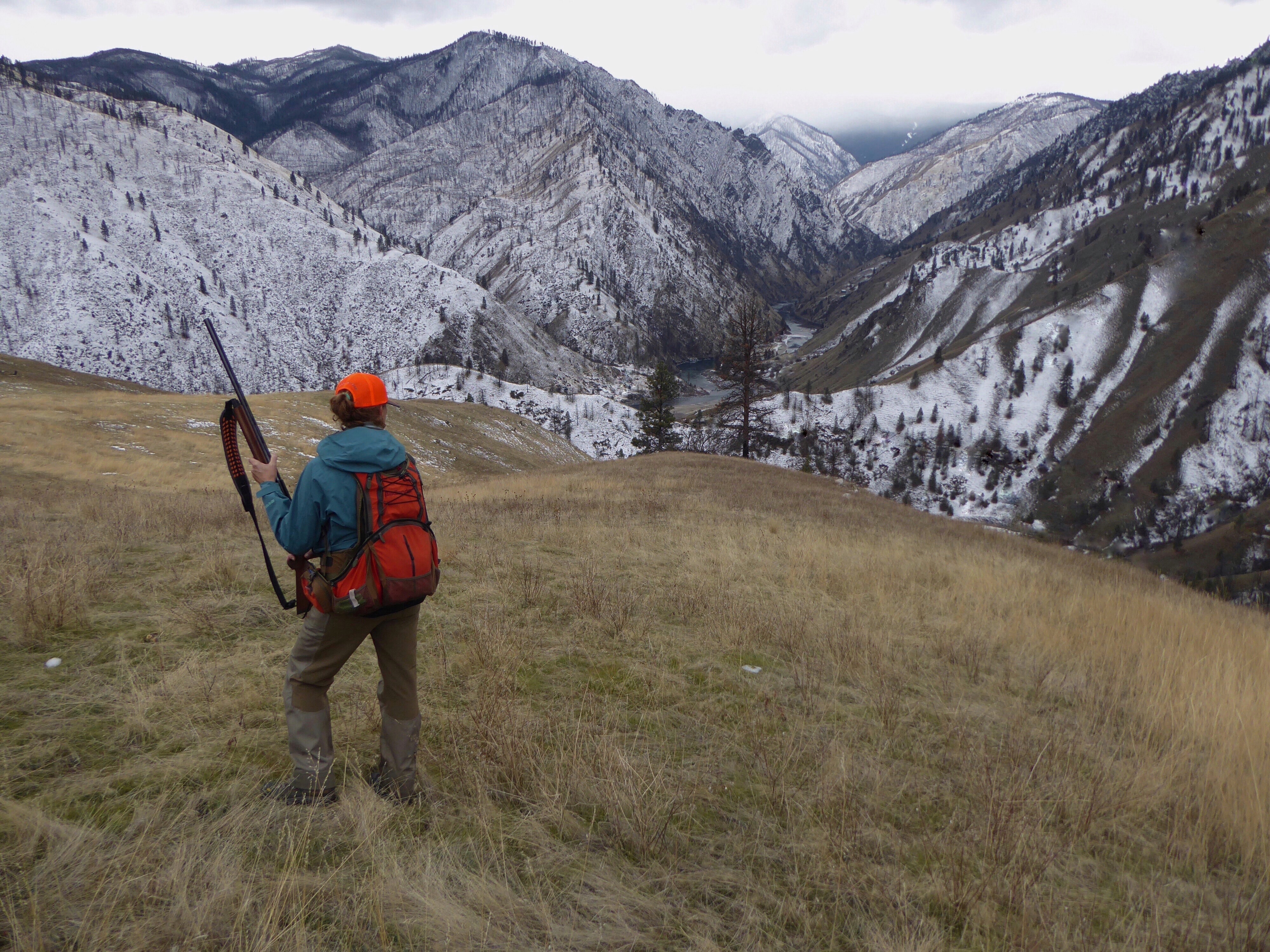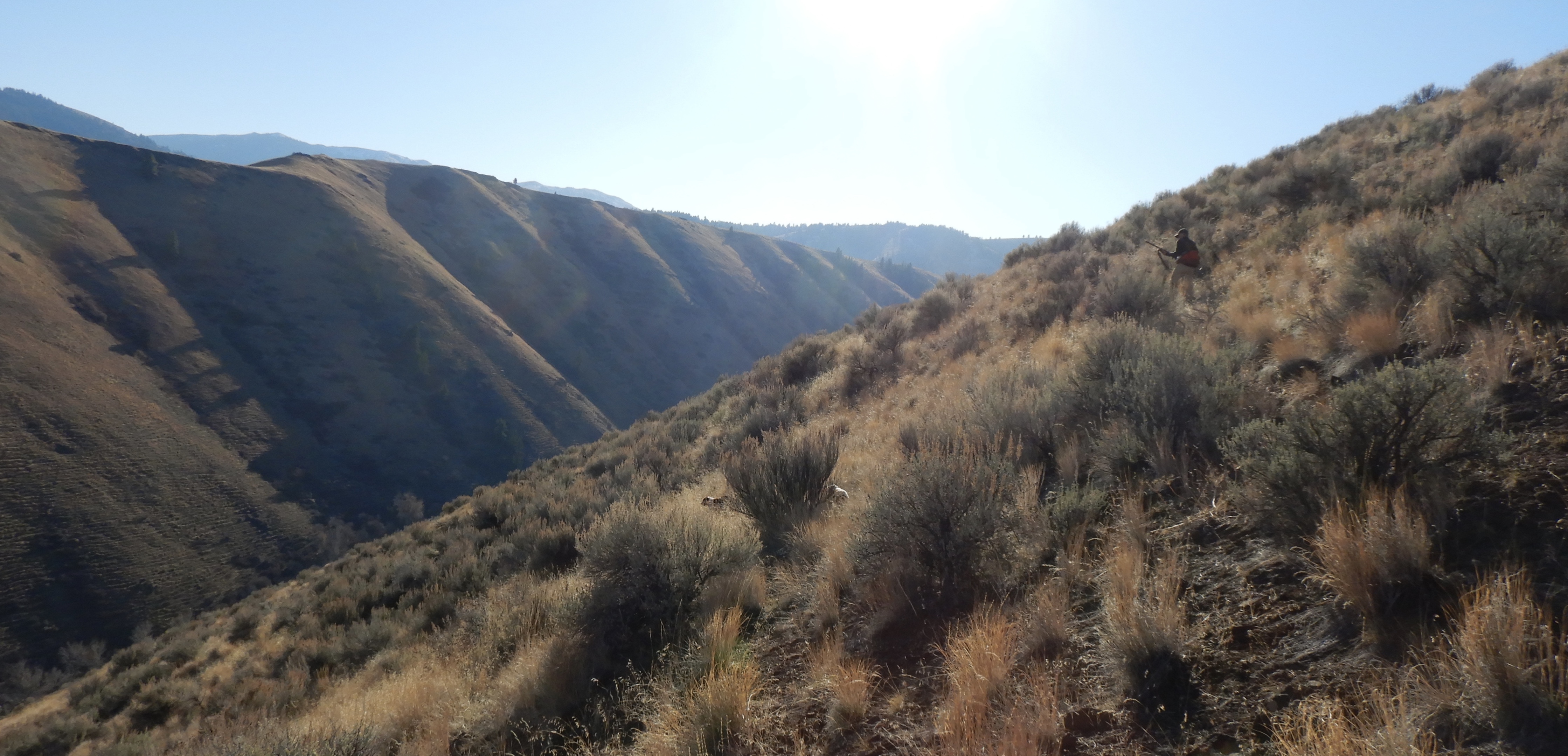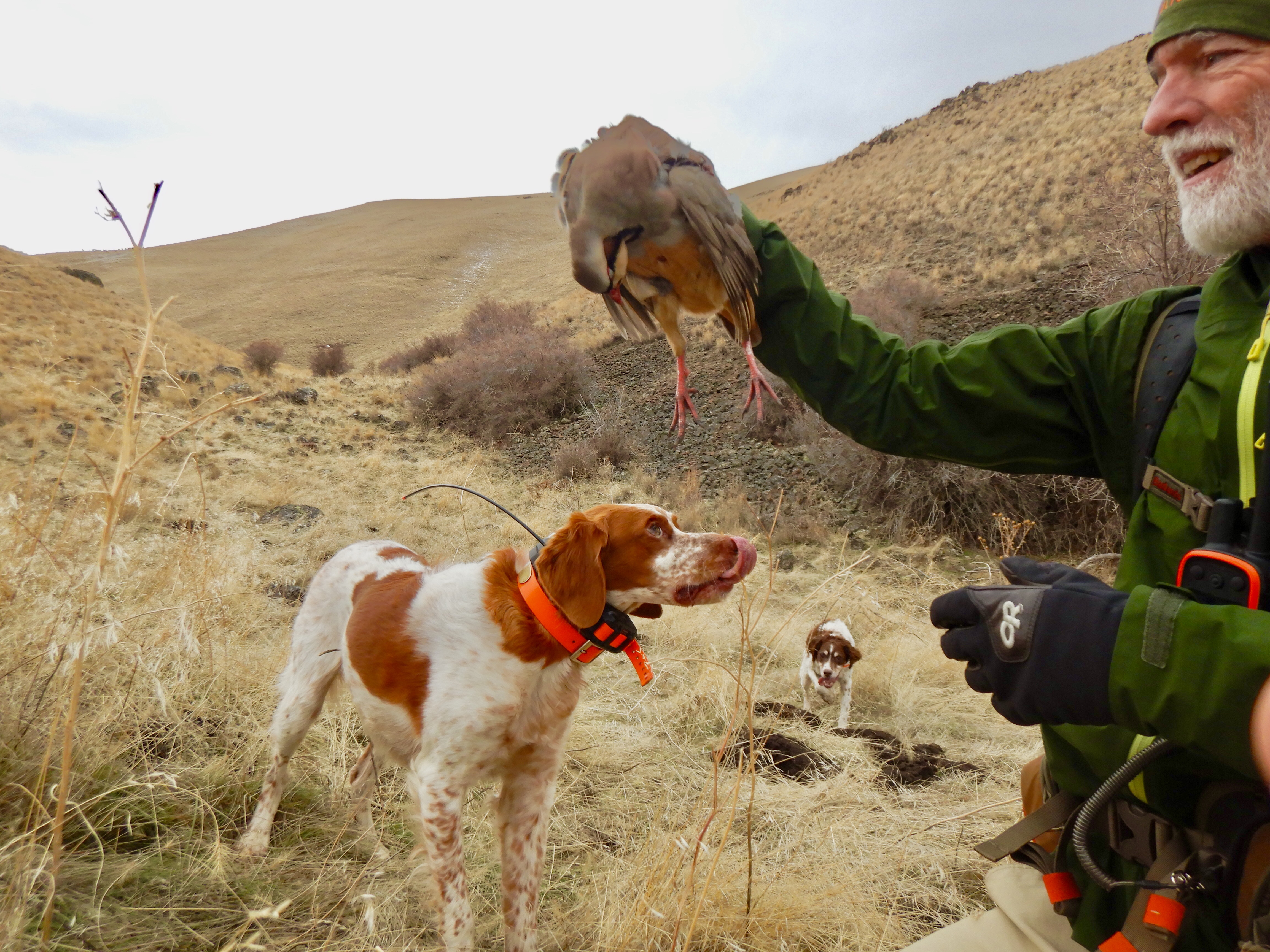
A big part of the appeal of chukar hunting for most of us is the beautiful places where these wild birds live. These captivating and lonely places are hard to get to, and they challenge us mentally and physically, but they continue to seduce us to them year after year.
We daydream about the solitude and the spirit of these kinds of places when we’re not there, and we long for the slippery snow underneath our boots, the loose scree, the damp fog coming up from the valley floor, the sight of a dog pointing and retrieving, and, especially, the intoxicating views from the top of these sacred mountains.
According to our blog stats, we get hundreds of hits and searches for chukar and upland bird recipes every month. I have no excuse, but we haven’t posted a new recipe on here for a while; it’s been about five years to be exact. Thanks to Peat, Angus, Bob, and on good days when I can actually hit them, we’ve got a nice supply of chukar, huns, and grouse in our freezer to last quite some time for us and to also share in recipes for visiting friends and family.
Grouse and chukar
This chukar curry recipe was a hit with Bob’s students during his introduction to upland bird hunting class recently; some of the kids from our rural Idaho town had never tasted Indian food, or chukar for that matter, and became immediate fans of both. Two other teachers sampled the curry and immediately wanted the recipe. It must be a winner! The ingredients are pretty easy to find, plus it’s super easy to make. It is my new favorite go-to upland bird recipe.
Chukar Curry
serves 4-6
8 chukar breast halves (from four birds) cut into 1-inch pieces*
1 cup plain Greek yogurt
4 garlic cloves, minced, divided
2-inch piece ginger, grated, divided
2 teaspoons kosher salt, divided, plus more to taste
3 tablespoons canola or vegetable oil
1 large yellow onion, minced
1 1/2 teaspoons cumin
1 15-ounce can crushed tomatoes*
1 ½ teaspoons ground turmeric
1 teaspoon garam masala*
1 tablespoon ground coriander
1 teaspoon cayenne powder
½ cup water
Fresh cilantro for garnish. Optional but recommended.
Combine chukar breast with yogurt, half of the garlic, ginger, and salt in a bowl and set aside to marinade. You can use it right away, in an hour, or up to a day refrigerated.
In a large heavy pan with lid, heat oil. Once hot, add onions and cook 5-10 minutes, until browned at edges. Add cumin, remaining ginger and garlic and cook one to two minutes more. Add remaining salt, turmeric, garam masala, coriander, and cayenne, and cook for two minutes.
Add canned tomatoes, chukar and yogurt marinade from bowl, plus water, stir to combine, and bring to simmer, stirring. Simmer 30 minutes over low heat, covered, stirring once or twice to ensure everything is cooked evenly.
~
Serve over basmati or jasmine rice and a side of plain or garlic Naan.*
* I’ve made this recipe using a mix of Huns, dusky grouse, and ruffed grouse cut into pieces instead of chukar. Adjust amount of bird meat to suit your taste.
*If you use a 28-ounce can of crushed tomatoes, use half of the can and freeze the remainder in a freezer container to use when making the recipe again.
*Garam Masala is an Indian spice.
Adjust all the other spices to your taste; I’d call this recipe mild or “Cambridge Hot.” Add more cayenne if you want it “Bombay Hot.”
*Naan is a flatbread that can be found in most grocery stores in the bread aisle or near the deli. Follow the directions on the package. If you can’t find Naan, white Pita bread can be used instead. Warm the pita bread in the oven at 400 degrees for about 5 minutes, remove from oven and brush with olive oil before serving.
Enjoy!
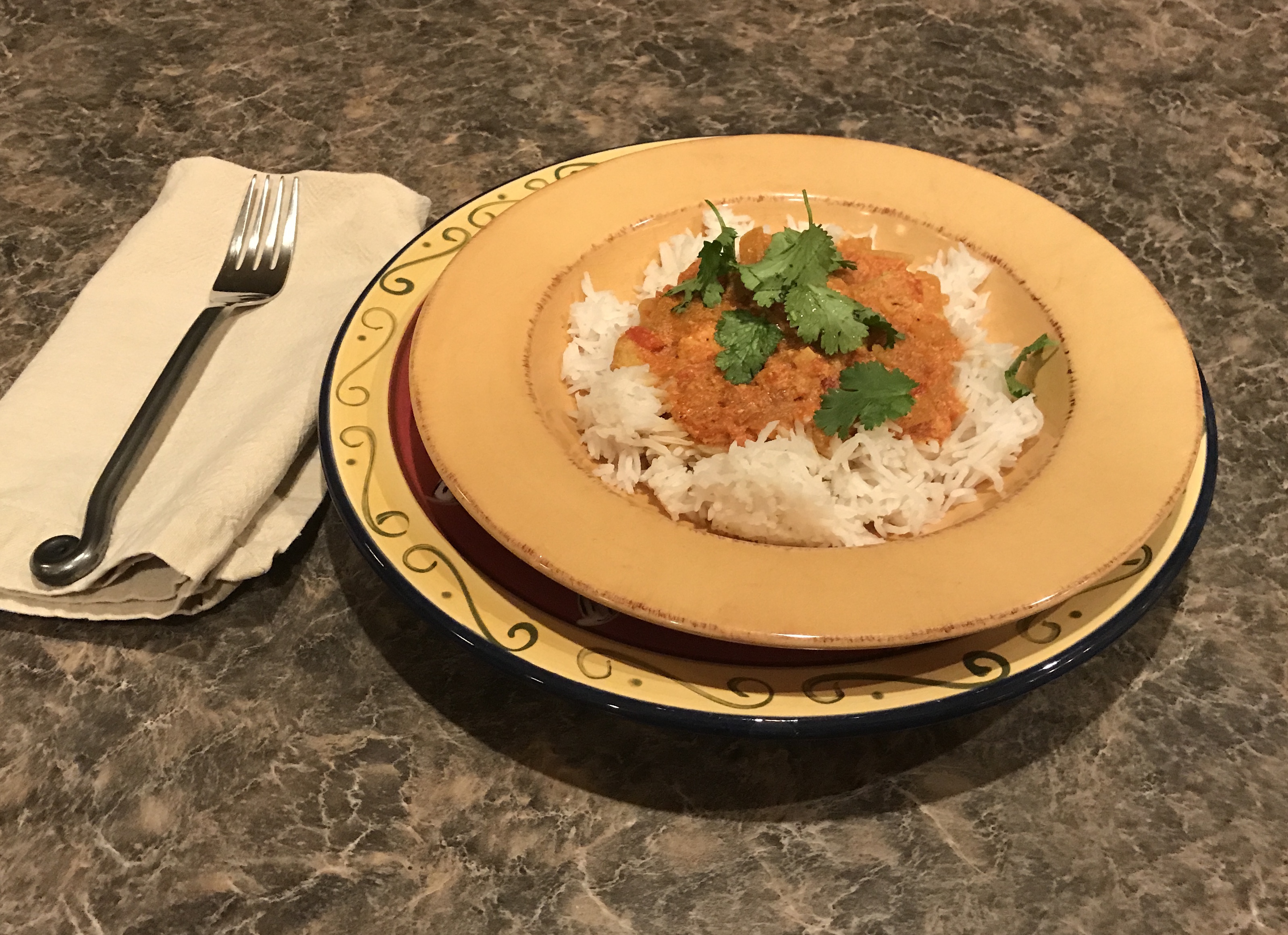
Chukar curry served over basmati rice and sprinkled with cilantro
Most of the snow lay clean and unmarked. We could tell nobody had hunted this spot since this first big snowstorm of the season, three days before. We were jacked. It was cold outside and early in the day, the pine trees, bushes, and grasses were frilled with snow, it was magical and beautiful. Hunting chukar in the snow does have its advantages; seeing fresh chukar tracks in the snow, you know they’re there.
Somewhere?
Chukar were here
The snow was also unwelcome.
The first mile uphill, I lead the rhythmic march following the legible impressions left in the snow by the dogs whenever they were running in a straight line. Angus stopped to pee ahead of me. I got up to him and stopped to examine the hole in the snow. It was a cruel reminder that his urine was tinged with blood, something we’re seeing more often recently.
Following Angus
Bob followed behind in my footsteps and as I slowed he’d take over. I felt like I was walking on a beach in deep thick sand. We rounded a corner and the strong wind once at our backs was now in our faces. I pulled up the hood on my jacket and Bob stopped to take off his hunting pack and as he was pulling out his wind shell he said, “I can’t believe I’m actually cold.” He’s never cold when we’re hunting. I stood there for a minute waiting for him until he said to go ahead, and once I reached the saddle I should turn left. Angus turned left before the saddle so I followed. We got to the top of a ridge but the windswept snow drifts were up to my knees. I saw Bob from a distance across the other side of the ridge and could see him signaling me over to him. I slowly made it over to him, threading my way through the sage and wobbily walking across the baby-head rocks and larger boulders underneath the snow, trying not to slip. From the top of the ridge we could see an area in the distance on another ridge where the snow was burned off. Bob said, “I think we should go over there, and get out of this wind. I bet the birds are all out of the snow right now.” I agreed.
Don’t let the sun fool you, it was bitter cold
We headed down the ridge and came across a perennial deer path worn by hooves heading up and down the mountain. We followed it for a while until we could see Peat and Angus looking birdy down in a tight draw. Angus immediately went on point while Peat was above him honoring him like a statue. Bob, below me, was slowly heading down towards Angus. The covey of a dozen chukar busted and flew like missiles straight downhill and around a corner. A single busted later and Bob got one shot off and I could clearly see it getting hit but it kept flying downhill until disappearing into the bushes about 400 yards below us. “We have to go get it!” I yelled over to Bob, “I saw where it landed!” We headed down and recovered it after Peat found it, only a wing sticking out of the snow.
There are definitely times when you don’t shoot chukar no matter what for fear of not recovering the bird. During every point you analyze the situation and imagine where the birds might bust and fly, and, if you do manage to hit one, where they might land. Some dogs will go to the end of the earth to find a downed bird; Peat and Angus are that way and it’s not worth risking losing them by having them go down a super steep rocky cliff wall and fall or get stuck.
Some people also say they don’t hunt birds in the snow because it’s unethical. Yesterday, I think the birds had the advantage on us because of the icy and slippery conditions, and getting to a point before the birds busted wild was almost impossible.
Waiting with Angus
Towards the end of the hunt, Bob and the dogs yesterday searched for at least 45 minutes for another chukar that went down. Bob saw it fall from the sky after shooting it and saw it hit the ground on a snowy, rocky hillside across a different ravine. I didn’t see it go down but he said he marked it and then yelled at the dogs, “Dead bird.” At this point in their lives they know what to do. Peat seemed part mountain goat, part house cat as his lithe body scoured the wall of snowy rocks, zigzagging back and forth and up and down, nose to the ground. I cringed from below, fearing he’d slip. He’s careful and cautious but also a little half-possessed while looking for downed birds. Peat couldn’t locate it, so Bob crossed the ravine to the other side to look for it while I stayed and watched from below. Once he got over there, the bird was nowhere to be found. Angus stayed closer to me and further below by busting through the brush looking for it. Between Bob, Angus, and Peat they couldn’t find the bird. Maybe it was buried in the snow? Maybe it landed only winged and stunned and then flew off and we didn’t notice.
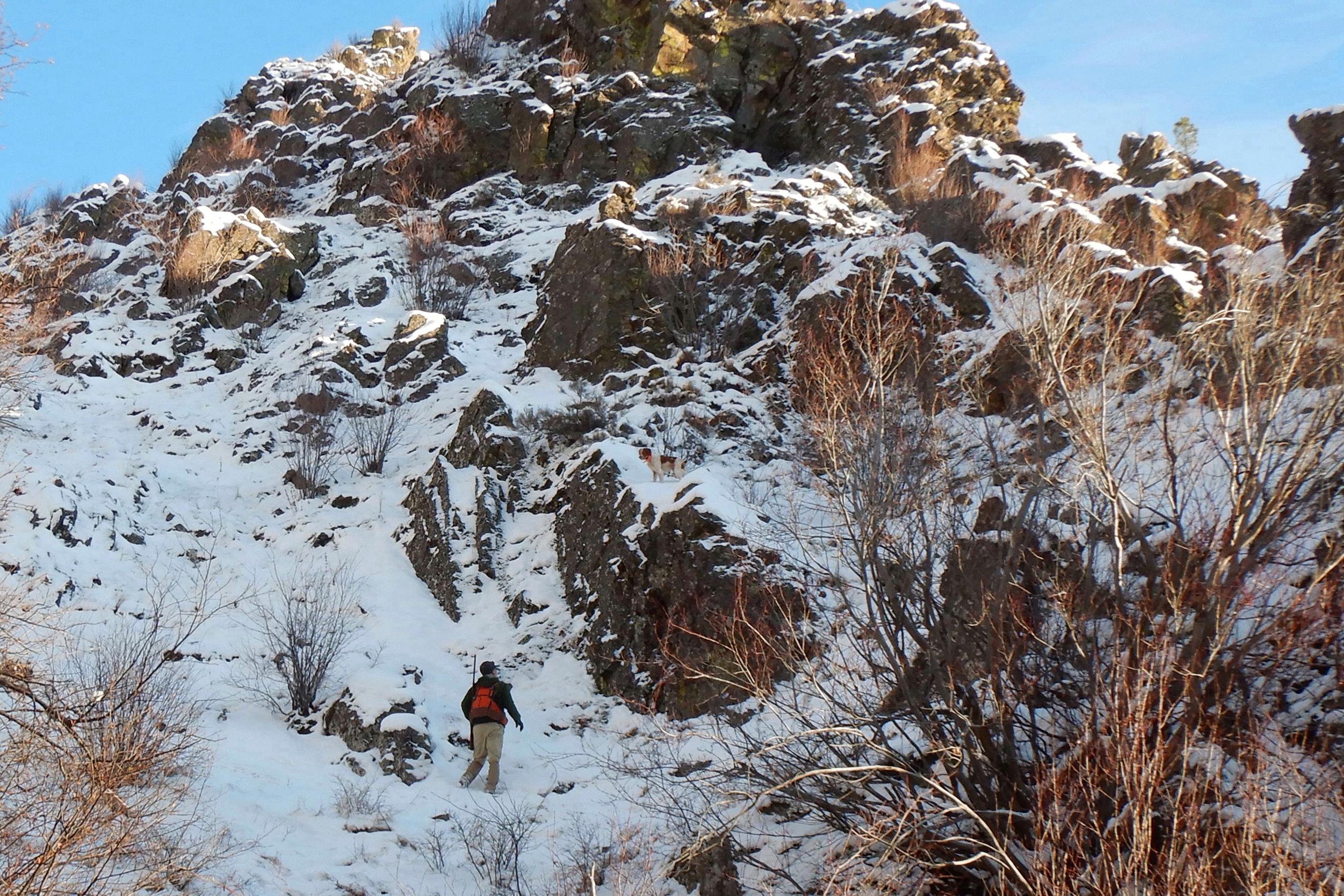
Heading up to look for the bird
When do you give up and walk away?
The sun was starting to set behind the mountain and it was getting colder by the minute. We’d already trounced around in the snow for 8 miles and were getting tired and the dogs were wet, it was time to start heading to the pickup before it got dark.
This wasn’t the first time this season that one of us has lost a bird we saw fall to the ground. I’m not sure what my odds are because I don’t keep records, but I’d say that of 20 birds this season, I’ve only lost one. Bob hits more birds so I’d say his odds are slightly higher.
It’s never easy leaving a dead or wounded bird behind, but it’s just part of hunting. I can still hear Bob’s choice words ringing in my ears when not finding downed birds; I’m sure nobody hates losing birds more than he does.
We’ve never been huge-mile hikers. We’ve never logged more than 9 miles on a chukar hunt, and I think our average hunt is less than 5 miles. But for some reason, each season we seem to go longer. Last weekend I hunted Saturday and Sunday, and totaled about 17 miles, which is a lot for me.
Angus did about 44. Something about the sensitivity to his condition, and wondering how much he can take, made me realize that I’ve taken for granted the fact that we do this together, human and dog. It’s deliberate, intentional, the heading out, returning together, and everything in the middle. All that cooperating. Checking in. Communicating. Sometimes the obvious things are the most interesting because we take them for granted. Not a new idea, I know, but when you think about what happens between you and your dog(s) on a hunt, it’s really pretty amazing.
I’m not the kind of person who’s used to tributes being paid to him (one can only hope), but for a dog to hunt with you, you’re being honored. The irony of my just now noticing this is not lost on me since the last post I wrote focused on how Peat honors Angus. Both dogs honor me simply by putting up with me, but to spend most of the day looking for birds I can shoot so they might be able to bring them back to me is ridiculous. It’s idiotically sublime, and kind of a source of shame; it makes me think of that saying, “I’m not sure I want to belong to a club that would have me as a member.” I do a lot of dumb, thoughtless things. What did I do to deserve this honor?
The answer is: nothing. Dogs grant us themselves. It’s an act of grace, “undeserved merit.” Yeah, we might think that without us the dog would be nothing. We might think that since we spent some serious cash rescuing them from someone who’d give them a more horrible life than we do that they owe us whatever we get from them. We might think other dumb things. Humans do that a lot. We think the world was made for us, that “lower” creatures were made to serve us. Our founders thought this justified slavery. They were wrong.
This Thanksgiving, I’m thankful for my dogs and their unfathomable and bottomless generosity. I’m thankful for their beauty and grace. I’m thankful for the fact that we go places together to do things together, and that we get out of the truck at the same time, hike in amazing country pursuing a variety of pleasurable experiences and recognizing each other in the process, and return to the rig together, continuing the bond of trust that threads my life together like the golden stitch. I’m thankful they want to be with us no matter what, that they’ll spend day after boring summer day baking in the bottom of the drift boat while I get increasingly grumpy from putting down countless trout. Like the honey badger, they don’t give a sh*t: they’ll still love my sorry ass.
It’s not like I never realized any of this. But it just hit me after two wonderfully long days with a dog living on borrowed time: this is a partnership only because he’s willing. It can’t be forced. He’s granting me himself. He’s done it, without fail, his entire life. That right there, that’s worth thinking about.
What a word. It’s a verb. It’s a noun. It’s an adjective. It’s an adverb. It’s a body part. It dominated my fall and winter last year. It’s the first word in the title of a great movie. It can signal a return to something horrific or sublime.
In upland bird hunting, it’s also a thing that, in its absence, can wreak havoc on a hunt, a season, hunters, dogs, friendships, marriages… “My dog backs,” one wants to say. Or, as Richard Wolters, the author of the bible (bird dog training bible), says, “You can criticize a man’s wife, but don’t you say one word about his dog,” and if that dog doesn’t back, it can be awkward.
During the quasi-nightmare of Peat’s childhood, in which he absolutely terrorized Angus, my second most abiding fear was that Peat would bust every future point Angus would ever make (my biggest fear was that he’d eat every single bird I shot, which — for the first half-dozen — he did). Despite how easy Richard Wolters makes it sound to train a dog to back another dog’s point, I thought it’d be impossible to train Peat to do that. Memories of my first Brittany, Glenna, who’d clear the county of all game birds and spend the day hunting for herself, returning to the truck when she was damned good and ready, flooded back to me during those first few months with Peat, and I fretted over what our first season together would look like. But the first time Angus pointed in the field, Peat froze harder than a pillar of Arctic salt. I nearly cried: massive relief, sudden shock, sheer beauty.
One of the things I’ve come to enjoy most about chukar hunting is watching Peat back, or “honor,” Angus. When Peat backs Angus, he appears possessed, crouching in electric contortion, an otherworldly concatenation of nerves and muscles. If Peat’s hunting another area and suddenly spies Angus on point 200 yards away, he’ll freeze, conduct a detailed but rapid visual analysis of the scene, noting Angus’s posture, rate of movement, the intervening vegetation and terrain, and determine the optimal course of action to allow him to get — as quickly as possible — closer to the birds without risking anything remotely dishonorable. When Peat does move, it’s with a mechanized precision but in machine-gun-like bursts. It is a marvel to watch.
Recently, Peat was in rare form, and Leslie got it on video. A couple of times he even bottomed out and actually lay down for a moment, his wee feet out in front of him. Enjoy the video.