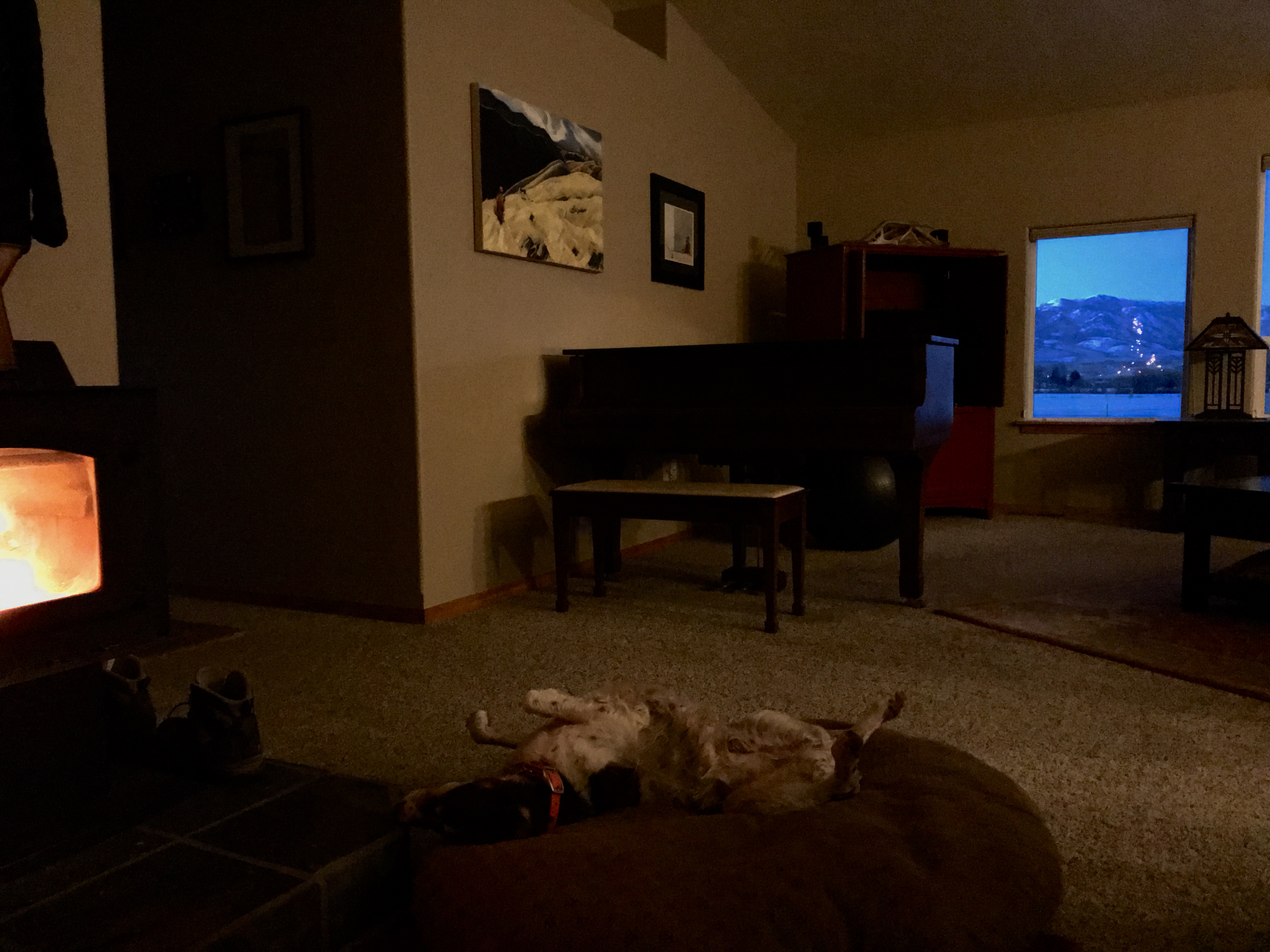
My dogs don’t make me reach between their legs
to light the fire. But they do sit right in front of it,
waiting and looking and wondering until it’s warm enough
for them to lie down and go to sleep on their cushy pads
and chairs, and they’re there when I leave, in the dark,
for school, and often there when I get home, often
in the dark. “May there be no sadness of farewell
when I embark.” They usually don’t even watch me
walk out the door. They know the drill. They’re smarter
than us all, smarter than the weather, smarter still.
Blog
-
Winter Still
-
Winter Faith
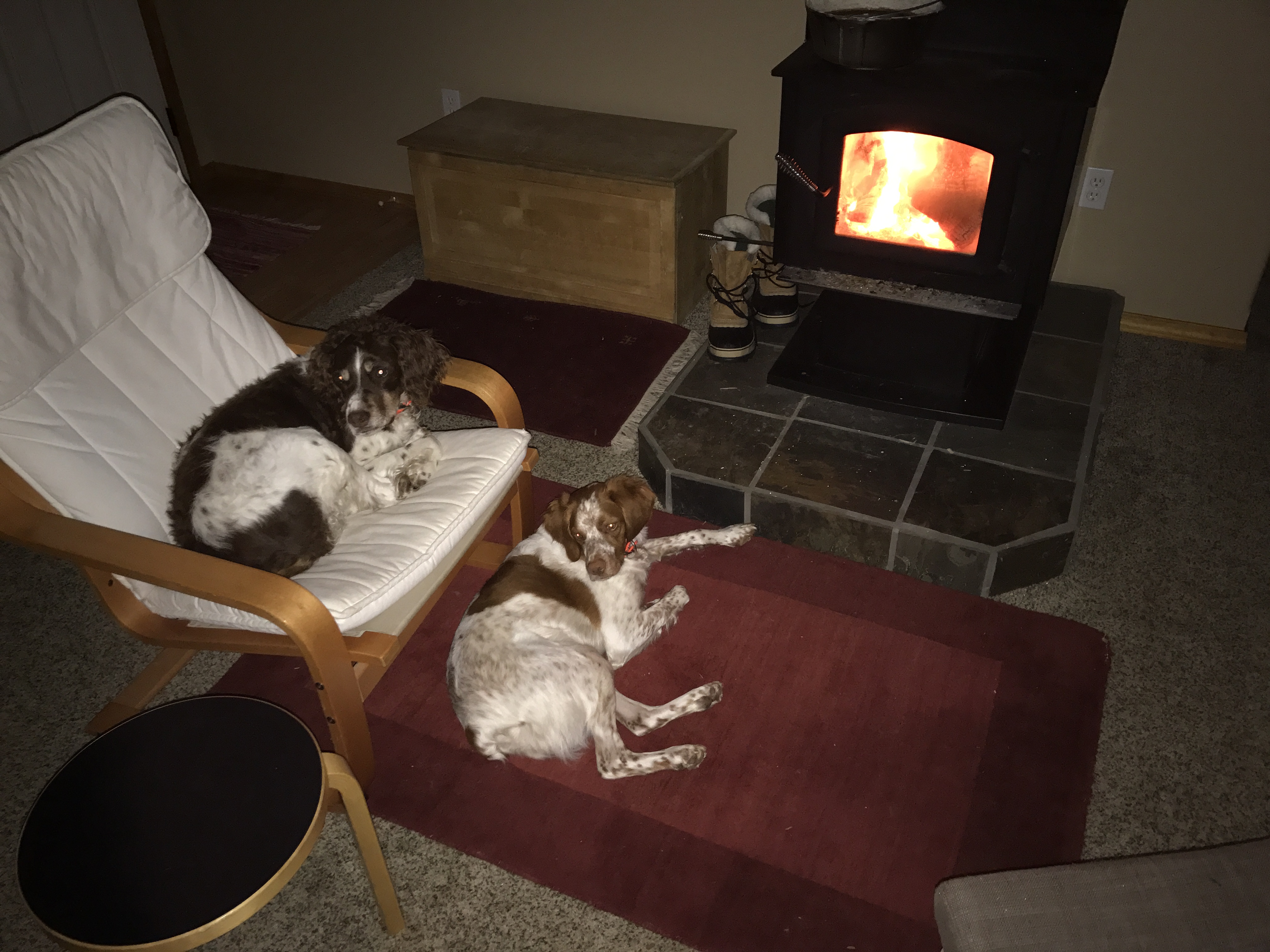
My dog does not care where heat comes from, but he cares ardently that it come, and soon. Indeed he considers my ability to make it come as something magical, for when I rise in the cold black pre-dawn and kneel shivering by the hearth making a fire, he pushes himself blandly between me and the kindling splits I have laid on the ashes, and I must touch a match to them by poking it between his legs. Such faith, I suppose, is the kind that moves mountains.
Aldo Leopold -
The Sequence
I live for this moment. This sequence.
My dogs look like they’re onto birds. I sense it from subtle nuances and have learned from training and experience how to read their body language. If I’m hunting with just one dog all my focus is on that one dog. If both of my dogs are in the picture, I have to decide which one to trust more and which one to follow more closely.
I remove my shotgun from my shoulder and hold it in ready position and carefully pick my way through the loose rocks without trying to look down. I see Angus through the thick sagebrush. He has stopped and is motionless. He’s on point. Out of the corner of my left eye, I see Peat rushing up and stopping just behind Angus.
Angus with his beautiful show dog gait starts creeping forward. Peat stays put. Scanning the tops of the sagebrush, I’ve consciously made myself focus softly, not knowing which direction the birds might bust. I slowly start moving into position in front of Angus.
Like a flash of lightning, more to my left than I’d anticipated, a small covey of chukar busts flying at top speed away from me. I quickly mount my gun while taking the safety off, then point the end of the barrel with the fleeing partridge’s arc, my index finger goes onto the trigger, and I squeeze. Everything happens so fast I don’t have time to think, relying on muscle memory from past experiences.
The dogs hear the noise of wing-whirr made by the covey of chukar taking off, and the sound of the single shot, and they get excited and run in the direction of where the birds flew hoping to pick up some scent on the ground of a downed chukar. They run back to me and give me that look: why did you miss? The sequence of usual events gets messed up this time and we don’t have a retrieve to make it complete.
I berate myself, making up all kinds of excuses and asking questions. Was it my stance and posture, my gun mount, or that I didn’t focus on the bird and follow through? Some or all are true. It messes with my head.
The three of us move on and we’ll try this spot again next year.

The initial point and honor, with Angus about to creep 
The approach 
Peat’s backing the invisible Angus 
Bust and shot: birds just above the sage 
Why’d you miss? Do you know what I went through to find those birds? Can you not hold up your end of this bargain? Would it kill you to practice once in a while? Do you think I’m doing this for my health? Do you think I’m getting fat? Why do you give me so many treats? -
Quilomene Upland Bird Vest Review

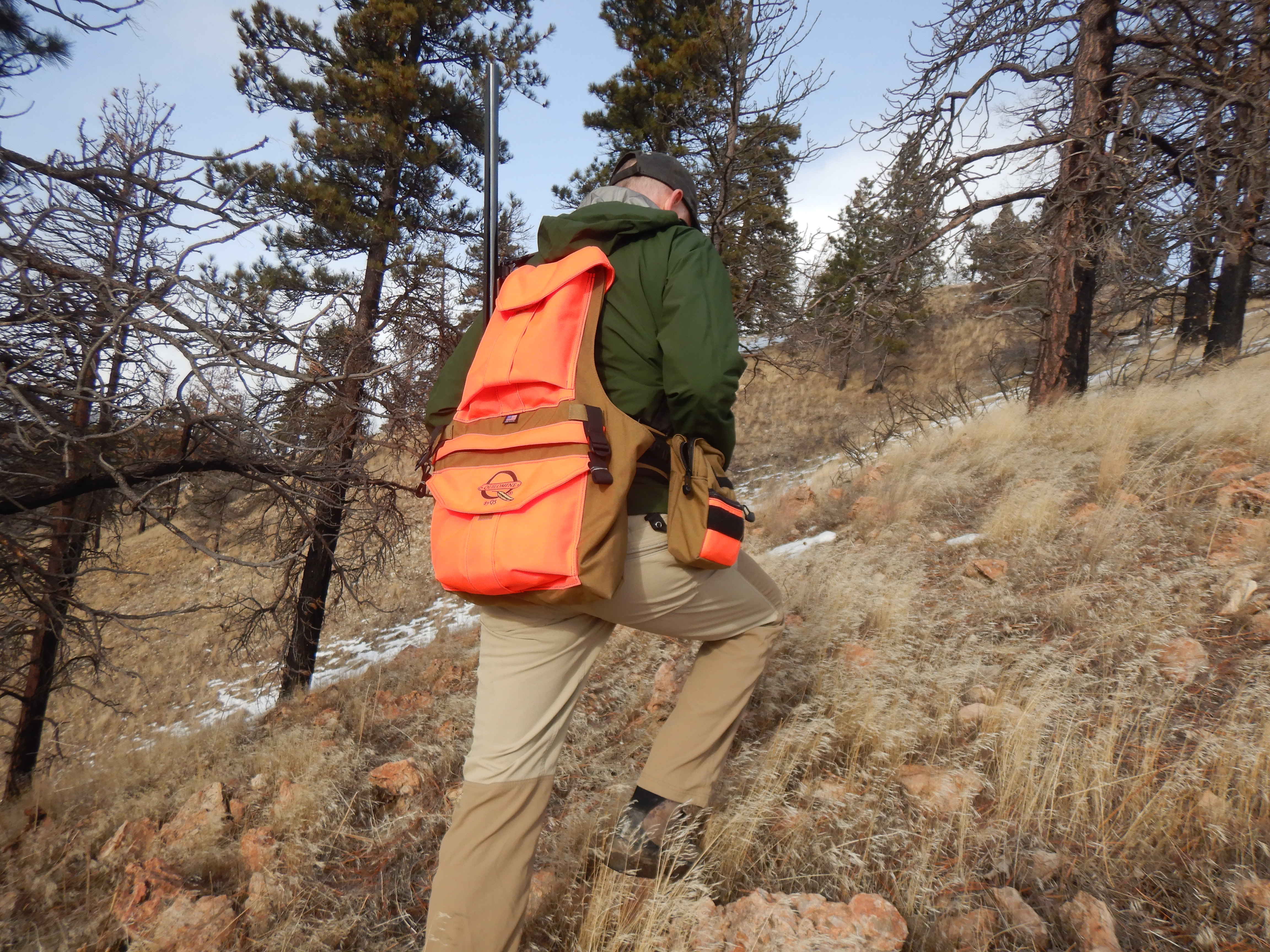
Heading out with the Quilomene Upland Bird Vest, nothing in the bird bag yet Just before New Year’s my new Q5 chukar vest arrived, which I’d ordered on November 30th: the Quilomene Upland Bird Vest. I’d been using the Badlands Upland Vest (no longer available) for the past couple of seasons and — as the weather asked us to bring more apparel, which goes on and off depending on the terrain — I started finding it just didn’t have the carrying capacity I wanted, especially as the bird bag began being burdened by bigger bunches of birds. The Badlands vest is still my favorite overall vest, but it’s not perfect and I continued to wonder if a perfect vest existed.
So I looked and looked: I looked at the Tenzing BV16 (currently out of stock everywhere I looked), at the Filson Pro Guide Strap Vest (no longer available), the Orvis Pro Series Hunting Vest (won’t work with a hydration bladder), Oregon Pack Works Rogue Bird Pack (not much information and only one photo, and by far the most expensive), and Wingworks Upland Wingshooting Vests (unavailable; I’ve been trying to get one of these for quite a while now). L.L. Bean makes a cool-looking vest, but I tried it a few years ago and returned it after one hunt because the water bladder sat too low in the pack to get it to flow without standing on my head. I’d used the Q5 Centerfire for a couple of seasons and really liked it, but ultimately found it too bulky for my style of chukar hunting, but decided to take another look at their wide variety of upland vests.
On the Q5 site, the Quilomene Upland Bird Vest looked like it might be the ticket: bladder-ready, easily-accessible large bird bag, moderate storage, modular straps (can add/remove accessory and shell pockets), and lash-strap ready for external carrying options. I’m about 6′ and 155, so I ordered the smallest waist belt, and it just fits cinched as tight as it goes; skinnier folks will probably find it too loose.
When I ordered it, the site showed one message saying they were running a 2-week lead time on new orders, and — somewhere else on the site — a 30-day turnaround. I received mine a month after they charged my card. The current message (as of 1/10/20) shows 30 days out and “unable to provide any status updates.” It’s ironic that chukar hunting seems never to have been more popular, yet it’s nearly impossible to get a new vest quickly, and the choices seem to be shrinking. Not sure what to make of that, other than American manufacturing doesn’t seem to be faring too well at the moment; the only two vests I mentioned that are available (the Orvis and the L.L. Bean) are not made in the U.S.
Anyway, I was very excited when the Quilomene vest finally arrived. It took a while to set it up to fit, but once I’d made some velcro adjustments, shortened the shoulder straps as far as they’d go (see more on this below), and added the two shell pockets to the padded hip belt, I was ready to install my 100-ounce Camelback hydration bladder. This wasn’t easy. The bladder pouch is directly against your back (which is moderately uncomfortable when the bladder’s full), and there is a hole on both sides of the bottom of the pouch, intended for the hydration bladder’s hose to exit the pouch for routing somewhere on the vest. The problem with this is that most bladders have their hoses exiting the bladder at an upward right angle; I hadn’t realized this until I couldn’t get any water out of the hose and had to pull the whole bladder out to see what the problem was. No matter how I tried routing the hose through the bottom holes in the pouch, the hose got kinked and wouldn’t flow. So I ended up running the hose up the inside of the pouch and out the top; not a huge deal, and it works fine.

Bladder pouch with hose coming out the top 
Top of the Camelbak bladder; note the retainer clip: the vest’s pouch doesn’t feature anything to clip it to Another issue with the vest if you use a bladder is that there’s nothing at the top of the bladder pouch to attach to the top of the bladder to keep it from sloughing down in the pouch as the water level drops. Most bladders have something at the top near the fill point to counteract gravity so the flow doesn’t get interrupted; the Q5 Centerfire did, but this vest doesn’t.

Hose clip sewn into right shoulder strap 
After cutting out the clip; I used a flame to seal the loose nylon threads… Still another problem with my particular set up is that I ordered a water hose retainer clip, which the Q5 video shows as removable, so I assumed it would come loose and I could put it wherever I wanted. But it was sewn low down on the right shoulder strap. The first problem here is that a right-handed shooter probably won’t want the drinking tube on the right side; second problem is that it’s sewn into the strap and prevents me from shortening the shoulder strap below the clip. I wanted to shorten the straps to get the vest to ride higher, so I had to cut the clip out (more on that below).
The other negatives I’m experiencing with this vest (I’ve hunted with it a half-dozen times now) have to do with the shell pockets. I ordered a standard Q5 shell pocket for my shells, which I keep on the right side and a Quilomene pocket for the left, which looked like it’d be roomy enough for me to carry our small camcorder. It’s not, but it’s bulkier and takes up more hip-belt real estate so that it rides on my left thigh when I’m climbing (very annoying), and requires two hands to open. The Q5 shell pocket holds a lot more shells than I’m used to, which I appreciate, but is not nearly as user-friendly as the substantially smaller Badlands magnetic closure shell pockets; for quick reloading, especially with gloves, the Q5 shell pockets are not easy to manipulate with one hand.

With just a couple birds in the bag, it falls lower on my body than I’d like The bird bag is really big and easy to get birds into, as long as the storage pockets (which sit on the outside of the top layer of the bird bag) aren’t too heavily loaded with gear, or you don’t have a heavy garment or elk shed lashed to the outside of the bag; if this is the case, you have to push hard backward to gain enough space to drop the bird in the pouch. Without birds in the bag, it rides much lower than I’d like, and when I’ve got a bunch of birds in it, it bangs on the bottom of my butt with every step, which gets old fast. At 6′, I don’t think the vest should hang as low as it does.

Bird bag, secured by snaps and velcro, opens to adjust the strap length and clean out the pouch So after cutting the sewn-in clip out of the right shoulder strap I shortened the straps a lot to see if I could get it to ride higher so the bird bag doesn’t ride on my rump. I was able to shorten the straps to get the bag to ride below the small of my back and on the top of my butt, but this moved the padded hip belt above my waist: not an option! So it seems the vest is definitely designed to ride as low as it does, which doesn’t make a lot of sense to me, but what do I know?
I don’t hate this vest. I really wanted to like it. At $240, it should be high quality, which I think it is, at least as far as the materials. The heavy-duty nylon and plastic components seem durable, although I do wonder if the very bright blaze sections will quickly fade as they did on my Centerfire vest. It’s been a long time since I’ve used a strap vest, so I wasn’t sure how I’d like the basic no-frill, unpadded nylon shoulder straps, and they’re actually a lot more comfortable than I expected. Ultimately, I just don’t like the fact that it’s designed to ride so low. If anyone’s interested, it’s available for $200, and I’ll throw in a couple of our new iron-on patches.

Our new Chukar Culture embroidered patch The bottom line is that this — so far — is definitely not my perfect chukar vest. I still haven’t found it and suspect it probably doesn’t exist.
Pros:
- Fairly comfortable (aside from the butt-whomping)
- Adjustable (within limits)
- Good amount of storage capability
- Easy to get birds in the bag (as long as you’re not carrying a lot of stuff in the storage pouches)
- High quality components and construction
Cons:
- Q5 shell pockets not easy to use with one hand
- Quilomene shell pockets almost impossible to use with one hand
- Water bladder setup not well designed
- Removable components should not be sewn onto vest
- Expensive
- Long lead times
-

2019-2020 Chukar Season Reflection
This has been an angst-filled season (and it’s not quite over) but it’s also had some unprecedented good things.
Here’s what I’ve learned this year that contributed to the angst:
- Leslie, in her 3rd season, gained confidence and skill, as well as an independent hunting style, as any good hunter should; this proved difficult for me since I’m stubborn and pig-headed and want to hunt my way, which differs from hers. So we often disagreed over where and how and who would get which dogs to hunt with.
- UTVs are becoming more of a nuisance and negatively impacting habitat, bird numbers, and others’ experiences. I’d heard of folks with big-running pointers driving UTVs along the roads in the Andrus while their dogs scoured the land, and that they’d stop when the dogs went on point and walk over to them. I doubted many did this, and thought about my neighbor Sam, an octogenarian (who only uses his UTV to get to spots to hike; he doesn’t road hunt with it) — I can understand older folks not able to scale the steeps still wanting to taste the chukar medicine, so I kind of forgot about this issue. Until I saw it first-hand: a bunch of able-bodied dudes in their 30s and 40s with multiple UTVs bedecked with custom aluminum dog boxes driving along the road, waiting for their pointers to beep on birds, and then they’d park the UTVs (sometimes right in the road), release the little setters to help bolster the pointer, and mosey over for the murder. I’d say, “To each his own,” but — if you’re able to hike — this is an absolute bullshit way to hunt chukar, and definitely not “fair chase.” This is what the nouveau-riche do on game farms in Georgia and Texas. In case any of this is unclear, I’m not calling out all UTV use in chukar hunting (although there’s a difference between hauling out a limit of chukar and hauling an elk, both of which can be done without a machine). I do worry, though, that public land and wildlife agencies are coming under increasing pressure from lobbyists and manufacturers (and the politicians in their pockets) to expand UTV use as hunters become more swayed by the idea they must have one to do any kind of hunting. Just because you can (and have enough cash), doesn’t mean you should.
- Long-standing bird populations in certain “popular” areas have relocated, most likely due to increased pressure. Idaho Fish and Game, and other agencies across the nation, report that hunting license sales are declining. Chukar hunters, however, in Hells Canyon and other growing population areas (such as Boise, Bend, Twin Falls, and Ontario) have noticeably increased (Idaho license sales have actually increased 14% since 2011). We’ve noticed this, as has every other hunter I’ve talked to who’s hunted chukar in Idaho and Oregon for more than 5 years. The biologists at the Andrus WMA will concur. The angsty part of this fact is selfish (I’d like bird numbers to improve), but also relates to the previous point about UTVs: when motorized vehicles and big-running dogs cover (often on consecutive days) 40 miles or more per day in prime chukar country (which is 4 to 10 times what a hiking hunter would cover), birds are gonna move and their numbers diminish resulting from what I’d consider unethical harvest and stress (road hunting is not “fair chase”).
- Covey sizes, birds per mile, and individual bird sizes are down (this is only based on my personal experience and informal surveys of other chukar hunters’ experiences this season, as well as my log over the past several seasons). The season in Idaho starts too early and the harvest limit should return to 6. I’m as guilty as anyone for hunting when Idaho’s season starts because I can’t help myself (and I do feel guilty about that). Neither can lots of people. We want to get out there. But the early start means lots of downy feathers and shrimpy-sized chukar, as well as smaller and more scattered coveys later in the year. Give the new birds a fairer chance at reaching adulthood, when they might fly well enough to beat the odds and live long enough to breed. And I’m sorry, but nobody needs 8 birds a day; based on the tailgate shots I’ve seen this season (often with a UTV in the frame), it seems lots of folks have no problem shooting a limit. I’ve always been able to find birds, but even if I shoot my absolute best, I’d have to hike 16 miles to harvest 8 birds; I’ve averaged about 5 miles per hunt this season, which is a record for me, so unless I double my shooting percentage and miles per hunt I’m pretty safe from limiting (I’ve averaged 2 birds per hunt this season, another best, which includes grouse and Hungarian partridge).
- Medusahead Rye is getting much worse, exponentially taking over some areas it didn’t exist in three or four years ago. Biologists in Oregon and Idaho are concerned because it quickly eliminates other vegetation and cannot be controlled or mitigated in chukar habitat, and chukar do not stay in mono-typic ecosystems.
- Chukar will be all but extinct in Hells Canyon and other places in Idaho and eastern Oregon within 20 years if things continue the way they are. Medusahead by itself might accomplish this impressive feat. But with increased pressure, the expansion of UTV use, the early season start, and excessive harvest limits chukar hunting does not seem sustainable. I’m not a scientist, but I know Fish and Game biologists are aware of and concerned about these threats yet they don’t have the budget to conduct studies that affirm these concerns, and the agency and its myopic legislative overlords want to make hunters happy in the short term (i.e., sell as many licenses as possible!).
- Social media has creepily colored chukar hunting (along with the rest of existence). I’m talking mainly about Twitter (which I never use but only know about because it has become, surreally, our country’s governance platform), Facebook, and Instagram; I don’t consider blogs per se as social media because it takes more time and effort to write and read a blog post than it does to post something on Instagram or Facebook or Twitter — has helped publicly enable and amplify our most vitriolic and inhumane traits; this is obvious to everyone who uses these things. If you’ve followed this blog this season, you’ve seen that attitude leak into some of the comments and a couple of my posts responding to this disturbing trend. If you follow Instagram, you might have noticed several upland hunting wannabe “influencers” out there whose main goal appears to be to promote themselves to get “sponsorships” and amass “followers” and “likes” (which can be, and are, purchased by the “influencer”). One of these wannabe influencers in particular, who’s distinguished himself by posting photos of himself with dead game birds in compromising (highly sexualized and disrespectful) positions, and who was the focus of a mostly slow-motion video by a well-known upland hunting promotional group (which deletes any comments on the video that aren’t hagiographic, as is their right), recently stated that he wanted to be the “badly-needed figurehead” of upland hunting (since when did upland hunting need a “figure-head”?). No, this is not a precis for a bad novel, although the thought has crossed my mind… Predictably, this post generated a mass of attacks from other wannabe “influencers” on Instagram, one of which appears to exist solely to make fun of hunters who take themselves too seriously but actually seems to be focused more on attacking a specific conservation group and its president. And on and on. These little wars and battles. This discourse. Three years ago I was unaware of any of this and obliviously torturing myself in pursuit of public land partridge. Thus my new year’s resolution to unplug from it all: I have enough angst from other, more honest, sources.
- Small American manufacturers, some of whom make bird hunting vests, don’t appear to be faring too well. The three best known vests for their popularity with chukar hunters have been hard to come by this year, if not impossible. While I have no idea what’s behind this for these particular companies, it’s frustrating and weird (angsty) in the 2020 economy, which is supposed to be so amazing, to see obvious production slowdowns or outright stoppages. Soon I’ll have a review of the vest I waited over a month for.
- Angus getting cancer.
Enough ranting. The good things:
- Angus appearing to beat, or at least hold off, cancer, for now. Diagnosed on August 30th and given 1 to 3 months to live, we allowed ourselves to hope only for one chukar hunt with him. We were ecstatic on opening day to have him with us. He’s hunted the entire season as well as ever (with a few more days off than before, but he is, after all, almost 13).
- We’re hunting harder than ever, if not smarter and better. This is why I keep a log. In all the categories I track (miles, duration, elevation gain, dog miles, shots, kills, and averages of these per hunt), this season is better than any previous season, with the exception of my shooting percentage, which continues to hover just around abysmal. After last year’s spine surgery-abbreviated season, I’m thrilled my body is working well enough to continue this insanity.
- We’ve hunted a bunch of new places (thanks partly to ONX Maps) and have been fairly successful finding birds in each one. It’s good to know that if a place looks like it should have chukar, it probably will (although I will admit that we’ve yet to find any place that has as many birds as we think it should).
- I started reloading our own shells. While I’m pretty sure this is not an economically sound endeavor, it’s been fun and a challenging learning experience. I haven’t found “the perfect load” (open to suggestions: send me your recipes!), but have had some apparent improvements with some loads (although the data set’s pretty small to come to any solid conclusions; biorhythmic theories might hold more water).
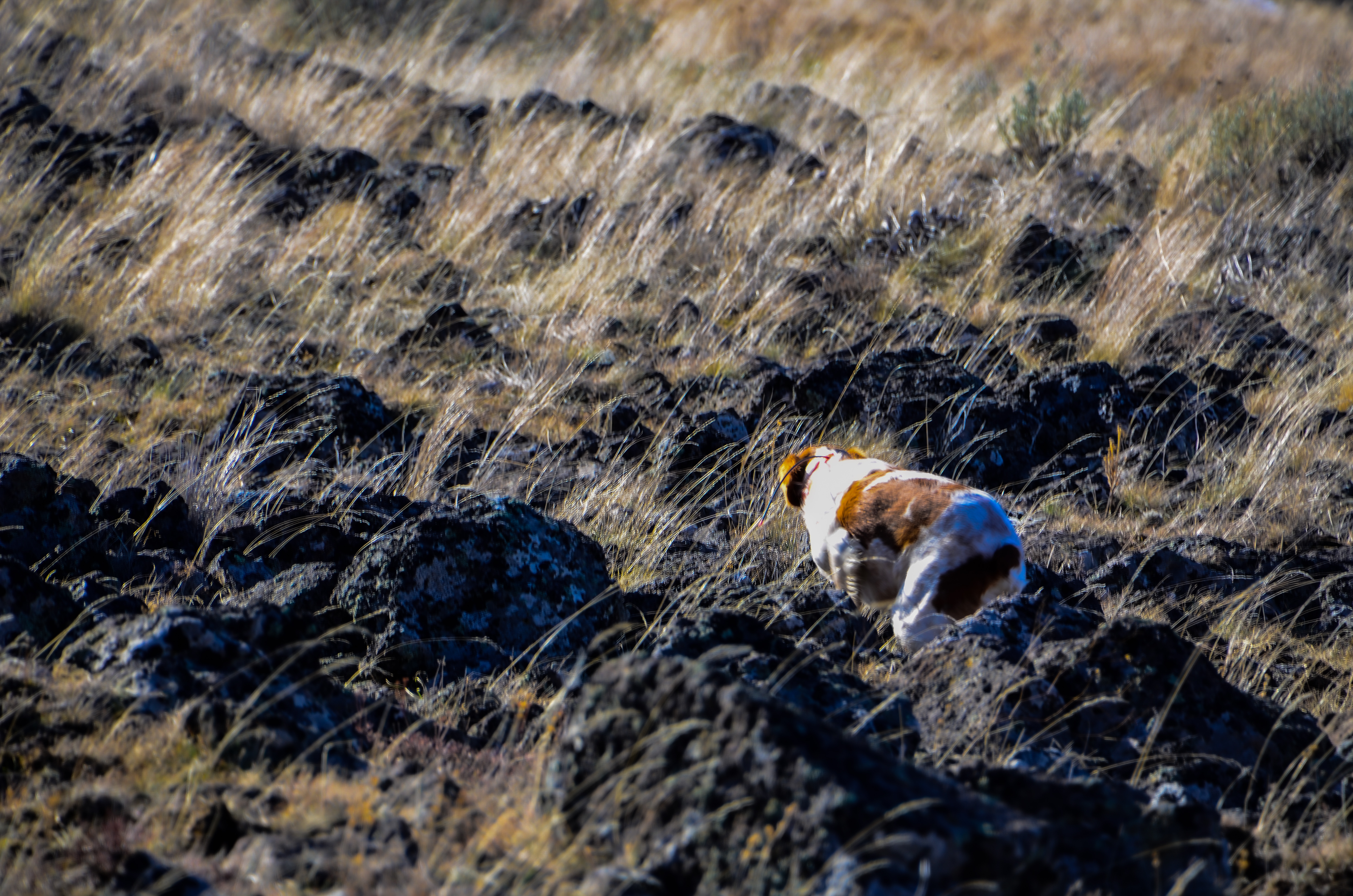
- Peat is better than ever. That’s saying a lot, because he was already really good, and has been since the end of his first season. This season he’s just been great, in both solo and partner situations. He’s become stealthier, and yesterday he showed me more clearly than ever that his number one concern when he finds birds is to hold them or — at the very least — make sure they don’t bust before I’m within range. I’m convinced he knows exactly what my shooting range is and isn’t, which I find remarkable. Yesterday he found a covey of chukar and pointed them from a reasonable distance. The birds slalomed through the sage, but Peat didn’t want to risk busting them so he held still. Angus came along and — as I’ve always known he’ll do — crept past Peat and followed the ambulating chukar carefully. Peat, the consummate backer, wanting to stay connected to the action, executed his short bursts toward the birds, at one point (see photos below) wedging himself discretely between a large rock and sage bush! He’s covering more miles and slightly extending his range and, as a result, finding more birds than ever. He’ll be 5 this spring, and I’m already lamenting (very prematurely, I know) his demise. I should probably take comfort in knowing that he’ll far outlast my ability to hunt these birds (if they don’t go extinct before then).
- Sunburst Brittanys is not only still in business, but doing very well and still producing phenomenal chukar hunting dogs that naturally point, back, and retrieve. Just as wonderfully, their dogs are good family dogs. This sounds like an advertisement, and maybe it is, but it’s heartfelt. Not a day goes by where Leslie and I don’t marvel at our canine-caused joy, whether it’s somewhere on a ridge during the 4-month season, floating down the Missouri in a drift boat, poaching heat and affection from them in bed, or watching them enjoy being the dogs I’d trade my life to be.
So there you have it, the bad, the good, and the no-good-to-look-at. And there’s still a few weeks before that sad, long off-season. I hope I haven’t bummed anyone out too much, but it is what it is. At this point, if there’s even one person still reading this, I’d count it a success. Best wishes to all for a good 2020.

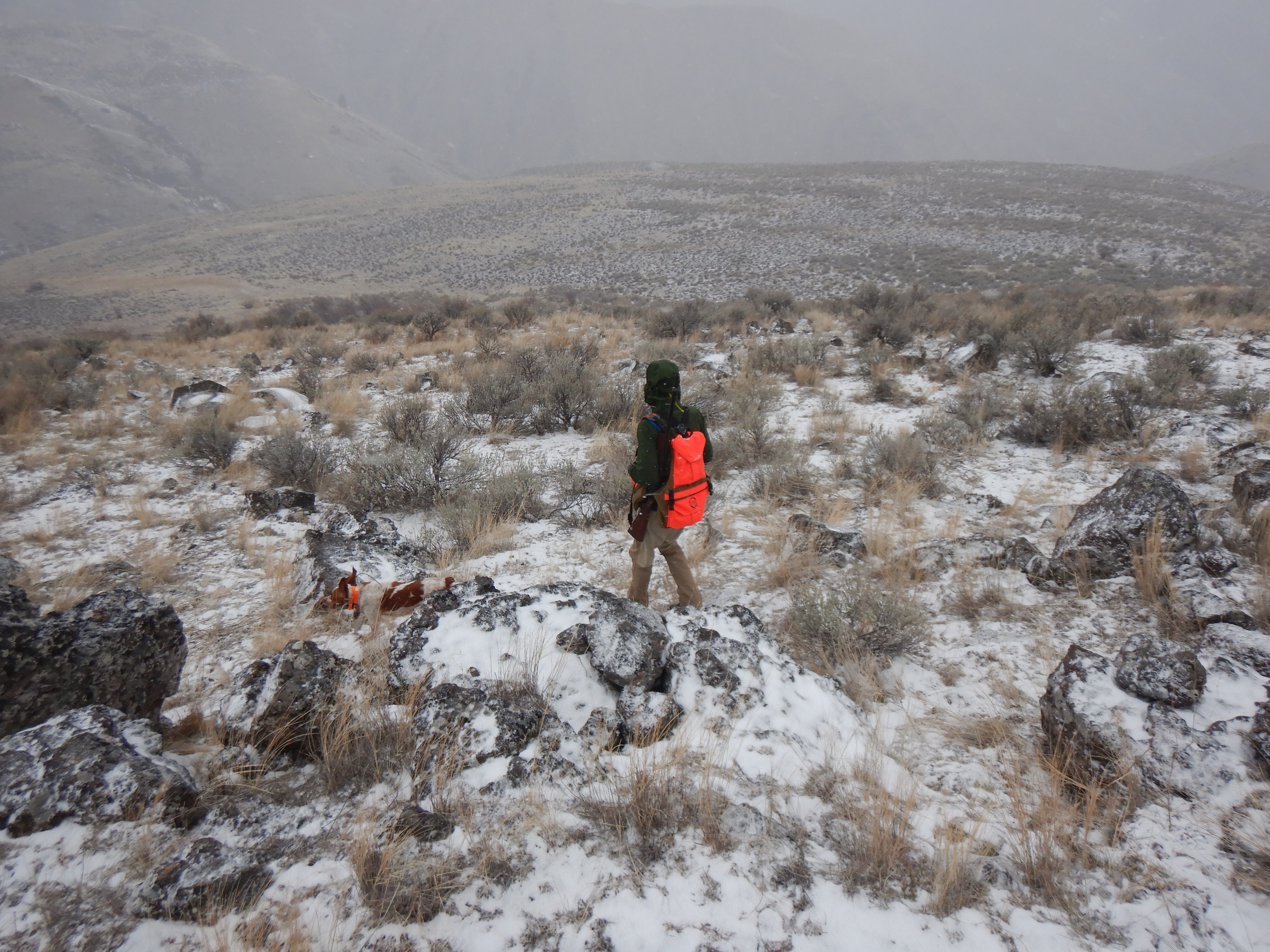
Peat moving up toward Angus on point (Angus on the right, mid-frame). Peat bounded to a low spot between the sage brush behind Angus and wedged himself, on his belly, between the sage and a rock (see next photo). 
Peat hunkered between sage and a rock, waiting for his next move toward Angus (top center).