For granted. It’s one of those things we don’t want to admit to doing. It’s come to my mind a lot in the past year, mainly in thinking about where we used to live. I tried hard not ever to take for granted living in chukar country. This blog is my evidence. That doesn’t mean I’m not surprised by what transpired in the last year. I guess that’s a good thing. Still, we have to move. Again. The word “regret” shares a lot of letters with “granted.”
During our recent 3-week trip in the camper, mainly to fish in Montana, we talked a lot about what we want and need in a place. At the top of my list is that it has to be within an hour of good upland bird hunting on public land. Second: within an easy day’s drive (<5 hours) from good trout fishing. Third: within a “reasonable” distance from an airport. Fourth: a town small enough to have a decent grocery store, at least one restaurant that serves beer, and one high school so I might substitute teach. Skewing all this is adding the word “chukar” before “upland.” We have some places in mind. Suggestions?
A big part of the appeal of chukar hunting for most of us is the beautiful places where these wild birds live. These captivating and lonely places are hard to get to, and they challenge us mentally and physically, but they continue to seduce us to them year after year.
We daydream about the solitude and the spirit of these kinds of places when we’re not there, and we long for the slippery snow underneath our boots, the loose scree, the damp fog coming up from the valley floor, the sight of a dog pointing and retrieving, and, especially, the intoxicating views from the top of these sacred mountains.
Yesterday, was my last hunt with Bob for the season. It was also Bob’s last hunt. We’d hoped he’d last until the end of the month but tomorrow he’s undergoing spinal surgery.
Our life for the past three months has revolved around his spine. Yes, our life. It’s not that it’s getting in the way of hunting things; we’ve spent many hours in the car together traveling back and forth for medical-related appointments and things, and his spine affected our ability to travel out of state to visit family over the holidays because sitting in a car or plane would be unbearable. We’ve missed going to see his students play basketball games for fear of being trapped in the bleachers when the pain would start up again. Bob even got to the point where he couldn’t go into the grocery store with me for even 5 minutes so he could pick out his own yogurt and cereal since I can never remember what kind he likes. Our time together spent moving up and down the chukar hills with the dogs looking for birds and being totally in the moment was the only time he said he forgot about his pain. When it did act up, the dogs were confused by him suddenly stopping to lay on the ground to get into a position that would lessen it.
Yesterday morning was spent doing chores he won’t be able to do after his surgery and other last minute things before heading out to hunt. Because of my lack of experience running our snowblower up and down our driveway by myself, we spent 15 minutes going over how the beast worked. I started out taking notes on a piece of paper but Bob suggested a video on my phone might be better so it would make more sense later.
I think he’s right. He knows me better than I know myself.
Opting out of hunting for the day and knowing I’ll have more chances before the season ends on January 31, I wanted Bob’s hunt yesterday to be for himself and for him to experience every point, every flush, and retrieve with both dogs. When Bob and I hunt together, Peat goes with Bob and Angus usually sticks with me. My fear every time we hunt with Angus is that we might lose him. This season because he’s almost totally deaf and going blind he’s relying more on his fine-tuned nose to find birds and because of this he’s ranging farther than he normally does.
Layers upon layers on our ascent from the valley below.Bob and AngusMagical pointAngus still moving like a young dog.Chukar nearby, Peat knows. He’s only getting better each season.
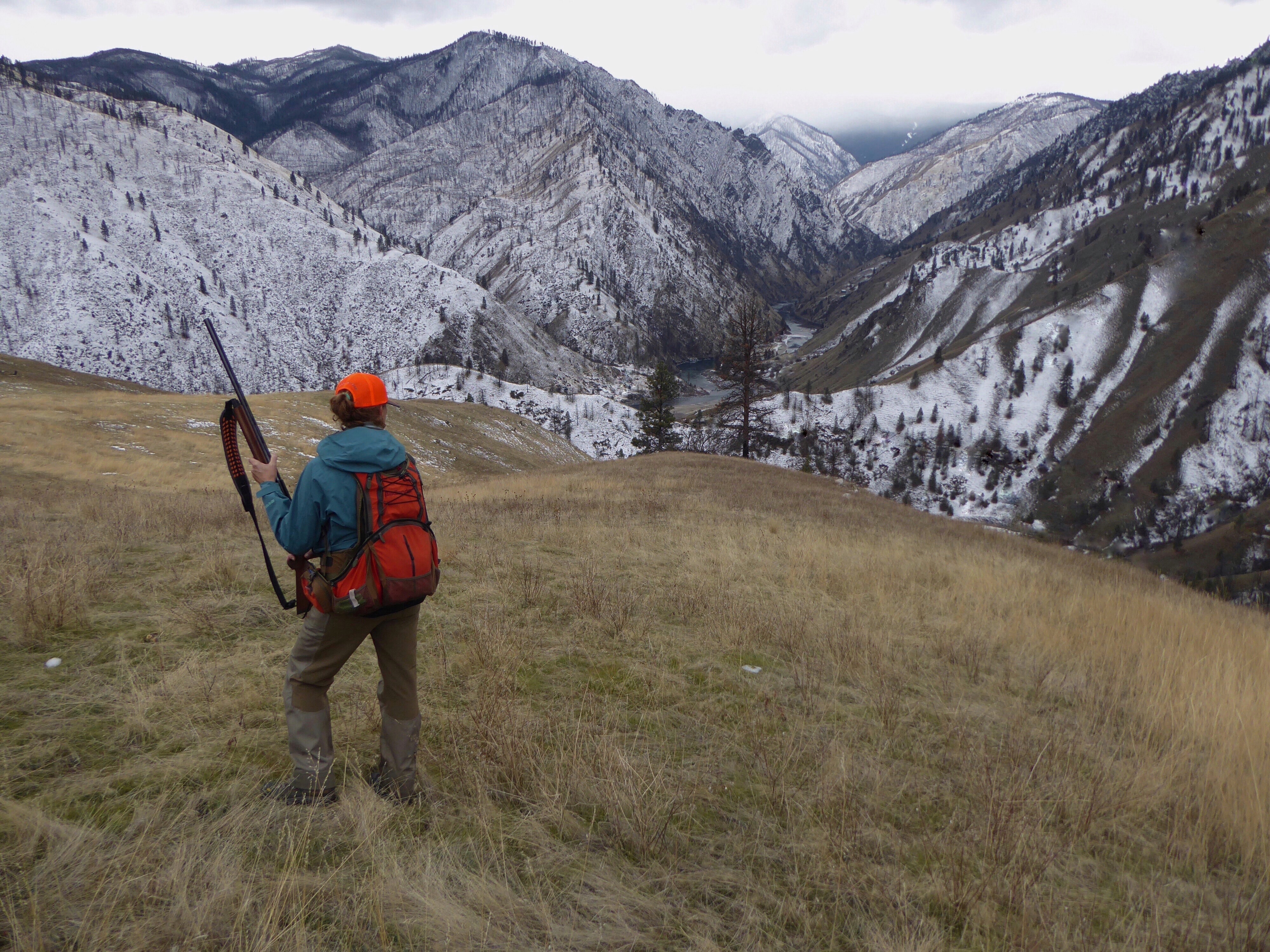
Heading up into the hills from the place Bob decided he wanted to try hunting, he wasn’t totally alone. I decided to follow along hoping to capture the pure essence and gorgeous landscapes of everything around us. It was just like the old days before I started carrying a gun; I’d be hot on his heels for every square mile hoping to catch with the camera some of the action and beauty of the sport. Looking down from the rocky outcroppings on the delicate hoarfrost covering the fresh green-up, the fragrant sage, tall pine trees, and the luminous light on the hillsides made an idyllic last hunt. The steadfast and confident points by Angus and the slow and very intense creeps of Peat backing him was stunning to witness.
Fresh scent nearby.Peat taking the lead for a change.Angus pinpointing chukar scent; he’s as good as ever. Chukar hills as far as you can see.Peat’s fast feet gliding across the terrain.Moving into position in front of Peat’s point.South facing slope traverse.Angus pointing chukar in the sage.Double point.Locked up.
Lastly, yesterday on our long descent hunting down the ridge on the soft and muddy south-facing slopes, the dogs would lead us to frozen but protected draws. I witnessed the wonderment and fair chase of the wild busting coveys of chukar fueled by swirling cold winds now at our backs, and the curious mule deer we awakened from his nap in the tall grasses tucked next to the sage. All birds quickly disappeared over the next ridge, followed by the dogs who continued to work hard like they always do to find the same or another covey.
The sound and smell of dogs and people
Our relationship has been a challenge the past three months. We both vowed in sickness and in health or something like that a long time ago. I know first-hand and intimately the fear patients face the second they set foot into a hospital. I worked in a major medical center as a patient care provider for 36 years, and the roles are reversed now: it’s not easy having a loved one on the receiving end and to witness his anxiety and fears of not knowing what might happen next, and the anticipation of general anesthesia, and knowing you are depending on someone or something else to breathe for you. Finally when the surgery is done, the long-term recovery, the medical bills in the mail that will soon follow, the reality that all of us are getting older and are slowing and falling apart: sometimes it’s hard to deal with or fathom.
We are some of the lucky ones to have health insurance, sick leave accrued, and money that we stashed away for a rainy day microdiscectomy. The weather forecast for tomorrow and the rest of the week calls for a chance of snow and then rain.
“What’s in a name? That we call a rose by any other name would smell as sweet.” –William Shakespeare
I’ve never called myself an upland hunter. I don’t know why, but maybe it’s too broad of a term. I don’t hunt quail or pheasant, and don’t usually go out of my way to hunt ruffed or dusky grouse in the deep draws with thick pine trees or hawthorn stands like Bob fancies doing. These days, when I do feel the urge to shoot a grouse it’s because it busted wild from the ground and wasn’t near any trees whatsoever. The first bird I ever shot was a big ruffed grouse from a tree limb down by a watery creek bed. My shooting it was probably more from the frustration of Peat’s insistent high pitched barking at it rather than me wanting to get my first bird under my belt. According to his breeder, Peat had come “from a long line of barkers,” and at the moment I shot that bird the pup was yapping his head off while standing on his hind legs at the base the tree with his little tail stub wagging furiously. Peat’s immediate retrieve directly to my hand shut him up, but I learned that I prefer shooting at a moving target in the air or one that I don’t have to think about too long before pulling the trigger. I wept for that bird on that early September morning and all the others that have since followed. That grouse was the first thing I’d ever purposely killed besides maybe spiders (which I try to avoid anyway because it would mean getting close to them to do it).
I like hunting chukar, or I might say I’m obsessed with chukar (alectoris chukar) and the wild and expansive open spaces they call home. I thrive on the adrenaline rush of not knowing where a covey might bust from after a sustained point by the dogs as they work together in beautiful harmony. Hunting chukar also suits my competitive personality. Hunting with Bob, I’ve been known to recklessly traverse a steep scree slope just to beat him to a point. I like the challenge of putting myself into position near the dogs to see the covey rise, up close.
The past two months so far, the boys, Angus and Peat haven’t been finding and pointing as many chukar as I’d prefer, but instead they’ve been finding gray partridge (perdix perdix), also known as Hungarian partridge or “Huns” as we call them. I’ve been busting these Huns often in prime-looking chukarish terrain. I’m talking about higher elevation rocky outcropping or just below these rocks on the steep sagebrush covered undulating slopes.
Uphill point on Huns
Recently, I was very surprised when Peat brought a retrieved bird to my hand only to discover it was a Hungarian Partridge. What’s in a name, anyway? Maybe I should start calling myself a Hungarian partridge hunter instead of always referring to myself as a chukar hunter.
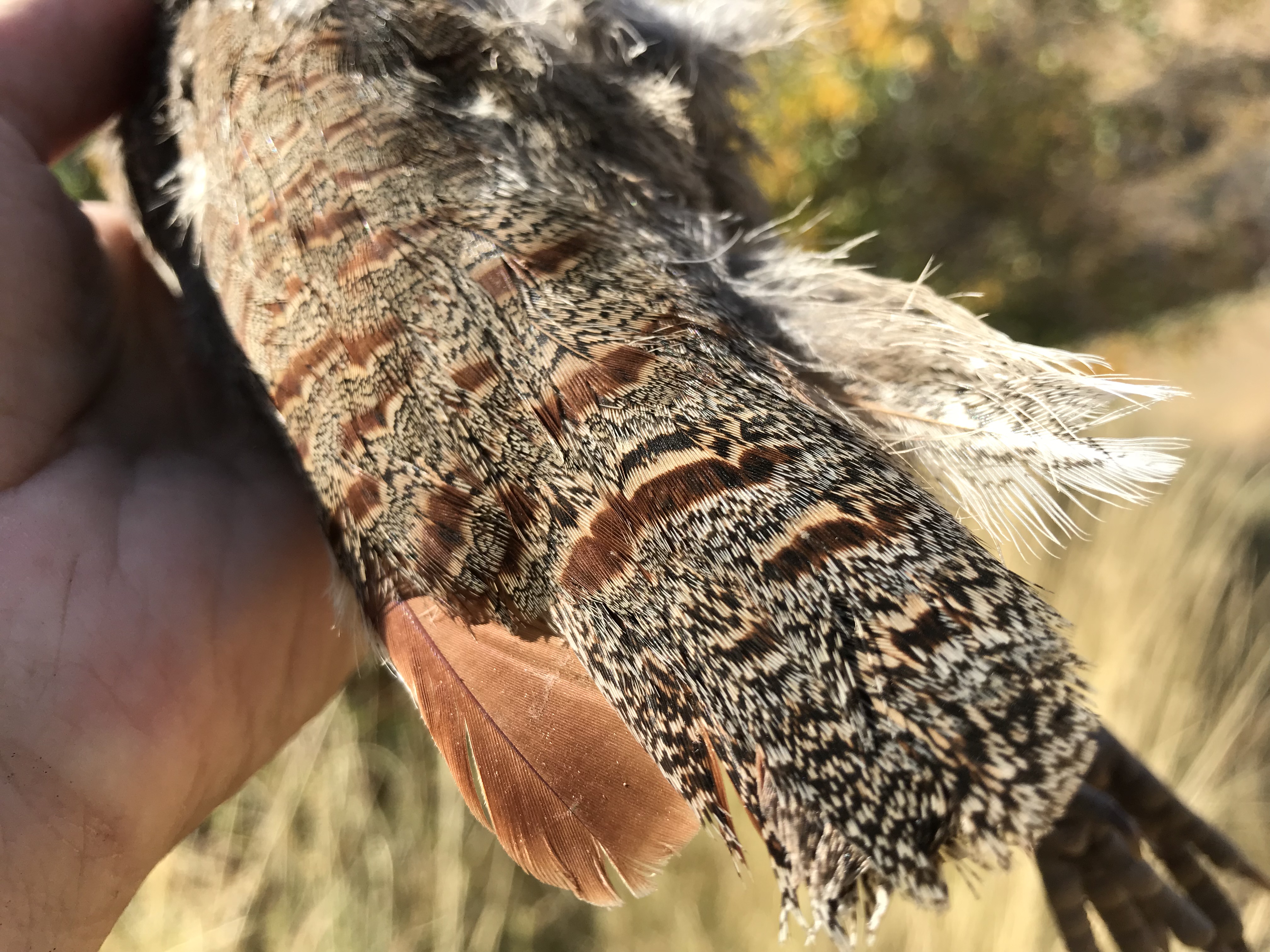
In chukar country, when a covey busts, most often flying away from you at rapid speed, you sometimes shoot regardless of whether you know if it’s a chukar or Hun. Most times you don’t have a chance to identify the species beforehand. In the hand, Huns don’t look anything like chukar and are typically smaller, and they usually don’t hold as long as chukar and often don’t often make any noise when they bust. I’m no expert, but I’ve been hiking the chukar hills for years and it’s still hard to tell the difference in that split second the birds take off. Ask any seasoned chukar hunter and they’d probably tell you the same thing.
Chukar partridge and Hungarian partridge hunting season here in Idaho coincide with each other, which is a good thing because I’d feel terrible to shoot a bird out of season. If any of you are reading this wondering why on earth anyone would shoot at a bird she can’t identify haven’t hunted chukar in habitat that is also home to Hungarian partridge.
Peat backing Angus on a covey of Huns
Ridge top Hun
Hun and gun
When Peat brought that most recent Hun to my hand, I said in disappointment, “Oh…it’s just a Hun!” Thinking back on it, I now feel bad for my lack of gratitude while stuffing it into my bird pouch. Have I turned into a chukar snob or connoisseur of fine chukar? Lately, my shooting has been way off, so any bird I can manage to knock down — even “just” a Hun — is something to be grateful for. Do the dogs care what kind of bird it is? Do they even know if it’s a chukar or Hun? I think they’re just happy and proud to bring any kind of bird to me so they can be lavished with the thanks and the praise that follows.
Peat backing Angus on flatter more typical looking Hun terrain
Bob heading to a covey of Huns, Peat was pointing earlier this season