“Will you go to lunch.” — Kevin Spacey as Williamson, Glengarry Glen Ross
“If others have their will Ann hath a way.” — James Joyce, Ulysses
“Jem and I were accustomed to our father’s last-will-and-testament diction…” Harper Lee, To Kill A Mockingbird
“The will to live, which forms the inmost core of every living being, exhibits itself most conspicuously in the higher order of animals, that is, the cleverer ones…” — Arthur Schopenhauer, “Psychological Observations” (1817)
I had this thought last night: “There are four dead birds _________ in my refrigerator.” I couldn’t think of any present participles. Actually, I could, but they didn’t make any sense, their cognitive dissonance was too great. The idea doesn’t really need a participle but, you know. Habits of language. Then I wondered why I was having this trouble. And it occurred to me that death can not be a state of existence that warrants any present anything, participles, verbs, presence. It’s the absence of being.
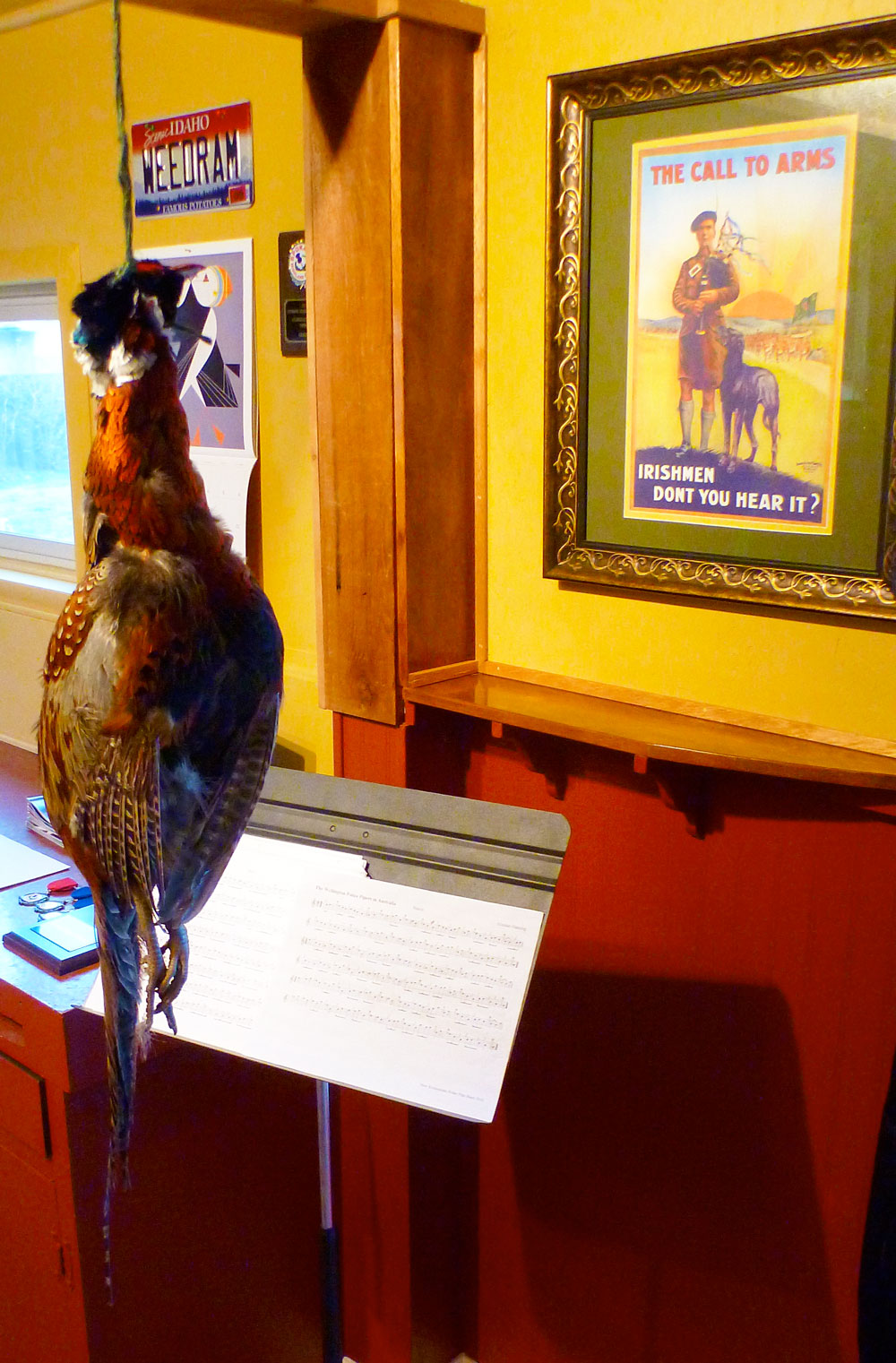
I would say that chukar are among the “cleverer” animals, so when their will to live is extinguished by a mortal wound caused by some number 6 steel shot fired from my gun, that bird is from that point forward verbless, regardless of whether it’s in my fridge or freezer, or even taxidermied on a beautiful mount that hangs on the wall. Its being no longer is, which includes its will to live. Or, as John Cleese described his dead parrot to the falsely incredulous pet shop owner, “This is an ex-parrot.” And I did that.
This all might seem pretty basic. But it wasn’t to me, and still isn’t. The problem intensifies, of course, when it’s turned onto me and my mortality. What’s the connection between all of our individual mortalnesses and this hobby of ours, trying to bag birds, trying to create ex-chukar?
The phrase in the regulations sheds some light on this: “reduced to possession.” When we will it and execute it properly, the chukar’s will to live (our idea) is not actually reduced, is it? Instead, it’s eliminated. But what the regs mean is that — like the word they also seem to love, “harvest,” as if we’re talking about corn here — we’ve merely diminished the animal’s state of existence. One could also argue that the regulations’ language here simply marks the difference between a daily bag limit and how many previous days’ harvest one has in possession. Regardless, it’s dishonest language. The discrepancy in meaning between “reduced” and “eliminated” is our (as the putatively cleverest of the animals) inclination (or will) to minimize or obfuscate the fact that we’ve asserted our will over another creature’s and rendered it a former being. Further, it’s generally assumed that asserting our will over another creature’s — as long as they’re “lower” than us — is normal, okay, unproblematic. Ortega y Gasset’s Meditations on Hunting, probably the most-cited writing on this subject, normalizes this hierarchy in a specist and specious argument (which is why I have no use for it).
Another aspect of the phrase strikes me, too: “possession.” When we possess the chukar, it’s not only dead but no longer free. We own it. But can something dead be owned, possessed? Grammar says no. Still, our will prevails. (I’m aware of my cultural bias here, as a non-Native Western European: Native American cosmology and ontology have much different takes on all this.)
But, despite the linguistic obstacle, who can do this to us? How are we reducible to possession? That’s not a real question. We all know the myriad answers to it. Some eliminations are accidental, some intentional, and some just are as a matter of course (dying of old age, for example). Or, for some, it just comes down to God’s will. Not sure what to do with that, aside from saying that we’re assuming the status of God when we “harvest” game (Gasset would have no problem with this). But it’s ironic to me that we cleverest animals have mucked up our wills to live far beyond the less clever but still clever enough to will a life. Maybe in Schopenhauer’s time humans’ will to live was pretty uniformly “conspicuous.” Existence was harder then, and humans, regardless of economic or social status, spent enormously more time than we do on subsistence-related endeavors. Food, shelter, clothing. Now, we have Amazon and Blue Apron. So our wills to live have been diminished somewhat, at least for those privileged enough to have a relatively easy life. I’d say that anyone who hunts for sport (as opposed to necessity) falls into that category.
If you’ve read this far you’re probably going, “Where the hell is he going with this?” For me, all this comes down to the question, Whose will to live shall prevail, and why? Clearly, we humans think our wills are superior to animals’ and therefore, duh, shall prevail. But I don’t actually buy that, although — hypocrite Me — I act on it at least fifty times a season. First, the concept of superiority, or hierarchy, is entirely ours, which is self-proving. “Fair chase” is probably the best known and most relied on ethical justification of this hierarchy, but in truth there’s nothing even remotely fair about it. It’s not a level playing field. Animals have no conception of the food chain, despite being programmed to fit in the various slots human analysis has constructed through observation over the millenia. This reminds me of the trouble Noah Lyles got in during the Olympics for criticizing the “World Champion” concept in American professional sport for assuming the U.S. equals “the world.” So yeah, bias is a bitch, and hackles will be raised when it’s called out. So I expect something.
A lot of this has to do with my metastasizing distaste for tailgate shots, which I wrote about not too long ago. “Look what I did!” Poses with dead game and their killers litter social media. Despite what Gasset says, there is nothing noble about “tradition,” which has been used for nefarious purposes forever. Why the need or desire to associate oneself with an ex-chukar and share it with the world. Penance? Pride? A cry for absolution? Atonement? Adulation?
When I kill a bird I feel guilty as hell. I think of the family I took it from. I think of the life it was endeavoring to live, the succulent blades of grass I found in its crop as I cleaned it (the vocabulary of all this rocks me). I think of the covey bust and its communal expression of the will of each of its members to live, and live together, going forward, fearing the demise of their lives, of being eliminated, of not wanting to be eliminated. I think of fear as a killer and a saver of life, and the crap shoot as to which it is in any given situation, and how my participation in this particular situation radically influences that outcome. I think of the things I share in the chukar’s fear, of my own fears about mortality, whether caused by an external force or not. I think of the dogs, and then I can barely take it, in good ways and bad.
And I will do this. Until I won’t.