Tag: Hungarian partridge

  • Haunting

    Haunting

    Yesterday, we carefully sneaked out of the house to head down to the canyon with just Peat, leaving Angus behind. The old warrior Angus has been running lots of miles hunting the past couple of weeks and against his will we forced him to take the day off. We knew getting ready to go wouldn’t be easy without him catching on so we put both Peat and Angus inside the car in the garage while we dressed and loaded up our hunting gear into pickup outside. Once ready, we let them back into the house and corralled Peat outside into the pickup and drove off and looked back as Angus was watching in disappointment from the fenced yard.

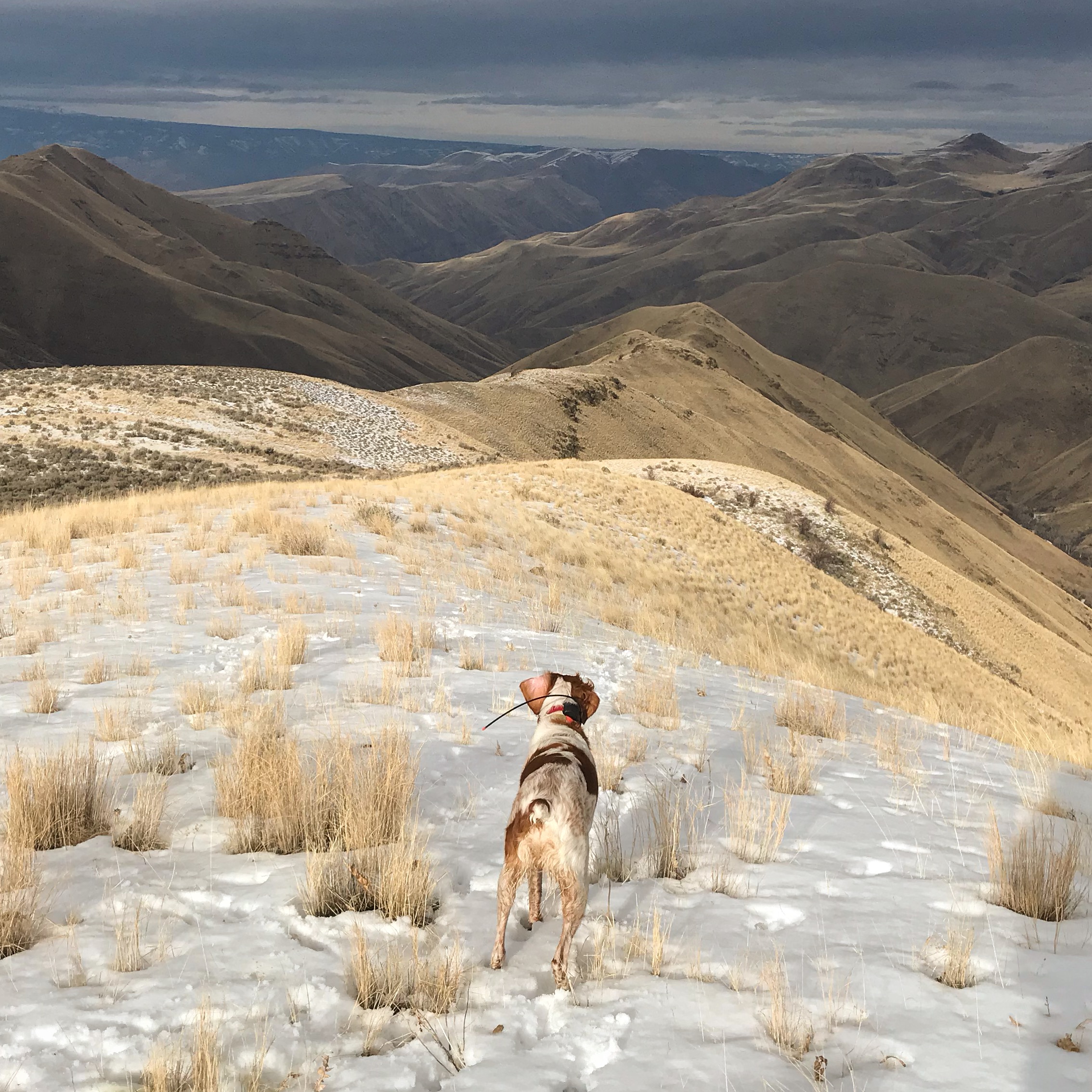
    The higher mountain elevations were blanketed with a fresh layer of snow overnight so we decided to hunt in a spot down in Hells Canyon, a place we hadn’t walked around this season and where there wasn’t as much snow. Our starting point was an easy spot to access right off the highway. Bob decided not to hunt so Peat could have a chance to hunt for me for a change. In the past so far, and we’re not sure why, but whenever Bob hunts, Peat prefers to only stay with him. As with all hunts down in the canyon, the terrain dictates that the only way is up so we headed up a small game trail in a thick draw lined with brush and trees hoping to find some grouse on the way up. Within five minutes, Peat busted through the brush and stopped above us, barking his head off. His bark was different this time, not his usual high pitched barking he makes when he flushes a grouse up into a tree. His bark was deeper and had the sound of fear in it. We quickly made our way up to him and found the source of his agitation. A big beautiful bobcat with haunting golden eyes was caught in a trapper’s snare underneath some bushes. I was angry. How could a trapper get away with putting a trap in an area close to a popular bird hunting area where hunting dogs could also get accidentally caught? Trapping bobcat in Idaho is totally legal from Dec 14-Feb 16 in this area so there was nothing we could do but walk away. We normally carry heavy duty wire cutters in case the dogs ever got into a snare but they were at home in Bob’s hunting pack. I would never mess with any trappers traps unless one of the dogs got caught in one and I would never tamper with or free wildlife from traps because it’s actually illegal to do so.

    Trapped cat

    Trying to put the whole affair behind us and forget about it, we continued our climb up about 1,500 feet with Oregon at our back and up into the snow that we were trying to get away from in the first place before finally getting into some birds.

    Fence line ascent
    The wall

    Once at the top of the steep climb, Peat found and pointed a covey of Huns and I managed to knock down one as they busted and flew downhill over the ridge. Peat, not used to hunting with just me, was confused on whether to bring the bird to me or to Bob.

    First point of the day
    The retrieve
    Thank you Peat!
    Pointing chukar
    Pointing a covey of chukar
    What next?
    Heading down and away from the draw

    The bluebird sky, amazing views, and Peat brilliantly hunting just for me made up for our terrible start. Yesterday’s hunt will be forever remembered as “Bobcat Gulch.” Now knowing that traps are in the area we will probably never hunt there again and especially not during trapping season.

  • What’s in a Name

    What’s in a Name

    “What’s in a name? That we call a rose by any other name would smell as sweet.”  –William Shakespeare

    I’ve never called myself an upland hunter. I don’t know why, but maybe it’s too broad of a term. I don’t hunt quail or pheasant, and don’t usually go out of my way to hunt ruffed or dusky grouse in the deep draws with thick pine trees or hawthorn stands like Bob fancies doing. These days, when I do feel the urge to shoot a grouse it’s because it busted wild from the ground and wasn’t near any trees whatsoever. The first bird I ever shot was a big ruffed grouse from a tree limb down by a watery creek bed. My shooting it was probably more from the frustration of Peat’s insistent high pitched barking at it rather than me wanting to get my first bird under my belt. According to his breeder, Peat had come “from a long line of barkers,” and at the moment I shot that bird the pup was yapping his head off while standing on his hind legs at the base the tree with his little tail stub wagging furiously. Peat’s immediate retrieve directly to my hand shut him up, but I learned that I prefer shooting at a moving target in the air or one that I don’t have to think about too long before pulling the trigger. I wept for that bird on that early September morning and all the others that have since followed. That grouse was the first thing I’d ever purposely killed besides maybe spiders (which I try to avoid anyway because it would mean getting close to them to do it).

    I like hunting chukar, or I might say I’m obsessed with chukar (alectoris chukar) and the wild and expansive open spaces they call home. I thrive on the adrenaline rush of not knowing where a covey might bust from after a sustained point by the dogs as they work together in beautiful harmony. Hunting chukar also suits my competitive personality. Hunting with Bob, I’ve been known to recklessly traverse a steep scree slope just to beat him to a point. I like the challenge of putting myself into position near the dogs to see the covey rise, up close.

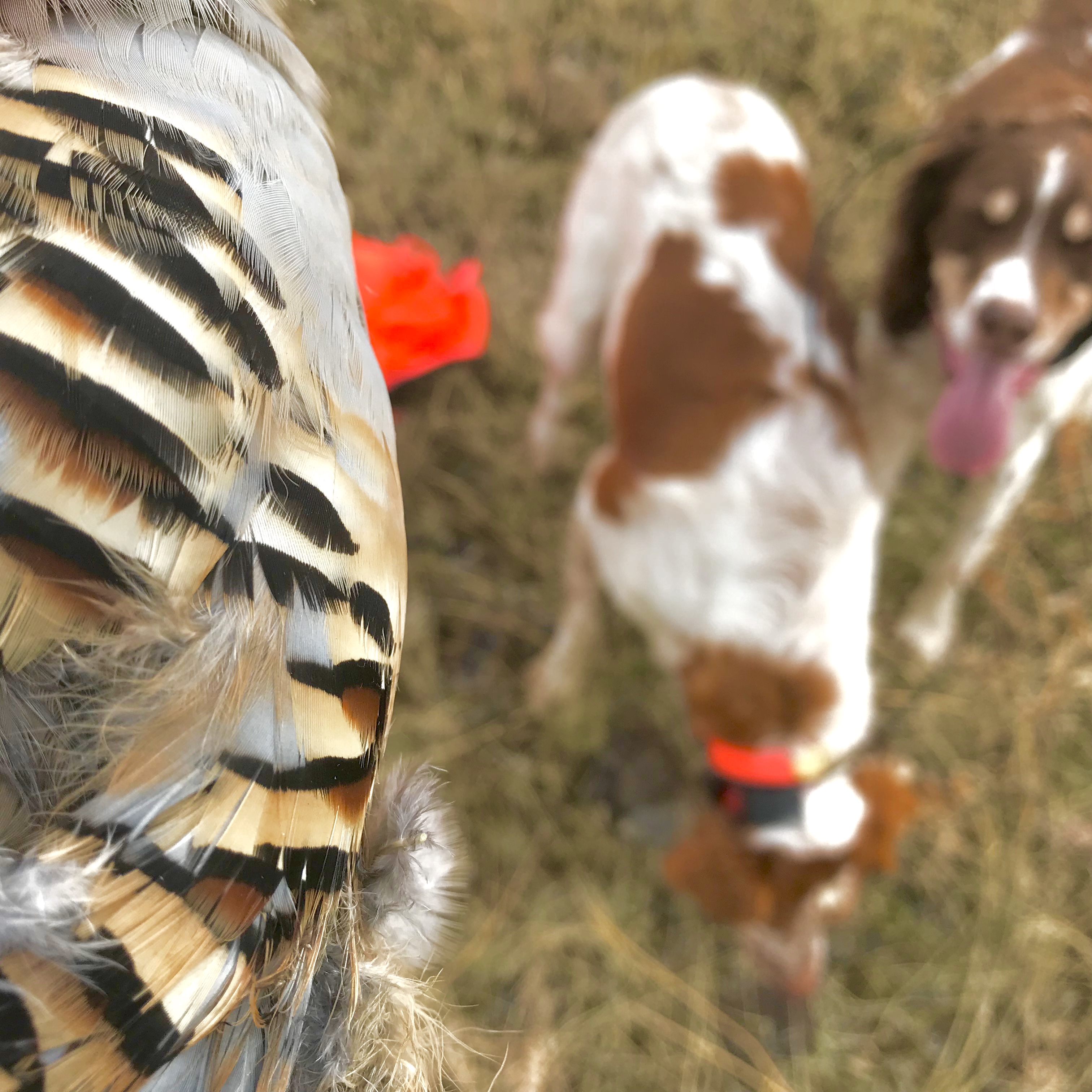
    The past two months so far, the boys, Angus and Peat haven’t been finding and pointing as many chukar as I’d prefer, but instead they’ve been finding gray partridge (perdix perdix), also known as Hungarian partridge or “Huns” as we call them. I’ve been busting these Huns often in prime-looking chukarish terrain. I’m talking about higher elevation rocky outcropping or just below these rocks on the steep sagebrush covered undulating slopes.

    IMG_0787
    Uphill point on Huns

    Recently, I was very surprised when Peat brought a retrieved bird to my hand only to discover it was a Hungarian Partridge. What’s in a name, anyway? Maybe I should start calling myself a Hungarian partridge hunter instead of always referring to myself as a chukar hunter.

    In chukar country, when a covey busts, most often flying away from you at rapid speed, you sometimes shoot regardless of whether you know if it’s a chukar or Hun. Most times you don’t have a chance to identify the species beforehand. In the hand, Huns don’t look anything like chukar and are typically smaller, and they usually don’t hold as long as chukar and often don’t often make any noise when they bust. I’m no expert, but I’ve been hiking the chukar hills for years and it’s still hard to tell the difference in that split second the birds take off. Ask any seasoned chukar hunter and they’d probably tell you the same thing.

    Chukar partridge and Hungarian partridge hunting season here in Idaho coincide with each other, which is a good thing because I’d feel terrible to shoot a bird out of season. If any of you are reading this wondering why on earth anyone would shoot at a bird she can’t identify haven’t hunted chukar in habitat that is also home to Hungarian partridge.

    IMG_1846
    Peat backing Angus on a covey of Huns

    IMG_1502 2
    Ridge top Hun

    IMG_0346
    Hun and gun

    When Peat brought that most recent Hun to my hand, I said in disappointment, “Oh…it’s just a Hun!” Thinking back on it, I now feel bad for my lack of gratitude while stuffing it into my bird pouch. Have I turned into a chukar snob or connoisseur of fine chukar? Lately, my shooting has been way off, so any bird I can manage to knock down — even “just” a Hun — is something to be grateful for.  Do the dogs care what kind of bird it is? Do they even know if it’s a chukar or Hun? I think they’re just happy and proud to bring any kind of bird to me so they can be lavished with the thanks and the praise that follows.

    IMG_1838 3
    Peat backing Angus on flatter more typical looking Hun terrain

    Bob heading to a covey of Huns, Peat was pointing earlier this season


  • Anticipation

    Anticipation

    IMG_2622

    We anticipate a lot things.

    The big yellow school bus recently started up its route again driving back and forth on our gravel road twice a day, spewing a cloud of dust behind it. We knew that would happen, just as we knew Bob would be returning to the classroom to teach literature and poetry to rural Idaho High School kids. Days around here are noticeably getting shorter, the air is getting cooler at night, and chukar season starts in a few short days. September 15th to be exact. I always think I’ll have plenty of time to get my body ready, the dogs ready, and to practice shooting, but before you know it it’s time. This approaching season will be my 12th year of chukar hunting. The first ten of those I wasn’t actually carrying a shotgun but instead following Bob and the dogs up and down the mountains and rock outcroppings with my camera in hand, documenting chukar hunting.

    My anticipation for the upcoming season always brings excitement and a tangle of emotions. Thinking about being in the thick of things again to witness first hand and intimately the magic of the dogs working up and down the terrain instinctively and methodically and in perfect harmony thrills me. With that it brings the hope that I’ll anticipate the moment right before the birds bust after a long steady point and be ready for it. I also look forward to the elation often followed by sorrow when my dogs carry in their soft mouths a downed chukar or Hungarian partridge directly to my hand. I have deep respect for these birds that live in these brutally dry western desert environments, and I don’t think of killing one as revenge for the hard work and determination it took me to put myself into the position to possess one. Often, I have to remind myself that these non-native game birds were originally introduced for the sole purpose of being hunted. It doesn’t always convince me to feel better about killing one, but I owe it to the dogs every once in a while to allow them the pleasure and reward of retrieving a bird they worked so hard to find for me. I want to think they understand the praise that soon follows.

    We know our two Brittanys aren’t perfect text book bird dogs and we also aren’t the best trainers. They’ve adapted to our style of hunting and we rely on their pure natural instinct, prey drive, and good breeding to guide them and pray for the cohesion of dog work and gun handling to happen at just the right time. It’s a beautiful thing to see elegant and well-seasoned Angus being backed by young and quick-footed Peat.

    IMG_1083
    Tangible gift

    IMG_4826
    Perfect harmony

    I’m probably an anomaly in the world of chukar hunting: female for starters, and I’m 55 years old and I didn’t handle a firearm for the first time until last year. I have no doubt this tough and mean country with its steep talus slopes will remind me again that I’m another year older. I’m prepared to have to dig deep and push my body to some uncomfortable extremes. I’m up for the challenge. I love the challenge and I’m not afraid to go out alone by myself again which I did a few times last season.

    The past couple of years, besides thinking about my age creeping up, I’ve dreaded that quite possibly it might be 11-year-old Angus’s last season, not because he can’t physically do it; we know he can. This past couple of weeks while out grouse hunting he’s been covering more ground and ranging farther than Peat, but he’s slowly going deaf and his eyes are starting to look cloudy gray. I worry that one of these days we might lose him on the mountain. The GPS tracker collar that I was dead set against purchasing and using in the first place because I dislike fussing with too many things has now become a reassurance to find a confused and wandering lost dog.

    IMG_2529 2
    The old warrior, Angus

    IMG_2573
    Heading up to the clouds

    IMG_4886
    Downhill traverse

    IMG_2589
    Mouth to hand

    leslie_peat_point
    Rushing to the point

    IMG_2613
    Fruits of labor

    Lastly, anticipation for the upcoming season also becomes a moment of reflection from past seasons. It’s those great memories that make us hungry for more. The culture of chukar hunting for us is about the beauty of the unhindered landscapes, the hard ascents up into the clouds, the smells of damp sage, the cold harsh mountain winds that remind us we’re alive, the sound of a covey busting, and for that intimate connection and trust we have with our dogs.

    IMG_2760
    Sunny south facing slope reflection


  • Leslie Bags Her First Chukar

    Leslie Bags Her First Chukar

    She did it

    They said it couldn’t be done. They said it was impossible. They said, well, they said lots of things I can’t repeat. But the one thing they didn’t say was, “She’ll never give up because she’s as stubborn as an Appalachian mule.” So today, Leslie proved them all right and wrong and bagged her first chukar. Two months into her first season, at age 55 and never having shot a gun until August, any chukar hunter will tell you this is an accomplishment-and-a-half.

    Both dogs were birdy, and Leslie was above me. Peat flushed four chukar just in front of Leslie, who – because she has learned to decipher the degrees of birdiness in our dogs – was expectant. I saw the birds go at the same time I heard the shot, but didn’t see it fall. It took Leslie a few moments to say to me, “I think I got one.” It was almost as if she couldn’t believe it. Then Angus made a beeline down the slope and lifted his head with a mouthful of feathers. Initially he headed to me, but Leslie called him and he changed course and brought it right to her hand. What made me feel even better than the pride I felt for Leslie was seeing her smile, like a curse had been lifted. She looked at the bird, which she’d killed instantly with her 20-gauge, 1 oz., 7-1/2 shot load, and thanked it for its life, something I’ve gotten away from doing, regrettably.

    Chukar Country Trifecta

    We continued on for another 2 hours or so, and she got off a couple more shots but didn’t connect. I managed a Hun and a Dusky grouse, so a three-species day in mid-November on a year that was supposed to be meager from last winter’s massive snowfall ain’t bad. Yesterday was a good day, too, in another spot where we saw lots and lots of chukar and bagged a couple. So there you have it!

  • Survivors

    p1000442
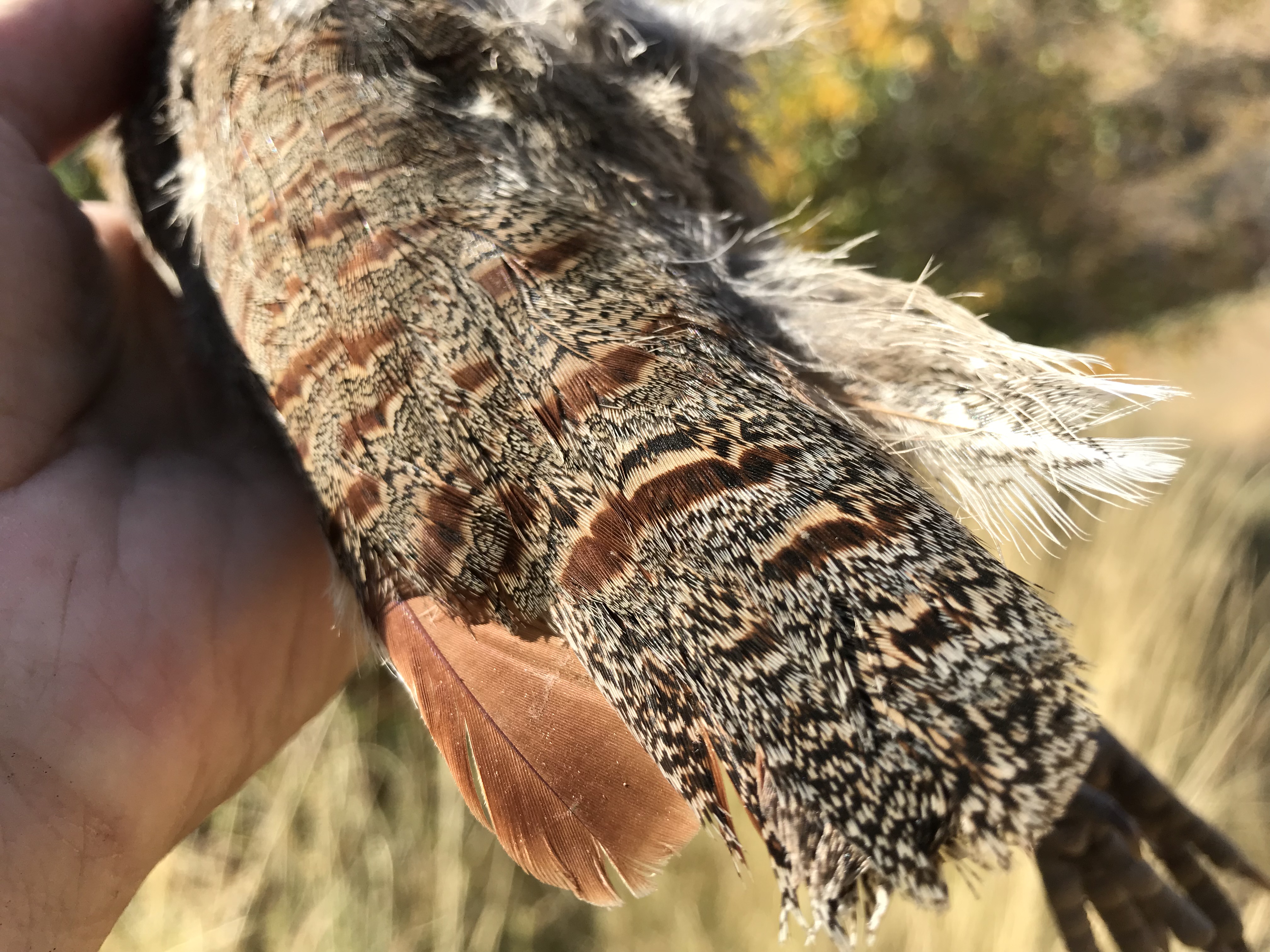
    Chukar feather

    My stress doesn’t come close to the stress wildlife endured this winter, but it’s been there daily, mainly in the form of wonder and hope. In a phone call with my dad earlier this winter, I lamented the tough conditions for chukar and the rest, and he reminded me of this wonderful Emily Dickinson poem:

    Hope is the thing with feathers  
    That perches in the soul,  
    And sings the tune without the words,  
    And never stops at all,  
       
    And sweetest in the gale is heard;          
    And sore must be the storm  
    That could abash the little bird  
    That kept so many warm.  
       
    I’ve heard it in the chillest land,  
    And on the strangest sea;         
    Yet, never, in extremity,  
    It asked a crumb of me.

    It doesn’t cost us anything to hope, and we did plenty of that this winter. On a recent bluebird day we got a chance to look for the birds whose mere existence warms our collective souls.

    It felt amazing to walk uphill, and reminded us of the abbreviated season and what we missed in its last month, and what the dogs missed. To say they were gleeful would be an understatement. We ascended up a two-track for a couple of miles, and then climbed off the road and circled back through some terrain I’ve seen plenty of birds on over the years, but I wasn’t expecting to see anything.

    I kept a close, hopeful eye on the dogs, though, and they began getting birdy in the stiff wind. And then Angus pointed, and Peat picked it up with a classic low-rider high-speed creep up to a steady backing position. Not having a gun, I enjoyed the rare chance to capture this beautifully addicting dance with a camera. A covey of 10 chukar busted. A short while later, my bird gods pointed another covey of about 10 chukar. And just a few minutes later, they pointed a covey of 5 Hungarian partridge. On the short walk along the creek on the way back to the truck, Angus dislodged a large grouse (couldn’t tell if it was a ruffed or dusky). All of the birds we saw looked sizeable and healthy. 4 miles, a couple hours, and a result greater than the hoped-for. We’ll steer clear of birds now so as not to disturb their mating, but I do feel relieved to have seen more survivors than expected.

    3adc2c50-45c0-4549-ab55-44c7e6e9f461
    p1000424
    p1000445