Tag: erzurum

  • Erika

    Erika

    Thirty years ago I spent a month in Turkey. Erika had invited me to join her, and initially I thought it was a bad idea. I’d been chronically depressed and my therapist worried something bad might happen and trigger a personal catastrophe way over there. But I decided to go, and the thought of being in a different place began feeling more and more exciting.

    Erika and I shared the same birthday, hers being a year after mine. My oldest friend introduced us, thinking we might like one another. We dated for a while, but by the time she invited me to join her in Turkey things had cooled into a state I thought was undefined. Plus, she’d been gone a while.

    Hardly a day has passed since then that I haven’t thought of that trip. Talk about formative. Talk about memorable. I’ve been blessed with more than my share of stellar travels, and I think about many of those a lot still, too. But the trip in Turkey with Erika has stuck with me more than any other, and I’m not sure why.

    I’ve been thinking about it lately in terms of chukar, probably because the season’s almost here. Erika and I traveled to the eastern part of Turkey, at one point taking a fairly large risk traveling in an unmarked Turkish Army van into Kurdish territory near Armenia. Traveling through landscapes that — later — Hells Canyon would remind me of, I had never heard of chukar but am sure — now — that I had to have been looking at their native habitat.

    That van ride sticks with me. Over-filled with soldiers, who chatted nervously the entire several-hour trip, I understood nothing of what they said and was almost glad about that. Kurds had bombed a number of Turkish military vehicles on that road in the previous couple of weeks. Erika, the only female on board, was nearly fluent in Turkish and talked with some of the men. Straight-faced. I sat on someone’s lap and watched.

    But we got to our destination safely and spent a couple of nights with a group of Kurds near Mt. Nemrut. Music and dancing at sunrise on a mountain top built by a vainglorious king in 62 BC.

    Erika with Kurdish friend on Mt. Nemrut
    Sunrise on Mt. Nemrut

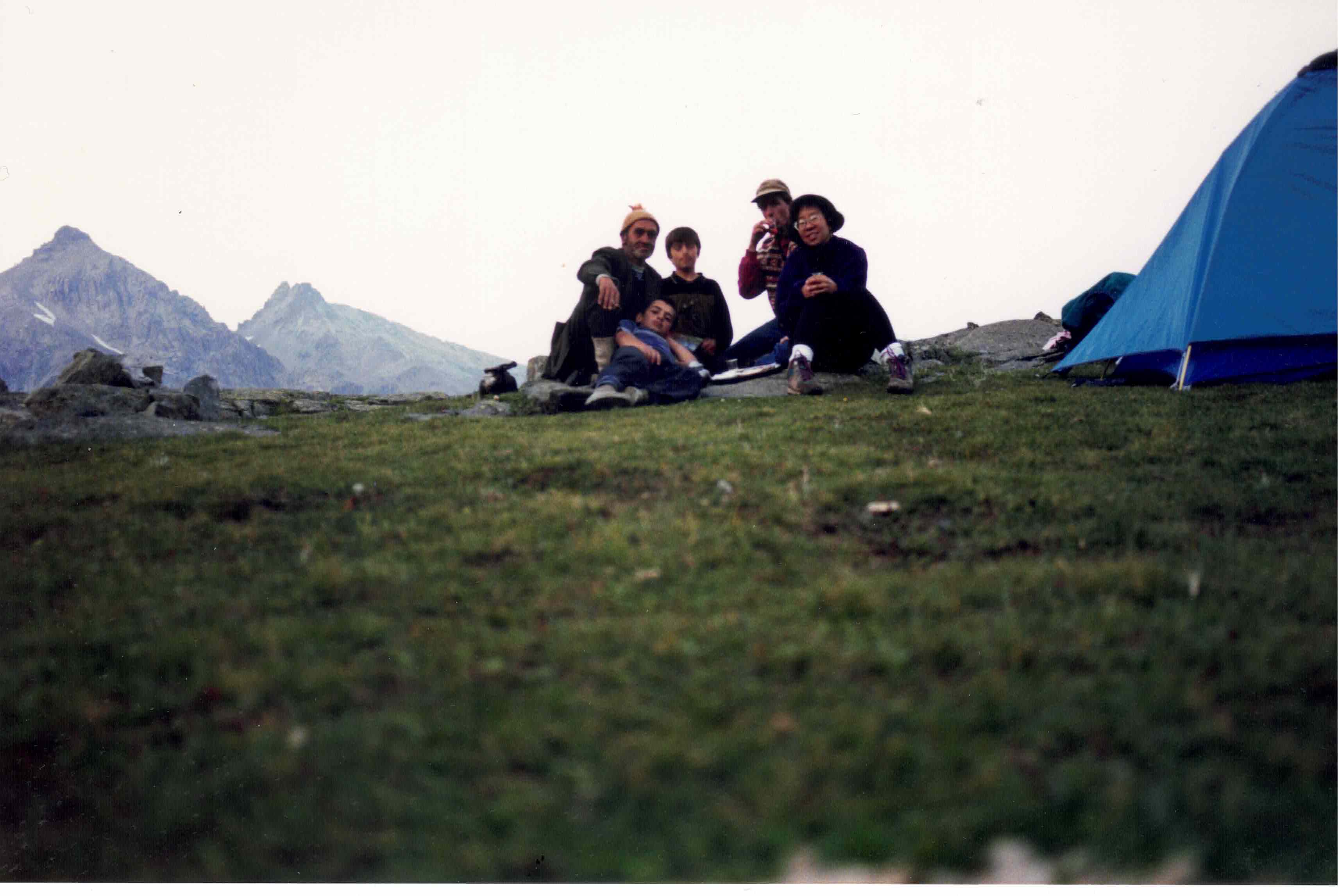
    Nearly everything we experienced on that trip was suffused with intensity for me. A hair-raising “cab” ride to a medieval ghost town on roller-coaster roads littered with sheep, one of which our frustrated Indy driver plowed into at high speed. A complicated, multi-person negotiation by Erika in a little town over what we needed to do to get to our hostel a few miles away. Having tea brought in a samovar to us on a silver tray by shepherds at a high mountain lake after they set up our tent for us, realizing we were beyond exhaustion. Getting lost in dense fog on a mountain peak the next day, afraid we’d perish there until we ran into a French mountaineer on a mission. Listening to Arif Sağ for hours and hours over the PA on a cross-country bus trip, not believing my ears. Somehow I got Erika to find out whose music that was. Some of my chukar videos on YouTube use Sağ’s music. Erzurum.

    The chukar hills of Erzurum
    Mountain shepherds with Erika and me in the Little Caucuses (before we got lost in the fog)

    Language has a lot to do with this intensity, with the adhesive quality of this trip’s memory. Communication. Until that trip I’d never been — and haven’t since — in a situation where I couldn’t communicate easily most of the time. English wasn’t common in Turkey, especially in the east, and Erika spoke five languages. I relied on her for everything. Movement. Nutrition. Lodging. Fun. Analysis.

    Which suggests something that looks like a trend, a fortunate one, in my life: trust in women more capable in important ways than me. I was raised from age five by a single mother who’d become a schoolteacher after her first marriage so that she could provide for her two boys. She wasn’t affectionate or textbook nurturing, but she was solid and I relied on that (she’s grown to be more affectionate with age, which I feel lucky to witness). In graduate school, I chose the one woman among my four advisers to direct my dissertation because I trusted her the most in terms of communication. The best boss I’ve ever had — my principal for the first three years I taught high school in Cambridge — was a woman, by far the most competent, fair, and reliable professional I’ve ever had the luck to work with.

    And so Erika. Soon after we met she revealed to me that a few years earlier she’d been hit by a car during a century ride on her bike, and that the majority of major bones in her body had been shattered. She’d spent a long time in the hospital. She said this matter-of-factly as she showed me some scars and her gnarled collar bones. After our trip to Turkey, we became better friends than lovers, and she continued developing her career as an agricultural economist, traveling all over the globe but also coming home frequently, often from the other side of the world, to do her share of care-taking for her cancer-stricken mother. I visited her in Mexico City, where she’d moved for a while and had a comfortable apartment. She spent a week or two with me and another friend at our cabin in eastern Idaho, fly fishing, hiking, and mountain biking.

    For years afterward, every August 26th she’d call me to wish us both a happy birthday. She did most of that kind of friendship tending, I’m ashamed to say. Once, for my birthday, she sent me a “Fly Fish Mongolia” hat from Ulaanbaatar where she was studying wheat farming. And she’d call me on that day no matter where she was, her voice joyous and always winningly sly, a soft laugh ready to pounce. Then, a year or two went by and I realized I hadn’t heard from her in a while. I did an Internet search sometime around 2010 and learned she’d passed away in 2008 from a long battle with ovarian and breast cancer. In all those phone calls she’d never once mentioned she was sick. Aside from the shock, reading her obituary was strange for a lot of reasons but one was how little I’d known about her. She was much more accomplished than I’d ever realized, which is saying a lot because — despite her definitive modesty — I always felt lazy and unremarkable around her, not from anything she did or said but simply from comparing our calendars. She was always heading somewhere far away to do something important. I was just hanging out, trying to pull my head out of my ass and finish my Ph.D.

    44 is too young. I can’t help but feel Erika was cheated. I’m still alive and have the tremendous luck to feel grateful our paths crossed. We all take too much for granted, but it seems that at least one measure of greatness in someone might come from an ability not to take much for granted. It exhausts me to imagine how that’s possible, how such people not only exist but prosper.

  • Making Connections

    Making Connections

    Eventually, all things merge into one, and a river runs through it. The river was carved by the world’s great flood, and runs over rocks from the basement of time. On some of the rocks are timeless raindrops. Under the rocks are the words, and some of the words are theirs.

    I am haunted by waters.

    –Norman Maclean, A River Runs Through It

    The final two paragraphs of Maclean’s first story, written in his seventies, may be one of the most-quoted chunks of literature about the west, maybe because it’s an anthem to an original wildness we continue moving away from in ever-accelerating fashion. Maybe it’s just beautiful and has to do with water that moves (all water moves, but at least we can watch and listen to it move in rivers, and feel it if we get in it). I connected with this story when I was much younger and falling in complicated love with fly fishing, a romance that’s recently been rekindled for some reason I’m not sure about. But I am sure that it (the book and its final paragraphs) connects to chukar hunting in some ways that might resonate with other bird chasers. The connections are visible: whether it’s on Instagram or in the flesh, we see people fly fishing accompanied by bird dogs; we see other drift boaters on the Missouri with big, bearded German breeds; in the “off season,” we see Idaho Chukar Foundation posting pictures on Facebook of what he calls “water chukars” he’s landed in some mysterious aqueous artery. There’s a stereotypical ethic, I think, that each activity shares: a honed-down pursuit of elusive, beautiful prey, based ninety percent on knowledge and the other half on patient perseverance. Ultimately, it doesn’t matter why. But there is a connection. It’s centered on the people, and cultivated in them. In a way, all things we experience as people eventually merge into the one person we are. We’re like rivers.

    Fly fishing with bird dogs requires more stops than usual, which is good for everyone.

    Earlier this spring we received the following message on Chukar Culture from a reader we’d never met.

    “Hey Bob and Leslie, I feel like I know you at least a little from your blog. I have commented a few times. I live in Butte, MT and have spent the last 22 years “researching” trout populations within a 60 miles radius of my home. I would be pleased to take you out for a day or two this summer on some of my favorite streams.”

    Chris and his wife Becky took us to a special place dear to them, where he knew we’d have a good chance of catching some Arctic Grayling.

    One of many grayling we caught that day

    The reader, Chris, knew from reading our blog that we’d be in Montana fly-fishing for much of the summer as soon as school got let out. After some emailing back and forth, Leslie and I took a day off from fishing the Missouri and drove down to Butte for our fly-fishing blind date. We put the coordinates of Chris’s house into our GPS. As we got closer and made the right turn into his subdivision we had a deja vu moment. The previous year, driving from Missoula to Bozeman we detoured into Butte to buy fishing licenses, and after leaving one of the local sporting goods stores to continue our journey out of town our GPS took us by mistake into the same neighborhood and down the same street past Chris’s house.

    Peat inspects his first grayling
    Chris and Becky

    The main reason we continue this blog is because of the real connections we make with people who are also passionate about it.

    Next upland hunting season will be our 10th sharing stories, photos, and occasional videos. This blog, and the videos that sometimes accompany it, continue to thicken the web of life for us. Just today, a Turkish man who’s coming to hunt Hells Canyon with his son this fall, sent me a comment asking about the Turkish music on one of our videos. I loved this chance to share a connection with a stranger through both bird hunting and music. The musician, Arif Sağ, whose music I used for the sound on this particular video has a song called “Erzurum” (which I’ve used on another video), which is one of the most memorable places I’ve ever been, and pretty remote, in the mountainous, arid eastern part of the country, which reminded me a lot of the area between Bozeman, Helena, and Butte. Chris, from Butte, was stationed in Erzurum when he was in the Army. I’d never imagined I’d meet another person who’d been to Erzurum, much less catch Arctic Grayling with him in a high mountain lake in Montana.

    Erzurum, Turkey

    Then there’s Haris from Cyprus, and our emailed conversation about Brittany puppies, which has led to a regular correspondence. Someday I hope he’ll be able to visit us with his Brittany Molly. And Larry of Moby Goes fame, who’s become a kind of guide for me about the ideal; he knows he’s at least responsible for several of my students eating chukar legs at lunch. And of course Gabe and Katie of Sunburst Brittanys, whose dogs have upgraded the foundation of our lives, and — I imagine — will continue to do so.

    Students eating chukar legs in my classroom.

    The longer I survive, the more connections strike me, and the more I look for them and, usually, appreciate them. In a way, they’re the only things which matter, and have everything to do with how we see things. Connections we miss hurt us sometimes (but often we have no way of knowing), although some we know will hurt us but we make them anyway; dogs are like that for sure. This blog has connected me, very favorably, with so many people and experiences real, digital, and otherwise that I feel I owe everyone who reads this a big “thank-you.” So thank you: the connections Leslie and I have made through Chukar Culture make our lives bigger and better in lots of different ways. I tried to express some of this six years ago when I made a video for a class I took after my first year of teaching. It’s called “Only Connect,” after the mysterious epigraph from a novel. The fact that each of us is the connector of all the things that make us who we are means that we need other people (and animals and hobbies and curiosities…) to make us who we are. I share it again because its main idea, as obvious as it is, still haunts me, just like this blog and Norman Maclean’s water.