
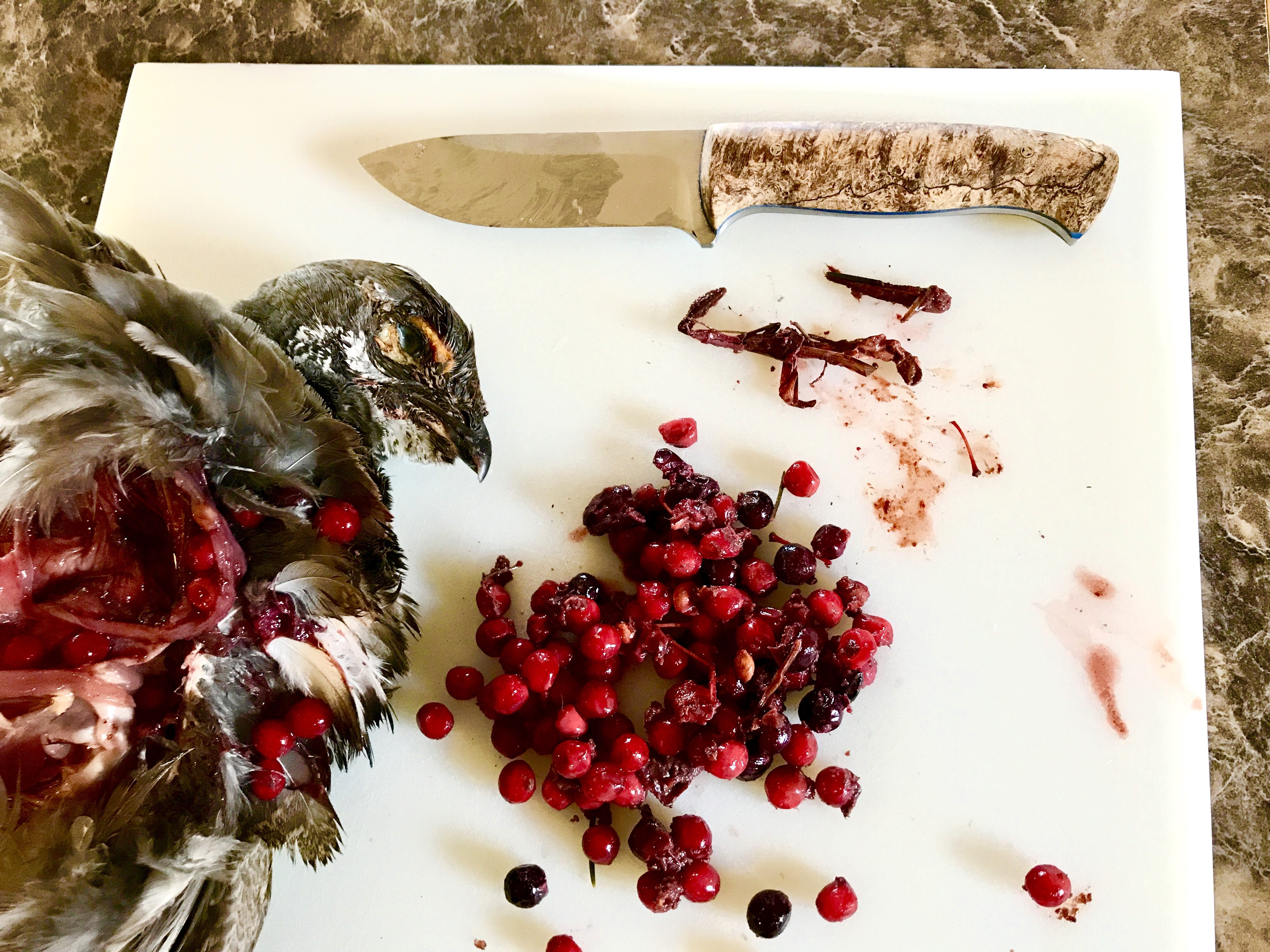
I just cleaned 20 birds (chukar, Huns, and dusky grouse). As I’ve mentioned before on this blog, I age my birds before cleaning them, sometimes for up to 3 weeks, so they tend to add up when we get around to cleaning them. They go from Peat or Angus’s hand to my Badlands vest to the fridge in the garage. This has worked well for us for years now, and we’re even alive to talk about it. I believe the meat is much tenderer this way.

The thing that was different today was that in those 20 birds, there was hardly any damage to breasts or legs. A few breasts had a pellet, but only one, and the legs were mostly clean. I wish I could say that this is because I’ve progressed in my shooting so much that I am mainly killing the birds with head shots. I’m probably doing more of that than before because of some changes I’ve made to my mount and leads on crossing shots. But the only thing I can point to that gave us much cleaner meat today is that I’ve basically switched to bigger shot. Number 6 steel to be exact; I mentioned this in a recent post, but the proof is in the pudding (bird meat). And maybe someone can educate me otherwise, but I also think that the steel stuff, although lacking the ballistic superiority of lead, might leave cleaner meat because it’s harder and rounder than the lead pellets that deform easily. Joel Loftis’s informative The Chukar Hunter’s Wingshooting Guide suggests as much.
I recently talked to Joel, and he’d spent a lot of time (and money) testing out some new shells, and his favorite was the super-expensive Kent Bismuth Upland Shotshells, specifically 12-gauge #6, 1-1/16 ounce, 2-3/4″, 1325 FPS. Several days after he mentioned this, I suffered a moment of insanity that lasted long enough for me to order some online (at $32 per box; yes, per box, not case). I’ll report on how they work for me if I’m lucky enough to hit anything with them once they get here from Mars or wherever they get bismuth, whatever that is. I keep thinking it’s made from expired Pepto Bismol. Maybe it is.

I also got some of the Winchester waterfowl loads I’d been shooting well with and which did little damage to our meat, which are only $7 or $8 a box, but whose ballistics apparently can’t come close to the bismuth puppies. I keep hearing the words “diminishing returns” in my head.

Speaking of that, our supply of Joel’s wingshooting guide is diminishing. I never thought I’d write this on this blog, but “get yours while supplies last.”


