
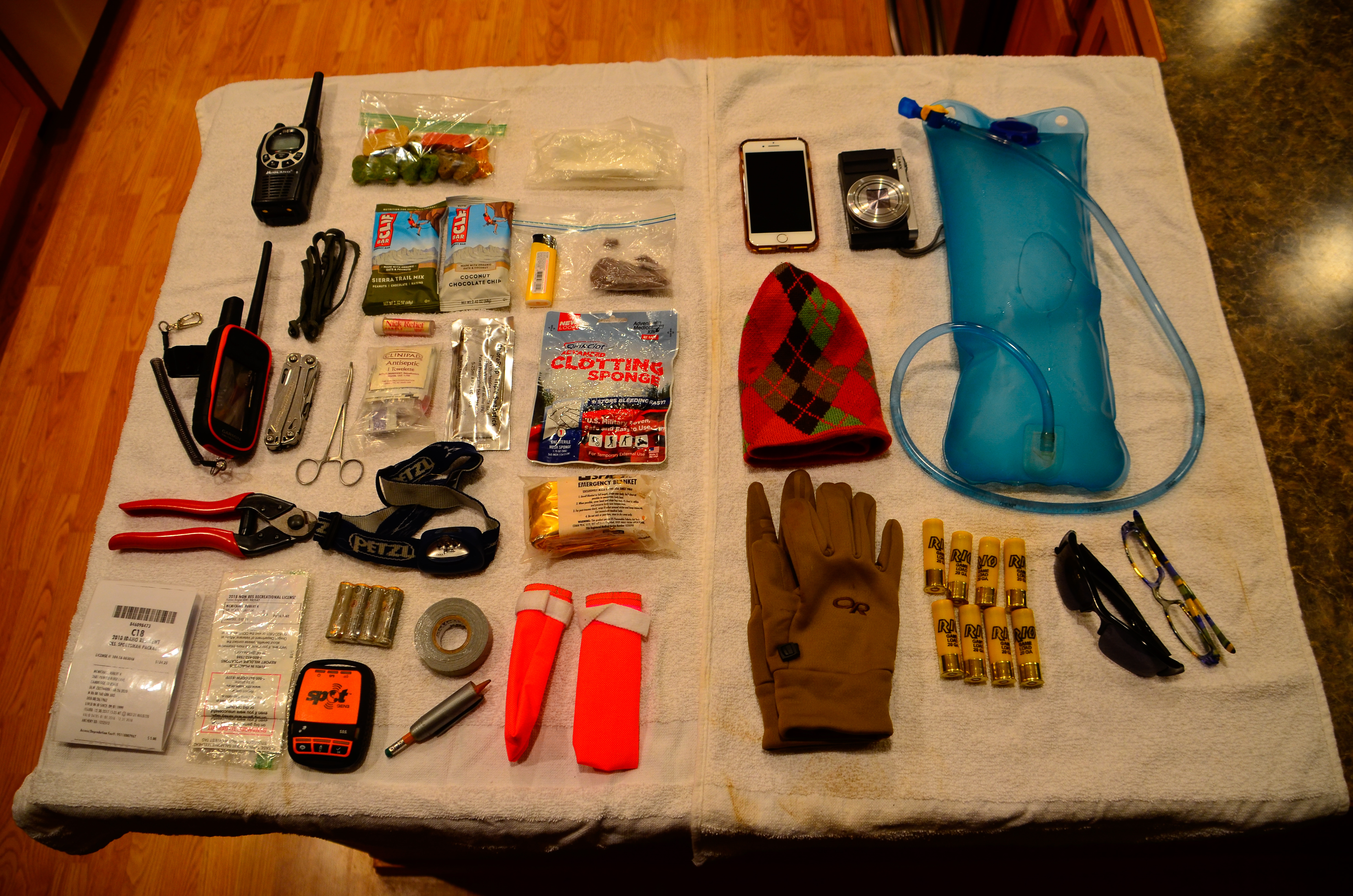
A few years ago I posted something about what’s in my vest, partly to seek advice and partly to offer it. I got lots of great ideas from the comments on what to include and what to jettison. I haven’t learned much since (both good and bad, I guess), but thought I’d do a quick update; if nothing else, it gave me a chance to remember what I’ve stashed away in my vest. There were some surprises, but nothing dramatic.

I’m still using the Badlands Upland Vest, and this is what I carry in it on most hunts. It all fits without much trouble, and there’s actually some more room in some of the pockets. It’s just that there’s not much room for bulkier things like extra layers, or a shell, and not really a good way of attaching an extra jacket or a rain shell onto the pack without a modification of some kind, or a goofy strap attached somewhere… Anyway, from upper left:
- Midland GXT1000 radio. Important note on this radio: I was about to look for a different radio because I got sick of these running out of batteries in the middle of every hunt, even when I didn’t have them turned on the whole time. It turns out they come with a battery pack that’s super low amp-hour rated (something like 1200 mAh), and I found a suggestion on a forum of dumping the battery pack and replacing it with rechargeable Li-Ion batteries, which I found on Amazon for cheap; they’re 2800 mAh, and I haven’t had to recharge them all season! And this radio works great at long distances, even without line-of-sight.
- Dog treats.
- Toilet paper in ziplock.
- Cell phone: sometimes I bring this instead of a camera, but the zoom sucks, so I use it mainly for ONXMaps I’ve downloaded for the area I’m in to show property boundaries, especially when I haven’t hunted there before.
- Panasonic Lumix DMC-ZS50: I got this mainly because its zoom is amazing, and pretty clear fully extended (the elk photos from a recent hunt were taken with the fully-extended zoom).
- 100 oz. Camelback bladder: I’m an unconvertable bladder guy, and this time of year rarely fill it since the dogs eat lots of snow and I’m just not that thirsty when it’s 20 degrees, windy, and I’m slogging through 6 inches of white stuff. In the early season, though, I routinely run out, and often determine the end of the hunt based on my water supply.
- Garmin Alpha: this is my third season with the Alpha and TT15/TT15-Mini, and I’m sold (after criticizing people who used them; I’m open to eating crow, and developing a taste for it). I will say that the first TT15-Mini I bought for Peat lasted only two years, which is unconscionably short for the $300 collar. I tried replacing the battery, did a bunch of trouble-shooting and research, asked Garmin if they’d repair it (no response!), and ended up just buying another. The original TT15, honking big, is still working fine with no issues (knock on wood), but it’d really be too bulky on little Peat’s neck.
- 8 feet of paracord with a loop tied in it for collapsing conibear trap springs.
- Leatherman Wingman: heavy, and heavy-duty. I could ditch this for a lighter pocketknife, but I’ve used a bunch of different things on it already and just feel safer knowing it’s there.
- Stainless curved locking forceps: haven’t had to use these yet, and hope I don’t.
- A couple of Clif Bars: sometimes I forget to re-stock these and for two reasons it’s never a problem. First, Leslie usually carries extra food and I’m a decent moocher. Second, as my friend Dale said in response to my earlier post about this: it’s a hunt, not a picnic, and you’re not going to starve on a 5-hour hike.
- Butane lighter: I used to carry a magnesium fire stone with built-in flint, but last night I tried using it (never had before) and could not for the life of me start a fire with the thing, even in the comfort of my home and after watching the instructional video. Oh well. I was never a Boy Scout.
- Ziplock with dryer lint, which is supposed to be a good fire starter. I didn’t try igniting this; maybe I should.
- Ziplock with some bandages, wipes, and antibiotic ointment.
- InfaLab Nick Relief Styptic Powder: a recommendation for stopping small bleeds.
- ChloraPrep Triple Swabstick: someone recommended this, and it’s expensive so I’m not sure where I got it, but it’s light, doesn’t take much space, and might come in handy.
- Quikclot Advanced Clotting Sponge: someone recommended this, also expensive, but it seemed like a good idea to have just in case. With Murphy’s Law determining so much of the cosmic order of things, I feel better knowing it’s there.
- Felco C7 Cable Cutters: heavy, expensive, and worth your dog’s life if it gets caught in a snare you can’t undo. (Cutting a snare is at 6:45 in the video.)
- Headlamp: I’d forgotten this was in my vest, but am glad it’s there.
- Space Blanket: I just like saying “space blanket” and think having one in a chukar vest is appropriate beyond description.
- Extra hat and gloves: depending on the season, these might or might not be in my pack, and possibly I’ll trade them out for warmer or cooler items, depending…
- Shells: we’re now a two-Benelli family, and Leslie has commandeered my 12-gauge Ultra Light (but I’m about to reneg on that deal and return her 20-gauge Montefeltro) which impacts the weight and number of shells one might have in the vest. Right now there are 20 1-ounce/7.5 shot 20-gauge shells in my vest, but I can only fit 15 12-gauge shells in the same pocket. I’ve only needed more than 15 shells once this season (and ran out that day in the middle of lots of birds!), and have averaged just 4 shots per hunt for my 33 outings this season (but 6 of those hunts were skunks).
- Extra glasses: I need cheaters for fine print, which I’d need to read to use any of the first-aid stuff. I don’t carry extra sunglasses, but they’re on my hat about half the time on each hunt, so I counted these as “carry” items.
- Idaho Sportsman’s Combo license: this is a photo-copied and laminated copy of my hunting license on one side, and my driver license on the other. I’m honestly not sure if that’s legal, but don’t like carrying my heavy wallet in my vest and don’t like moving my driver license from one place to another because I’ll eventually lose it or have to tell the ISP that my DL is in my bird vest. Does anybody else do this?
- Oregon non-resident license: I should have my head examined for buying this, but I had the best of intentions.
- SPOT Gen3 emergency beacon: a very cool device that can be a life-saver, and your pal at home can track you on a computer (if you like that idea). Beware of the annual subscription cost (mine was $225 this year), and that you’ll need a Search-And-Rescue membership on top of that. I have an auto-renew SAR membership for Leslie and me that costs $35 a year through GEOS.
- Spare batteries: these are AA, and I’d forgotten they were in my vest, but I guess I thought I’d use them for my radio if the batteries died. The headlamp uses AAA, so not much use there…
- Duct tape: I have a 1/2″ roll I got for taping dog booties more securely onto Peat’s wee feet, but had forgotten about the several feet of regular width tape wrapped around a short pencil.
- Finally, dog booties from Dogbooties.com, out of Anchorage, Alaska. These things are amazing, and cheap. They stay on, don’t slip on ice like the rubber ones do, are super durable, and come in all kinds of cool colors. Plus, they’re super easy to install and remove. Peat spent about 4 entire hunts in these things (just on his front paws), and got used to them very quickly, and was not impaired or hampered from them.
So that’s that. The only modification I’m thinking of making right now is to figure out how I can bring the honking Nikon D7000 with 18-300 lens along with my gun and vest so I can hunt and take good photos. So far I haven’t been able to figure out how to do that, and with my back issue it’s probably a good thing I haven’t tried. Greedy? Next year I’m thinking of giving the Wingworks vest a try… the Badlands is hard to beat, but the price for its streamlined-ness is that it’s tough to get birds in the pouch when the pockets have a bunch of stuff in them. So I’m thinking of next year already.
I’d love to hear from people about their ideas for vest essentials, or if you think I’m missing something crucial or should get rid of something…


